What Is Zowie AI for E-commerce Logistics?
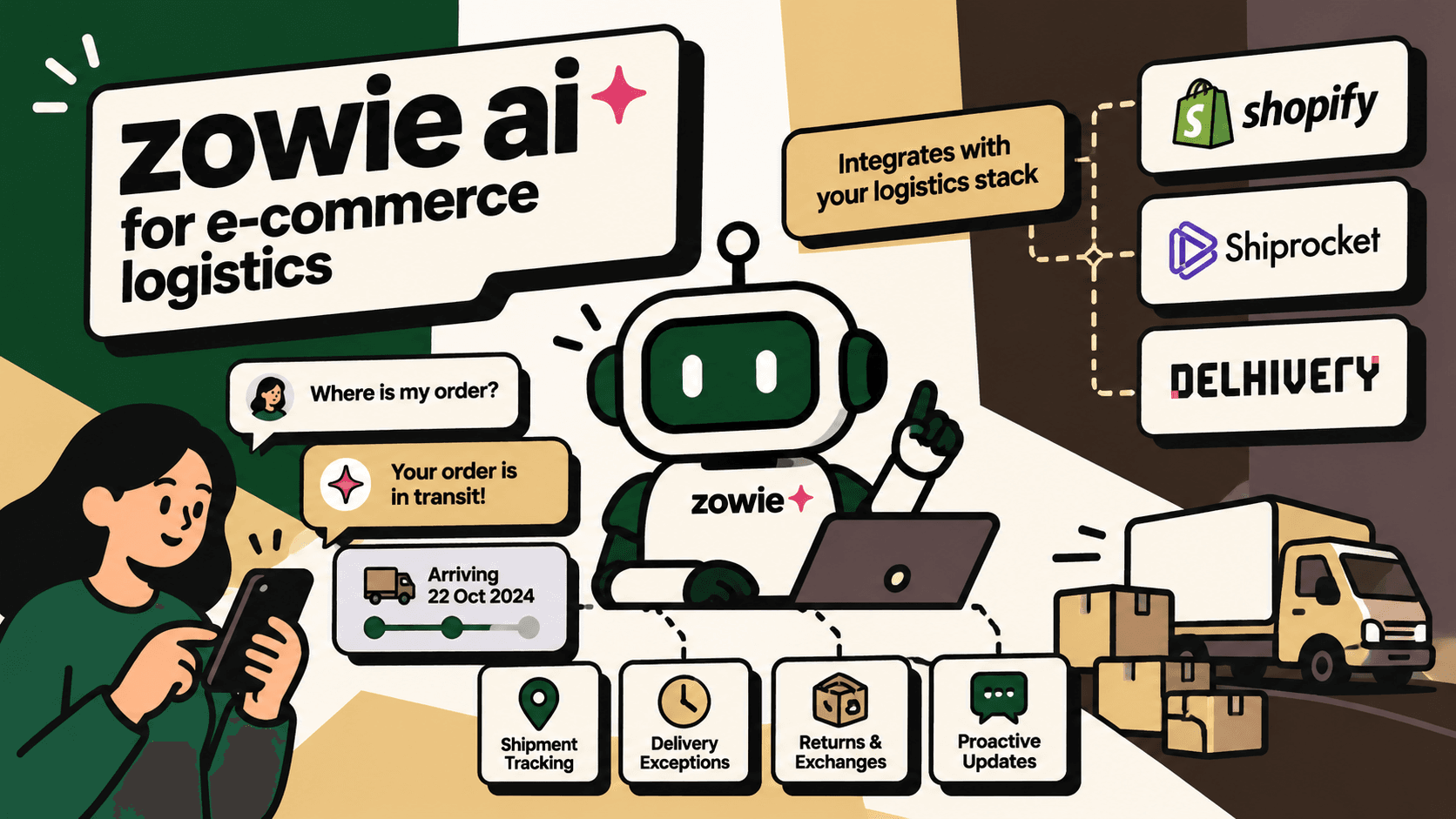
Zowie AI is an AI agent platform designed to automate customer service conversations, including post-purchase questions that ecommerce businesses receive about orders, shipments, delivery delays and returns. Its logistics offering focuses on helping customers obtain information and complete supported service workflows without requiring a human agent to handle every interaction.
The important distinction is that Zowie primarily addresses customer-facing logistics communication, not the entire physical logistics operation. A brand may use it to answer shipment-tracking questions or manage selected delivery-related conversations, but warehouse execution, inventory allocation, courier selection and financial reconciliation still depend on the underlying operational systems and their integrations.
Zowie describes its logistics offering on its official AI Agents for Logistics page. Its technical documentation also covers ecommerce modules, external API integrations and configurable automation flows. These capabilities make integration design an important part of evaluating whether the platform fits a particular logistics stack.
For D2C brands, the practical question is not simply whether an AI agent can answer a customer. It is whether the agent can retrieve accurate order and tracking information, follow the business's delivery and returns policies, take only authorized actions, and escalate cases when the connected data is incomplete or an operational decision is required.
Why E-commerce Logistics Creates So Many Support Tickets
Post-purchase support often becomes difficult because customers see the delivery outcome, while the information required to explain it is distributed across multiple systems. The storefront may contain the order record, a shipping platform may contain tracking events, a courier may hold the latest delivery status, and the support team may work in a separate helpdesk.
When these systems do not provide a consistent view, agents must look up information manually, interpret tracking updates and communicate the next step. Customers may contact support more than once if a status is unclear or a promised update does not arrive.
Common logistics questions
- Where is my order?
- Why has my shipment been delayed?
- Has the courier attempted delivery?
- Can I change the delivery address?
- Can the delivery be rescheduled?
- What should I do if the package is marked delivered but I have not received it?
- How do I return a product or report a damaged delivery?
These requests differ in complexity. A tracking question may require a read-only lookup. A delivery reschedule may require an authorized action through a courier API. A missing parcel claim may require investigation, evidence collection and human review. Treating all three as equivalent chatbot conversations creates avoidable risk.
AI agents are most useful when they can combine natural-language understanding with reliable operational data and clearly defined action permissions. They should not be expected to resolve a logistics issue that the connected systems cannot explain or act upon.
What Can Zowie AI Automate in E-commerce Logistics?
1. Shipment tracking and WISMO queries
WISMO means “Where Is My Order?” These questions are common in ecommerce support because customers want a clear view of order progress and delivery expectations.
With the relevant ecommerce and tracking data connected, a Zowie agent can support conversations that retrieve order or shipment information and present an understandable response. The exact information available depends on the connected systems, the integration configuration and the data returned by those systems.
Example: A customer asks whether an order has shipped. The agent identifies the order using the approved verification process, retrieves the available order and tracking status, and explains the latest recorded event. If no tracking event is available, it should communicate that limitation or route the case for investigation rather than inventing an estimated delivery date.
Business implication: Automating routine tracking questions can reduce repetitive agent work when accurate tracking data is available. Measure the effect using tracking-related ticket volume, resolution time, repeat contacts and escalation rates rather than assuming that every automated conversation represents a successfully resolved issue.
2. Delivery delays and shipment exceptions
A delivery exception occurs when a shipment does not progress as expected. Possible situations include a failed delivery attempt, an incomplete address, a courier delay or a status that needs clarification.
Zowie's logistics offering is relevant to customer-facing conversations about these situations. The ability to initiate a specific action, such as rescheduling delivery or updating an address, depends on whether the connected carrier or logistics system exposes that action and whether the integration has the required permissions.
Example: A customer asks why a package has not arrived. The agent checks the latest available tracking information, explains the recorded exception and presents the approved next step. If a courier update is required but cannot be initiated through the integration, the agent should create or route the case to the appropriate operations team.
Implementation requirement: Define which delivery exceptions can be resolved automatically, which require a courier-side action and which must be reviewed by a human. A response that merely explains an exception is different from a workflow that actually changes the delivery outcome.
3. Returns and post-delivery questions
Returns conversations often combine policy questions, order verification, eligibility checks, shipping instructions and refund-status requests. An AI agent can help interpret the customer's request, retrieve relevant order details and guide the customer through supported steps.
However, return eligibility should be determined using the retailer's actual policy and authoritative order data. A customer message alone should not determine whether a refund is approved, whether an item has been received or whether a financial transaction has completed.
Example: A customer requests a return because an item arrived damaged. The agent collects the required information, checks the relevant order details and routes the case according to the return policy. A straightforward request may follow an approved automated workflow, while a disputed claim or a high-value exception goes to a human reviewer.
The specific return actions available through Zowie depend on its configured ecommerce modules and connected systems. See the official ecommerce modules configuration documentation before assuming a particular return, label or refund action is supported in a given deployment.
4. Proactive customer communication
Customer service is often reactive: the buyer notices a delay and contacts the brand. A more coordinated workflow can use a reliable shipment event to initiate an approved notification before the customer needs to ask for an update.
For example, a logistics integration may detect a meaningful status change and pass it to the customer communication layer. The message should reflect the actual event and provide a useful next step when one exists. A delayed scan should not automatically be interpreted as proof that a parcel is lost.
Proactive communication requires more than an AI model. It needs event availability, clear trigger rules, customer contact preferences, duplicate-message prevention and a way to handle contradictory or late-arriving tracking events.
5. Customer service across supported channels
Customers may start a logistics conversation through one channel and continue it through another. Zowie documents supported customer-service channels and platform automation capabilities, but the exact channel availability and behavior should be checked against the account configuration.
A useful design keeps the relevant conversation context and order information accessible to the agent or support team. If a customer moves from an automated conversation to a human agent, the handoff should preserve the question, the order identifier, the data already retrieved and the action still required.
Explore Zowie's channel documentation for implementation-specific details.
Zowie AI Integrations: Ecommerce, Shipping and External APIs
Integration compatibility is one of the most important parts of evaluating Zowie for ecommerce logistics. An AI agent can only provide reliable order information or execute an operational action when the required data and permissions are available through a supported connection.
Zowie publishes documentation for ecommerce modules and for connecting external APIs. Its documentation establishes that external API integration is an available technical approach; it does not establish that every courier, warehouse system or ERP has a ready-made connector.
| System or integration area | Potential role in the workflow | What to verify |
|---|---|---|
| Shopify | Provide relevant order and ecommerce context for customer conversations | Supported objects, available actions, permissions and configuration |
| WooCommerce | Connect store order information to customer-service workflows | Required order fields, tracking availability and action support |
| Magento / Adobe Commerce | Expose relevant ecommerce data to the support agent | Connector scope, data freshness and supported operations |
| ShipStation | Make supported order or tracking information available | Account configuration and the specific data or actions required |
| Indian shipping platforms such as Shiprocket | Provide shipment events and potentially support approved logistics actions | Whether a native integration exists or a custom API connection is needed |
| Indian courier platforms such as Delhivery | Provide tracking events or supported delivery operations | API access, event coverage, authentication and action permissions |
| ERP, OMS or WMS | Supply order, fulfillment, inventory or warehouse context | System ownership, API availability, data mappings and failure handling |
The table distinguishes integration possibilities from confirmed connector coverage. Zowie's official documentation includes external API integration guidance and REST automation documentation. These are appropriate starting points for assessing custom connectivity.
Can Zowie AI Integrate with Shiprocket and Delhivery?
For Indian D2C brands, this is a practical implementation question. The supplied research identifies Shiprocket and Delhivery as integrations that should be verified directly rather than assumed to be available as native Zowie connectors.
Zowie's documented ability to connect to external REST APIs may provide a route for custom integration, but it is not proof that a particular Shiprocket or Delhivery workflow can be implemented without additional engineering. The required API endpoint, authentication, event model, account permissions and supported actions must all be checked.
Integration questions to resolve before committing
- Does Zowie currently offer a native connector for the required shipping platform and account type?
- If not, can the required carrier or aggregator API be called through a supported external API workflow?
- Can the workflow retrieve the exact tracking events and shipment identifiers needed for the customer conversation?
- Can it initiate the required action, or is it limited to reading information?
- How are expired credentials, rate limits, failed requests and missing tracking records handled?
- How quickly do shipment events become available to the agent?
- What data is shared with the AI platform, and what access controls apply?
A proof of concept should test a real but limited set of shipment scenarios before the integration is treated as production-ready. Include successful deliveries, delays, failed delivery attempts, missing tracking information and conflicting statuses.
Zowie AI vs. Logistics Automation Software
Zowie should be evaluated as part of a wider architecture rather than as a universal replacement for logistics software. Customer-service automation and operational logistics automation have related but different responsibilities.
| Capability | Zowie-style customer-service AI | Logistics or integration platform |
|---|---|---|
| Answer shipment questions | Primary customer-facing use case | Provides the underlying tracking data |
| Explain delivery exceptions | Communicates supported information and next steps | Supplies carrier events and operational status |
| Update inventory across channels | Not the primary purpose | Handled by inventory, ERP, OMS or integration workflows |
| Allocate warehouse or courier work | Not a substitute for operational execution systems | Depends on the relevant logistics, warehouse and order systems |
| Run custom cross-system reconciliation | Requires supported integrations and additional workflow design | Often requires an integration or data orchestration layer |
| Escalate complex customer cases | Can support customer-service handoffs when configured | Must route the case to the responsible operational team |
The right architecture depends on the problem. If the main bottleneck is repetitive customer questions, a customer-service AI platform may be a suitable starting point. If the business cannot reliably synchronize inventory, process orders or reconcile shipment data, those underlying operational workflows need to be addressed separately.
How Zowie Fits into a D2C Logistics Architecture
A connected D2C workflow commonly involves a storefront, an order-management or ERP system, a shipping aggregator or courier, tracking events and a customer-service interface. The exact architecture varies by business and should follow the systems already in place.
Illustrative architecture: Storefront → OMS or ERP → shipping platform or courier → tracking events → customer-service AI → customer response or human escalation.
In this design, the logistics platform remains responsible for the shipment data and supported delivery operations. The customer-service AI interprets the customer's request, retrieves relevant information through approved integrations and communicates the next step. If the required data is unavailable or a workflow needs an operational decision, the case is routed to the responsible team.
This division of responsibility reduces the risk of treating a conversational response as proof that a shipment action actually occurred. A successful API response, a confirmed status update or a verified downstream event should determine whether an operational action is recorded as complete.
Implementation Plan: From Use Case to Production
Step 1: Map the current support workflow
Record the most frequent logistics questions, the systems agents open to answer them, the manual steps involved and the reasons cases are escalated. Separate read-only requests from actions that change a delivery, order or financial record.
Step 2: Establish baseline metrics
Measure ticket volume by issue type, first-response time, resolution time, repeat-contact rate, escalation rate and the amount of manual lookup work. Use a consistent time period and clearly defined calculations so the pilot can be evaluated fairly.
Step 3: Validate data and integration coverage
Confirm that the relevant order, tracking and policy data can be retrieved reliably. Check API availability, authentication, required fields, rate limits, update frequency and supported actions. Test the exact shipping providers and ecommerce configuration the business uses.
Step 4: Define what the AI can and cannot do
Use the agent for interpreting customer language, summarizing a case and presenting information grounded in connected records. Use deterministic rules for policy eligibility, required fields and authorized state changes. Require human approval for disputed claims, sensitive financial actions and cases that fall outside the approved rules.
Step 5: Build guardrails and escalation paths
Define what happens when a tracking record is missing, a courier API fails, the customer cannot be verified or two systems disagree. Include access controls, logs, duplicate-action prevention, retry rules, alerts and a human owner for unresolved cases.
Step 6: Pilot one high-volume workflow
Shipment tracking is often a practical pilot candidate because the request is easy to identify and may be answerable using read-only data. Start with a defined set of order types and tracking states, then test ordinary cases and exceptions before expanding to delivery changes, claims or returns.
Step 7: Measure the result and scale carefully
Compare post-pilot performance with the baseline. Review correct resolution, escalation quality, repeat contacts, response time, data errors and the effort required to maintain the integration. Expand only when the workflow is reliable and the operational benefit is demonstrated.
Risks and Limitations to Evaluate
Incorrect or stale tracking data
An AI agent cannot reliably explain a shipment if the connected source is delayed, incomplete or contradictory. The workflow should communicate the last confirmed status, avoid unsupported promises and route unresolved discrepancies to a human.
Actions that are described but not executed
A customer may believe that a delivery has been rescheduled or an address has been updated simply because the agent said so. The workflow must verify the downstream response before confirming that the action succeeded.
Carrier and integration differences
Different couriers may expose different event names, fields and operational actions. Custom integrations need mappings that normalize statuses without erasing important distinctions. A generic “delayed” label should not replace the actual reason when that reason is available and relevant.
Privacy and access control
Order and delivery information may contain personal data. Use approved verification procedures, limit the information exposed in conversations and grant the integration only the permissions required for its job. Review data retention, credential management and vendor processing terms before production deployment.
Ongoing maintenance
Shipping APIs, store configurations and business policies change. Assign an owner to monitor integration failures, review unresolved cases, test changes and update workflows. Automation is a maintained operational capability, not a one-time configuration exercise.
How to Evaluate the Business Case
Do not evaluate Zowie only by the number of conversations handled by AI. A conversation that ends without answering the customer's question, or that generates a repeat ticket, may not represent a successful resolution.
Begin with the volume of eligible logistics tickets, the time agents spend on each ticket, the percentage that can be resolved with reliable data and the cost of handling exceptions. Then include platform fees, implementation, custom integrations, maintenance, monitoring and human review in the total cost.
Illustrative scenario: If a support team handles a defined set of repetitive tracking requests, the potential time benefit can be estimated by multiplying eligible requests by the average manual handling time saved per request. The estimate should then be adjusted for failed automations, repeat contacts, escalation work and ongoing platform costs. This is a planning method, not a claim about Zowie's actual customer results.
| Metric | Why it matters | What to monitor |
|---|---|---|
| Eligible ticket volume | Shows the scale of the problem | Tracking, delay and delivery-exception requests by category |
| Resolution rate | Distinguishes successful outcomes from automated replies | Resolved cases, repeat contacts and reopen rate |
| Response and resolution time | Measures customer-service speed | Time to first response and time to confirmed resolution |
| Escalation quality | Checks whether difficult cases reach the right team | Correct routing and time to operational follow-up |
| Data accuracy | Protects customer trust | Incorrect status statements and mismatches with source records |
| Total cost to operate | Captures the full economics | Platform, integration, monitoring, maintenance and human-review costs |
Where Five Anchor Fits
For D2C brands, the logistics support problem may be only one part of a wider systems issue. Order data, courier events, inventory, warehouse operations and customer communication often need to work together for a reliable post-purchase experience.
Five Anchor's positioning in AI infrastructure for D2C and ecommerce is relevant when the business needs to map and connect these operational workflows. Depending on the systems involved, the work may include marketplace and ERP integrations, order-processing automation, shipping connections, event validation, exception handling and operational reporting.
In a Zowie-based architecture, Five Anchor's role would be to assess the wider commerce workflow and help implement the required integration layer where appropriate, rather than assume Zowie replaces the shipping or warehouse systems. This can include checking the availability of carrier APIs, defining which system owns each data field, designing reliable event flows and creating human escalation paths for unresolved delivery cases.
Five Anchor's AI-powered customer operations and ecommerce intelligence areas may also be relevant when the business wants to connect customer-service outcomes with order status, operational exceptions and reporting. The appropriate scope should be determined by a system and workflow assessment, not by assuming that every connector or capability is available by default.
Final Verdict: Is Zowie AI Right for E-commerce Logistics?
Zowie AI is worth evaluating when the main objective is to automate customer-facing conversations about shipment tracking, delivery delays, returns and other post-purchase issues. Its value depends on the availability of accurate ecommerce and logistics data, the supported actions in the chosen configuration and the quality of the escalation process.
It should not be treated as a replacement for an ERP, warehouse management system, courier platform or complete logistics orchestration layer. Those systems remain responsible for the operational records and actions they manage.
For Indian D2C businesses, verify Shiprocket and Delhivery integration feasibility directly before planning the rollout. Zowie's external API documentation provides a starting point for assessing custom connections, but it does not confirm that every India-specific carrier workflow is available out of the box.
The strongest starting point is a limited, measurable workflow such as shipment tracking. Confirm data access, define what the agent may say or do, build reliable exception handling, measure confirmed resolution and scale only after the workflow performs consistently.
Key Takeaways
- •Zowie AI focuses on customer-service automation for logistics-related conversations rather than replacing the entire logistics operation.
- •Shipment tracking, delivery exceptions, returns conversations and proactive communication are relevant use cases when the required data and actions are connected.
- •The actual workflow depends on Zowie's configured ecommerce modules, available channels, permissions and external integrations.
- •Zowie documents external REST API integration, but this does not establish that every courier or shipping platform has a ready-made connector.
- •Indian D2C brands should verify Shiprocket and Delhivery integration feasibility before implementation.
- •AI should communicate information grounded in authoritative order and tracking records and should not claim an operational action succeeded without confirmation.
- •A practical implementation starts with workflow mapping, baseline metrics, integration validation, guardrails, a limited pilot and ongoing monitoring.
Zowie AI vs. Logistics Integration Platforms
| Capability | Zowie AI customer-service layer | Logistics or integration layer |
|---|---|---|
| Inventory Sync Frequency | 15–30 min batch polling (high oversell risk) | Sub-second atomic locking (<450ms) |
| Concurrent Drop Resilience | Fails under concurrency; causes negative stock balance | Redis atomic reservation queue guarantees exact counts |
| Error Handling & Retries | Silent failure; manual CSV audit needed | Dead-letter queues with automated exponential retry |
| Fulfillment Routing Speed | 2–4 hours delayed batch export to 3PL warehouse |