What Is the Best Alternative to Skubana?
The best Skubana alternative depends on the operational problem your business needs to solve: multichannel order processing, inventory synchronization, warehouse fulfillment, purchasing, retail operations or integration across multiple commerce systems.
Skubana is now associated with Extensiv Order Manager. It is important to distinguish between replacing the legacy product, evaluating another order management system (OMS), and redesigning the workflows around your existing OMS. These are different projects, and each requires a different shortlist.
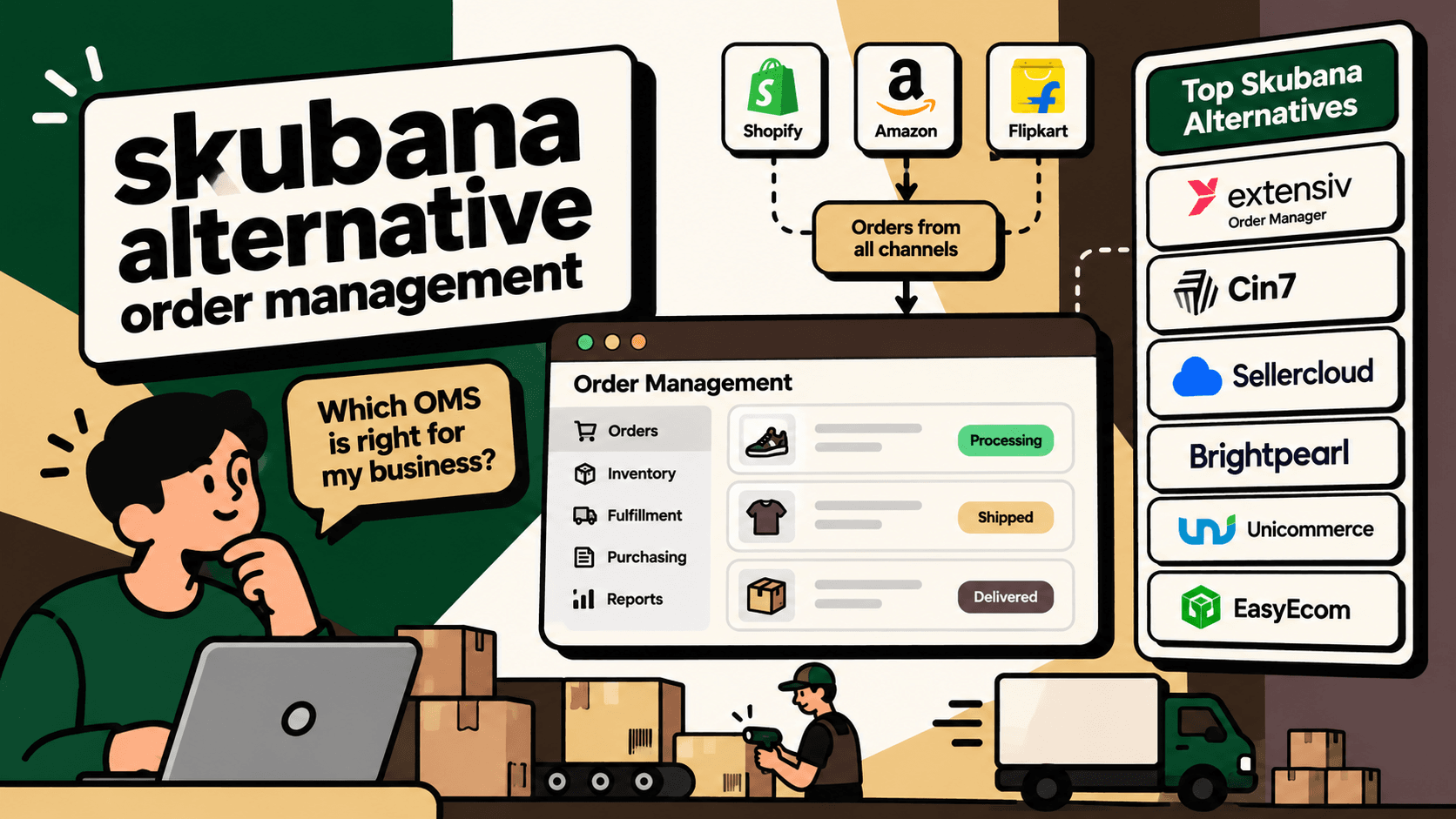
For growing D2C and ecommerce brands, five alternatives worth evaluating are Cin7, Sellercloud, Brightpearl, Unicommerce and EasyEcom. Each serves a different operational profile. Cin7 is relevant to inventory-led product businesses, Sellercloud to marketplace-heavy operations, Brightpearl to retail operations, and Unicommerce and EasyEcom to multichannel ecommerce workflows, particularly for businesses operating in India.
There is no universally best option. The right decision depends on your sales channels, order volume, warehouse structure, inventory accuracy requirements, integrations, reporting needs and implementation budget.
Why Businesses Look for Skubana Alternatives
Businesses typically evaluate an alternative when their existing order management setup no longer matches their operating model. The trigger may be a software change, new sales channels, international expansion, more complex fulfillment rules or the need to connect order processing with ERP, finance and customer operations.
1. Inventory is not synchronized reliably
When inventory information is spread across a storefront, marketplaces, warehouses and spreadsheets, the same SKU can appear available in one channel and unavailable in another. This can create overselling, cancelled orders, manual corrections and unnecessary customer-service work.
An OMS should be evaluated on how it receives inventory updates, determines available-to-sell quantities, handles reservations and synchronizes stock across the channels the business actually uses. The label “real-time inventory” is not enough: ask about update frequency, failure handling and how conflicting stock records are resolved.
2. Order routing is becoming difficult
A business may need to route orders based on warehouse location, stock availability, delivery constraints, marketplace requirements or fulfillment cost. Basic order capture is not the same as reliable order orchestration. A suitable system must support the routing rules the business needs and provide visibility when an order cannot follow the normal path.
3. Marketplace operations are fragmented
As brands add marketplaces, direct-to-consumer stores, wholesale orders or retail locations, operational teams may have to manage different order formats, status codes, cancellation rules and dispatch deadlines. A centralized OMS can reduce manual coordination, but only when the required channels and actions are supported.
4. Reporting does not match operational reality
Order counts alone do not show whether the operation is healthy. Teams may also need to understand unfulfilled orders, delayed dispatches, stock discrepancies, returns, cancellations and the financial impact of fulfillment decisions. If these metrics require manual exports and spreadsheet reconciliation, the business may need better reporting or an integration layer in addition to a new OMS.
5. The business needs broader system integration
Replacing one application will not automatically fix disconnected ERP, warehouse, shipping, returns and customer-service workflows. Before switching, map where data originates, which system owns each record and which process breaks. Otherwise, a new OMS can inherit the same operational problems.
5 Skubana Alternatives to Evaluate
1. Cin7: For inventory-led product businesses
Cin7 is worth evaluating when inventory, purchasing, sales orders and fulfillment need to work together. It may suit a growing product business that wants more coordinated stock and order workflows across multiple sales channels.
Consider Cin7 if:
- Inventory management and purchasing are central to the problem.
- You need to coordinate sales orders with stock availability.
- Your business wants inventory and order workflows connected rather than maintained in separate tools.
Check before choosing: Confirm that the relevant ecommerce channels, accounting systems, warehouses and fulfillment workflows are supported in the specific product edition you are considering. Test how inventory reservations, backorders, bundles and stock adjustments behave in your real scenarios.
Potential limitation: A product business with highly specialized marketplace, warehouse or custom routing requirements should validate those workflows directly instead of assuming that general inventory coverage guarantees fit.
2. Sellercloud: For marketplace-heavy sellers
Sellercloud is a candidate for businesses managing many marketplace listings, orders, inventory records and fulfillment activities. It is particularly relevant when marketplace operations create a large amount of catalog and order coordination work.
Consider Sellercloud if:
- Your business sells across multiple marketplaces and ecommerce channels.
- Order processing, catalog management and inventory visibility need central coordination.
- Your operational team needs better control over marketplace workflows and warehouse processes.
Check before choosing: Validate support for each marketplace account, listing workflow, fulfillment location, shipping method and required API action. Confirm how exceptions, cancelled orders, partial shipments and channel-specific requirements are handled.
Potential limitation: A wide feature set does not automatically mean a simple implementation. The effort required to configure channels, map data and train teams should be included in the evaluation.
3. Brightpearl: For retail operations
Brightpearl is positioned around retail operations, including order management, inventory, purchasing, accounting and operational automation. It is worth considering when a retailer needs a broader operational system rather than a narrowly focused order-processing tool.
Consider Brightpearl if:
- You operate across ecommerce and other retail or wholesale channels.
- Order processing needs to connect with purchasing and financial operations.
- You want to evaluate a retail-focused operating model rather than stitching together many separate tools.
Check before choosing: Review the financial workflows, accounting integrations, inventory rules and regional requirements that matter to your business. Test whether the product fits your operating model before planning a migration.
Potential limitation: A broader retail platform may introduce more scope than a business needs if its only problem is a specific marketplace connector or a narrow order-routing rule.
4. Unicommerce: For Indian ecommerce and multichannel operations
Unicommerce is a relevant option for Indian ecommerce brands that need to coordinate orders, inventory, dispatch and returns across online stores and marketplaces. Its regional relevance makes it a practical candidate for businesses whose operating requirements are shaped by Indian marketplace and fulfillment workflows.
Consider Unicommerce if:
- Your business operates primarily in India.
- You sell through marketplaces as well as direct-to-consumer channels.
- Order processing, warehouse coordination, dispatch and returns are important evaluation areas.
Check before choosing: Confirm the exact marketplace and storefront integrations you need, along with warehouse coverage, courier workflows, inventory update behavior, return handling and available reporting. Test the full order lifecycle rather than only order import.
Potential limitation: Regional fit does not guarantee that every ERP, warehouse, finance or custom workflow is covered. Document the integrations that are native and those that may require additional implementation.
5. EasyEcom: For multichannel order and fulfillment workflows in India
EasyEcom is another candidate for Indian ecommerce businesses that need centralized order processing, inventory allocation, fulfillment routing and returns. Its EasyOMS offering is relevant to brands managing complex operations across several channels.
Consider EasyEcom if:
- You manage a high volume of orders across multiple ecommerce channels.
- Inventory allocation and fulfillment routing are recurring operational challenges.
- You need to coordinate returns and broader multichannel order processes.
Check before choosing: Verify channel coverage, allocation logic, return workflows, API availability and the reporting needed by operations and finance teams. Confirm how the system behaves when stock is unavailable or a channel sends duplicate or delayed updates.
Potential limitation: The right fit depends on your specific process complexity, integrations and deployment scope. A demonstration using generic examples will not reveal all the edge cases in your operation.
Skubana Alternatives: Quick Comparison
| Platform | Primary area to evaluate | Potential best fit |
|---|---|---|
| Cin7 | Inventory, purchasing and sales-order workflows | Growing product businesses |
| Sellercloud | Marketplace, catalog, order and warehouse operations | Marketplace-heavy sellers |
| Brightpearl | Retail operations, inventory, purchasing and accounting | Omnichannel retailers and wholesalers |
| Unicommerce | Multichannel orders, inventory, dispatch and returns | Indian ecommerce brands |
| EasyEcom | Order processing, allocation, fulfillment and returns | Multichannel sellers in India |
This is a shortlist based on product positioning, not an independently verified performance ranking. Features, integrations, pricing and availability can change. Confirm the current capabilities of each platform against your actual requirements before making a purchasing decision.
How to Choose the Right Skubana Replacement
Start with the operational job to be done, not the vendor feature list. An OMS should be assessed against the transactions, exceptions and integrations your team handles every day.
Step 1: Document your current order lifecycle
Map what happens from order creation through payment validation, inventory allocation, fulfillment, shipping confirmation, delivery, returns and financial reconciliation. Identify which system creates each record and which system is responsible for updating it.
Include the exception paths: out-of-stock orders, partial shipments, address problems, cancellations after allocation, failed dispatches, duplicate events and returns that do not match the original order. These cases often reveal more about system fit than the standard happy path.
Step 2: Establish a baseline
Collect data for a representative period before comparing products. Useful baseline metrics include:
- Orders requiring manual intervention.
- Inventory discrepancies and overselling incidents.
- Order-to-dispatch time.
- Orders delayed by routing or integration failures.
- Cancellation and return rates by channel.
- Time spent reconciling orders, inventory and payouts.
- Support contacts caused by order or fulfillment problems.
Define each metric precisely. For example, distinguish an order that has been imported from an order that has been successfully allocated, dispatched and confirmed by the downstream system.
Step 3: Separate essential requirements from optional features
Create a shortlist of non-negotiable requirements, including channel support, inventory rules, warehouse locations, accounting connections, shipping integrations, access controls and reporting. Then identify features that would be useful but are not necessary for the first deployment.
Ask vendors to demonstrate your workflows using representative scenarios and sample data. Record whether each requirement is supported natively, requires configuration, needs custom integration or is not supported.
Step 4: Validate integration coverage
Build an integration matrix for your storefronts, marketplaces, ERP, warehouse system, shipping providers, returns processes and finance tools. For each connection, record the data exchanged, the direction of synchronization, the expected update frequency, available actions and the owner responsible for failures.
Do not treat a logo in an integration directory as proof that the required workflow is covered. A connector may support order import but not cancellations, inventory adjustments or custom fulfillment rules. Confirm the exact objects, events and actions needed.
Step 5: Calculate total cost of ownership
Compare more than subscription prices. Include implementation, data migration, connector fees, custom development, training, maintenance, support, monitoring and the cost of running old and new systems during transition.
Also account for the cost of disruption. A low subscription price may not be attractive if the platform requires extensive manual work or creates more exceptions than it resolves.
Step 6: Run a controlled pilot
Test a limited but representative set of channels, SKUs, warehouses and order types. Include normal orders and difficult cases such as stock conflicts, partial shipments, cancelled orders and delayed status updates.
Compare the pilot results with the baseline. Check data accuracy, processing time, manual interventions, failed integrations and the quality of exception handling. Expand only when the workflow is reliable enough for the operational risk involved.
When a New OMS Is Not the Whole Answer
Sometimes the main problem is not the OMS itself. A business may already have a suitable order management platform but still struggle because its ERP, storefront, marketplaces, shipping system, warehouse software and support tools do not exchange data reliably.
In that situation, replacing the OMS can be an expensive way to address an integration problem. The better approach may be to retain the existing system, improve the connections around it and automate the specific workflows that currently require manual intervention.
Examples of problems that may need integration work
- Orders arrive in the OMS but do not update the ERP correctly.
- Inventory changes in the warehouse are not reflected across marketplaces quickly enough.
- Shipment events are available in a shipping platform but are not visible to customer support.
- Returns are processed operationally but are not reconciled with inventory and finance.
- Marketplace payouts require manual matching against orders, fees and refunds.
- Operational reports are assembled manually from multiple systems.
These problems may require a combination of configuration, API integrations, event handling, deterministic business rules and monitoring. AI may be useful for classifying exceptions, summarizing cases or helping users interpret operational information, but it should not replace authoritative transaction records or execute sensitive actions without the necessary controls.
Where Five Anchor Fits
Five Anchor is positioned around AI infrastructure for D2C and ecommerce. Its relevance is greatest when the problem extends beyond selecting an OMS and involves connecting commerce systems, automating operational workflows or improving visibility across order, inventory, shipping and customer operations.
Depending on the existing stack, an implementation could begin with workflow mapping and system ownership, followed by integrations between marketplaces, storefronts, ERP, shipping and warehouse systems. Additional automation could address order processing, inventory synchronization, exception routing, invoice workflows and operational reporting.
The goal is not to add another platform unnecessarily. It is to determine which system should own each transaction, which integrations are missing and which manual steps can be safely automated. Five Anchor's commerce infrastructure and ecommerce intelligence services are relevant to that assessment when a business needs cross-system implementation rather than only a standalone OMS subscription.
Migration Checklist for a Skubana Alternative
Before committing to a new platform, use this checklist to reduce migration risk.
- Document current order, inventory, fulfillment and returns workflows.
- List every storefront, marketplace, warehouse, ERP, shipping and finance integration.
- Identify which system owns orders, stock quantities, shipment status and financial records.
- Confirm connector coverage and required API permissions with each vendor.
- Define how historical orders, SKUs, bundles, customer records and inventory data will be migrated.
- Test duplicate orders, delayed events, partial shipments, cancellations and failed API calls.
- Set rules for retrying failed updates without creating duplicate transactions.
- Define who reviews exceptions and how they are escalated.
- Establish baseline KPIs and acceptance criteria for the pilot.
- Plan staff training, cutover, rollback and post-launch monitoring.
Final Recommendation
If inventory and purchasing are your primary concerns, evaluate Cin7. If marketplace operations dominate, include Sellercloud in the shortlist. If you need a broader retail operating model, assess Brightpearl. For Indian multichannel ecommerce, compare Unicommerce and EasyEcom against your marketplace, warehouse, dispatch and returns requirements.
Before replacing Skubana, confirm whether the current Extensiv product already meets your requirements. Then compare alternatives using your actual workflows, not generic feature lists. Validate integrations, model total cost of ownership and run a controlled pilot before migrating every channel.
If your underlying issue is disconnected systems rather than missing OMS features, consider whether integration and workflow automation can solve the problem with less disruption. A well-designed architecture should make order processing, inventory, fulfillment, returns and reporting more reliable, regardless of which OMS remains at the center.
Key Takeaways
- •Skubana is now associated with Extensiv Order Manager, so verify the current product and your replacement requirements before migrating.
- •Cin7 is a candidate for inventory-led product businesses that need coordinated purchasing and order workflows.
- •Sellercloud is worth evaluating for marketplace-heavy sellers that need centralized order, catalog, inventory and warehouse operations.
- •Brightpearl is relevant to retailers looking for a broader retail operations platform.
- •Unicommerce and EasyEcom are candidates for Indian ecommerce brands managing multichannel orders, inventory and fulfillment.
- •Integration coverage must be verified at the workflow level; a listed connector may not support every required action.
- •Compare total cost of ownership, including implementation, migration, custom integration, training, monitoring and maintenance.
- •
Skubana Alternative Comparison
| Platform | Primary focus | Potential fit |
|---|---|---|
| Inventory Sync Frequency | 15–30 min batch polling (high oversell risk) | Sub-second atomic locking (<450ms) |
| Concurrent Drop Resilience | Fails under concurrency; causes negative stock balance | Redis atomic reservation queue guarantees exact counts |
| Error Handling & Retries | Silent failure; manual CSV audit needed | Dead-letter queues with automated exponential retry |
| Fulfillment Routing Speed | 2–4 hours delayed batch export to 3PL warehouse | Instantaneous automated webhook dispatch (<90 sec) |