What is the XpressBees chatbot?
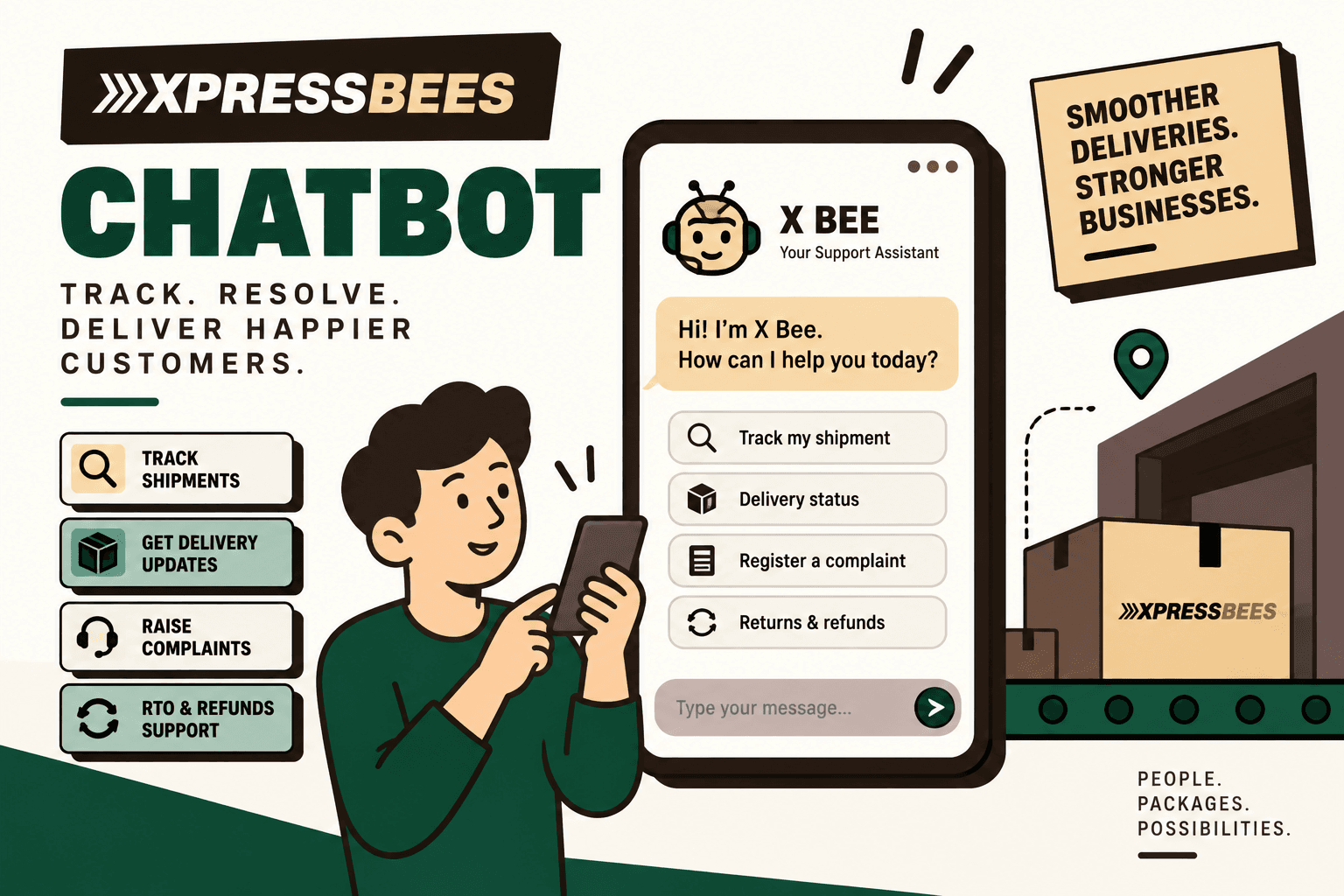
The XpressBees chatbot, referred to on the company's website as Chat-Bot (X Bee), is part of its customer-support experience. XpressBees specifically directs customers to the chatbot to register complaints about delivery executives. Its support experience also covers shipment tracking, delivery issues, payment and refund queries, and other customer questions. XpressBees official customer support page
That distinction matters when evaluating the phrase “XpressBees AI chatbot.” The official source confirms the existence and role of X Bee, but it does not establish that every capability of X Bee is powered by generative AI. XpressBees separately describes its logistics technology as including AI-powered tracking, automated hubs and real-time shipment visibility. XpressBees tracking and logistics page
For ecommerce brands and logistics operators, the more useful question is therefore not simply whether a courier has a chatbot. It is how far a chatbot can move from answering questions to actually resolving post-purchase workflows.
Quick answer
Answer: An effective logistics chatbot should connect customer conversations with live shipment information and approved operational workflows. For an XpressBees-style use case, that can include shipment tracking, delivery exceptions, complaint registration, RTO questions, payment or refund queries and escalation to human support.
Explanation: A chatbot becomes operationally valuable when it can identify the customer's intent, retrieve the correct shipment context, provide a precise answer, perform an approved action where integrations allow it, and escalate cases that require human intervention.
Example: Instead of asking a customer to find a tracking page manually, the chatbot can collect an AWB or order identifier, retrieve the shipment status from the connected logistics system, explain the current stage and route the conversation to the appropriate exception workflow when the shipment is delayed or misrouted.
Implication: The real opportunity is not “chatbot versus human.” It is connecting the chatbot to the systems and workflows that determine what can actually happen next.
Action: Design the chatbot around the highest-volume post-purchase questions first, then connect deeper workflows as reliability is demonstrated.
What XpressBees currently offers through its support experience
XpressBees provides a support experience covering several common logistics questions. Its official support page includes shipment tracking, misrouting, delivered-but-not-received shipments, delivery rescheduling, delivery-agent contact, complaints against delivery executives, incorrect shipments and RTO-related questions. XpressBees customer support
The company also provides a dedicated tracking experience where customers can enter an AWB number, Order ID or mobile number to retrieve shipment information. XpressBees shipment tracking
| Customer need | XpressBees support evidence | Potential AI workflow |
|---|---|---|
| Shipment tracking | Tracking through AWB, Order ID or mobile number | Identify shipment, retrieve status and explain next step |
| Delivery complaint | X Bee can be used to register a complaint about a delivery executive | Collect structured complaint details and route to the right queue |
| Misrouted shipment | Support information explains the issue and expected routing process | Classify exception and provide shipment-specific guidance |
| Delivered but not received | Customer is directed to support for complaint registration | Collect evidence, identify shipment and escalate according to policy |
| RTO query | Support explains Return to Origin and directs customers to the seller for clarification | Explain RTO status and route seller-dependent cases appropriately |
| Payment or refund issue | Payment and refund is a dedicated support category | Identify issue type and route to the appropriate resolution workflow |
This gives an important baseline: a logistics chatbot can begin with information retrieval and complaint capture, but its operational value increases when it is connected to live shipment and customer-service systems.
Why shipment tracking is the natural starting point for an AI logistics chatbot
“Where is my order?” is one of the most repetitive post-purchase questions in ecommerce. The problem is rarely the language of the question. The problem is that answering it accurately requires current operational data.
A customer may ask:
- Where is my package?
- When will it arrive?
- Why is my shipment delayed?
- Why was my shipment misrouted?
- Why does tracking show delivered when I have not received it?
- What does RTO mean?
- Can I change the delivery date?
- How do I contact the delivery executive?
A generic chatbot can produce an explanation. A connected logistics chatbot can determine which shipment the customer is referring to, retrieve its current state and decide which workflow should handle the request.
XpressBees itself provides tracking through AWB and Order ID, while its support content also references mobile-number-based tracking. XpressBees tracking page
The difference between a chatbot and a tracking agent
| Capability | Basic chatbot | Connected AI workflow |
|---|---|---|
| Answer FAQ | Yes | Yes |
| Understand customer intent | Limited to configured flows | Can classify varied requests |
| Retrieve shipment status | Only with an integration | Designed around live operational data |
| Explain exceptions | Generic explanation | Shipment-specific explanation |
| Trigger operational action | Usually limited | Possible when approved APIs and workflows exist |
| Escalate with context | Often transfers the conversation | Can pass shipment and conversation context to support |
What an AI-powered XpressBees chatbot could automate
The exact capabilities depend on the APIs, permissions and systems available to the business. A useful architecture can be divided into several workflow layers.
1. Shipment status lookup
The customer provides an AWB, order ID or another supported identifier. The chatbot validates the identifier, retrieves the shipment record and explains the current status in plain language.
The important design principle is that the answer should come from current shipment data rather than a language model guessing what a status might mean.
2. Delivery exception handling
Exceptions require more than status retrieval. The chatbot should identify what happened and determine whether the issue can be resolved automatically or needs escalation.
For example, an illustrative workflow could be:
- Customer says the shipment has not arrived.
- Chatbot identifies the shipment.
- System retrieves the latest delivery event.
- AI classifies the customer's intent and the operational exception.
- Approved rules determine the next action.
- Customer receives an explanation.
- Cases outside the rules are escalated with the relevant shipment context.
3. Delivery-agent complaints
XpressBees explicitly states that customers can use X Bee to register a complaint against a delivery executive. XpressBees official support page
An AI-enhanced version of this workflow could structure the complaint before escalation. Instead of passing an unstructured conversation to an operations team, the system could capture the shipment identifier, complaint category, relevant description and requested resolution, then create or update the appropriate support record.
The purpose is not to let AI decide the validity of a complaint. The purpose is to make intake and routing more structured while keeping the final operational decision governed by the responsible team.
4. RTO support
Return to Origin, or RTO, creates a different type of customer question because responsibility can span the logistics provider and the seller.
XpressBees explains RTO as a shipment being returned to the origin because of cancellation or non-delivery reasons such as an unavailable customer or incomplete address, and directs customers to the seller for further clarification. XpressBees customer support
An AI workflow should preserve that responsibility boundary. If the answer depends on the merchant's cancellation, refund or replacement policy, the chatbot should not invent an answer merely to keep the conversation automated.
5. Payment and refund queries
Payment and refund questions can be more sensitive than ordinary tracking questions. The chatbot can classify the request and retrieve available information, but financial actions should generally be governed by explicit business rules and approval thresholds.
This is an example of where AI plus workflow controls is more appropriate than unrestricted autonomous decision-making.
Where AI should stop and humans should take over
A logistics chatbot should not be designed around the assumption that every conversation must end with an automated answer.
| Request type | Potential automation | Human involvement |
|---|---|---|
| Simple tracking request | Retrieve and explain status | Not normally required |
| Standard delivery FAQ | Answer from approved knowledge | Only if unresolved |
| Routine complaint intake | Collect details and create case | Review and resolution |
| Shipment exception | Classify and route | Required when outside approved rules |
| Refund dispute | Classify and retrieve context | Approval or specialist handling |
| Fraud or abuse concern | Flag and gather evidence | Human investigation |
The goal is controlled automation. An AI system should escalate when it lacks sufficient information, encounters conflicting data or reaches a decision outside its approved authority.
How to build a logistics chatbot around XpressBees data
A useful architecture separates the conversation layer from the operational systems.
Customer → Chatbot → Intent detection → Integration layer → XpressBees or logistics data → Decision rules → Response or escalation
The chatbot handles conversation. The integration layer handles connectivity. The logistics platform remains the source of shipment information. Business rules determine what actions are permitted. Human support handles exceptions that cannot be safely automated.
Depending on the actual integration surface available to the business, the connection could use APIs, webhooks or middleware. The exact interface should be confirmed against the courier's current technical documentation before implementation.
Example: shipment tracking workflow
- Trigger: Customer asks, “Where is my XpressBees order?”
- Identify: Chatbot requests or detects the AWB or order ID.
- Validate: Integration verifies the identifier.
- Retrieve: System obtains current shipment information.
- Interpret: AI converts operational status into a customer-readable explanation.
- Act: If an approved action is available, the workflow triggers it.
- Escalate: Unresolved or sensitive cases move to human support with context.
Why a generic AI chatbot is not enough
A common implementation mistake is putting a large language model on a website and assuming that it has become a customer-service agent.
It has not.
An AI model can generate language. A production customer-service workflow also needs:
- Live data access
- Identity and shipment validation
- API integrations
- Business rules
- Permissions
- Fallback behavior
- Human escalation
- Conversation history
- Action logging
- Monitoring
- Security and privacy controls
This is especially important in logistics because the customer often expects an answer about a specific physical shipment, not a general explanation of how shipping works.
What the XpressBees chatbot topic reveals about the larger logistics opportunity
The search demand around “XpressBees chatbot” naturally expands into several related use cases: X Bee chatbot, customer support chatbot, shipment tracking chatbot, delivery chatbot, complaint chatbot, courier tracking chatbot, logistics customer-service automation and AI customer support for logistics.
The underlying search intent is broader than the name of one chatbot. Users want to know whether conversational AI can reduce the friction around tracking and post-purchase support.
XpressBees' current website supports this broader context: it describes 24/7 customer support, shipment tracking, reverse logistics and technology-driven logistics including AI-powered tracking and real-time shipment visibility. XpressBees logistics and tracking
Five Anchor POV: For ecommerce operators, the opportunity is not to place AI on top of an existing support process and stop there. The larger opportunity is to connect customer conversations to shipment, order, returns and operational data so that the agent can move a request toward resolution instead of simply explaining a process.
How to prioritize logistics chatbot automations
Not every customer-support workflow deserves AI first. Start with tasks that combine high volume, repetitive handling and clear decision rules.
A practical prioritization model is:
volume × frequency × manual effort × error cost × revenue impact ÷ implementation complexity
This is a practical framework, not an industry-standard formula. It provides a consistent way to compare candidate workflows.
| Workflow | Potential priority | Reason to evaluate |
|---|---|---|
| Shipment tracking | High-volume candidate | Frequent, structured and data-driven |
| Delivery FAQ | High-volume candidate | Often repetitive and rule-based |
| Complaint intake | Medium to high | Can structure information before human review |
| RTO explanations | Medium | Requires clear responsibility boundaries |
| Refund decisions | Controlled | Higher financial sensitivity |
| Complex disputes | Human-led | High ambiguity and exception risk |
Metrics to measure after deployment
A chatbot should be measured as an operational workflow rather than only as a conversational interface.
Useful baseline and pilot metrics include:
- Customer queries per day
- Percentage of tracking queries handled automatically
- Average first-response time
- Average handling time
- Human escalation rate
- Repeat-contact rate
- Complaint routing accuracy
- Resolution time
- Customer satisfaction
- Automation failure rate
- API failure rate
- Cost per resolved interaction
Do not assume that a higher automation percentage is automatically better. If automation increases repeat contacts or sends customers into incorrect workflows, the apparent deflection can hide a worse customer experience.
Implementation roadmap for an AI logistics chatbot
1. Map the workflow
Document the triggers, inputs, systems, decisions, actions, exceptions, human handoffs and outputs for the support process.
2. Establish the baseline
Measure query volume, handling time, response time, escalation rate, errors and operational cost.
3. Prioritize
Choose one high-volume, relatively low-risk workflow such as shipment tracking or standard delivery questions.
4. Classify each step
Decide which steps should be deterministic automation, AI-assisted reasoning, human approval or human-only handling.
5. Connect the systems
Integrate the chatbot with the relevant shipment, order, CRM or helpdesk systems through approved APIs, webhooks or middleware.
6. Add guardrails
Define permissions, validation, escalation thresholds, fallback behavior, retry policies, logging and monitoring.
7. Pilot
Start with one workflow and controlled access rather than automating every customer-support scenario at once.
8. Measure
Compare pilot results against the baseline and investigate both successful automation and failed automation.
9. Scale
Expand into delivery exceptions, complaints, returns and other workflows only after the initial workflow operates reliably.
How Five Anchor could approach an XpressBees chatbot integration
For a D2C or ecommerce business using XpressBees, the chatbot is only one part of the architecture. Five Anchor's AI-Powered Customer Operations offering covers AI chat operations, customer self-service, automated customer communication, returns and exchange automation and ticket automation.
The practical implementation would begin with the support workflow rather than the chatbot interface: identify the most common shipment and post-purchase queries, map the systems that contain the required information, establish the API or integration layer, define what the AI can answer or execute, add human escalation and measure the resulting workflow.
For a more connected operation, the same infrastructure can extend into Commerce Infrastructure, linking marketplace, order, ERP, inventory and shipping systems so that customer support has access to the operational context needed for resolution.
The relevant architecture is therefore problem → workflow → integration → AI agent → guardrails → human escalation → measurement, rather than simply “add a chatbot.”
Common mistakes when building a logistics chatbot
- Calling an AI model a complete support system: A language model needs data, integrations and workflow controls to become operationally useful.
- Automating without live shipment data: The chatbot can produce polished but outdated answers.
- Giving the agent too much authority: High-impact actions should have explicit permissions and approval rules.
- Ignoring exception paths: Delivery failures, RTOs and disputes often matter more than the happy path.
- Measuring only chatbot conversations: The real KPI is whether the workflow resolves customer needs more effectively.
- Hiding human escalation: Customers should have a clear path when automation cannot resolve the issue.
- Confusing X Bee with every AI capability of XpressBees: The official support page confirms X Bee as a chatbot for specific support functionality, while XpressBees separately describes AI-powered tracking and other technology capabilities. XpressBees customer support
Frequently searched XpressBees chatbot questions
Is XpressBees X Bee a chatbot?
Yes. XpressBees' official support page refers to Chat-Bot (X Bee) and specifically directs customers to it for registering complaints about delivery executives. XpressBees official support page
Can I track my XpressBees shipment through a chatbot?
XpressBees provides online shipment tracking using identifiers including an AWB number and Order ID, and its support information also references mobile-number-based tracking. Whether a particular chatbot interface provides direct tracking should be confirmed from the current XpressBees interface. XpressBees tracking
What can the XpressBees chatbot help with?
The official support documentation confirms X Bee for registering complaints against delivery executives. XpressBees' broader support system covers tracking, delivery problems, refunds and payments, RTO questions and other customer-service issues. XpressBees customer support
Does XpressBees have AI-powered logistics technology?
XpressBees currently describes its logistics technology as including AI-powered tracking, automated hubs and real-time shipment visibility. This does not by itself establish that the X Bee chatbot uses generative AI for every interaction. XpressBees logistics technology
What is an AI chatbot for logistics?
An AI chatbot for logistics is a conversational interface connected to operational systems that can understand customer requests, retrieve shipment or order information, provide contextual answers and route or execute approved workflows.
The bigger opportunity: from chatbot to customer operations agent
The XpressBees chatbot is a useful entry point into a much larger category of logistics automation.
A basic chatbot answers questions. A customer-operations agent can coordinate information and actions across the post-purchase journey.
That journey can look like:
Order → Shipment → Tracking → Delivery → Exception → RTO or Return → Refund → Customer communication
Each stage can generate customer questions, and each question may require data from a different operational system. The objective of AI infrastructure is to connect those systems so the customer does not have to become the integration layer.
For ecommerce brands, that is the practical distinction between chat automation and AI-powered customer operations. The first improves conversation handling. The second connects conversation to operational resolution.
That distinction is where a logistics chatbot becomes strategically useful: not because AI can talk, but because it can help turn a fragmented post-purchase workflow into a measurable, governed customer-service operation.
Key Takeaways
- •XpressBees officially identifies X Bee as a website chatbot used for specific customer-support functionality, including delivery-executive complaints.
- •XpressBees provides shipment tracking through identifiers such as AWB and Order ID, creating a natural foundation for connected customer-service workflows.
- •Do not automatically equate the X Bee chatbot with generative AI; XpressBees separately describes AI-powered tracking and other technology capabilities.
- •A logistics chatbot becomes more useful when connected to live shipment, order and customer-service data.
- •AI should classify intent and assist with contextual decisions, while deterministic rules should control predictable actions.
- •Sensitive refunds, disputes, fraud concerns and ambiguous delivery exceptions should have appropriate human oversight.
- •The strongest implementation path is to pilot one high-volume, low-risk workflow, measure it against a baseline and expand only after reliability is demonstrated.
Basic Logistics Chatbot vs Connected AI Customer Operations
| Capability | Basic Chatbot | Connected AI Workflow |
|---|---|---|
| Inventory Sync Frequency | 15–30 min batch polling (high oversell risk) | Sub-second atomic locking (<450ms) |
| Concurrent Drop Resilience | Fails under concurrency; causes negative stock balance | Redis atomic reservation queue guarantees exact counts |
| Error Handling & Retries | Silent failure; manual CSV audit needed | Dead-letter queues with automated exponential retry |
| Fulfillment Routing Speed | 2–4 hours delayed batch export to 3PL warehouse | Instantaneous automated webhook dispatch (<90 sec) |