What Is AI Quick Commerce Logistics Software?
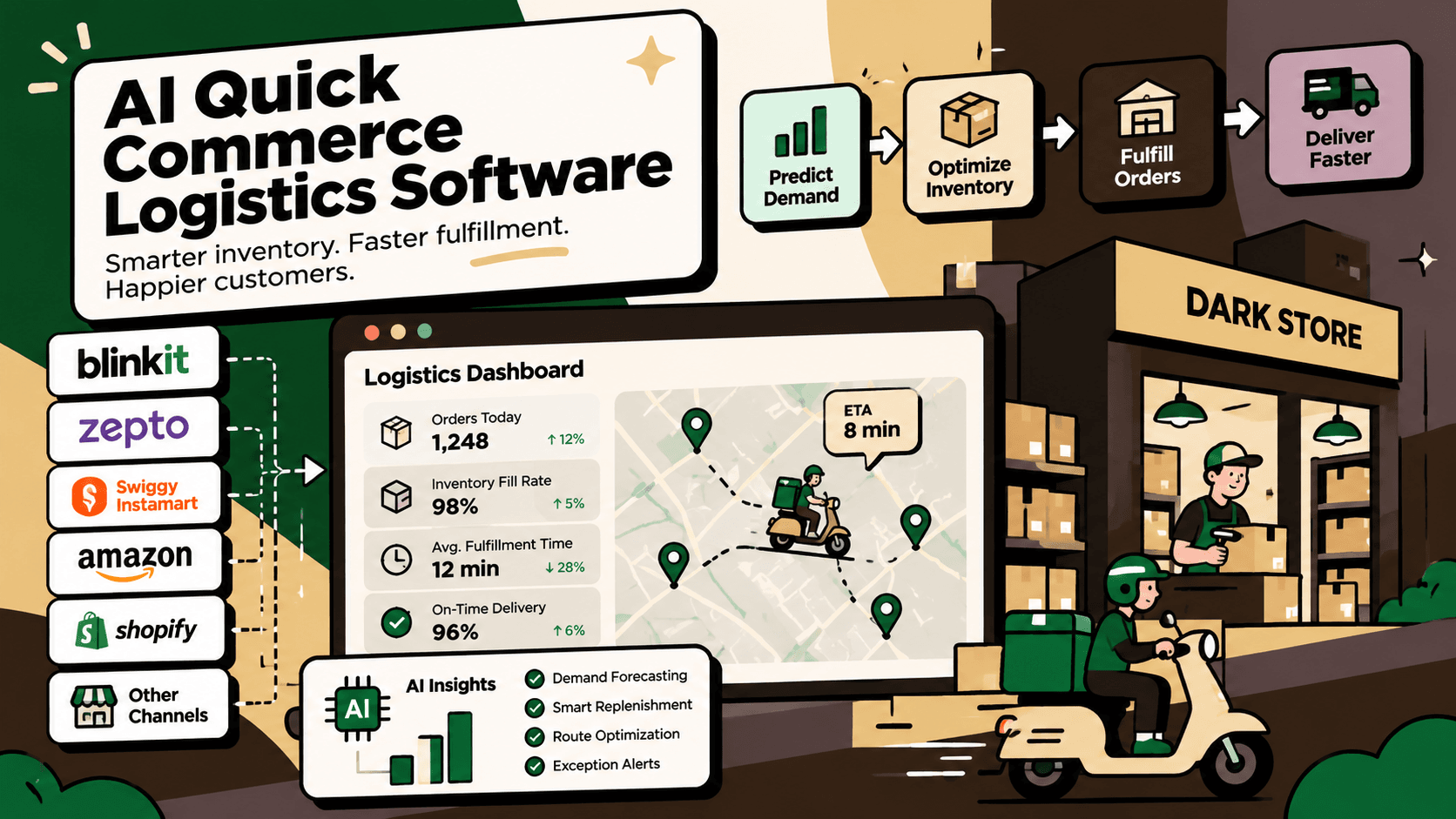
AI quick commerce logistics software helps retailers, D2C brands, dark-store operators and fulfilment networks coordinate orders, inventory, warehouse activity, replenishment and delivery operations through connected digital workflows. It combines operational software with analytics and, where appropriate, AI-assisted decisions to help teams respond to changing demand, stock availability and fulfilment constraints.
For a business operating in India's quick commerce ecosystem, the challenge is not simply to dispatch an order quickly. The business must make sure that the right product is available at the right location, inventory records are reliable, orders reach the correct fulfilment point, picking and packing happen accurately, and marketplace or delivery partners receive timely updates.
The term AI quick commerce logistics software can describe several different categories of solution. Some platforms focus on order and inventory management across channels. Others support warehouse management, dark-store operations, fulfilment services or delivery coordination. AI may add forecasting, anomaly detection, prioritisation or decision support, but the exact capabilities vary by product and implementation.
The central buying question is therefore: which operational problem must the software solve, and which existing systems must it connect to?
Why Quick Commerce Logistics Is Operationally Difficult
Quick commerce compresses the time available to coordinate inventory, fulfilment and delivery. A process that can tolerate delayed reconciliation in a conventional warehouse may become a recurring source of cancellations or missed service targets when inventory changes rapidly and orders must be fulfilled locally.
Inventory changes faster than reporting cycles
When inventory is distributed across multiple dark stores, warehouses, retail locations or marketplace fulfilment points, a central stock figure may not accurately represent what can be sold from a particular location. Sales, returns, damaged units, transfers and inbound receipts can all change availability. If those events do not synchronise correctly, customers or marketplace systems may see stock that cannot actually be fulfilled.
Order allocation is a constrained decision
The nearest fulfilment location is not always the best one. A location may lack one item, have a picking backlog, face temporary capacity constraints or be unable to meet the required service window. A useful allocation process considers availability, fulfilment capacity, delivery coverage and business rules rather than distance alone.
Dark-store execution depends on reliable handoffs
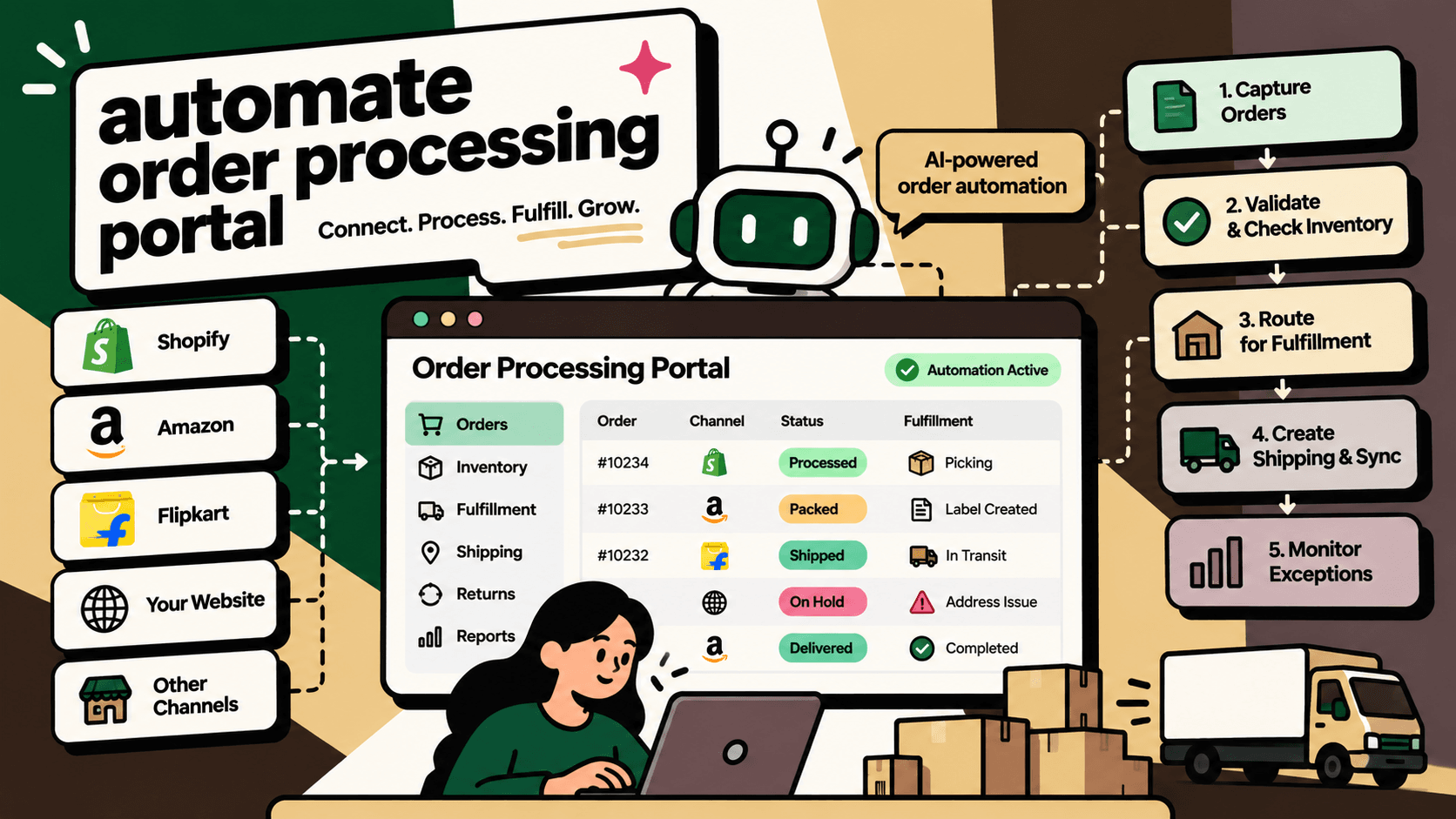
An order may move through several states: received, validated, allocated, picked, packed, handed over and delivered. If the warehouse, order management system, marketplace and delivery partner disagree about the current state, staff may repeat work, customer updates may become inaccurate and exceptions may remain unresolved.
Demand and replenishment are connected
Local demand can vary by time, location, product and promotion. Replenishing every location using the same static rule can create simultaneous stockouts and excess inventory. Forecasts are useful only when they account for reliable sales history, lead times, availability, substitutions and operational constraints.
What AI Quick Commerce Logistics Software Should Include
A practical solution is a connected operating layer, not simply a dashboard labelled AI. The required components depend on whether the business runs dark stores, supplies quick commerce marketplaces, manages its own delivery network or combines these models.
| Capability | What it does | Business question to test |
|---|---|---|
| Order management | Receives, validates, allocates and tracks orders across connected channels. | Can every order be traced from receipt to final status? |
| Inventory synchronisation | Updates stock availability across supported systems and locations. | How are stale stock, duplicate events and failed updates handled? |
| Warehouse or dark-store management | Coordinates picking, packing, stock movement and fulfilment tasks. | Does it reflect the actual layout and operating process of each location? |
| Replenishment planning | Uses demand, stock and supply constraints to support replenishment decisions. | Can recommendations account for lead times, minimum quantities and shelf life? |
| Dispatch and delivery coordination | Connects fulfilment readiness with dispatch, delivery assignment and status updates where supported. | Which delivery partners and dispatch events are supported? |
| Analytics and exception monitoring | Highlights delays, inventory mismatches, cancellations and operational trends. | Can managers identify the cause of a problem, not just see that it happened? |
| AI-assisted decision support | May support forecasting, anomaly classification, prioritisation and recommendations. | Are recommendations explainable, measurable and subject to appropriate controls? |
AI Versus Rules-Based Automation
Not every logistics decision needs AI. Reliable quick commerce operations generally combine deterministic rules, predictive models and human judgement. Rules are appropriate when the decision is clear and repeatable. AI can help where patterns are complex or information is incomplete. Humans should retain control over high-impact decisions that require context, accountability or negotiation.
| Workflow | Rules-based automation | Potential AI contribution |
|---|---|---|
| Order validation | Check required fields, identifiers, payment status and serviceability. | Classify unusual patterns for review when structured rules are insufficient. |
| Inventory updates | Apply stock movements, reconciliation rules and idempotent event handling. | Detect unusual discrepancies or recurring mismatch patterns. |
| Demand planning | Apply minimum stock levels and approved replenishment policies. | Forecast demand and estimate uncertainty using suitable historical and contextual data. |
| Order allocation | Apply availability, location eligibility and capacity constraints. | Recommend allocation priorities when multiple trade-offs exist and data supports the model. |
| Exception handling | Retry known transient failures and route predefined exceptions. | Classify exception descriptions and suggest likely causes or next actions. |
| Supplier and operational decisions | Enforce approval limits and contractual rules. | Prepare recommendations; leave material commercial or safety decisions to authorised staff. |
The operational principle is straightforward: use ordinary software for predictable state changes, AI for carefully bounded interpretation or prediction, and human approval for consequential exceptions. This approach is easier to audit than delegating an entire fulfilment workflow to an unrestricted AI agent.
Leading Quick Commerce Logistics Software and Services to Evaluate
The supplied search research identifies several products and service providers worth evaluating. They do not all serve the same purpose. Some focus on order and warehouse software, while others combine technology with fulfilment infrastructure or dark-store operations. The following is a shortlist for investigation, not a ranking or a guarantee that every listed feature is available in every plan or deployment.
1. Prozo
Prozo's quick commerce fulfilment offering is relevant to brands evaluating a combination of fulfilment services and operational technology. The research positions Prozo around warehousing and quick commerce fulfilment. Businesses should establish whether they need an outsourced logistics partner, software alone or a combination, then confirm location coverage, marketplace processes, inventory visibility, service levels and commercial terms directly with the provider.
2. Unicommerce
Unicommerce's quick commerce solution is relevant to brands coordinating orders and inventory across ecommerce and quick commerce channels. Its integrations information is a useful starting point when assessing channel connectivity. Verify the specific marketplace connections required, supported transaction types, inventory update behaviour, reporting and exception management before committing.
3. Increff
Increff is another provider identified in the supplied research in the inventory and retail technology landscape. It may merit consideration when inventory accuracy, allocation and warehouse-related workflows are central to the project. Confirm the fit for the business's specific quick commerce model rather than assuming that every inventory or warehouse capability is designed for rapid dark-store fulfilment.
4. Hubler
Hubler's dark-store operations solution is relevant to teams researching software for dark-store workflows. During evaluation, ask for a demonstration using realistic picking, stock adjustment, replenishment and exception scenarios. Clarify which decisions are rules-based, which use AI, and which require configuration or external integrations.
5. QuickCommerceOS
QuickCommerceOS presents itself as software for multi-vendor quick commerce marketplaces. It may be relevant to operators building or managing a marketplace model rather than a brand that only needs to supply existing platforms. Confirm how it handles vendor onboarding, catalogue and inventory ownership, order routing, fulfilment responsibilities and integrations.
6. ElasticRun
ElasticRun appears in the research as a fulfilment and distribution network provider. Businesses considering a network-led operating model should evaluate geographic reach, service coverage, technology integration, inventory responsibilities and the division of operational accountability between provider and brand.
7. Zippee
Zippee is identified in the research in the quick commerce fulfilment space for consumer brands. It may be worth assessing where the requirement involves getting products into quick commerce channels or coordinating fulfilment services. Validate current coverage, operating model, platform relationships and technology responsibilities directly with the provider.
8. Other options from the research
The supplied search results also identify HyperNow, StoreKing and Quick Commerce Map as resources to investigate. These represent different possible parts of the ecosystem, so they should not be treated as direct software substitutes without checking their actual products, services and intended customers.
How to Choose the Right Solution for Your Operating Model
The first selection decision is not which vendor has the longest feature list. It is which operating model you need to support. A D2C brand supplying third-party quick commerce marketplaces has different requirements from a business operating its own dark stores and delivery fleet.
| Operating model | Primary requirement | What to prioritise |
|---|---|---|
| D2C brand selling through quick commerce platforms | Coordinate marketplace orders, stock and replenishment. | Verified channel integrations, inventory accuracy, purchase or supply workflows and reconciliation. |
| Dark-store operator | Manage local stock and fulfilment execution. | Location-level inventory, picking workflows, stock adjustments, task visibility and exception handling. |
| Multi-vendor marketplace | Coordinate vendors, catalogues, orders and fulfilment responsibilities. | Vendor permissions, order routing, serviceability and clear ownership of inventory records. |
| Retailer with its own delivery operations | Coordinate order readiness, dispatch and delivery status. | Dispatch integration, delivery tracking, capacity visibility and service-level reporting. |
| Brand using a third-party logistics provider | Connect commerce systems to outsourced fulfilment. | Inventory ownership, data exchange, fulfilment cut-offs, reconciliation and escalation agreements. |
How to Evaluate Vendors Beyond the Demo
A polished demonstration can hide the operational work required to make software reliable. The evaluation should test real workflows, failure conditions and data ownership, not only the happy path.
- List every required integration. Document the order source, marketplace, ERP, inventory system, warehouse software, finance system and delivery partner. Ask the vendor to identify native connectors, APIs, webhooks, custom work and unsupported functions.
- Test inventory consistency. Demonstrate a sale, cancellation, return, damaged-stock adjustment and transfer between locations. Observe how each event updates availability and what happens when a synchronisation fails.
- Test duplicate and delayed events. Send a repeated order notification or simulate a delayed status update. The system should avoid creating duplicate work and should reconcile state changes safely.
- Test a partial fulfilment exception. Use an order with one unavailable item, an incorrect pick or a short shipment. Check the rules for substitutions, cancellation, refund or escalation and determine which actions need human approval.
- Inspect operational reporting. Ask to trace an order from receipt through fulfilment and identify its timestamps, stock movements, status changes, retries and responsible system.
- Confirm support and recovery. Establish how incidents are detected, who owns them, how failed messages are replayed and what recovery procedures exist if an integration or location goes offline.
- Validate the commercial model. Compare setup fees, subscription or transaction charges, integration costs, support, hardware, training, data migration and ongoing maintenance.
Where AI Adds Value in Quick Commerce Logistics
Demand forecasting and replenishment recommendations
AI-assisted forecasting can help estimate demand by product and location when reliable historical data and relevant contextual signals are available. A useful replenishment workflow combines a forecast with current stock, confirmed inbound supply, supplier lead time, minimum order quantities, expiry risk and storage capacity. The output should be a recommendation or an approved replenishment action, not an unexplained quantity generated without constraints.
Start with a small group of products and locations. Compare the model with a transparent baseline, such as the existing replenishment rule. Measure stockout frequency, excess stock, waste where relevant, forecast error and planner overrides. If the forecast does not improve decisions against the baseline, more complex modelling may not be justified.
Inventory anomaly detection
AI can help flag unusual differences between recorded stock and observed sales or stock movements. For example, repeated discrepancies for a product at one location may indicate a scanning problem, an integration issue or a process failure. The system should show the evidence behind the alert and direct the issue to a responsible operator. It should not silently overwrite inventory records simply because a model predicts that the current value is wrong.
Exception classification and resolution support
Operational teams often receive inconsistent descriptions of delayed orders, failed updates, unavailable items or delivery exceptions. An AI classifier can group similar issues, summarise the event history and suggest a next action. Approved, reversible actions may be automated after validation. Refunds, inventory write-offs, supplier disputes and other material decisions should follow explicit policies and approval limits.
Capacity and fulfilment prioritisation
AI-assisted recommendations may help prioritise work when order volume, product availability and local capacity fluctuate. But the system must respect hard constraints such as serviceability, food or product handling rules, location capability and promised service windows. A recommendation that appears efficient on average may be harmful if it systematically disadvantages certain orders or relies on stale capacity data.
A Practical Architecture for AI Quick Commerce Logistics
A dependable architecture separates source systems, operational rules, AI recommendations and audit records. This makes it easier to investigate errors and replace a component without rebuilding every workflow.
- Source systems: marketplace and commerce channels, ERP, product catalogue, inventory, warehouse or dark-store software, delivery systems and finance records.
- Integration layer: APIs, webhooks, scheduled imports or message queues move events between systems. Each integration should define authentication, data ownership, retry behaviour and duplicate-event handling.
- Operational state: a controlled record of order status, stock movements, fulfilment location and timestamps allows the system to determine what has actually happened.
- Rules engine: deterministic policies validate orders, check serviceability, enforce approval limits and control permitted state transitions.
- AI services: bounded forecasting, anomaly detection, classification or recommendation functions operate on approved data and return outputs with appropriate confidence or supporting evidence.
- Human operations: staff review exceptions, approve high-impact changes and correct source data when necessary.
- Monitoring and reporting: logs, alerts, reconciliation reports and operational dashboards show failures, delays and business outcomes.
AI should not become a separate decision-making island. Its recommendations must be grounded in current operational data and checked against rules before an action is executed. If the model or an integration is unavailable, the workflow should fall back to a safe deterministic process or an explicit manual queue.
Implementation Roadmap: From Manual Coordination to Controlled Automation
Step 1: Map the current workflow
Choose one measurable process, such as inventory synchronisation between a brand's central system and a quick commerce channel, or replenishment for a small set of dark stores. Document the trigger, input data, decisions, systems, manual work, failure points, approvals and final outcome.
Step 2: Establish baseline metrics
Measure the current performance before introducing automation. Depending on the workflow, useful baselines include order processing time, stock mismatch rate, cancellation rate caused by unavailable inventory, picking accuracy, replenishment lead time, exception backlog, manual handling time and fulfilment cost per order. Define each metric precisely so the before-and-after comparison is meaningful.
Step 3: Prioritise the smallest viable workflow
Use a practical prioritisation model: volume multiplied by frequency, manual effort, error cost and revenue impact, divided by implementation complexity. This is a decision aid, not an industry-standard formula. Prefer a high-volume workflow with clear rules, reliable data and limited downside before attempting broad autonomous optimisation.
Step 4: Separate rules, AI and human decisions
Specify which actions can happen automatically, which require an AI recommendation and which need human approval. For example, a missing required field can trigger a deterministic validation error; a suspicious stock discrepancy can trigger an investigation; a material inventory write-off can require authorised approval.
Step 5: Integrate and validate the data
Define the authoritative source for each important field. Product identifiers, location codes, units of measure, stock quantities and order statuses must have consistent meanings across systems. Add reconciliation checks and test delayed events, duplicate messages, rate limits, partial outages and failed updates before enabling live automation.
Step 6: Add guardrails and recovery
Set access permissions, approval thresholds, retry limits, audit logs, alerts and fallback procedures. Use idempotent processing where appropriate so replaying an event does not create duplicate orders or stock movements. Decide who owns an exception and how quickly it must be reviewed.
Step 7: Pilot in a controlled environment
Start with one location, a small product group or a limited transaction type. Compare automated recommendations with the current process, review errors and capture staff feedback. Keep a clear rollback path and avoid expanding scope until the workflow is reliable under normal and exceptional conditions.
Step 8: Measure and scale
Compare results against the baseline. Expand only when the pilot demonstrates a meaningful operational improvement without unacceptable increases in errors, support burden or risk. Revisit the workflow after changes to marketplaces, APIs, product catalogues, operating policies or AI models.
KPIs That Show Whether the Software Is Working
Measure business outcomes rather than counting the number of automated tasks. A system can process more events while leaving stock accuracy or fulfilment quality unchanged.
| KPI | What it reveals | Measurement consideration |
|---|---|---|
| Inventory accuracy | Whether system stock matches verified physical or operational stock. | Define the counting method, product scope and location scope consistently. |
| Stockout-related cancellation rate | How often an order cannot be fulfilled because the item is unavailable. | Separate inventory-related cancellations from payment, customer and delivery causes. |
| Order processing time | Time from order receipt to a defined processing milestone. | Use event timestamps and define start and end points clearly. |
| Picking accuracy | Whether the correct items and quantities are picked. | Track substitutions, short picks and packing errors separately when useful. |
| Replenishment performance | Whether stock arrives before demand exceeds available inventory. | Account for supplier lead times, minimum quantities and inbound reliability. |
| Exception resolution time | How long issues remain unresolved. | Measure both average duration and the oldest outstanding exceptions. |
| Fulfilment cost per order | The operating cost associated with completing an order. | Include relevant labour, platform, delivery and exception-handling costs. |
| Automation error rate | How often automated actions need correction or rollback. | Track severity as well as frequency. |
Illustrative Business Case: Measure the Workflow, Not the AI Label
Illustrative scenario: Suppose a team spends 30 minutes each day reconciling inventory exceptions for each of 10 locations. That represents five hours of daily handling across those locations. If a new workflow reduces the manual effort, the business should calculate the actual time saved from observed pilot data, subtract ongoing monitoring and exception-review time, and account for implementation and software costs.
The financial case should include more than labour savings. Depending on the operation, the system may affect stockout-related cancellations, avoidable transfers, picking errors, waste, delayed fulfilment and the time required to investigate discrepancies. These benefits should be measured separately to avoid counting the same improvement twice.
Use a simple evaluation structure: total implementation and operating cost, measured changes in relevant operating costs and revenue leakage, the period over which the benefits are realised, and the cost of maintaining the integration. Do not treat a vendor forecast or a model-generated estimate as a verified result.
Risks and Common Implementation Failures
Automating inaccurate data
AI cannot reliably compensate for inconsistent product identifiers, missing stock movements or unclear inventory ownership. Resolve the most important data-quality problems before scaling automation, and maintain reconciliation controls after launch.
Assuming every provider offers the same integrations
A vendor's general claim of marketplace connectivity does not establish support for every marketplace, event type, account configuration or workflow. Confirm the precise integration scope and test it with representative transactions.
Giving AI too much authority
Unrestricted automation can turn a classification error into an inventory adjustment, cancellation or financial action. Limit permissions, require validation and approval for consequential actions, and log the reason for every automated change.
Ignoring operational ownership
Every exception needs an owner, a response expectation and a recovery path. If the software produces alerts without a defined process for resolving them, the business may simply replace manual work with an unattended queue.
Underestimating maintenance
Marketplace APIs, product catalogues, business rules and delivery integrations change. Budget for monitoring, integration updates, regression testing, access reviews, incident response and model evaluation. Software that works during a demonstration may fail when upstream systems change.
Measuring speed while ignoring accuracy
Reducing processing time is not a success if it increases cancellations, incorrect picks or reconciliation work. Evaluate speed, accuracy, cost and customer impact together.
Security, Privacy and Governance
Quick commerce systems can handle customer details, addresses, order history, staff activity, inventory information and commercial data. Access should follow least-privilege principles, and integrations should use appropriate authentication, secrets management, encryption and audit trails. Send only the data required for a specific workflow to an AI service, and confirm data retention, processing terms and access controls before deployment.
Operational governance also means being able to explain why an order was allocated to a location, why replenishment was recommended or why an exception was escalated. Keep the relevant inputs, rules, model version where applicable, timestamps and approval records. Define fallback behaviour for low-confidence recommendations, missing data and unavailable services.
How Five Anchor Fits Into Quick Commerce Logistics
For D2C brands and ecommerce operators, the core challenge is often not the absence of another dashboard. It is the gap between marketplace data, inventory records, warehouse operations, finance and delivery systems. Adding AI before those workflows are connected can make errors harder to trace.
Five Anchor's positioning as AI Infrastructure for D2C & E-Commerce is relevant where a business needs to connect its existing systems and automate the operational work between them. Depending on the specific requirement, an implementation could include marketplace and ERP integrations, inventory synchronisation, order processing automation, warehouse or shipping integrations, exception routing and operational reporting.
A practical engagement begins with workflow mapping and baseline measurement. The implementation then connects the required systems, separates deterministic rules from AI-assisted decisions, adds validation and human escalation, and pilots one high-value workflow. The outcome should be assessed using the business's own metrics, such as inventory accuracy, exception resolution time, order processing time and fulfilment cost per order.
For brands selling through quick commerce marketplaces, the initial project might focus on stock synchronisation and reconciliation. For a dark-store operator, it might focus on exception visibility and task coordination. For a business with fragmented reporting, it might focus on a reliable operational view across locations. The right starting point is the bottleneck that can be measured and safely improved—not the largest possible AI project.
Conclusion
AI quick commerce logistics software is most useful when it connects reliable operational data with controlled decisions. Order management, inventory synchronisation, warehouse execution, replenishment and delivery coordination must work together, while AI should be applied to specific forecasting, anomaly detection or decision-support tasks where it provides measurable value.
Start by identifying the operating model, mapping the workflow and establishing a baseline. Evaluate providers against actual integrations and exception scenarios, then pilot a limited workflow with clear guardrails and human ownership. Scale only when accuracy, operating cost and fulfilment performance improve together.
The strongest solution is not necessarily the platform with the most AI features. It is the one that fits the operating model, integrates with the systems already in use, handles failures transparently and produces measurable improvements in daily operations.
Key Takeaways
- •AI quick commerce logistics software should connect inventory, order management, fulfilment and delivery workflows rather than operate as an isolated dashboard.
- •D2C brands supplying quick commerce marketplaces have different needs from dark-store operators, multi-vendor marketplaces and businesses running their own delivery operations.
- •Prozo, Unicommerce, Increff, Hubler, QuickCommerceOS, ElasticRun and Zippee appear in the supplied research as options to investigate, but their roles and capabilities should be verified for the intended use case.
- •Use deterministic rules for predictable transactions, AI for bounded forecasting or exception interpretation, and human approval for consequential actions.
- •Vendor evaluation should test inventory consistency, duplicate events, failed integrations, partial fulfilment and recovery workflows.
- •Measure inventory accuracy, stockout-related cancellations, order processing time, picking accuracy, exception resolution and fulfilment cost per order.
- •
Quick Commerce Logistics Software: Operating Model Comparison
| Operating model | Primary requirement | Priority capabilities |
|---|---|---|
| Inventory Sync Frequency | 15–30 min batch polling (high oversell risk) | Sub-second atomic locking (<450ms) |
| Concurrent Drop Resilience | Fails under concurrency; causes negative stock balance | Redis atomic reservation queue guarantees exact counts |
| Error Handling & Retries | Silent failure; manual CSV audit needed | Dead-letter queues with automated exponential retry |
| Fulfillment Routing Speed | 2–4 hours delayed batch export to 3PL warehouse |