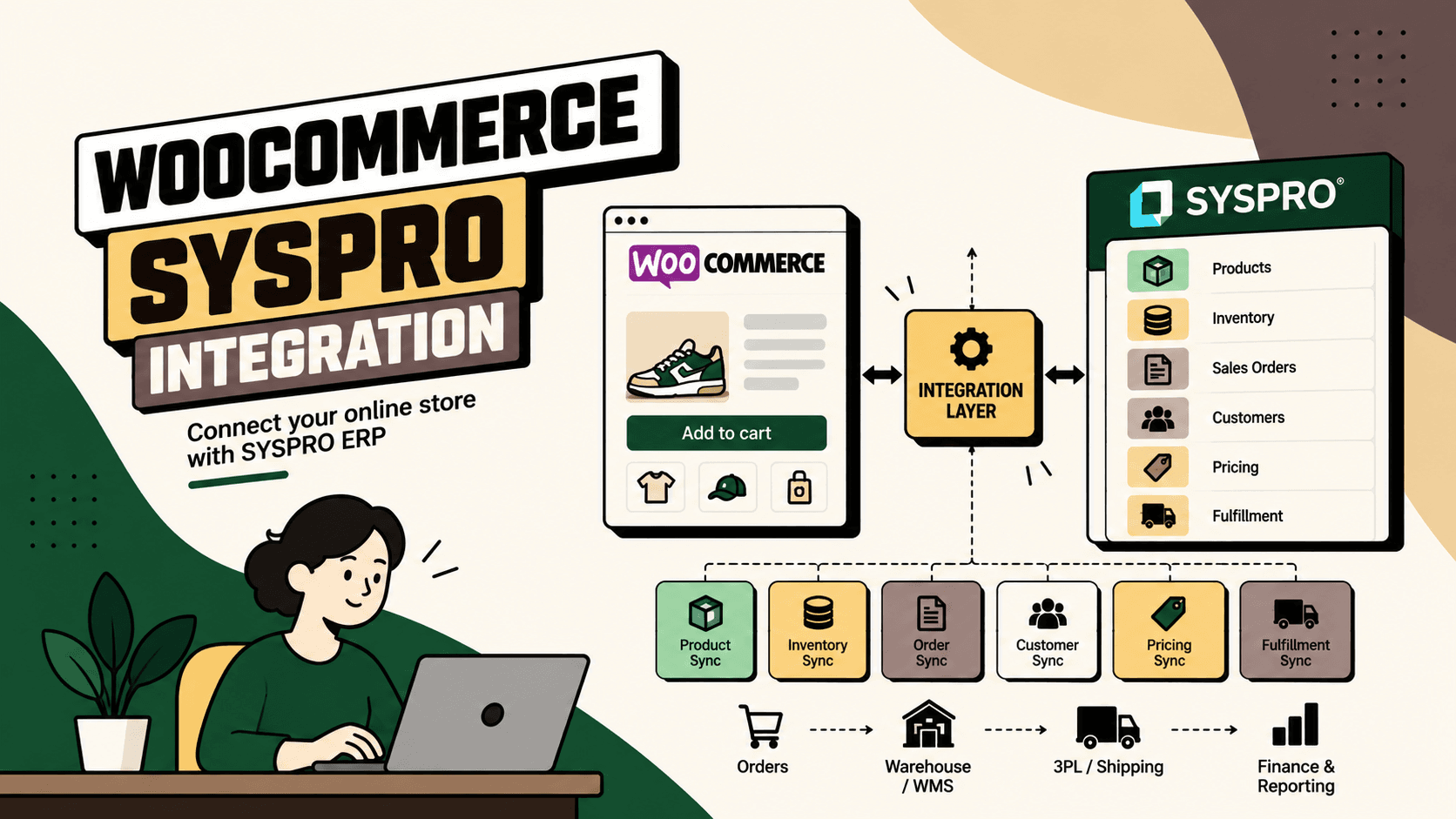
WooCommerce SYSPRO integration connects an online store with SYSPRO ERP so ecommerce transactions and operational data can move between systems without relying on repetitive manual entry. The integration can connect products, SKUs, inventory, pricing, customer records, sales orders, fulfillment status, shipment information and other operational data.
The important part is not simply creating a technical connection. A reliable integration defines which system owns each piece of data, how records are mapped, when information should move, how errors are handled and what happens when the two systems disagree.
WooCommerce provides a REST API for connecting stores with external systems, while SYSPRO provides integration capabilities including e.net Solutions, business objects, WCF services and OData. SYSPRO also positions its integration platform for connecting third-party applications and business systems. WooCommerce REST API documentation SYSPRO Integration Platform
What Is WooCommerce SYSPRO Integration?
Answer: WooCommerce SYSPRO integration is the connection between a WooCommerce storefront and SYSPRO ERP that allows relevant ecommerce and ERP data to move between the two systems through APIs, integration services or middleware.
Explanation: WooCommerce manages the online shopping experience and captures customer transactions. SYSPRO can manage operational information such as products, inventory, sales orders and fulfillment processes. An integration layer connects these environments and applies the rules required to keep their workflows aligned.
Example: A customer places an order in WooCommerce. The integration validates the customer and SKU information, transfers the order into a SYSPRO sales-order workflow, and then sends appropriate status or shipment information back toward WooCommerce.
Implication: The integration becomes part of the complete order lifecycle rather than a simple data export.
Action: Start by mapping the workflow from product creation through order capture, inventory allocation, fulfillment, shipment, cancellation and return. Then decide which parts should be automated.
Why Integrate WooCommerce With SYSPRO?
When ecommerce and ERP systems are disconnected, teams often compensate with spreadsheets, exports, imports, manual order entry or repeated data checks. These workarounds can become difficult to manage as order volume, SKU count, inventory locations and fulfillment complexity increase.
A WooCommerce SYSPRO integration creates a controlled data flow between the customer-facing storefront and the operational system. The objective is not to make every field synchronize in every direction. It is to make the important business workflows consistent.
- Orders: Move WooCommerce orders into the appropriate SYSPRO sales-order process.
- Inventory: Publish appropriate available inventory from SYSPRO toward WooCommerce.
- Products: Keep selected SKU and product information aligned.
- Pricing: Synchronize approved pricing information where SYSPRO is the relevant source.
- Customers: Reduce duplicate customer data entry where the workflow requires it.
- Fulfillment: Return relevant order and shipment status toward the storefront.
- Returns: Connect ecommerce return or cancellation events with the appropriate ERP workflow.
- Reconciliation: Identify records that failed, duplicated or became inconsistent.
Existing SYSPRO and WooCommerce integration solutions demonstrate common bidirectional patterns, including product and inventory synchronization and the creation of SYSPRO sales orders from WooCommerce orders. Commercient SYSPRO and WooCommerce integration Stock2Shop SYSPRO and WooCommerce integration
What Data Can WooCommerce and SYSPRO Synchronize?
The exact fields and direction of synchronization depend on the SYSPRO environment and business process. A useful starting point is to divide the data into customer-facing commerce information, operational information and transaction information.
| Data or process | WooCommerce to SYSPRO | SYSPRO to WooCommerce |
|---|---|---|
| Customer accounts | Customer details and account information | Customer record updates where required |
| Products and SKUs | Selected product changes where WooCommerce is authoritative | ERP product and SKU information |
| Inventory | Limited or exception-driven updates | Available inventory and stock information |
| Pricing | Commerce-specific changes where applicable | Approved ERP pricing information |
| Sales orders | Order creation and updates | Order status information |
| Fulfillment | Customer-selected fulfillment information | Fulfillment and shipment status |
| Tracking | Shipping selections | Tracking information |
| Invoices | Payment or order context | Invoice or financial status where required |
| Returns and cancellations | Return or cancellation requests | Approved return or cancellation status |
The most important design decision is not how many fields can be synchronized. It is which system should be authoritative for each field and what should happen when data conflicts.
WooCommerce SYSPRO Integration Architecture
A scalable architecture typically places an integration layer between WooCommerce and SYSPRO rather than allowing every connected system to communicate independently with every other system.
WooCommerce
↓
Commerce Integration Layer
↓
SYSPRO ERP
↓
WMS / 3PL / Shipping / CRM / Customer Support
The integration layer can handle field mapping, validation, authentication, retries, deduplication, error handling, business rules and reconciliation.
SYSPRO's OData capability can provide access to ERP data, while transactional integrations can use SYSPRO business objects and related integration services. The exact interface should be selected according to the transaction and SYSPRO environment rather than assuming that one API pattern should handle every workflow. SYSPRO OData Service SYSPRO Developer Integration Resources
Layer 1: WooCommerce
WooCommerce is the ecommerce transaction layer. It captures customers, carts, orders, products and storefront interactions. Its REST API provides a mechanism for external applications and services to interact with store data. WooCommerce REST API
Layer 2: Integration Layer
This layer translates data between systems and applies the workflow rules. It should be responsible for tasks such as identifier mapping, validation, authentication, retry logic, duplicate-event detection and exception routing.
Layer 3: SYSPRO
SYSPRO provides the ERP-side operational context. Depending on the implementation, the integration may read product, inventory or other ERP information and create or update appropriate business transactions.
Layer 4: Downstream Operations
A growing ecommerce operation may also connect the ERP workflow with warehouses, 3PLs, shipping systems, CRM platforms, customer support and financial processes. Designing the integration around the full workflow prevents WooCommerce from becoming a direct dependency for every downstream connection.
WooCommerce to SYSPRO Order Integration
Answer: A WooCommerce order can be transferred into a SYSPRO sales-order workflow when the integration maps the order data, validates required information and invokes the appropriate SYSPRO transaction interface.
The basic workflow is:
WooCommerce order → customer validation → SKU validation → inventory and business-rule checks → SYSPRO sales order → warehouse fulfillment
The critical point is that an API request succeeding does not necessarily mean the business transaction succeeded. The integration should track the order through its meaningful states.
Step 1: Capture the WooCommerce Order
The integration receives the order event or retrieves the order through the WooCommerce API. It records the WooCommerce order identifier so the transaction can be traced later.
Step 2: Validate the Customer
The integration determines whether the customer already exists in the required SYSPRO context or whether a new customer workflow is needed. Customer matching rules should be explicit rather than based on a single loosely controlled field.
Step 3: Validate SKUs
Every ordered SKU should map to an expected ERP item. Missing or ambiguous mappings should become exceptions rather than silently creating incomplete transactions.
Step 4: Apply Business Rules
Rules may cover pricing, inventory, customer eligibility, shipping requirements, tax treatment or other operational requirements. The exact rules depend on the business and SYSPRO configuration.
Step 5: Create the SYSPRO Transaction
The validated order is passed into the appropriate SYSPRO transaction workflow using the selected integration interface.
Step 6: Confirm and Reconcile
The integration records the relationship between the WooCommerce order and the resulting SYSPRO transaction. This makes duplicate detection and exception investigation much easier.
SYSPRO to WooCommerce Inventory Synchronization
Inventory synchronization is often one of the highest-value WooCommerce SYSPRO workflows because storefront availability affects purchasing decisions and downstream fulfillment.
Answer: SYSPRO can act as the operational source for selected inventory information that is published to WooCommerce through an integration workflow.
The architecture should define exactly what “available inventory” means. It may not be identical to total physical stock. The calculation can depend on locations, allocations, commitments, safety stock or other business rules.
A robust inventory workflow therefore looks like:
SYSPRO inventory data → availability rules → sellable quantity → validation → WooCommerce inventory update
Common failure: Publishing a raw ERP quantity directly to WooCommerce without considering allocated or unavailable inventory.
Better approach: Define a sellable-inventory calculation and document which warehouse locations and stock states contribute to it.
Expected result: Storefront availability becomes more closely aligned with the operational inventory state, while exceptions can be routed to operations rather than hidden by automatic updates.
Product and SKU Synchronization
Product synchronization can reduce duplicate catalog maintenance when SYSPRO contains authoritative product or item information.
Typical data may include SKU identifiers, descriptions, product status and selected product attributes. The exact fields should be determined during the data-mapping stage.
A common mistake is making every product field bidirectional. If both WooCommerce and SYSPRO can update the same attribute, the integration can create conflicting values or repeated update cycles.
A safer approach is field-level ownership:
- Define the authoritative system for each field.
- Define the permitted update direction.
- Validate required fields before publishing changes.
- Track rejected or unmapped records.
- Separate ERP item data from storefront-specific merchandising content where appropriate.
Pricing Synchronization Between WooCommerce and SYSPRO
Pricing is more than a simple numeric field. Businesses may have customer-specific pricing, price lists, promotions, regional pricing, contract pricing or other commercial rules.
If SYSPRO is the source of truth for a particular price, the integration should publish the approved value to WooCommerce. If WooCommerce owns a promotional price, the architecture should prevent the ERP synchronization from unintentionally overwriting it.
Implementation rule: Do not create a second pricing engine inside the integration unless there is a clear business reason to do so. Prefer an authoritative calculation and a controlled synchronization path.
Customer Synchronization
Customer data can move in either direction depending on the business model. A B2C store may create customer information primarily in WooCommerce, while a B2B operation may already have customer accounts and commercial relationships managed in SYSPRO.
The integration should define matching logic before creating records automatically. Useful identifiers can include account numbers, email addresses or other approved business identifiers, but the appropriate matching rule depends on the data model.
Common failure: Using email alone as a universal customer key.
Better approach: Define a durable cross-system identifier and establish explicit rules for new, existing, merged and ambiguous customer records.
Fulfillment and Shipment Synchronization
Once a WooCommerce order enters the ERP and warehouse workflow, the customer still needs visibility into what happens next.
A connected workflow can return relevant fulfillment status, shipment information and tracking details toward WooCommerce.
The implementation should account for cases such as:
- Partial shipments
- Multiple tracking numbers
- Backordered items
- Cancelled lines
- Split fulfillment across locations
- Shipment exceptions
Do not design the workflow around the assumption that every order has one shipment and one tracking number. The data model should reflect how the business actually fulfills orders.
Returns and Cancellations
Returns connect ecommerce, customer service, inventory and ERP processes. A WooCommerce return request may need to become a controlled SYSPRO return or RMA workflow.
Data transfer and decision automation should be treated separately. The integration can automatically move a valid return request, but approval may still require rules or human review.
For example, the workflow may be:
WooCommerce return request → eligibility rules → approved or exception state → SYSPRO return workflow → inventory and financial processing → WooCommerce status update
This approach keeps the integration deterministic while allowing human intervention for unusual cases.
Real-Time vs Scheduled WooCommerce SYSPRO Integration
Not every data flow needs to run in real time. The appropriate synchronization pattern depends on the business consequence of stale information.
| Approach | Best suited for | Main consideration |
|---|---|---|
| Event-driven or near real time | Orders, critical inventory and customer-facing status | Requires strong monitoring, retries and duplicate handling |
| Scheduled synchronization | Selected catalog, reporting and lower-frequency data | Information can remain temporarily stale |
| On-demand API retrieval | Specific operational lookups | Depends on API availability and response time |
A useful rule is to prioritize real-time processing when stale information can directly create a customer, revenue or operational problem. Use scheduled synchronization when the business can tolerate a delay.
WooCommerce SYSPRO Integration Options
There is no single integration architecture that fits every SYSPRO and WooCommerce implementation. The main choices are a packaged connector, an integration platform or a custom integration layer.
| Integration approach | Best suited for | Primary trade-off |
|---|---|---|
| Packaged WooCommerce-SYSPRO connector | Standard synchronization requirements that closely match the connector | Business-specific workflows may require extensions |
| Integration platform or iPaaS | Businesses connecting WooCommerce, SYSPRO and multiple downstream systems | Requires platform governance and ongoing ownership |
| Custom integration layer | Complex rules, specialized workflows and custom data transformations | Greater engineering and maintenance responsibility |
SYSPRO provides an integration platform and marketplace for extending its environment, while third-party providers offer SYSPRO and WooCommerce connectors. The right choice should be evaluated against required workflows rather than connector availability alone. SYSPRO Marketplace System2System WooCommerce and SYSPRO integration
How to Choose the Right WooCommerce SYSPRO Integration
Answer: Choose the smallest integration architecture that reliably supports the required business workflows, while leaving room for additional systems and automation when the operation grows.
- Map the workflows. Document products, inventory, pricing, customers, orders, fulfillment, shipping, returns and cancellations.
- Define data ownership. Identify the source of truth for every critical object and important field.
- Measure transaction volume. Record order volume, SKU count, inventory updates and exception volume.
- Assess business rules. Identify pricing, allocation, customer, fulfillment and return rules that cannot be handled by simple field mapping.
- Count connected systems. Include WMS, 3PL, shipping, CRM, customer support and finance systems.
- Compare integration options. Evaluate packaged connectors, integration platforms and custom architecture against actual requirements.
- Design failure handling. Define retries, duplicate handling, dead-letter or exception states and human escalation.
- Plan monitoring. Track transaction failures, latency, unmatched records and unresolved exceptions.
WooCommerce SYSPRO Integration Implementation Roadmap
1. Map the Current Process
Document how a WooCommerce order currently travels through customer validation, ERP entry, inventory allocation, warehouse fulfillment, shipping, invoicing and customer communication.
Include spreadsheets, manual exports, copy-and-paste steps and approval points. These often reveal the actual integration requirements more clearly than an API specification.
2. Establish Baseline Metrics
Measure manual order-entry time, number of manual touches per order, synchronization errors, inventory discrepancies, exception volume and processing latency where those metrics are available.
These measurements provide the baseline for evaluating whether the integration is actually improving the operation.
3. Define the Data Model
Create mappings between WooCommerce and SYSPRO for customers, products, SKUs, inventory, pricing, orders, fulfillment and shipment information.
For each object, document its identifier, ownership, synchronization direction, validation requirements and exception behavior.
4. Select the Smallest Viable Workflow
Do not begin by synchronizing every possible object. Select one high-value workflow, such as WooCommerce order creation in SYSPRO or inventory synchronization, and make that workflow reliable first.
5. Build Validation
Validate required SKUs, customers, quantities, pricing information and other business requirements before submitting transactions to SYSPRO.
Validation should identify predictable problems before they become downstream exceptions.
6. Implement Secure Connectivity
Use supported authentication mechanisms, secure credential storage and appropriate access controls. The exact security model depends on the chosen WooCommerce and SYSPRO interfaces.
7. Add Retry and Deduplication Logic
Network failures and duplicate events are normal integration conditions. A production workflow should know whether an event has already been processed and when a failed transaction can safely be retried.
8. Test Edge Cases
- Duplicate orders
- Invalid SKUs
- Missing customer records
- Out-of-stock products
- Price mismatches
- Partial shipments
- Multiple tracking numbers
- Cancellations
- Returns
- ERP downtime
- WooCommerce API failures
- Incomplete or rejected records
9. Pilot and Measure
Run the workflow under controlled conditions and compare actual results against the baseline. Evaluate both successful transactions and the quality of exception handling.
10. Scale Carefully
Once the initial workflow is stable, extend the integration to additional data objects and downstream systems according to measurable business value.
What Should Be Automated?
Not every part of a WooCommerce SYSPRO workflow should be automated in the same way. Deterministic data movement is usually a strong automation candidate. Ambiguous business decisions should use explicit rules or human approval.
| Workflow | Recommended approach | Human role |
|---|---|---|
| Transfer validated WooCommerce orders | Automate | Handle rejected or exceptional orders |
| Publish approved inventory availability | Automate | Resolve conflicting inventory states |
| Synchronize approved product data | Automate | Review unusual catalog changes |
| Update shipment tracking | Automate | Investigate conflicting shipment data |
| Apply unusual pricing exceptions | Rule-driven with escalation | Approve commercial exceptions |
| Approve unusual returns | Rule-driven with human approval | Make policy exceptions |
The objective is not maximum automation. It is reliable automation of repeatable work while keeping high-impact exceptions visible to people.
Adding AI to WooCommerce SYSPRO Integration
AI can add value around the integration when the workflow contains unstructured requests, exception classification or natural-language customer interactions. It should not replace deterministic transaction rules without a clear reason.
A useful division of responsibility is:
- AI layer: classify customer intent, extract entities, summarize exceptions and assist with natural-language workflows.
- Integration layer: authenticate, map fields, validate data, call APIs, manage retries and apply deterministic rules.
- SYSPRO: provide authoritative ERP information and execute approved ERP processes.
- WooCommerce: provide storefront and ecommerce transaction context.
- Human operators: review ambiguous exceptions, sensitive decisions and high-impact overrides.
For example, an AI customer-service workflow could identify that a customer is asking about an order, extract the order reference, retrieve verified information through the integration layer and draft a response. The AI should not invent shipment status or independently modify an ERP transaction without an approved workflow and appropriate controls.
Monitoring and Reconciliation
A production integration needs more than successful API calls. It needs operational visibility.
Useful monitoring metrics include:
- Orders received from WooCommerce
- Orders successfully created in SYSPRO
- Rejected transactions
- Retry counts
- Duplicate events
- Inventory synchronization failures
- Unmatched SKUs
- Customer mapping exceptions
- Processing latency
- Unresolved records
Reconciliation should compare meaningful business states, not just request logs. If WooCommerce contains an order that has no corresponding SYSPRO transaction, that is a business exception even if every API request in the surrounding period returned successfully.
Security and Data Quality Considerations
WooCommerce and SYSPRO integration creates a path between customer, commerce and ERP information. Security therefore needs to be designed into the workflow rather than added after deployment.
- Use secure credential storage.
- Apply appropriate permissions to integration accounts.
- Limit access to only the data and operations required.
- Protect customer and order information during transmission and storage.
- Log important transaction events without unnecessarily exposing sensitive information.
- Monitor failed authentication and unusual integration activity.
- Maintain documented ownership of credentials, mappings and integration rules.
Data quality is equally important. An integration can reliably synchronize incorrect data if the source records are wrong. Establish validation rules and reconciliation processes before assuming that automation alone will improve data quality.
Common WooCommerce SYSPRO Integration Mistakes
1. Treating the Integration as a Simple Data Pipe
Data movement is only one part of the problem. The workflow also needs ownership, validation, business rules and exception handling.
2. Making Every Field Bidirectional
Bidirectional synchronization can create conflicts when both platforms modify the same field. Define field-level ownership instead.
3. Publishing Raw Inventory Quantities
Total ERP stock may not equal sellable ecommerce inventory. Define availability using the business's actual allocation and fulfillment rules.
4. Assuming One Order Equals One Shipment
Partial and split fulfillment can require multiple status events and tracking references.
5. Automating Returns Without Approval Rules
Return requests can have eligibility, inventory and financial implications. Separate request transfer from return approval.
6. Measuring Technical Success Instead of Business Success
A successful API request does not prove that the customer order was correctly processed. Measure the full business transaction.
7. Building Too Much Before Testing the Core Flow
A broad integration with unstable order or inventory synchronization creates a larger failure surface. Start with the smallest viable workflow.
How to Measure WooCommerce SYSPRO Integration ROI
Integration ROI should be measured from the workflow that changes, not from the number of endpoints connected.
Useful metrics include:
- Manual order-entry time
- Manual touches per order
- Order synchronization failure rate
- Inventory discrepancy frequency
- Time spent resolving exceptions
- Order-processing latency
- Shipment-status update latency
- Number of orders requiring manual intervention
- Return-processing effort
Illustrative calculation: If a business processes 500 orders per day and removes five minutes of repetitive manual handling from every order, the theoretical time represented by that step is approximately 41.7 hours per day. This is an illustrative calculation, not an industry benchmark or predicted result. The actual business case depends on the company's workflow, staffing model, order volume and labor cost.
A practical prioritization model for deciding what to automate is:
Priority = volume × frequency × manual effort × error cost × revenue impact ÷ implementation complexity
This is a practical framework, not an industry-standard formula. It helps compare candidate workflows so implementation effort is directed toward processes with meaningful operational impact.
Where Five Anchor Fits
Problem: WooCommerce captures ecommerce demand while SYSPRO and connected operational systems manage products, inventory, orders and fulfillment. Without a deliberate integration architecture, teams can spend time moving information between systems and resolving exceptions manually.
Solution: Five Anchor approaches this as commerce infrastructure: connect WooCommerce and SYSPRO through a controlled integration layer, define data ownership, automate repeatable workflows and extend the architecture into warehouse, shipping and customer operations where justified.
Implementation: A WooCommerce SYSPRO project can include workflow mapping, API and system integration, product and inventory synchronization, order-processing automation, fulfillment connectivity, validation, retries, reconciliation, guardrails and human escalation.
Business outcome: The intended result is a more consistent order lifecycle with fewer unnecessary manual handoffs and clearer visibility into exceptions. The actual improvement should be measured against the company's baseline rather than assumed in advance.
This aligns with Five Anchor's positioning as AI Infrastructure for D2C & E-Commerce, particularly its Commerce Infrastructure capability. The WooCommerce-SYSPRO connection can become the operational backbone for additional automation across inventory, order processing, fulfillment, shipping and customer operations.
WooCommerce SYSPRO Integration Checklist
- Map the complete WooCommerce-to-SYSPRO order lifecycle.
- Identify the source of truth for products, inventory, pricing, customers and orders.
- Document field mappings and identifiers.
- Choose between a packaged connector, integration platform or custom integration layer.
- Define real-time versus scheduled synchronization requirements.
- Implement secure authentication and appropriate access controls.
- Build validation and duplicate-event handling.
- Define retry, failure and escalation behavior.
- Test cancellations, returns, partial shipments and inventory exceptions.
- Establish operational baselines and KPIs.
- Pilot one high-value workflow.
- Monitor the workflow before expanding into additional automation.
Conclusion
WooCommerce SYSPRO integration is an operational workflow problem as much as a technical integration problem. WooCommerce captures ecommerce transactions, while SYSPRO can provide the ERP context required for products, inventory, sales orders and operational fulfillment. The integration layer determines how those systems exchange information, how records are validated and how exceptions are handled.
The strongest implementations begin with a focused workflow such as order synchronization or inventory availability. They establish data ownership, build reliable mappings, handle duplicates and failures, test real-world edge cases and measure the result against a baseline.
Once the core workflow is stable, the architecture can expand into fulfillment, shipping, returns, customer support and AI-assisted operations. The goal is not to automate everything. It is to create a reliable commerce infrastructure in which repeatable work is automated, important exceptions remain visible and business systems stay synchronized.
For ecommerce businesses operating WooCommerce and SYSPRO, Five Anchor can connect the storefront and ERP as part of a broader commerce infrastructure strategy, with workflow mapping, integration, automation, guardrails and measurement built around the actual operational process.
Key Takeaways
- •WooCommerce SYSPRO integration connects storefront transactions with ERP and operational workflows.
- •Common synchronization areas include products, SKUs, inventory, pricing, customers, sales orders, fulfillment and shipment information.
- •WooCommerce provides a REST API, while SYSPRO provides integration capabilities including e.net Solutions, business objects, WCF services and OData.
- •A dedicated integration layer can handle mapping, validation, authentication, retries, deduplication, business rules and reconciliation.
- •The right architecture depends on workflow complexity and may use a packaged connector, integration platform or custom integration layer.
- •AI can assist with interpretation and exception workflows, while deterministic ERP transactions should remain governed by explicit rules and appropriate human approval.
- •Five Anchor can extend WooCommerce and SYSPRO connectivity into broader commerce infrastructure across inventory, fulfillment, shipping and intelligent automation.
WooCommerce SYSPRO Integration Approaches
| Approach | Best suited for | Primary trade-off |
|---|---|---|
| Inventory Sync Frequency | 15–30 min batch polling (high oversell risk) | Sub-second atomic locking (<450ms) |
| Concurrent Drop Resilience | Fails under concurrency; causes negative stock balance | Redis atomic reservation queue guarantees exact counts |
| Error Handling & Retries | Silent failure; manual CSV audit needed | Dead-letter queues with automated exponential retry |
| Fulfillment Routing Speed | 2–4 hours delayed batch export to 3PL warehouse | Instantaneous automated webhook dispatch (<90 sec) |