Why Post-Purchase Support Becomes More Expensive as Ecommerce Sales Grow
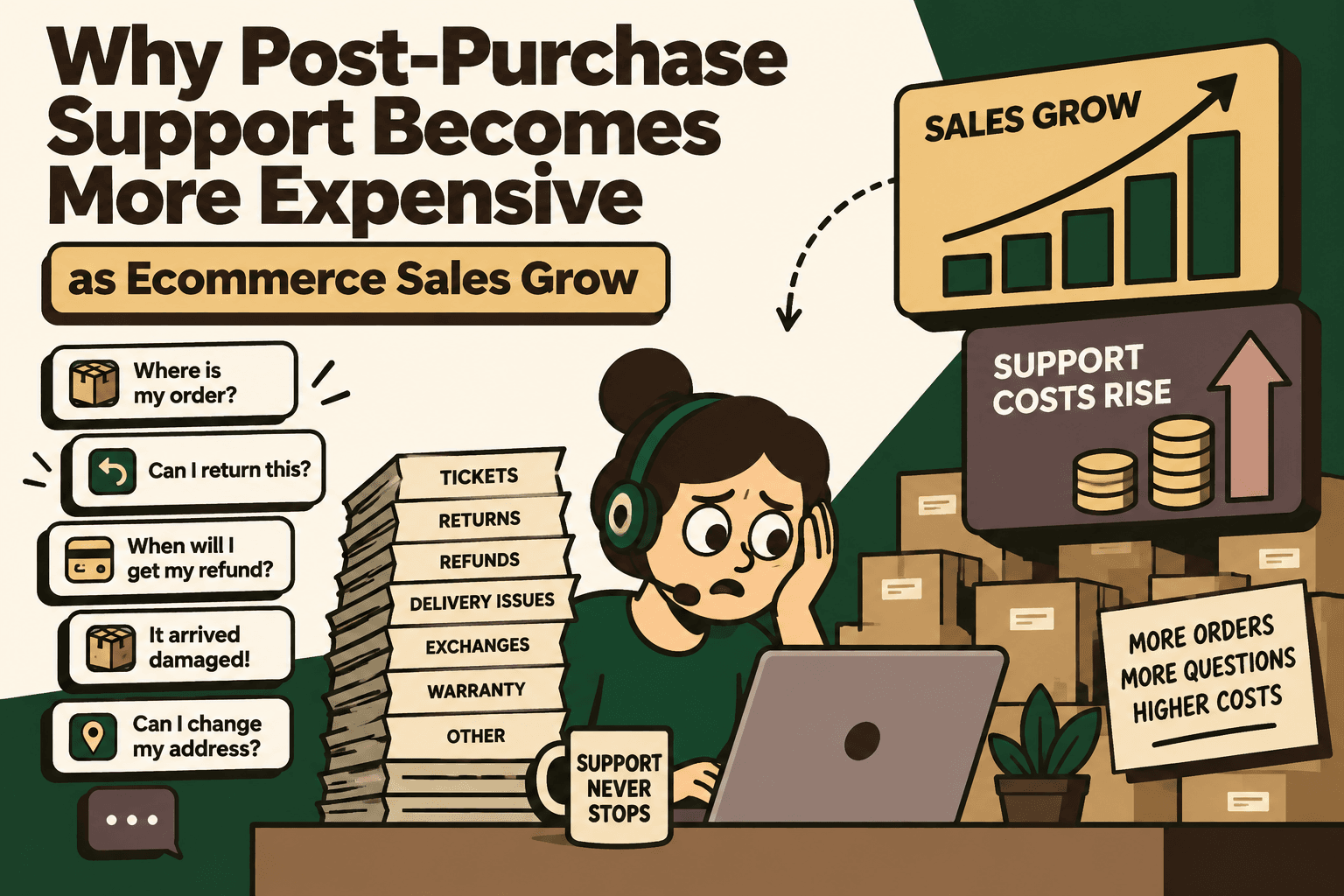
Ecommerce sales can grow faster than a support operation can absorb. More orders create more customers who need tracking information, delivery updates, return instructions, refund status, exchanges, address changes and help when something goes wrong. The result is a support workload that can become disproportionately expensive when every post-purchase question still requires a human agent to retrieve information and move the issue forward.
The important distinction is that post-purchase support is not primarily a communication problem. Much of it is an information retrieval and workflow execution problem. The answer already exists somewhere in the order system, carrier platform, warehouse, returns system, payment system or customer record. When those systems are disconnected from the support experience, people become the integration layer.
That is why the traditional growth model looks like more orders → more tickets → more agents → more management overhead. A more scalable model is more orders → more proactive communication and self-service → automated handling of predictable requests → humans focused on exceptions.
Shopify's current post-purchase guidance emphasizes proactive communication, tracking engagement, service contacts per order and return-related metrics as important parts of the customer experience. Shopify also notes that returns create processing and inventory costs beyond the refund itself. Shopify's post-purchase experience guide and Shopify's ecommerce returns guide provide useful context for these operational costs.
The Short Answer: Why Does Support Cost Rise as Sales Grow?
Post-purchase support becomes more expensive because every additional order creates another opportunity for a support interaction, while the complexity of exceptions, returns, delivery problems and fragmented operational data can grow at the same time.
If a customer can independently see an accurate order status, understand a delay, initiate an eligible return and check refund progress, the order may never require an agent.
If the customer has to email support to ask where the package is, wait for an employee to check a carrier portal, then ask again about a return, the same order creates several labor events.
The cost problem is therefore not simply how many orders you process. It is how much human work each order creates after checkout.
1. More Orders Create More Opportunities for Support Contacts
Every completed order enters a post-purchase lifecycle. That lifecycle can include:
- Order confirmation
- Payment confirmation
- Fulfillment status
- Shipment tracking
- Estimated delivery
- Delivery exceptions
- Address or order changes
- Return requests
- Exchange requests
- Refund questions
- Damaged-product complaints
- Missing-package investigations
- Warranty or product-use questions
Not every order creates a support ticket. That is precisely why a useful support metric is tickets per 1,000 orders rather than ticket count alone.
A 2026 working benchmark published by Eightx places the broad ecommerce range at roughly 200 to 500 support tickets per 1,000 orders, while noting that automation maturity can materially change the number. This should be treated as a working industry benchmark rather than a universal target for every brand. Eightx's 2026 support-ticket benchmark explains the assumptions behind that range.
The operational implication is straightforward. If order volume increases while tickets per 1,000 orders remain unchanged, support workload increases with sales. If ticket intensity also rises because shipping complexity, returns or product questions are increasing, support costs can grow faster than orders.
An Illustrative Example
Imagine a D2C brand processing 5,000 orders per month and generating 250 support tickets per 1,000 orders. That produces approximately 1,250 tickets per month.
If the brand grows to 10,000 orders without improving its post-purchase experience, the same ticket intensity would produce approximately 2,500 tickets.
This is an illustrative calculation, not a forecast. The point is that support workload is tied not only to revenue but also to the number of post-purchase interactions created by each order.
If the brand instead reduces ticket intensity through proactive delivery updates, self-service order lookup, automated return flows and better exception handling, revenue can grow without requiring support labor to grow at the same rate.
2. WISMO Becomes a Hidden Tax on Ecommerce Growth
One of the most common post-purchase questions is WISMO: Where Is My Order?
It is deceptively simple. The customer is not necessarily asking for judgment. They usually want information that already exists in the ecommerce platform, order management system, warehouse, carrier or tracking platform.
The traditional workflow looks like this:
Customer → Support Agent → Order System → Carrier System → Support Agent → Customer
The agent is effectively acting as a manual interface between the customer and operational data.
Ephanti's 2026 analysis estimates WISMO at 30% to 50% of ecommerce support volume and argues that many of these requests are fundamentally data-retrieval problems. Those figures are an industry estimate rather than a universal benchmark, but they illustrate why order-status automation is often one of the first post-purchase workflows worth examining. Ephanti's WISMO analysis provides the underlying assumptions.
The better workflow is:
Customer → Real-time order information
Or, even better:
Order event → Proactive customer update → No ticket created
This distinction matters. The cheapest support interaction is often the one the customer never needs to initiate.
3. Proactive Communication Changes the Cost Structure
Many support teams are designed around responding to questions. A scalable post-purchase operation also asks why those questions are being created.
Consider a shipment that is delayed by two days.
Without proactive communication:
- Carrier detects the delay.
- Customer sees an unclear tracking status.
- Customer contacts support.
- Agent checks the shipment.
- Agent explains the delay.
- Customer waits for the revised delivery.
- Customer may contact support again.
With a connected post-purchase workflow:
- Carrier event indicates a delay.
- System identifies affected orders.
- Customer receives an approved message explaining the delay.
- Customer receives the latest expected delivery information.
- Only unusual cases are escalated.
The second workflow changes support from reactive ticket handling to exception management.
Shopify's post-purchase guidance recommends tracking customer contacts per order and using communication, tracking and return processes to improve the experience after checkout. Shopify's post-purchase guidance is a useful reference for the broader operating model.
4. Returns Turn One Order Into a Multi-Step Operational Workflow
Returns are another reason post-purchase costs can rise faster than sales.
A return is rarely just a refund button.
A typical flow may include:
Customer request → eligibility check → return method → label or pickup → shipment tracking → warehouse receipt → inspection → refund or exchange → customer confirmation
Each stage can create a customer question or internal task.
For example, the customer may ask:
- Am I eligible for a return?
- Can I exchange instead of refund?
- Where is my return label?
- Has my return arrived?
- When will my refund be processed?
- Why has my refund not appeared yet?
Returns also create operational costs beyond customer support. Shopify cites National Retail Federation and Happy Returns data estimating that 19.3% of online sales were returned in 2025, and notes that returns tie up working capital and create processing labor before products can be resold. Shopify's 2026 ecommerce returns guide provides the cited return-rate context.
The important lesson is not that every return should be automated end to end. It is that return eligibility, status and routine communication are often structured enough to reduce manual handling, while exceptions may still require human judgment.
5. Returns Also Create a Second Support Queue
One reason return-related support can become expensive is that the customer journey and operational journey do not always move at the same speed.
A customer may submit a return today, while the warehouse receives the product several days later. The refund may happen after inspection. An exchange may depend on inventory availability.
That creates a synchronization problem.
| Customer Sees | Operational Reality |
|---|---|
| Return requested | Eligibility needs to be checked |
| Return approved | Label or pickup needs to be generated |
| Return shipped | Carrier is transporting the package |
| Return received | Warehouse still needs to inspect it |
| Refund initiated | Payment system still needs to settle it |
If these states are not synchronized, the support team becomes responsible for explaining the gap.
A connected post-purchase workflow instead exposes the correct state to the customer and triggers appropriate updates as the order moves through the process.
6. Support Costs Increase When Channels Multiply
Growing ecommerce brands rarely keep customer conversations in one place.
Customers may contact a brand through:
- Website chat
- Instagram or social messaging
- Phone
- Contact forms
- Marketplace messaging
Multiple channels are not inherently inefficient. The cost appears when the operational context is fragmented across them.
A customer may ask about an order through Instagram after already emailing support. If the second channel cannot see the first conversation, the agent may repeat the same identity verification, order lookup and explanation.
Now multiply that by thousands of orders.
The support problem becomes:
More orders → more conversations → more duplicated context → more agent handling time.
LateShipment.com's post-purchase operating-system analysis similarly frames fragmented post-purchase workflows as an operational problem involving customer support, logistics, claims and returns. LateShipment.com's post-purchase operations analysis provides additional context.
7. The Real Cost Is Bigger Than Agent Salaries
Support cost is often measured as payroll plus helpdesk software.
That is incomplete.
A more useful model is:
Total Post-Purchase Support Cost = Direct Labor + Management Overhead + Tooling + Escalation Cost + Rework + Operational Opportunity Cost
There can also be commercial consequences when customers experience poor communication, delayed responses or difficult returns.
That does not mean every support contact causes lost revenue. It means support quality can influence the economics of the customer relationship, so the business should avoid measuring the function only as a cost center.
A better set of metrics includes:
| Metric | What It Tells You |
|---|---|
| Support tickets per 1,000 orders | How much support demand each unit of order volume creates |
| Post-purchase cost per order | How much support operation is consumed by each order |
| WISMO share | How much demand comes from order-status questions |
| Return contacts per return | How much support work is attached to returns |
| First-contact resolution | How often an issue is resolved without follow-up |
| Self-service resolution | How many routine requests customers resolve without an agent |
| Human escalation rate | How much work still requires judgment or intervention |
| Repeat-contact rate | How often customers need to ask again about the same issue |
8. Why Hiring More Agents Is Not Always the Right First Response
When ticket volume increases, hiring is the obvious response.
Sometimes it is necessary. A customer with a damaged high-value product, a fraud concern or a complex warranty issue may genuinely need a human.
The problem is hiring people to perform tasks that software could execute safely.
Consider an agent whose day includes:
- Looking up order status
- Copying tracking information
- Explaining standard delivery statuses
- Repeating return-policy instructions
- Checking return eligibility
- Answering routine refund-status questions
- Sending the same exchange instructions
Adding more agents makes the queue larger. It does not change the underlying workflow.
A more scalable operating model separates routine information work from judgment work.
9. What Should Be Automated and What Should Stay Human?
The strongest post-purchase automation is not “AI handles everything.” It is a deliberate allocation of work.
| Workflow | Preferred Operating Model |
|---|---|
| Order status lookup | Automate when reliable order and tracking data is available |
| Delivery ETA questions | Automate with current fulfillment and carrier data |
| Standard return eligibility | Automate according to explicit policy rules |
| Return status | Automate status retrieval and communication |
| Routine product questions | Use approved knowledge and AI-assisted self-service |
| Damaged high-value order | Escalate to a human |
| Fraud-adjacent or unusual refund | Require human review |
| Complex complaint | Escalate to an accountable human owner |
Rules should control predictable decisions. AI should help interpret intent and coordinate workflows. Humans should own sensitive exceptions.
This division is especially important because an AI agent should not be given unrestricted authority simply because a workflow is repetitive.
10. AI Is Most Useful When It Can Access Operational Data
An AI support agent is more valuable when it can retrieve the information required to resolve a customer's request rather than merely generate a plausible-sounding response.
For post-purchase operations, the architecture can look like:
Customer channel → AI support layer → Order/commerce system → WMS/3PL → Carrier → Returns/payment systems
The AI layer can identify intent, retrieve approved information, apply documented rules, initiate permitted actions and escalate cases that fall outside the workflow.
Open's 2026 ecommerce AI analysis describes order status, returns, refunds, product questions and shipping inquiries as categories that can be suitable for AI support, while also identifying complex, out-of-policy and fraud-related cases as areas where human involvement remains important. Open's ecommerce AI support analysis provides the source context.
The principle is simple: AI should connect the conversation to the workflow, not replace the workflow.
11. A Post-Purchase Support Agent Needs Guardrails
Connected automation introduces a new responsibility: preventing the system from taking an incorrect action.
Useful guardrails include:
- Only access customer data after appropriate identity or order verification.
- Use approved sources for order and shipment status.
- Keep return eligibility rules explicit and version-controlled.
- Require human approval for sensitive refunds or unusual compensation.
- Escalate damaged, high-value or fraud-adjacent cases.
- Record automated actions for audit and troubleshooting.
- Monitor failed API calls and stale operational data.
- Provide a clear human handoff when the workflow cannot continue.
The objective is not maximum automation. It is safe automation of the right work.
12. Start With the Highest-Volume, Lowest-Risk Workflow
One of the common mistakes in automation projects is starting with the most complicated workflow.
Start with a workflow that has:
- High volume
- High frequency
- Clear business rules
- Reliable source data
- Low decision risk
- Measurable operational cost
Order-status questions are often a strong candidate because the information is usually structured and the customer intent is relatively clear.
Returns can come next once eligibility rules, return status and refund states are reliable.
Product questions can follow when product content, policies and knowledge sources are well maintained.
Complex complaints, fraud-adjacent cases and unusual compensation should remain human-led until the organization has evidence that additional automation is safe.
13. A Practical Automation Prioritization Model
A useful way to rank post-purchase automation opportunities is:
Volume × Frequency × Manual Effort × Error Cost × Revenue Impact ÷ Implementation Complexity
This is a practical prioritization framework, not an industry-standard formula.
Use it comparatively rather than treating the output as a precise financial forecast.
| Workflow | Typical Priority Logic |
|---|---|
| Order tracking | High volume, structured data, relatively low decision complexity |
| Return eligibility | High volume if return rate is significant, but requires accurate policy rules |
| Refund status | Good candidate when payment and order states are accessible |
| Product questions | Good candidate when product data and knowledge content are reliable |
| Complex complaints | Lower automation priority because judgment and relationship management matter |
14. Implementation Starts With Workflow Mapping, Not an AI Tool
Before selecting an AI support platform, map what happens after an order is placed.
For every major support request, document:
- Customer intent: What is the customer actually asking?
- Source data: Which system contains the answer?
- Decision rule: What determines the next step?
- Action: Does anything need to be changed or triggered?
- Customer communication: What should the customer be told?
- Exception: When should the workflow stop?
- Human owner: Who handles the escalation?
This produces a workflow map rather than a vague automation requirement.
Example: Order-Tracking Workflow
Intent: Customer asks where an order is.
Data: Order ID, fulfillment state, tracking number, carrier events and expected delivery.
Rule: Return the latest approved order and carrier information.
Action: No operational change unless a separate exception workflow is triggered.
Escalation: Missing tracking data, unusual delay, delivered-but-not-received claim or another exception.
Outcome: Customer receives an answer without an agent manually checking several systems.
15. Establish a Baseline Before Automating
Without a baseline, it is difficult to determine whether automation actually improved the operation.
Measure at least:
- Total monthly orders
- Total monthly support contacts
- Tickets per 1,000 orders
- WISMO percentage
- Return-related contacts
- Average handling time
- First-contact resolution
- Repeat-contact rate
- Human escalation rate
- Support cost per order
Then identify the largest avoidable category.
If 30% of tickets are order-status questions, that category may be a better starting point than trying to automate every support interaction at once.
16. Build the Smallest Viable Post-Purchase Workflow
A first implementation does not need every channel, warehouse and exception.
A small pilot might connect:
- One ecommerce platform
- One helpdesk or support channel
- One carrier or logistics source
- Order lookup
- Tracking status
- Human escalation
Once the workflow is stable, add returns, exchanges, refund status and additional customer channels.
This approach reduces implementation risk and makes it easier to identify whether the underlying problem is the AI layer, the source data, the integration or the business rule.
17. Data Quality Is the Hidden Dependency
An AI support agent cannot reliably answer a question if the operational system contains stale or conflicting information.
Common examples include:
- Tracking numbers not synchronized with orders
- Incorrect order statuses
- Return status not updated after warehouse receipt
- Inventory availability that does not match the fulfillment system
- Different customer identifiers across systems
- Product information that conflicts between the catalog and support knowledge base
This creates an important rule for ecommerce automation:
Do not use AI to hide broken operational data.
Fix the source systems and integrations first, then use AI to make that reliable information easier to access and act on.
18. Monitoring Matters After Deployment
Post-purchase automation is not a one-time project.
Carriers change status formats. Return policies change. Products change. Warehouse workflows change. Promotions create unusual order volumes. New marketplaces create additional operational paths.
A production workflow therefore needs monitoring for:
- Failed integrations
- Stale data
- Unexpected ticket spikes
- Incorrect automated answers
- Escalation volume
- Refund or return exceptions
- Customer re-contact
- Changes in resolution rate
If the system begins escalating more tickets after a policy change, that should be visible to the operations team rather than discovered weeks later through customer complaints.
19. What Should Stay Human?
Automation should reduce repetitive work, not eliminate accountability.
Human agents remain particularly valuable for:
- High-value customers and orders
- Damaged or missing shipments
- Complex complaints
- Fraud or abuse concerns
- Policy exceptions
- Emotionally sensitive situations
- Compensation decisions
- Cases involving multiple operational failures
The human role changes from information retrieval toward judgment, recovery and exception management.
That is a more defensible reason to scale a support team than simply adding people to answer a larger volume of repetitive questions.
20. How to Measure Whether Automation Actually Worked
Do not judge a post-purchase automation project only by how many conversations an AI system handles.
A high automation percentage can still be harmful if customers need to contact the company repeatedly because the first answer was incomplete.
Measure the full operating loop:
| KPI | Desired Direction |
|---|---|
| Tickets per 1,000 orders | Down for preventable routine contacts |
| Post-purchase support cost per order | Down without degrading service |
| WISMO share | Down through proactive communication and self-service |
| First-contact resolution | Up |
| Repeat-contact rate | Down |
| Human escalation rate | Focused on genuine exceptions |
| Customer satisfaction | Stable or improving |
| Return resolution time | Down where process automation is appropriate |
The business outcome should be lower support intensity and better customer resolution, not merely more AI activity.
21. The Post-Purchase Operating Model That Scales
A mature ecommerce support operation can be organized into five layers.
- Proactive communication: Tell customers what is happening before they ask.
- Self-service: Give customers access to order, shipment and return information.
- AI assistance: Interpret intent, retrieve information and execute approved routine workflows.
- Human escalation: Route exceptions to people with the authority to resolve them.
- Operational feedback: Feed recurring support problems back into logistics, inventory, product content and fulfillment processes.
The fifth layer is frequently overlooked.
If customers repeatedly ask where orders are, the solution may not be a better chatbot. It may be better shipment communication.
If customers repeatedly ask whether a product can be returned, the solution may be clearer policy content.
If customers repeatedly complain about damaged shipments, the root cause may sit in packaging or carrier handling.
Support data should therefore become an operational feedback loop.
22. Where Five Anchor Fits
For a D2C brand, post-purchase support becomes difficult when customer conversations are separated from the operational systems that contain the answers.
Five Anchor's AI-Powered Customer Operations is relevant to this problem because the service model can connect customer support workflows with order data, returns, customer self-service, automated communications and ticket handling rather than treating support as an isolated helpdesk function.
A practical implementation would begin with workflow mapping and baseline metrics, identify the highest-volume post-purchase requests, connect the required ecommerce and logistics data, define automation rules and escalation paths, then pilot a narrow workflow such as order tracking before expanding into returns, exchanges and other customer operations.
The broader infrastructure can also involve the commerce systems behind the conversation. When the customer asks about an order, the support layer needs reliable access to the order and fulfillment state. When the customer asks about a return, it needs the applicable policy and return status. When a case becomes exceptional, it needs a reliable human handoff.
That is where Commerce Infrastructure and AI-Powered Customer Operations intersect: the objective is to connect operational data to customer-facing workflows so routine questions can be resolved without creating unnecessary manual work.
23. A Simple Cost Model for D2C Operators
One useful metric is:
Post-Purchase Support Cost per Order = Total Post-Purchase Support Cost ÷ Total Orders
Then break the cost into operational categories.
| Cost Driver | Question to Ask |
|---|---|
| WISMO | How many customers contact us for information they could retrieve themselves? |
| Returns | How many support interactions does each return create? |
| Refunds | Can customers see refund status without contacting support? |
| Delivery exceptions | Are affected customers notified proactively? |
| Product questions | Is reliable product information available before and after purchase? |
| Repeat contacts | Why do customers need to contact us more than once? |
| Manual system lookup | How many systems must an agent check to answer one question? |
This exposes where the cost actually comes from.
24. The Most Important Question Is Not “How Many Agents Do We Need?”
As ecommerce sales grow, the natural staffing question is: How many more support agents will we need?
A better question is:
How much human work does each order create, and which parts of that work should never have required a human?
That reframes post-purchase support from a headcount problem into an operating-model problem.
If an agent spends time retrieving tracking information, the opportunity is order-data access.
If agents repeatedly explain return eligibility, the opportunity is self-service and policy-aware automation.
If customers repeatedly ask about delayed deliveries, the opportunity is proactive communication.
If agents spend hours reconciling information across systems, the opportunity is integration.
If complex cases are being handled poorly because agents are overloaded with routine tickets, the opportunity is better workload allocation.
Frequently Asked Questions
Why does ecommerce customer support get more expensive as sales increase?
More orders create more opportunities for tracking questions, delivery exceptions, returns, refunds, exchanges and product-related requests. If the number of support interactions per order does not fall as the business scales, support workload and associated labor can increase alongside order volume.
What is post-purchase support in ecommerce?
Post-purchase support includes the customer interactions and workflows that occur after checkout, including order tracking, delivery updates, address issues, returns, exchanges, refunds, damaged shipments, warranty questions and other order-related assistance.
What is WISMO in ecommerce?
WISMO means “Where Is My Order?” and refers to customer questions about shipment status, location or expected delivery. Industry analyses commonly identify WISMO as a significant portion of ecommerce support volume because the required information often already exists in order and logistics systems.
How can ecommerce brands reduce WISMO tickets?
Start with accurate order lookup and tracking, then add proactive updates for shipment milestones and delays. The objective is to give customers reliable information before they need to contact support.
Can AI automate post-purchase customer support?
AI can automate or assist with structured workflows such as order-status questions, returns information, refund-status requests and routine product questions when it has access to reliable data and approved business rules. Complex complaints, fraud-adjacent cases and sensitive exceptions should remain human-controlled.
Should ecommerce brands automate returns?
Routine return eligibility, status communication and self-service initiation can often be automated when return policies and operational data are clear. Exceptions such as unusual claims, damaged high-value products or policy overrides may require human review.
What metrics should ecommerce brands track for post-purchase support?
Useful metrics include support tickets per 1,000 orders, post-purchase support cost per order, WISMO share, return contacts per return, first-contact resolution, repeat-contact rate, self-service resolution and human escalation rate.
Should AI replace ecommerce support agents?
No. A scalable model uses AI and automation for predictable information and workflow tasks while human agents handle judgment, exceptions, recovery and sensitive customer situations.
Conclusion
Post-purchase support becomes more expensive as ecommerce sales grow when the business scales orders without scaling the underlying information and workflow infrastructure.
Every additional order can create tracking questions, delivery exceptions, return requests, refund questions and product issues. If each request requires an employee to open multiple systems, interpret the data and manually respond, support cost rises with transaction volume.
The scalable alternative is not to automate everything. It is to redesign the post-purchase workflow around the actual work involved.
First, identify the highest-volume support categories. Second, measure tickets per 1,000 orders and support cost per order. Third, determine which answers already exist in operational systems. Fourth, connect those systems to self-service and approved automation. Fifth, keep human ownership for exceptions and sensitive decisions. Finally, feed recurring support problems back into fulfillment, logistics, returns and product operations.
For growing D2C brands, the strongest post-purchase infrastructure is therefore not simply a larger support team or a chatbot. It is a connected operating model where customers can access reliable information directly, automation handles predictable workflows, and human teams focus on the problems that actually require judgment.
Key Takeaways
- •Support workload is driven by both order volume and the number of human interactions created by each order.
- •WISMO is a major post-purchase workload category because customers often need information already available in order and logistics systems.
- •Returns create multiple customer and operational events rather than a single refund transaction.
- •Proactive delivery and return communication can prevent some support contacts before they become tickets.
- •The real support-cost metric is broader than headcount and should include cost per order, repeat contacts and manual handling.
- •AI is most useful when connected to reliable order, fulfillment, return and customer data.
- •Rules should govern predictable decisions, AI should assist with intent and workflow coordination, and humans should own sensitive exceptions.
- •
Traditional vs Scalable Post-Purchase Support
| Traditional Model | Connected Automation Model | Best Human Role |
|---|---|---|
| Inventory Sync Frequency | 15–30 min batch polling (high oversell risk) | Sub-second atomic locking (<450ms) |
| Concurrent Drop Resilience | Fails under concurrency; causes negative stock balance | Redis atomic reservation queue guarantees exact counts |
| Error Handling & Retries | Silent failure; manual CSV audit needed | Dead-letter queues with automated exponential retry |
| Fulfillment Routing Speed | 2–4 hours delayed batch export to 3PL warehouse | Instantaneous automated webhook dispatch (<90 sec) |