Introduction: Marketing Budget Allocation Has Become a Buyer Discovery Problem
Marketing leaders have traditionally divided investment across organic search, paid acquisition, content, social media, and brand-building activities. Each channel has its own metrics, reporting systems, and assumptions about how buyers discover and evaluate a solution.
AI-driven search is making those assumptions harder to maintain. Buyers can now discover brands through traditional search results, AI-generated summaries, conversational assistants, comparison answers, recommendations, and paid placements. A buyer may encounter a company in an AI answer, validate its credibility through an organic search, click a paid advertisement, and eventually convert through a direct visit.
For a CMO, the question is no longer simply whether SEO or paid media delivers the better return. It is how to allocate resources across channels that perform different roles in the buyer journey, influence one another, and produce outcomes on different timelines.
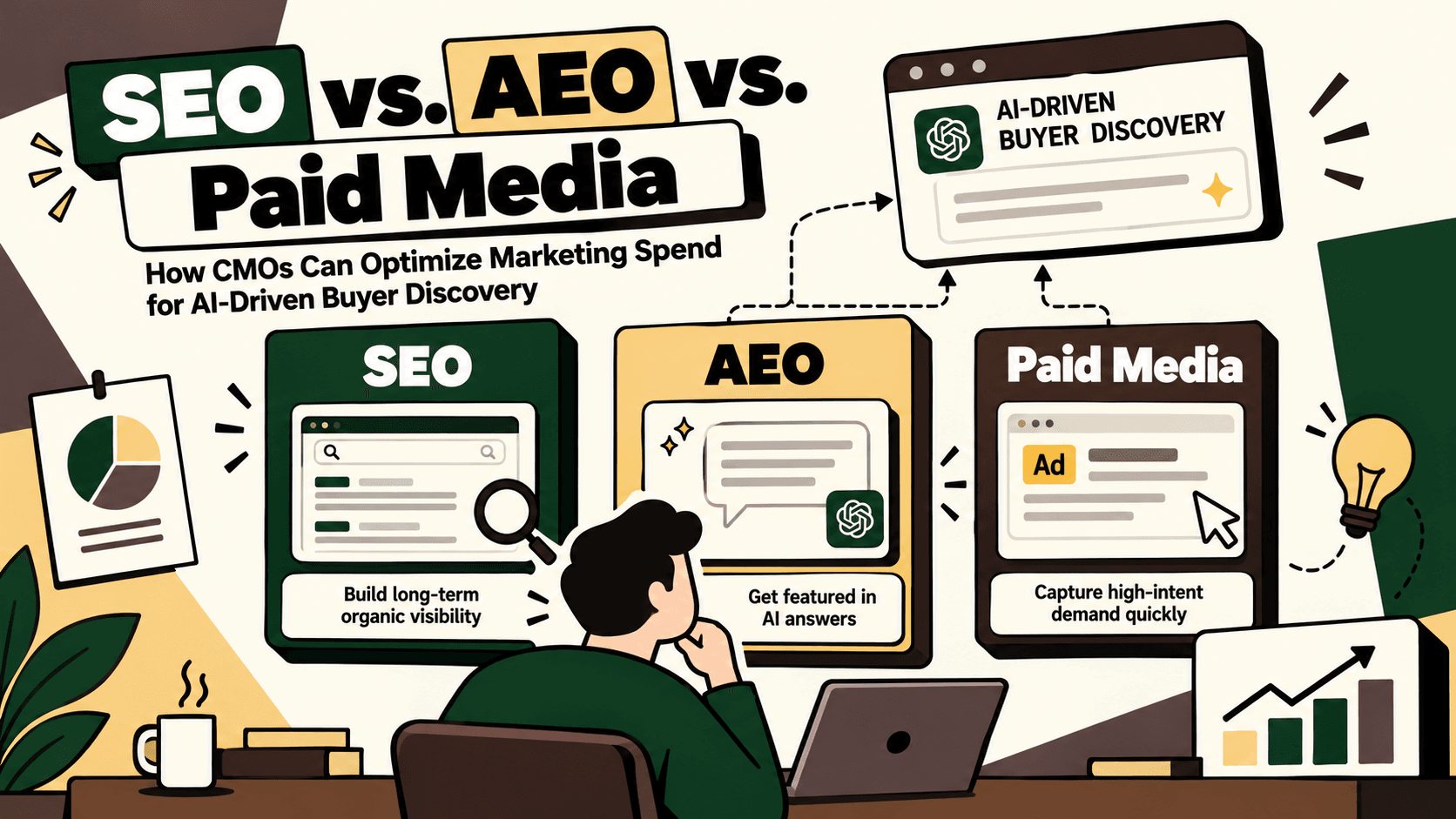
The central recommendation is to treat SEO, Answer Engine Optimization (AEO), and paid media as complementary investments within one measurable buyer-discovery system—not as three competing channels with interchangeable metrics.
SEO builds discoverability through search engines and useful website content. AEO improves the likelihood that a brand's information is understood, retrieved, cited, or used in answer-oriented experiences. Paid media provides controllable distribution, targeting, and opportunities to capture demand. The right mix depends on the business model, buying cycle, competitive intensity, current organic visibility, budget, and evidence of incremental business value.
This guide provides a practical framework for deciding where to invest, what to measure, how to test AI-search visibility, and how to connect marketing activity to qualified pipeline and revenue.
1. SEO vs. AEO vs. Paid Media: What CMOs Need to Understand
What is SEO?
Search Engine Optimization (SEO) is the practice of improving a website's technical accessibility, relevance, quality, and authority so that its pages can be discovered and ranked in organic search results.
SEO includes technical health, information architecture, internal linking, content quality, search-intent alignment, relevant references and links, and ongoing performance analysis. It can support informational discovery, commercial evaluation, and high-intent searches.
SEO is not simply a way to generate free traffic. It requires investment in research, content production, technical maintenance, subject-matter expertise, and measurement. Its economic advantage may emerge over time as useful pages continue to attract relevant demand, but rankings and traffic are never guaranteed.
What is AEO?
Answer Engine Optimization (AEO) is an approach to making a brand's information useful and accessible to systems that answer questions directly, including AI-powered search experiences and conversational assistants.
In practice, AEO can involve publishing clear answers to real buyer questions, explaining products and processes precisely, maintaining consistent company information, supporting claims with credible evidence, organizing content around relevant entities, and making important information accessible to search systems.
AEO is an emerging and inconsistently defined discipline. Some of its practices overlap with established SEO, content strategy, digital PR, and technical website quality. It should not automatically be treated as a separate platform or a guaranteed source of AI citations.
Google's official guidance states that established SEO best practices remain relevant to AI Overviews and AI Mode. Google does not require special AI-specific markup or a separate optimization technique to become eligible for these features. Eligibility also does not guarantee that a page will appear. See Google Search Central's guidance on AI features and websites.
What is paid media?
Paid media includes advertising placements purchased through channels such as search advertising, paid social, display, video, and other digital advertising platforms.
Paid media offers more direct control over campaign timing, audience selection, creative, budget, and testing than organic channels typically provide. It can help capture existing demand, test messages, reach new audiences, and support launches where waiting for organic visibility is impractical.
Paid media also introduces ongoing costs, auction competition, creative fatigue, platform dependency, and measurement challenges. A campaign can report conversions without proving that every conversion was incremental. Paid performance must therefore be assessed against margins, customer quality, conversion behavior, and the cost of generating additional business.
The practical difference
| Dimension | SEO | AEO | Paid media |
|---|---|---|---|
| Primary role | Improve organic search discoverability | Improve usefulness and visibility in answer-oriented discovery | Buy targeted reach and capture demand |
| Typical investment | Content, technical work, research, authority, maintenance | Answer-focused content, entity consistency, evidence, monitoring | Media spend, creative, targeting, testing, campaign operations |
| Time horizon | Often medium to long term | Variable and dependent on the platform and content | Campaign delivery can begin quickly |
| Control | Limited control over rankings and traffic | Limited control over inclusion, citation, and generated answers | Greater control over campaign settings, subject to platform rules and auctions |
| Useful indicators | Qualified organic visits, conversions, non-brand visibility, pipeline | Relevant answer visibility, citations, referral quality, assisted conversions | Incremental conversions, CAC, contribution margin, qualified pipeline |
| Main limitation | Competition, time to build visibility, algorithm changes | Limited measurement consistency and uncertain platform behavior | Recurring cost and potential attribution inflation |
These categories overlap. AEO work often improves content that also supports SEO, while paid search can reveal language and intent that inform organic content. The objective is to coordinate investment around buyer needs rather than force every activity into a separate budget silo.
2. How AI Is Changing Buyer Discovery
AI-driven discovery changes how buyers research complex questions, compare alternatives, and move between sources. Instead of issuing a sequence of short searches and opening multiple pages, a buyer may ask an AI system to explain a problem, compare vendors, summarize trade-offs, and recommend what to evaluate next.
These experiences can influence the information a buyer sees before visiting a vendor website. They can also create new opportunities for relevant sources to be surfaced through links and citations. However, AI discovery is not a single channel: Google AI Overviews, Google AI Mode, ChatGPT, Perplexity, and other experiences use different products, interfaces, and retrieval behaviors.
AI discovery affects the middle of the funnel as well as awareness
Early-stage questions often involve definitions, education, and problem diagnosis. Commercial research involves comparing approaches, vendors, features, implementation requirements, and costs. Transactional intent is closer to taking action, requesting a demo, or making a purchase.
These stages can require different investments. Educational content may support organic search and AI-answer visibility. Comparison pages and detailed implementation guides may help buyers evaluate alternatives. Paid media can capture high-intent demand and test offers or messages. A single campaign or content format should not be expected to serve every stage equally well.
A Semrush study published in July 2026 analyzed more than 600,000 keywords across 10 industries over six months. It reported a 71% increase in the presence of AI Overviews on commercial-intent search results pages during the study period, while the average share for transactional-intent results decreased by 5%. The study also reported that AI Overviews and Google Ads appeared together on the same results page roughly twice as often as a year earlier. These findings describe the study's keyword set and period; they should not be generalized to every market, industry, or search query. Read the Semrush commercial-search study.
The strategic implication is not that every brand should move its budget into AEO. It is that CMOs should inspect how discovery is changing in their own category, particularly for commercial comparison queries where buyers evaluate options before contacting sales.
Why zero-click behavior complicates reporting
Some buyers can receive useful information without clicking through to a website. A brand may be mentioned in an answer, influence a shortlist, or help a buyer understand a category without producing an immediately measurable session.
That creates a measurement gap, but it does not justify assigning a monetary value to every AI mention. A citation is an exposure signal, not proof of a qualified lead or incremental sale. The useful question is whether visibility in answer-oriented experiences is associated with meaningful downstream outcomes and whether the relationship can be tested with credible evidence.
3. Why CMOs Should Not Choose One Channel and Abandon the Others
SEO, AEO, and paid media solve different problems. SEO supports persistent organic discoverability. AEO focuses attention on how a brand's information can be surfaced and used in answer-driven experiences. Paid media can reach defined audiences, capture demand, and run controlled campaign experiments.
Choosing one channel as the universal winner ignores differences in customer acquisition cost, sales-cycle length, competitive conditions, buying intent, and the maturity of the existing marketing program.
When SEO should receive priority
- Your website has important technical or content gaps that prevent relevant pages from being discovered.
- Customers repeatedly search for problems, comparisons, and solutions that your organization can answer credibly.
- Organic traffic contributes qualified opportunities, conversions, or revenue that can be measured.
- You need to reduce dependence on recurring paid acquisition for established categories of demand.
- Your organization can invest in useful content and maintain it as products, customer questions, and search results change.
SEO should not be prioritized solely because organic clicks appear inexpensive. The total cost includes people, tools, content production, technical work, and the time needed to establish visibility. Evaluate qualified outcomes rather than traffic alone.
When AEO should receive priority
- Your buyers use conversational or answer-oriented systems to research vendors, products, or technical questions.
- Important category, comparison, or implementation questions are poorly answered by your existing content.
- Your brand's information is inconsistent across your website and credible third-party sources.
- Competitors appear in relevant AI-generated answers and you need to understand why.
- You can establish a repeatable process for measuring visibility, citation context, referral quality, and downstream influence.
AEO should not be prioritized because a vendor promises guaranteed citations or a proprietary AI ranking formula. Platforms can change their behavior, and no responsible optimization program can guarantee inclusion in every generated answer.
When paid media should receive priority
- You need to test a new offer, product, market, or positioning quickly.
- There is demonstrable high-intent demand that can be acquired at acceptable economics.
- Your sales team needs additional qualified pipeline within a defined period.
- You have a conversion path that works and can measure the cost and quality of resulting customers.
- You can use controlled experiments or credible comparison methods to assess incremental performance.
Paid media should not be scaled simply because the platform reports a low cost per lead. Low-quality leads, weak conversion to opportunity, discounting, churn, or poor contribution margin can erase the apparent efficiency.
4. Build a Budget Allocation Framework Around Business Outcomes
There is no universal percentage that every CMO should allocate to SEO, AEO, and paid media. A suitable mix depends on current channel performance, budget constraints, buyer behavior, time horizon, competitive intensity, and the cost of being wrong.
Instead of starting with fixed channel percentages, start with the business objective, the evidence available, and the role each channel needs to play.
Step 1: Define the outcome that matters
Choose a primary outcome such as qualified pipeline, new-customer contribution margin, customer acquisition cost, revenue growth, or expansion. Supporting metrics can explain performance, but the budget decision should have a clear commercial objective.
For a B2B company, this may mean qualified opportunities and pipeline value rather than raw lead volume. For a direct-to-consumer brand, it may mean incremental orders and contribution margin after advertising, discounts, returns, and fulfillment costs.
Step 2: Establish a baseline for each channel
Collect comparable data on cost, qualified traffic, conversions, lead or customer quality, revenue, and time to outcome. Separate brand search from non-brand search where possible, distinguish new customers from returning customers, and use consistent cohort periods.
For SEO and AEO, include the cost of content, technical work, measurement, and maintenance. For paid media, include media spend and relevant campaign operating costs. Use a consistent accounting boundary so the comparison does not make one channel appear cheaper simply because its costs are excluded.
Step 3: Classify the investment by role
| Investment role | Typical focus | Budget decision question |
|---|---|---|
| Demand capture | High-intent paid search, conversion pages, relevant organic pages | Can we acquire additional qualified demand at acceptable economics? |
| Demand education | Problem-led SEO content, category guides, comparison resources | Are we helping buyers understand the problem and evaluate options? |
| AI discovery readiness | Clear answers, credible evidence, consistent entities, technical accessibility | Can relevant answer systems understand and reference our information? |
| Experimentation | Paid message tests, landing-page tests, content pilots, AI visibility monitoring | Which uncertainty can we reduce with the next unit of spend? |
| Measurement infrastructure | Analytics, CRM integration, attribution, reporting, experimentation | Can we distinguish reported activity from actual incremental outcomes? |
Step 4: Allocate according to evidence and risk
Protect the minimum investment required to maintain essential technical SEO, accurate product information, conversion tracking, and measurement. Then allocate discretionary spend to the opportunities with the strongest combination of expected value, confidence, strategic importance, and manageable execution risk.
Where evidence is strong, scale carefully and monitor diminishing returns. Where uncertainty is high, fund a bounded test with a clear hypothesis and decision threshold. Where the business case is weak, do not continue spending simply because the channel is fashionable or has already received a large budget.
Illustrative budget scenario
Consider a hypothetical company that has a functioning paid-search program but weak organic comparison content and limited visibility monitoring in AI answer systems. Rather than moving a large share of paid spend into AEO immediately, it could retain campaigns that produce qualified pipeline, repair technical and content gaps, create a small set of high-value comparison resources, and establish a repeatable AI-visibility baseline.
After a defined pilot period, the team would compare changes in qualified conversions, paid efficiency, relevant organic visibility, AI citations, referral behavior, and opportunity progression. Budget changes would follow the evidence. This is an illustrative approach, not a recommendation for a fixed percentage or a claim of guaranteed improvement.
5. Measure SEO, AEO, and Paid Media Without Mixing Their Metrics
A common attribution mistake is to compare the most visible metric from each channel as if the metrics represent equivalent business outcomes. Organic sessions, AI citations, and paid clicks describe different events. They should not be added together or treated as direct substitutes for qualified pipeline and revenue.
SEO measurement
- Organic impressions and clicks by query intent and landing page.
- Non-brand visibility for relevant category, problem, and comparison searches.
- Qualified organic sessions, conversion rates, and lead or customer quality.
- Pipeline and revenue associated with organic acquisition under documented attribution rules.
- Content production and maintenance costs relative to qualified outcomes over time.
AEO measurement
- Visibility in a defined set of relevant buyer questions across selected AI systems.
- Whether the brand is cited, linked, described accurately, or omitted in the tested responses.
- Competitor presence and the context in which brands are mentioned.
- Referral sessions from identifiable AI platforms and the quality of those sessions.
- Assisted conversions, branded-search changes, and pipeline patterns where reliable data exists.
AI-answer monitoring requires a consistent methodology. Save the prompts or queries, platform, date, geography, device or account context where relevant, response, citations, and scoring rules. Repeated observations are important because responses can vary. Treat a manual sample as directional evidence, not a complete measure of market-wide visibility.
Also distinguish AI referral traffic from AI visibility. A system may mention a brand without producing a click, and a referral session may not represent a new customer. These signals answer different questions and should be reported separately.
Paid media measurement
- Spend, impressions, clicks, conversion rate, and cost per conversion.
- Qualified lead rate, opportunity creation, win rate, and sales-cycle progression.
- Customer acquisition cost and contribution margin where the data is available.
- Incremental conversions or revenue estimated through an appropriate test or comparison design.
- Frequency, creative fatigue, audience overlap, and diminishing marginal returns.
Use a shared commercial scorecard
| Measurement layer | Question answered | Example indicators |
|---|---|---|
| Visibility | Can the buyer discover us? | Search impressions, rankings, relevant AI citations, paid reach |
| Engagement | Does the buyer investigate further? | Qualified visits, content engagement, referral behavior, return visits |
| Conversion | Does the buyer take a meaningful next step? | Demo requests, qualified leads, trials, purchases |
| Revenue | Does the activity contribute to business outcomes? | Qualified pipeline, closed-won revenue, contribution margin |
| Efficiency | What does it cost to produce the outcome? | CAC, cost per qualified opportunity, payback period |
| Incrementality | Did the investment create additional outcomes? | Holdout lift, conversion lift, incremental contribution |
6. Understand Attribution Before Moving Budget
Attribution models distribute credit across marketing interactions. They help organize evidence about the buyer journey, but they do not automatically establish which activity caused the outcome.
First-touch attribution
First-touch attribution assigns credit to the first recorded interaction under the chosen tracking rules. It can help teams understand how buyers initially discover a brand, but it may overstate the importance of one entry point and miss later influences.
Last-touch attribution
Last-touch attribution credits the final recorded interaction before conversion. It is easy to interpret and can be useful for understanding the immediate path to conversion, but it may understate the role of earlier education, brand exposure, and comparison research.
Multi-touch attribution
Multi-touch models distribute credit across selected interactions using rules or model-based estimates. They can offer a broader journey view, but results depend on which touchpoints are observed, how credit is distributed, and whether offline or untracked interactions are missing.
Incrementality testing
Incrementality testing asks whether an investment produced outcomes that would not otherwise have happened. Depending on the channel and context, methods may include randomized holdouts, geographic experiments, controlled campaign tests, or other defensible causal designs.
Incrementality is particularly important when paid media may capture existing demand, branded search may receive credit for customers who already intended to buy, or an AI visibility initiative is being evaluated for commercial impact.
For AI-driven discovery, keep three questions separate: Was the brand visible? Did the visibility correlate with a customer action? Did the intervention create additional business outcomes? Each question requires different evidence.
7. A Practical 90-Day Plan for CMOs
A focused 90-day plan can help a marketing organization establish a baseline, test channel priorities, and improve its measurement process. The timeline is a planning framework rather than a guarantee; existing analytics quality, engineering capacity, and sales-cycle length will affect the work.
Days 1–30: Audit discovery and measurement
- Map the buyer journey. Identify the main questions buyers ask, the channels they use, and the points where they evaluate vendors or products.
- Audit current performance. Review SEO, paid media, referral, CRM, and conversion data. Separate branded from non-branded demand where possible.
- Establish a baseline. Record channel costs, qualified conversion rates, pipeline contribution, tracking coverage, and reporting limitations.
- Test AI discovery visibility. Build a representative set of buyer questions and record brand mentions, citations, competitor presence, and answer accuracy across selected systems.
- Agree on business definitions. Define qualified lead, qualified opportunity, sourced pipeline, influenced pipeline, new customer, and incremental outcome.
Expected output: a channel baseline, prioritized buyer-question set, measurement gaps, and a documented budget hypothesis.
Days 31–60: Run focused channel experiments
- Repair high-impact SEO issues. Address crawlability, indexing, internal linking, content gaps, and pages that support high-value buyer questions.
- Create answer-oriented resources. Publish or improve detailed comparison pages, implementation guides, FAQs, product explanations, and evidence-backed answers.
- Continue viable paid campaigns. Protect campaigns with defensible performance while testing messages, landing pages, audiences, or query segments.
- Instrument measurement. Connect analytics and CRM outcomes where feasible, preserve campaign parameters, and document limitations in identity and attribution.
- Set decision thresholds. Define what results would justify scaling, revising, or stopping each test before reviewing the outcomes.
Expected output: a small set of channel experiments with clear owners, comparable cost definitions, and measurable success criteria.
Days 61–90: Evaluate and reallocate
- Compare commercial outcomes. Evaluate qualified conversions, opportunity quality, customer economics, and available revenue evidence alongside visibility metrics.
- Assess AI visibility trends. Repeat the same question set and methodology. Distinguish changes in mentions or citations from changes in referrals and conversions.
- Review attribution assumptions. Compare first-touch, last-touch, and multi-touch results where useful, then identify decisions that require incrementality testing.
- Reallocate incrementally. Increase investment in validated opportunities, continue bounded experiments where uncertainty remains, and stop activities that fail agreed thresholds.
- Establish ongoing governance. Assign ownership for data quality, content maintenance, AI visibility monitoring, budget reviews, and reporting.
Expected output: a documented channel-mix decision, evidence gaps, a refreshed budget plan, and a repeatable measurement process.
8. Use AI to Improve Marketing Decisions, Not Just Produce More Content
AI can support marketing operations across research, analysis, content workflows, and reporting. Its usefulness depends on the quality of the inputs and whether the output changes a real decision.
Useful applications
- Buyer-question analysis: cluster search queries, sales-call notes, customer interviews, and support questions into recurring needs and objections.
- Content gap analysis: compare existing pages with the questions buyers need answered and prioritize missing evidence or explanations.
- Campaign analysis: summarize performance differences across segments and flag unusual changes for investigation.
- Creative testing: generate candidate messages or variations for controlled testing, with human review for brand, accuracy, and compliance.
- AI visibility monitoring: organize response samples, citation data, competitor mentions, and changes over time.
- Reporting assistance: explain changes in governed metrics and prepare draft summaries linked to source data.
What should not be fully automated?
Do not allow AI to invent customer evidence, publish unverified product claims, make unsupported budget decisions, or treat a generated citation as proof of commercial impact. Human review should remain part of decisions involving financial commitments, regulated claims, customer data, or significant brand risk.
AI-generated content should add original value rather than multiply pages with little substance. Google's guidance on generative AI content and Search policies warns that producing many pages without added value can fall under scaled content abuse. Use AI to improve research and workflow efficiency, while retaining expert judgment, evidence, and editorial accountability.
9. Common Budget Allocation Mistakes
- Moving spend based on hype: a new AI-search trend is not enough evidence to abandon a channel that delivers profitable incremental outcomes.
- Comparing incompatible metrics: clicks, citations, leads, pipeline, and revenue are different measures and should not be treated as equivalent.
- Counting attributed revenue as incremental revenue: a platform's credit model does not prove the investment created the sale.
- Ignoring full channel costs: organic content and AEO require research, people, tools, technical work, and maintenance.
- Expecting immediate SEO or AEO returns: discovery and citation behavior can change unpredictably, and commercial impact may take time to observe.
- Overlooking sales-cycle maturity: recent campaigns may not have had enough time to generate opportunities, closed revenue, or renewals.
- Relying on one AI prompt: generated answers can vary by query, platform, time, and context; monitoring needs a repeatable method.
- Ignoring measurement quality: inconsistent campaign tags, missing CRM fields, duplicate leads, and broken conversion events can make budget comparisons unreliable.
- Automating without ownership: dashboards and AI summaries do not create value unless a person or team owns the resulting decision and follow-up.
10. Where Five Anchor Fits: Connecting Discovery to Operational Intelligence
For ecommerce and D2C businesses, marketing efficiency depends on more than acquisition-channel performance. A campaign can generate demand while stock availability, order processing, delivery, returns, or customer support issues weaken the final commercial result.
Five Anchor's positioning is AI Infrastructure for D2C and E-Commerce. Its relevant services include E-Commerce Intelligence, Commerce Infrastructure, and AI-Powered Customer Operations. For a brand evaluating SEO, AEO, and paid media, the most relevant connection is the ability to bring marketing and operational data into a more dependable view of business performance.
A practical implementation could connect campaign and analytics data with order, SKU, inventory, margin, marketplace, and customer-operation information where the necessary integrations and data permissions exist. This helps teams investigate whether acquisition activity is associated with profitable orders, whether stock constraints affect campaign outcomes, and whether returns or support issues change the economics of a customer cohort.
The implementation should begin with workflow mapping, baseline metrics, data-source validation, and a clearly defined business question. Integrations and dashboards should be built around that question, with reconciliation checks, access controls, and human approval for consequential budget changes.
The intended outcome is more informed marketing decisions that account for the economics of the full customer journey rather than optimizing clicks or leads in isolation. Five Anchor is relevant when this requires practical integration between ecommerce operations and business intelligence—not as a substitute for sound attribution design or proof of incremental advertising impact.
11. The CMO's Marketing Spend Decision Framework
Before approving a budget shift, use the following checklist to test whether the recommendation is supported by evidence.
- Business outcome: Is the investment tied to a specific goal such as qualified pipeline, incremental orders, contribution margin, or new-customer growth?
- Buyer behavior: Is there evidence that the target audience uses the channel or discovery experience for the relevant question or purchase stage?
- Measurement readiness: Are tracking, identity, conversion definitions, and CRM or commerce outcomes reliable enough to evaluate the test?
- Cost completeness: Does the comparison include media spend, production, tools, people, maintenance, and relevant operating costs?
- Time horizon: Is the evaluation period appropriate for the channel's role and the business's sales cycle?
- Incrementality: Can the team distinguish channel credit from additional outcomes created by the investment?
- Execution risk: Are technical dependencies, content quality, privacy, platform changes, and human review accounted for?
- Decision rule: What evidence will trigger scaling, further testing, revision, or stopping?
A useful prioritization model for comparing initiatives is: priority score = volume × frequency × manual effort × error cost × revenue impact ÷ implementation complexity. This is a practical framework, not an industry-standard marketing allocation formula. Use consistent scoring scales and adapt the factors to the decision being made.
Conclusion: Optimize for Profitable Discovery, Not Channel Labels
SEO, AEO, and paid media should not be treated as mutually exclusive strategies. SEO supports durable organic discoverability, AEO focuses on making brand information useful in answer-oriented discovery, and paid media provides controlled opportunities to reach and convert audiences. Their relative importance changes with buyer behavior, competition, business maturity, and the quality of available evidence.
For CMOs, the priority is to establish a shared measurement system that connects discovery to qualified engagement, pipeline, customer acquisition economics, and revenue. AI visibility is worth monitoring, but citations and mentions should remain distinct from referral traffic and incremental business outcomes.
Start with a clear commercial objective, audit the data, run bounded experiments, and reallocate investment based on the strongest available evidence. Where causality matters, use suitable tests rather than relying solely on attribution models. Where AI is used for research or analysis, retain human oversight and traceable sources.
The best marketing mix is not the one that invests most heavily in the newest channel. It is the mix that reaches the right buyers, supports informed decisions, and produces measurable business value within the organization's financial and operational constraints.
Key Takeaways
- •SEO, AEO, and paid media serve different but overlapping roles in buyer discovery and should be evaluated within one commercial measurement framework.
- •AEO is an emerging discipline with substantial overlap with established SEO, content quality, technical accessibility, and digital authority practices.
- •Google's official guidance says foundational SEO best practices remain relevant to AI Overviews and AI Mode; special AI-only optimization is not required for eligibility.
- •AI visibility, citations, referral sessions, attributed conversions, and incremental revenue are distinct measurements and should not be treated as interchangeable.
- •Budget allocation should reflect business objectives, complete channel costs, buyer intent, measurement quality, time horizon, and evidence of incremental outcomes.
- •A focused 90-day plan can establish a baseline, run SEO/AEO/paid experiments, and create a repeatable process for reallocating marketing spend.
- •For ecommerce and D2C businesses, marketing outcomes should be interpreted alongside inventory, margin, order, return, and customer-operation data where available.
SEO vs. AEO vs. Paid Media
| Decision factor | SEO and AEO | Paid media |
|---|---|---|
| Inventory Sync Frequency | 15–30 min batch polling (high oversell risk) | Sub-second atomic locking (<450ms) |
| Concurrent Drop Resilience | Fails under concurrency; causes negative stock balance | Redis atomic reservation queue guarantees exact counts |
| Error Handling & Retries | Silent failure; manual CSV audit needed | Dead-letter queues with automated exponential retry |
| Fulfillment Routing Speed | 2–4 hours delayed batch export to 3PL warehouse | Instantaneous automated webhook dispatch (<90 sec) |