Introduction: GTM Attribution Is a Data Architecture Problem Before It Is an AI Problem
For B2B companies with complex go-to-market (GTM) operations, the challenge is rarely a complete lack of data. Marketing has campaign engagement and acquisition costs. Sales has contacts, opportunities, pipeline stages, and deal outcomes. Customer success has product adoption, onboarding activity, support history, renewals, expansion, and churn signals. The problem is that these records frequently live in disconnected systems, use inconsistent identifiers, and measure different stages of the customer lifecycle.
When these systems cannot reliably connect an account's acquisition journey to its eventual revenue and retention outcomes, attribution becomes incomplete. Marketing may report leads and campaign conversions, sales may report closed-won revenue, and customer success may report renewal performance without a shared way to understand how those outcomes relate.
The solution is to build a unified GTM data layer that connects customer interactions to pipeline, closed-won revenue, retention, and expansion, then use AI to interpret the resulting relationships. AI can improve analysis, surface patterns, support forecasting, and help teams investigate performance. It cannot compensate for missing campaign history, duplicate accounts, inconsistent revenue definitions, or unreliable source data.
This guide explains how to connect CRM, marketing, and customer success data; establish a dependable identity and measurement model; apply AI to attribution; and implement the architecture in manageable stages.
1. Why GTM Attribution Breaks Down
Marketing data measures engagement, not the entire revenue journey
Marketing platforms capture impressions, clicks, website sessions, email engagement, form submissions, campaign membership, and lead generation. These records are useful for understanding acquisition activity, but they do not automatically show whether an engaged contact became part of a buying committee, influenced an opportunity, purchased, renewed, or expanded an account.
Tracking can also be fragmented by consent settings, browser restrictions, device changes, offline interactions, and inconsistent campaign tagging. A report that credits a channel based on available digital events may not represent every meaningful customer interaction.
CRM data does not always preserve the full customer history
CRM systems commonly contain leads, contacts, accounts, opportunities, sales activities, and deal outcomes. However, source fields may be overwritten, campaign membership may be incomplete, contact records may be duplicated, and several contacts may be associated with one opportunity without a consistent buying-group model.
First-touch source, lead-creation source, opportunity source, and influenced pipeline are different measurements. Treating them as interchangeable can lead to conflicting reports and double-counted revenue.
Customer success data starts after the sale in a separate system
Customer success platforms, product analytics, support systems, and billing tools may record onboarding completion, product usage, feature adoption, support incidents, renewal dates, contract changes, and churn risk. Without account-level relationships connecting those events to the original opportunity and acquisition history, teams cannot reliably compare channels by downstream customer quality.
A campaign that generates many leads may look attractive before the company evaluates conversion, retention, and expansion. Another campaign may generate fewer leads but attract accounts with stronger long-term economics. The data model must make that distinction measurable rather than assume one channel is superior.
The questions a unified GTM model should answer
- Which channels and campaigns generate qualified pipeline and closed-won revenue?
- Which interactions occur before opportunities are created or progress through the sales cycle?
- Which acquisition sources correlate with stronger retention, expansion, and customer lifetime value?
- How do marketing-sourced pipeline and marketing-influenced pipeline differ?
- What are customer acquisition cost, payback period, and revenue outcomes by channel?
- Which product adoption, onboarding, or customer success signals are associated with renewal or churn?
- How much of reported pipeline and revenue can be connected to trustworthy journey data?
These questions require more than another dashboard. They require connected records, consistent definitions, lifecycle coverage, and transparent measurement rules.
2. What a Unified GTM Data Architecture Looks Like
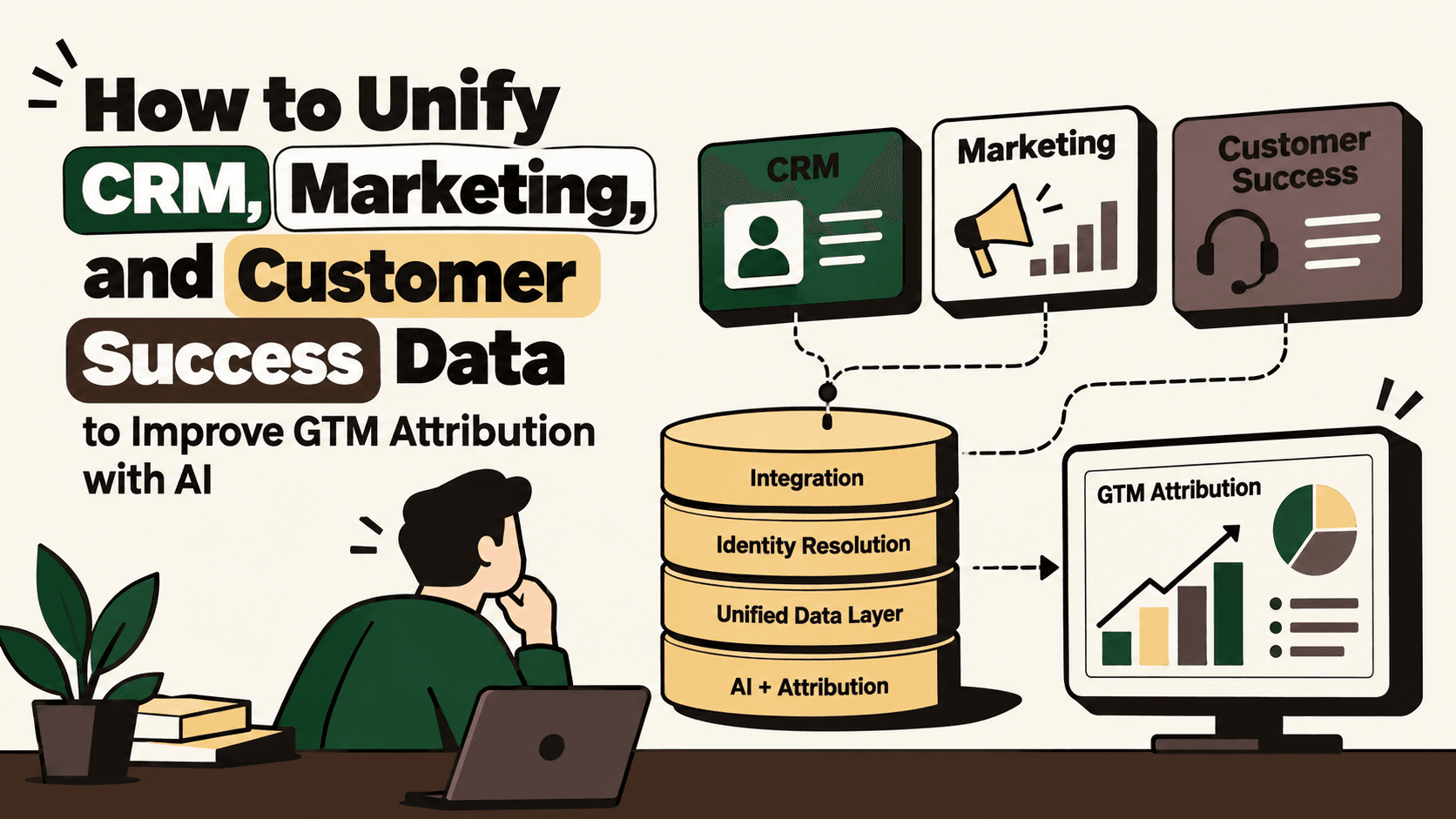
A unified GTM data architecture connects source systems to a governed data layer where customer identities, accounts, campaigns, opportunities, product events, contracts, and revenue can be related consistently. Attribution and AI models operate on that layer, while approved insights are delivered back to the tools used by marketing, sales, finance, and customer success.
The architecture is conceptual rather than tied to one vendor. A company may use a cloud data warehouse, a customer data platform (CDP), a revenue intelligence platform, or a combination. The right design depends on its existing stack, event volume, governance requirements, latency needs, and analytical maturity.
The five architectural layers
- Data ingestion and integration: Collect records and events from CRM, marketing automation, advertising platforms, sales engagement tools, product analytics, billing, support, and customer success systems through APIs, webhooks, managed connectors, or controlled data exports.
- Identity resolution: Match leads, contacts, accounts, and product users using stable identifiers and explicit matching rules. Preserve source-system IDs and flag uncertain matches instead of forcing every record into a single identity.
- Centralized data model: Standardize campaigns, touchpoints, accounts, opportunities, revenue, contracts, renewals, and expansion into documented entities with consistent definitions and relationships.
- Attribution and AI analytics: Apply transparent attribution rules, descriptive analysis, predictive models, and appropriate incrementality methods to answer different business questions.
- Activation and feedback: Deliver governed insights to CRM, marketing planning, sales prioritization, customer success workflows, and executive reporting. Record outcomes so recommendations can be evaluated.
Salesforce documents identity resolution and unified customer profiles in its identity resolution guidance and explains how organizations can unify sales data. These are useful references for understanding the identity and data-modeling problems, even when an organization uses a different technology stack.
Which systems should contribute data?
| System category | Typical data | Why it matters |
|---|---|---|
| CRM | Leads, contacts, accounts, opportunities, sales activities, deal stages | Connects engagement to pipeline and sales outcomes |
| Marketing automation | Campaigns, email engagement, forms, lead scoring, campaign membership | Records marketing interactions and campaign context |
| Advertising and web analytics | Spend, impressions, clicks, sessions, landing-page events, conversion events | Supports channel cost and digital journey analysis |
| Sales engagement | Emails, calls, meetings, sequences, rep activity | Adds sales touchpoints to the opportunity journey |
| Product analytics | Activation, feature usage, active users, product events | Connects customer behavior to adoption and potential expansion |
| Customer success and support | Onboarding, health indicators, tickets, escalations, renewal risks | Supports lifecycle analysis beyond acquisition |
| Billing and finance | Contracts, invoices, recognized revenue, renewals, credits, expansion | Provides financial outcomes and reconciled revenue definitions |
Not every source needs to be integrated on day one. Start with the systems required to connect campaign history, account and opportunity records, closed-won outcomes, and renewal or expansion data. Add further sources when they improve a defined decision.
3. Identity Resolution: The Foundation of GTM Attribution
Identity resolution is the process of determining which records across systems refer to the same person, account, or organization. It is essential because a marketing contact, CRM lead, product user, billing contact, and customer success record may represent the same person but have different internal IDs.
Use deterministic matching before probabilistic matching
Start with identifiers that provide strong evidence of a match, such as a shared CRM contact ID, account ID, authenticated product-user ID, or verified system-to-system mapping. Normalized email addresses and account domains can provide additional evidence, but neither should be treated as universally unique. People change email addresses, organizations share domains, subsidiaries use different domains, and one person may use multiple addresses.
Where deterministic matching is insufficient, a probabilistic or AI-assisted matching process may rank possible matches using approved attributes. Low-confidence matches should be reviewed or left unresolved. A false merge can be more damaging than an unmatched record because it can attribute one company's revenue or behavior to another.
Maintain a canonical identity model
A practical model separates the real-world entity from the records held by individual systems. For example, one canonical account can link to several CRM account IDs, multiple contacts, product users, opportunities, subscriptions, and customer success records. Preserve the original identifiers so a data issue can be traced back to its source.
Useful canonical entities include person, account, account-person relationship, campaign, touchpoint, opportunity, opportunity-contact role, product event, contract, invoice, renewal, and expansion event. Define relationships explicitly, including whether a touchpoint belongs to an individual, an account, an opportunity, or more than one of these.
Preserve buying-group and account context
B2B purchases are rarely the result of one isolated contact. A buying committee may include a technical evaluator, business sponsor, finance stakeholder, and end user. Attribution should preserve relevant person-level activity while linking it to the appropriate account and opportunity under documented rules.
Do not assume that every interaction from an employee of an account influenced a particular deal. Use time windows, campaign membership, relationship records, and qualifying engagement criteria to determine which interactions are eligible for a given analysis.
Salesforce's documentation on identity resolution rulesets provides a further reference for configuring matching behavior. The implementation principle is broader than any one platform: matching logic must be explicit, testable, monitored, and reversible.
4. Build a Shared GTM Data Model and Metric Dictionary
Connecting systems is not enough if every team defines the same business term differently. Marketing may count an opportunity when a campaign member is associated with it; sales may count only opportunities created under a specific source rule; finance may report recognized revenue rather than contract value. Each definition can be useful, but combining them without clarification creates misleading comparisons.
Define the core entities and event history
Keep important business entities separate and connect them with stable keys. Campaigns, touchpoints, contacts, accounts, opportunities, contracts, invoices, renewals, and product events have different lifecycles. Avoid flattening the entire journey into one row per contact or account, which can multiply revenue when multiple contacts or touchpoints are joined to one opportunity.
Store event timestamps, source-system identifiers, ingestion timestamps, and relevant status changes. Preserve history when attribution fields or opportunity stages change. If only the current value is retained, it may be impossible to reconstruct what was known when a deal was created or when a campaign ran.
Document metric definitions centrally
| Metric | Definition to document | Common implementation risk |
|---|---|---|
| Marketing-sourced pipeline | Rules defining when marketing is considered the originating source of an opportunity | Changing source fields or inconsistent eligibility rules |
| Marketing-influenced pipeline | Qualifying engagement rules, attribution window, and opportunity association logic | Counting the same opportunity multiple times across campaigns |
| Customer acquisition cost | Included acquisition expenses, customer or account denominator, and measurement period | Mixing incompatible cost scopes or customer cohorts |
| Pipeline conversion rate | Eligible starting population, stage definitions, and observation window | Comparing cohorts with different maturity |
| CAC payback period | Acquisition cost and the margin or revenue basis used to recover it | Using inconsistent revenue or gross-margin assumptions |
| Customer lifetime value | Observed or modeled value, time horizon, retention assumptions, and cost basis | Presenting forecasts as realized revenue |
| Net revenue retention | Starting recurring revenue, expansion, contraction, churn, and period boundaries | Mixing new-customer revenue into an existing-customer measure |
| Attribution coverage | Share of eligible opportunities or revenue linked to usable journey data | Reporting coverage without disclosing unresolved records |
For every metric, record its owner, formula, source tables, refresh cadence, exclusions, and known limitations. Finance should validate revenue and cost definitions; marketing and sales should agree on sourcing and influence rules; customer success should validate renewal, expansion, and churn definitions.
5. How AI Improves GTM Attribution
AI can make a unified GTM data layer more useful by helping teams investigate patterns, estimate outcomes, and prioritize decisions. Its role should be matched to the question being asked rather than treated as one universal attribution model.
| AI capability | Business application | Important limitation |
|---|---|---|
| Multi-touch analysis | Compare first-touch, lead-creation, opportunity-creation, and full-journey credit models | Credit allocation depends on the chosen model and eligible touchpoints |
| Predictive modeling | Estimate conversion likelihood, expected deal value, or account risk | Predictions reflect the quality and representativeness of historical data |
| Incrementality analysis | Estimate whether a campaign caused additional outcomes beyond what would otherwise have occurred | Requires a suitable experimental or causal design and valid assumptions |
| Revenue forecasting | Combine pipeline, historical conversion, deal velocity, and customer signals | Forecasts can drift when markets, products, or sales processes change |
| Churn and expansion prediction | Identify accounts that may need intervention or may be ready to expand | Risk scores do not prove why a customer will churn or grow |
| Natural-language analytics | Allow users to ask questions about channels, pipeline, and customer value | Answers must use governed definitions and traceable data |
Separate attribution from prediction and causality
Attribution assigns credit to interactions according to a defined model. Prediction estimates what may happen next. Incrementality analysis estimates whether an intervention changed outcomes compared with a credible alternative. These are related but distinct tasks.
A predictive model may discover that accounts engaging with a particular campaign convert at a higher rate. That relationship does not prove the campaign caused the difference. The campaign may have reached accounts that were already more likely to buy. Where the business question concerns incremental impact, use suitable experiments, holdout groups, or defensible causal methods where feasible.
Salesforce explains available approaches in its documentation on multi-touch attribution and supported attribution models. For a broader measurement perspective, consult Microsoft's incrementality guidance. These resources help distinguish model-based credit allocation from the separate question of whether an activity produced additional results.
Use AI to explain patterns, not invent evidence
A useful AI analysis should state which data and time period it used, what definition of sourced or influenced revenue applies, which records were excluded, and how confident the conclusion is. It should distinguish observed values from predictions and show the supporting records or calculations wherever practical.
Generative AI can summarize a performance change, compare segments, or help investigate why a channel's reported conversion shifted. It should not silently invent missing touchpoints, infer unobserved campaign exposure, or turn correlation into a causal claim. For consequential budget changes, retain human review and use a measurement method appropriate to the decision.
6. Attribute the Full Customer Lifecycle
For B2B organizations, a useful GTM measurement model extends beyond lead generation. It connects acquisition and pipeline to initial revenue, product adoption, retention, and expansion. This broader view helps teams assess customer quality alongside acquisition volume.
- Acquisition: Capture campaign, channel, source, cost, relevant touchpoints, consent status, and event timestamps.
- Pipeline creation: Connect eligible contacts and buying-group members to the account and opportunity, including opportunity creation date, amount, stage history, and source definition.
- Revenue conversion: Connect closed-won opportunities to contracts, invoices, and the agreed revenue basis. Reconcile CRM deal values with finance data instead of assuming they are equivalent.
- Onboarding and adoption: Connect onboarding milestones, product activation, usage, and support signals to the customer account and subscription.
- Retention and expansion: Track renewal, contraction, churn, upsell, and cross-sell events against the same account identity and defined reporting period.
Lifecycle attribution should not imply that every customer success action can be assigned a precise causal share of renewal revenue. It should make the sequence of events visible, identify associations worth investigating, and support controlled tests of interventions where practical.
Illustrative scenario: comparing acquisition quality
Consider a hypothetical B2B company comparing two acquisition channels. Channel A generates more leads, while Channel B generates fewer leads but appears to attract accounts with stronger product adoption and renewal rates. A lead-only dashboard could favor Channel A. A unified data model allows the company to compare qualified pipeline, customer acquisition cost, realized revenue, retention, and expansion across comparable cohorts.
This scenario is illustrative, not a reported company result. Before shifting budget, the company should check whether cohort sizes and maturity are comparable, whether acquisition costs are complete, and whether differences remain after accounting for customer segment, contract size, sales cycle, and other relevant factors. If the decision depends on incremental impact, it should test that question directly rather than rely solely on attributed revenue.
7. Implement the Unified GTM Data Layer in 90 Days
A practical implementation starts with one clearly defined business question and expands only after the data and measurement model are reliable. The schedule below is a planning framework, not a guarantee that every organization can complete all work within the same period. Existing data quality, security requirements, integration complexity, and team capacity will affect delivery.
Days 1–30: Audit and standardize
- Map the current journey. Document how campaign interactions, leads, contacts, accounts, opportunities, contracts, renewals, and customer success events move through the existing systems.
- Inventory the sources. Record each system's owner, key identifiers, available history, update frequency, API or export options, permissions, and known gaps.
- Establish baseline metrics. Measure current attribution coverage, duplicate rates, missing source fields, reconciliation differences, reporting latency, and time spent preparing GTM reports.
- Agree on definitions. Define sourced pipeline, influenced pipeline, closed-won revenue, CAC, retention, expansion, and the reporting periods each metric uses.
- Choose a pilot question. Select a high-value question such as which acquisition cohorts produce the strongest qualified pipeline and early retention outcomes.
Expected output: a source inventory, documented metric dictionary, data-quality baseline, and prioritized implementation scope.
Days 31–60: Connect and validate
- Integrate priority sources. Ingest the CRM, campaign and marketing data, opportunity outcomes, and the minimum finance or customer success data needed for the pilot.
- Implement identity rules. Define deterministic matching first, maintain source identifiers, and create a review path for ambiguous records.
- Build canonical entities. Model accounts, contacts, campaigns, touchpoints, opportunities, revenue events, and relevant lifecycle outcomes with explicit relationships.
- Preserve history. Retain event timestamps, source-system references, and relevant changes so that historical journeys can be reconstructed.
- Validate the joins. Check duplicate records, one-to-many relationships, missing identifiers, time-zone handling, late-arriving events, and possible revenue multiplication in joins.
- Reconcile outputs. Compare pipeline and revenue totals with the systems of record. Investigate differences before presenting the model as a trusted source of truth.
Expected output: a validated initial GTM data layer with documented identity rules, reproducible transformations, and visible data-quality exceptions.
Days 61–90: Add attribution, AI, and activation
- Implement transparent baseline models. Start with clearly defined first-touch, lead-creation, opportunity-creation, or other appropriate rules before introducing more complex models.
- Compare model outputs. Explain how different models distribute credit and why those differences matter. Do not choose a model only because it favors a preferred channel.
- Add a focused AI use case. Consider natural-language analysis over governed metrics, account-level risk summaries, or prediction of a clearly defined outcome when suitable historical data exists.
- Keep recommendations traceable. Show the relevant time period, metric definition, underlying data, uncertainty, and exclusions for each AI-generated insight.
- Activate carefully. Send approved findings to dashboards or workflows. Require review before material budget reallocations or consequential customer actions.
- Measure the pilot. Compare reporting effort, attribution coverage, reconciliation differences, decision latency, and the usefulness of recommendations against the original baseline.
Expected output: a working attribution pilot, a documented comparison of model behavior, and an evidence-based decision about whether to expand the architecture.
8. Prioritize AI Use Cases by Business Value and Risk
Not every GTM task should be automated with AI. Deterministic rules are generally better for repeatable calculations and policy-based transformations. AI is useful where unstructured information, complex pattern recognition, or natural-language investigation adds value. Human approval remains important when recommendations materially affect budgets, customer treatment, or financial reporting.
| Use case | Preferred approach | Approval and guardrails | Success metric |
|---|---|---|---|
| Campaign tagging validation | Rules-based validation with exception classification | Review exceptions and prevent silent overwrites | Completeness of campaign fields |
| Duplicate identity candidates | Deterministic matching with AI-assisted candidate ranking where needed | Review uncertain matches; retain source IDs | False-match rate and unresolved records |
| Attribution reporting | Governed SQL or metric definitions; AI for explanation | Reconcile to source systems and show model assumptions | Reconciliation accuracy and reporting time |
| Account risk summaries | Rules and predictive models using approved customer signals | Human review before consequential outreach or account decisions | Risk-review usefulness and validated prediction quality |
| Budget recommendations | Scenario analysis, causal evidence where available, and AI-assisted interpretation | Human approval; monitor changes and holdout results | Incremental outcomes and acquisition economics |
| Natural-language analytics | AI grounded in a governed semantic or metric layer | Restrict access, expose definitions, and log queries | Answer accuracy and analyst time saved |
A practical prioritization model
Use the following framework to compare candidate automations:
Priority score = volume × frequency × manual effort × error cost × revenue impact ÷ implementation complexity.
This is a practical prioritization framework, not an industry-standard formula. Define consistent scoring scales before comparing workflows. It helps teams favor recurring problems with meaningful business impact while considering integration effort and operational risk.
9. Governance, Security, and Data Quality
A unified GTM data layer concentrates information about people, companies, commercial relationships, product usage, and revenue. Access controls, retention policies, consent handling, and auditability must be designed alongside the integrations rather than added after the AI workflow is deployed.
Control data access
- Apply role-based access to sensitive contact, account, contract, and revenue fields.
- Respect applicable consent, communication preferences, and data-use restrictions when activating customer information.
- Minimize the data sent to external AI services and assess vendor retention, training, residency, and security terms before use.
- Log data transformations, identity merges, metric changes, model versions, and material recommendations.
- Define retention and deletion processes that account for source systems and derived datasets.
Design for failure and change
APIs can fail, events can arrive late, campaign identifiers can change, and CRM records can be merged or deleted. Build retry handling, idempotent ingestion, validation checks, schema-change alerts, and reconciliation reports. A repeated event should not silently duplicate spend, touchpoints, or revenue.
Monitor identity-match quality, source freshness, null rates, duplicate rates, event lag, join cardinality, and reconciliation differences. When a source changes its schema or business process, the system should expose the impact instead of silently producing a plausible but incorrect dashboard.
Keep AI outputs explainable and reviewable
AI-generated analysis should include the metric definition, data window, relevant segments, supporting records, and uncertainty. Establish thresholds for when a recommendation is advisory, requires approval, or must not be executed automatically. Revalidate models when markets, sales processes, product packaging, or customer behavior changes.
10. Common GTM Attribution Mistakes
- Using AI before fixing identity: disconnected or duplicate accounts produce unreliable model inputs.
- Confusing influence with causality: a touchpoint receiving attribution credit does not prove it created incremental revenue.
- Double-counting pipeline: joining several contacts or campaigns to one opportunity can multiply the opportunity value if aggregation rules are missing.
- Overwriting source history: retaining only current CRM fields can destroy evidence of earlier acquisition and sales interactions.
- Comparing immature cohorts: recent campaigns may not have had enough time to produce closed-won revenue, renewals, or expansion.
- Ignoring finance reconciliation: CRM opportunity amount, contract value, bookings, and recognized revenue are different concepts.
- Automating every decision: AI should not make consequential budget or customer decisions without suitable evidence, permissions, and review.
- Building a dashboard without activation: insight has limited value if no team owns the decision, workflow, and feedback loop.
11. How Five Anchor Approaches AI and Data Integration
The same architectural principle applies across operational businesses: AI becomes more useful when the systems it depends on share consistent data, clear permissions, and reliable workflows. For organizations whose GTM data spans CRM, marketing automation, product analytics, billing, and customer success tools, the first requirement is a dependable integration and governance layer.
Five Anchor's relevance is its focus on AI infrastructure, system integration, automation, and operational intelligence. For a GTM attribution initiative, an implementation could begin by mapping the source systems, identifying key entities and data owners, documenting metric definitions, and connecting the systems required for the first use case.
The implementation can then add identity-resolution rules, validated data transformations, a governed analytics layer, and AI-assisted analysis with traceable outputs and human approval. The business outcome to measure is not simply the presence of an AI model. It is whether the organization can produce more reliable revenue analysis, reduce manual reconciliation, improve the speed of decision-making, and connect acquisition activity to lifecycle outcomes with greater confidence.
Five Anchor should be considered where the work requires practical integration and automation across systems, rather than as a substitute for the organization's finance-approved metric definitions or a properly designed causal measurement method.
12. Measure Whether the Architecture Is Working
Set a baseline before the pilot and measure changes using the same definitions and observation windows. A useful scorecard includes:
- Attribution coverage: the share of eligible opportunities and revenue connected to usable campaign or journey data.
- Identity quality: duplicate rates, unresolved records, and the rate of incorrect identity matches found in review.
- Reconciliation quality: differences between the analytical layer and CRM, billing, or finance source totals.
- Data freshness: the time between a source event and its availability for analysis.
- Reporting effort: analyst and operations time required to prepare recurring GTM reports.
- Decision latency: the time required to answer a defined revenue or campaign-performance question.
- Predictive quality: performance against an appropriate baseline on a held-out or later time period.
- Business outcomes: qualified pipeline, acquisition economics, conversion, retention, and expansion, interpreted with suitable controls for other influences.
Do not claim that the data platform or AI caused a revenue improvement simply because performance changed after launch. Other changes in pricing, sales capacity, campaign mix, product fit, or market conditions may explain the difference. Use controlled tests where feasible and treat observational comparisons as evidence with limitations.
Conclusion: Unify First, Measure Second, Apply AI Third
Improving GTM attribution requires more than connecting dashboards or adding an AI assistant to existing reports. The organization must first connect its customer and account records, preserve journey history, standardize definitions, and reconcile pipeline and revenue with the appropriate systems of record.
Once that foundation is dependable, attribution models can provide transparent views of touchpoint credit, predictive models can help estimate future outcomes, and incrementality methods can investigate whether campaigns actually change results. Customer success data extends the analysis beyond acquisition to adoption, retention, churn, and expansion.
The most effective starting point is a focused use case with a measurable baseline, clear data ownership, explicit matching rules, and a defined approval process. Prove that the data is trustworthy and the workflow is useful before expanding to more systems or more autonomous AI.
For teams planning this work, the next step is to map the current GTM data journey, identify the largest gaps between marketing, CRM, and customer success, and choose one attribution question to validate end to end.
Key Takeaways
- •GTM attribution breaks when marketing, CRM, finance, product, and customer success records cannot be connected consistently.
- •Identity resolution should use explicit matching rules, preserve source identifiers, and flag uncertain matches instead of forcing them.
- •A shared metric dictionary must distinguish marketing-sourced pipeline, marketing-influenced pipeline, bookings, recognized revenue, retention, and expansion.
- •AI can support multi-touch analysis, prediction, forecasting, and natural-language analytics, but predictive relationships do not automatically prove causality.
- •A practical 90-day pilot should audit data, integrate priority sources, validate identity and revenue joins, test attribution models, and measure against a baseline.
- •Security, access controls, event history, data-quality monitoring, and human review are essential parts of a production-ready GTM data architecture.
GTM Attribution Approaches Compared
| Dimension | Disconnected Reporting | Unified GTM Data Layer |
|---|---|---|
| Inventory Sync Frequency | 15–30 min batch polling (high oversell risk) | Sub-second atomic locking (<450ms) |
| Concurrent Drop Resilience | Fails under concurrency; causes negative stock balance | Redis atomic reservation queue guarantees exact counts |
| Error Handling & Retries | Silent failure; manual CSV audit needed | Dead-letter queues with automated exponential retry |
| Fulfillment Routing Speed | 2–4 hours delayed batch export to 3PL warehouse | Instantaneous automated webhook dispatch (<90 sec) |