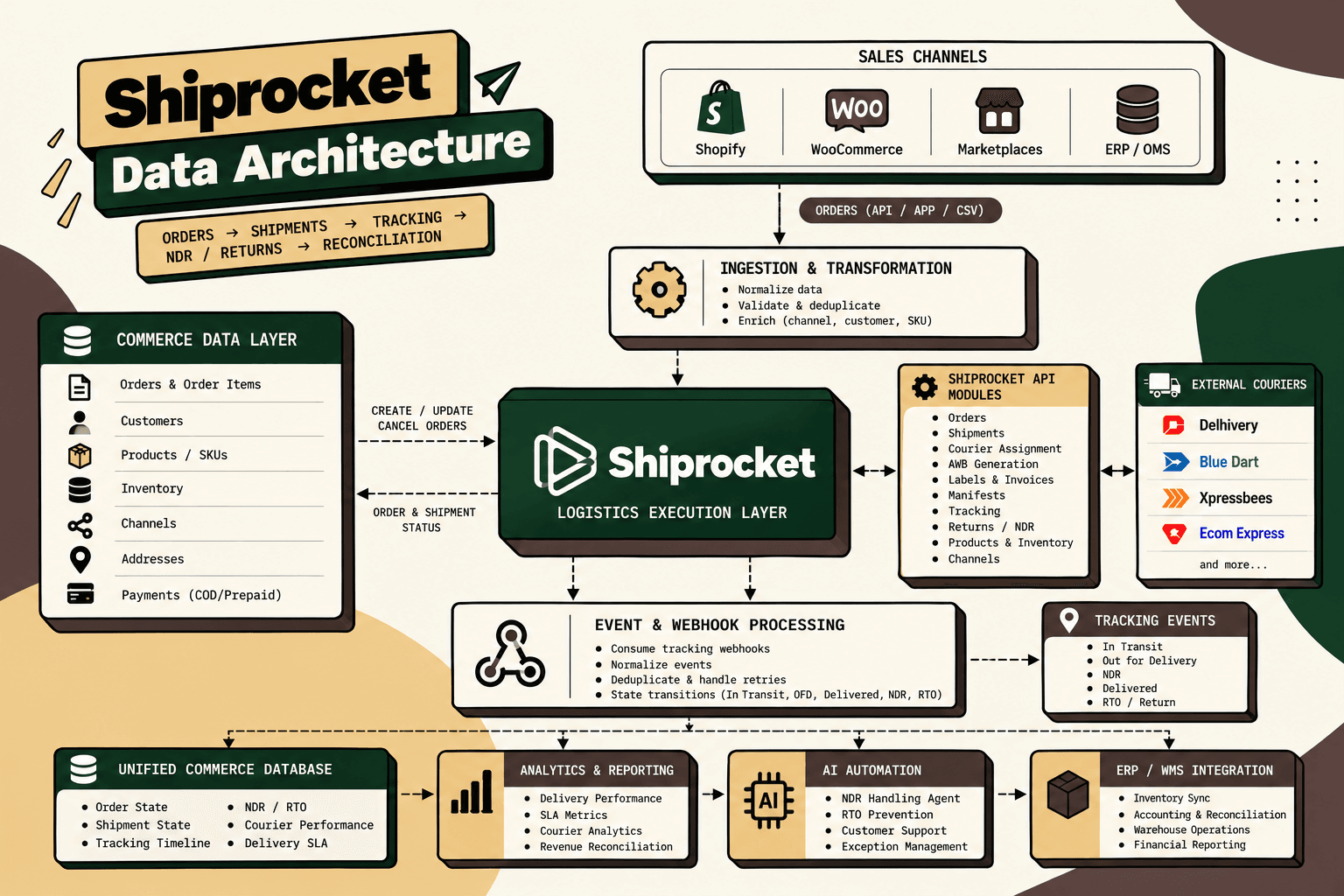
Shiprocket data architecture should be designed as more than a collection of API calls. For an ecommerce business, the useful architecture connects sales channels, orders, products, inventory, shipments, courier allocation, AWBs, tracking events, NDR, returns and reconciliation into one consistent operational model.
Shiprocket's public API is REST-based, accepts JSON requests and returns JSON responses, and exposes separate areas for orders, shipments, couriers, tracking, returns and exchanges, products, inventory, channels, pickup addresses and related logistics operations. Shiprocket also provides webhooks for tracking updates. Shiprocket API Documentation
The architectural question is therefore not simply how do we connect our store to Shiprocket? It is: where should commerce state live, how should Shiprocket events be normalized, and how should downstream systems consume those events?
For an AI-enabled ecommerce infrastructure, the strongest pattern is to treat Shiprocket as a logistics execution system while maintaining a canonical commerce data layer outside it. That layer can then feed ERP, WMS, customer operations, analytics and AI workflows without making every downstream system understand Shiprocket-specific identifiers and payloads.
What Is Shiprocket Data Architecture?
Shiprocket data architecture is the structure used to move, normalize, store and act on ecommerce order and logistics data as it flows between storefronts, marketplaces, ERP or OMS systems, Shiprocket, courier networks and downstream operational systems.
A useful high-level model is:
- Sales channels create or update orders.
- An integration layer validates and normalizes the order.
- Commerce systems maintain the canonical order, customer, SKU and inventory state.
- Shiprocket receives the shipping-ready order and manages shipment execution.
- Shiprocket assigns courier and AWB information and supports pickup, label and manifest workflows.
- Tracking events return through API calls or webhooks.
- An event-processing layer normalizes those events into a canonical shipment timeline.
- ERP, WMS, analytics, customer support and AI workflows consume the normalized state.
Shiprocket's own documentation describes APIs for creating or updating orders, assigning couriers and AWBs, generating pickups, manifests and labels, and retrieving tracking information. Shiprocket API Document Helpsheet
The Core Shiprocket Data Architecture
The most important design principle is to separate commerce data from logistics execution data. An ecommerce platform may know that an order exists and what the customer purchased. Shiprocket adds the operational logistics state needed to move that order through fulfillment.
| Layer | Primary responsibility | Typical data |
|---|---|---|
| Sales channels | Capture demand | Orders, customers, payments, products |
| Commerce data layer | Maintain normalized business state | Orders, order items, SKUs, customers, inventory |
| Shiprocket integration | Translate commerce intent into shipping operations | Shiprocket order IDs, shipment IDs, pickup data |
| Courier layer | Execute transportation | Courier, AWB, pickup, delivery status |
| Event layer | Normalize operational changes | Tracking events, NDR, RTO, delivery events |
| Operational systems | Act on logistics state | ERP, WMS, CRM, helpdesk, analytics |
| AI automation | Interpret context and trigger approved workflows | NDR actions, support responses, exception handling |
This separation matters because a shipping provider should not become the accidental master database for every aspect of commerce. If the business later changes shipping providers, adds another 3PL or introduces a second logistics platform, the rest of the architecture should not need to be redesigned.
The Main Data Domains
1. Orders
The order is the commercial transaction from which the fulfillment workflow begins. It should contain a stable internal identifier plus the source-channel identifier and any external logistics identifiers.
Useful order fields include:
- Canonical order ID
- Source order ID
- Sales channel
- Customer ID
- Payment method
- Payment status
- Order status
- Order value
- Currency
- Billing and shipping references
- Creation and modification timestamps
Shiprocket's documentation distinguishes the reference order ID supplied by the merchant from the Shiprocket order ID returned by the API. That distinction is important when building integrations because the two identifiers should not be treated as interchangeable. Shiprocket API Documentation
2. Order Items and SKUs
An order should be separated from its individual items. Each order item should reference a canonical SKU or product ID rather than relying exclusively on whatever product identifier happens to be present in a channel payload.
A normalized order-item model can contain:
- Order ID
- SKU
- Product ID
- Quantity
- Unit price
- Discount
- Tax
- Fulfillment quantity
- Warehouse or fulfillment location
This becomes particularly important when inventory, bundles, multi-item orders or partial fulfillment enter the workflow.
3. Customer and Address Data
Customer and address data should be modeled independently from orders because the same customer can place multiple orders and addresses can change between transactions.
The architecture should distinguish billing and shipping addresses and retain the address state associated with the transaction. It should also avoid unnecessarily copying sensitive customer information into every downstream system.
4. Product and Inventory
Product data provides the commercial identity of an item, while inventory represents its operational availability. These should not be collapsed into a single entity.
Useful inventory attributes include available quantity, reserved quantity, fulfillment location and synchronization timestamp. Shiprocket's API documentation also exposes product and inventory-related API areas, reinforcing the need to treat product and inventory as distinct data domains. Shiprocket API Documentation
5. Shipment
The shipment is the logistics representation of an order or part of an order. It should be modeled separately from the commercial order because one order can require different shipment-level states.
Useful shipment fields include:
- Canonical shipment ID
- Order ID
- Shiprocket shipment ID
- Package dimensions
- Package weight
- Pickup location
- Shipment status
- Courier ID
- AWB
- Expected delivery information
- Creation and update timestamps
6. Courier and AWB
Courier allocation identifies the logistics provider handling a shipment. The AWB is the shipment's operational tracking identifier within the courier flow.
These should be modeled separately from the shipment because courier assignments can change and because downstream systems frequently need to search or reconcile using the AWB.
7. Tracking Events
Tracking should not be represented only as a single shipment status. A better model stores an ordered timeline of tracking events.
A tracking event can contain:
- Shipment ID
- AWB
- Event timestamp
- Normalized event code
- Source status
- Activity description
- Location
- Raw payload reference
- Received timestamp
This distinction allows the system to answer questions such as when did the shipment actually leave the origin facility?, rather than only what is its current status?
8. NDR and RTO
Non-delivery reports and return-to-origin events deserve their own domain because they often trigger business decisions rather than simple status updates.
An NDR record can include the reason, delivery attempt, timestamp, current action, customer response and resolution. RTO should track the return movement and its relationship to the original shipment.
This is where the architecture becomes operationally valuable. A tracking event tells you what happened. A normalized NDR record can help the business decide what should happen next.
The Critical Relationship Model
The core relationship can be understood as:
- A channel creates many orders.
- An order contains many order items.
- An order belongs to a customer.
- An order can generate one or more shipments.
- A shipment can have a courier and AWB.
- A shipment generates many tracking events.
- A shipment can generate NDR events.
- A shipment can eventually enter an RTO or return workflow.
The practical implication is that the architecture should preserve these relationships rather than flattening everything into a single order record.
Shiprocket as a Logistics Execution Layer
Shiprocket should generally be treated as a logistics execution layer, not the canonical master database for the entire ecommerce operation.
That distinction becomes more important as a business adds multiple storefronts, marketplaces, ERP systems, WMS platforms, 3PLs or AI automation.
A resilient architecture looks like this:
- Shopify, WooCommerce, marketplaces or ERP systems generate business events.
- A commerce integration layer validates and normalizes those events.
- The canonical data layer stores the internal order, SKU, customer and shipment relationships.
- Shiprocket receives the logistics-specific request.
- Shiprocket returns logistics identifiers and operational status.
- Webhook or polling mechanisms bring tracking information back into the integration layer.
- The integration layer converts provider-specific states into canonical events.
- Downstream applications consume the canonical state instead of depending directly on Shiprocket payload formats.
This design reduces vendor coupling. If the business later introduces another shipping provider, the canonical shipment model remains stable while only the provider adapter changes.
Why Webhooks Matter in the Architecture
Polling can be useful, but repeatedly asking a logistics platform for the latest status creates unnecessary coupling and can complicate latency, rate management and event processing.
Shiprocket documents webhook support for tracking updates. When a new tracking event occurs, Shiprocket can send a POST request to the configured callback URL. Shiprocket API Documentation — Webhooks
The recommended architecture is therefore:
- Receive the webhook.
- Authenticate and validate it.
- Persist the raw event.
- Generate an idempotency key.
- Deduplicate repeated events.
- Normalize the provider status.
- Apply the state transition.
- Publish the canonical event.
- Trigger downstream workflows.
Do not allow the webhook handler to directly perform every downstream business action. A safer pattern is to accept the event quickly, persist it, and process the business consequences asynchronously.
Raw Events and Canonical Events Should Be Different
One of the most important architectural decisions is to preserve both the raw provider event and the normalized business event.
For example, Shiprocket may provide a carrier-specific tracking status and activity description. Your canonical event model might convert that into a smaller set of business states such as:
- Shipment created
- Courier assigned
- Picked up
- In transit
- Out for delivery
- Delivery attempted
- Delivered
- NDR raised
- RTO initiated
- RTO received
- Return initiated
The raw payload remains available for audit and troubleshooting, while downstream systems work against a stable event vocabulary.
This is particularly useful when AI agents are consuming operational data. An AI system should not have to infer the meaning of dozens of carrier-specific strings every time it answers a customer or recommends an action.
An Example: WISMO Tracking Workflow
Illustrative scenario: A customer asks, “Where is my order?” through a website chat or support channel.
- The customer is authenticated or matched to an order.
- The support system retrieves the canonical order.
- The order points to the active shipment.
- The shipment points to the AWB and courier.
- The latest normalized tracking state is retrieved.
- The customer-facing workflow returns the current status and appropriate tracking information.
- If the shipment is in an abnormal state, the workflow can create or escalate a support case instead of presenting a generic status.
The important architectural insight is that the AI or support interface should not need to know how Shiprocket stores every underlying field. It should consume a normalized shipment object and a reliable event timeline.
Where AI Fits Into Shiprocket Data Architecture
AI is most useful after the operational data has been connected and normalized. Putting an AI model directly on top of fragmented logistics payloads does not solve the underlying data problem.
A practical AI architecture is:
- Retrieve context: order, customer, shipment, SKU, payment and tracking state.
- Interpret intent: determine what the customer or operator is asking.
- Apply rules: evaluate permissions, policies and deterministic conditions.
- Take an approved action: create a support task, request an NDR action or initiate another permitted workflow.
- Verify the result: confirm that the underlying system actually changed.
- Escalate when necessary: send high-risk or ambiguous cases to a human.
For example, an NDR agent might classify a delivery exception, retrieve the applicable order and customer context, check whether a reattempt is permitted, and then trigger an approved action. The AI should not be allowed to invent an operational state or silently override business rules.
Rules vs AI vs Human Decisions
| Decision | Best mechanism | Reason |
|---|---|---|
| Normalize courier status | Deterministic rules | Known mappings should be predictable |
| Deduplicate webhook | Deterministic logic | Identity and idempotency should not depend on model judgment |
| Interpret customer message | AI | Natural language requires contextual interpretation |
| Check return eligibility | Rules plus AI | AI can interpret intent while policy remains deterministic |
| Approve exceptional refund | Human approval | High-impact financial decision |
| Explain tracking status | AI plus verified data | AI can communicate while the source of truth remains structured data |
Data Quality and Idempotency Are More Important Than Model Quality
A sophisticated AI layer cannot compensate for unreliable operational data. If an order has multiple identifiers, shipment states are stale or webhook events are duplicated, an AI agent can produce a polished answer that is still wrong.
Three controls are particularly important.
Identifier discipline
Maintain explicit mappings between internal IDs, source-channel IDs, Shiprocket order IDs, shipment IDs and AWBs. Do not rely on fuzzy matching when deterministic identifiers are available.
Idempotent event processing
The same event should not create multiple shipments, duplicate tickets or repeated customer notifications. Persist an event identity or equivalent deduplication key before executing downstream actions.
State transition rules
Not every event should be allowed to move a shipment into every state. Define valid transitions and retain the event history so unexpected sequences can be investigated.
Integration Failure Modes to Design For
A Shiprocket integration should be designed around failure rather than assuming every API request and webhook will succeed.
- Duplicate events: use idempotency and event identity.
- Out-of-order events: use event timestamps and state-transition rules.
- API errors: implement retries with controlled backoff.
- Rate limits: queue non-urgent operations and monitor API responses.
- Authentication expiry: manage credentials and token refresh centrally.
- Partial failures: record which steps completed before retrying.
- Schema changes: validate external payloads before mapping them into canonical objects.
- Unavailable downstream systems: use queues or durable event storage rather than dropping events.
- Incorrect business state: provide manual reconciliation tools.
Shiprocket's documentation lists standard HTTP response codes, including authorization, validation, rate-limit and server-error responses, so integration monitoring should distinguish these failure categories instead of treating every failed request as the same problem. Shiprocket API Documentation
Security and Privacy Considerations
Customer names, phone numbers, email addresses and delivery addresses can move through multiple systems in a logistics architecture. The integration should therefore minimize unnecessary duplication and establish clear access controls.
At minimum, define:
- Which systems can read customer data.
- Which systems can modify orders or shipments.
- Which AI agents have read-only access.
- Which actions require human approval.
- How API credentials are stored and rotated.
- Which payloads are retained for auditing.
- How sensitive data is masked in logs.
- How failed events are quarantined and replayed.
The principle should be simple: AI should have the minimum permissions required to complete an approved workflow.
How to Implement a Shiprocket Data Architecture
The implementation should begin with workflow mapping rather than API development.
1. Map the current workflow
Document every trigger, input, system, decision, action, exception, human handoff and output. Start with one process such as order-to-shipment or shipment-to-delivery.
2. Establish a baseline
Measure order volume, shipment volume, manual handling time, error frequency, support tickets, reconciliation effort, exception volume and operational response time.
3. Define the canonical model
Agree on the internal definitions of order, order item, SKU, customer, shipment, courier, AWB, tracking event, NDR, RTO and return before building downstream automations.
4. Separate deterministic logic from AI
Use conventional code for validation, identifiers, state transitions, permissions, calculations and reconciliation. Use AI where interpretation, classification or natural-language interaction creates genuine value.
5. Connect the systems
Build adapters for the ecommerce platform, ERP or OMS, inventory system, WMS, Shiprocket, CRM or helpdesk and analytics environment. Use APIs for commands and webhooks or event mechanisms for changes where appropriate.
6. Add guardrails
Define permissions, approval thresholds, retries, fallbacks, monitoring, audit logs and escalation paths before enabling autonomous actions.
7. Start with one high-volume workflow
A sensible pilot might be shipment tracking synchronization because it has a clear input, structured output and measurable operational value.
8. Measure the result
Track data freshness, synchronization failures, reconciliation exceptions, manual handling time, support response time, ticket volume, customer escalations and processing latency.
9. Scale only after reliability is proven
Once the first workflow is stable, extend the same architecture to NDR, RTO, returns, customer support, inventory intelligence and reconciliation.
How to Prioritize Shiprocket Automations
A practical prioritization model is:
volume × frequency × manual effort × error cost × revenue impact ÷ implementation complexity
This is a practical framework, not an industry-standard formula. Its purpose is to force teams to compare automation opportunities using operational value rather than novelty.
| Workflow | Automation opportunity | Human involvement |
|---|---|---|
| Tracking synchronization | High | Exception handling |
| Order creation | High | Approval for unusual orders |
| NDR classification | High | Escalation for ambiguous cases |
| RTO reconciliation | Medium to high | Financial or inventory exceptions |
| Courier performance analysis | High | Operational review |
| Exceptional refunds | Limited | Human approval |
Shiprocket Data Architecture for Five Anchor
For Five Anchor, the strongest architecture is a carrier-independent commerce data layer that sits between the client's sales and operational systems and logistics execution platforms such as Shiprocket.
The architecture can be organized as:
- Shopify, WooCommerce, marketplaces and ERP systems feed the commerce layer.
- The commerce layer maintains canonical orders, SKUs, customers, inventory and shipments.
- A Shiprocket adapter translates canonical shipment commands into Shiprocket API operations.
- Shiprocket manages courier allocation, AWB, pickup and shipment execution.
- Tracking webhooks enter the Five Anchor event-processing layer.
- The event layer normalizes provider-specific events.
- ERP, WMS, analytics, customer operations and AI agents consume the canonical state.
This is where Five Anchor's Commerce Infrastructure positioning becomes relevant: the objective is not simply to connect one ecommerce platform to one shipping provider, but to create an operational layer that keeps commerce data coherent as systems and workflows multiply.
The same foundation can support AI-powered customer operations. A customer-service agent can retrieve the canonical order and shipment state, answer tracking questions, identify delivery exceptions and escalate cases without requiring the support workflow to understand every underlying Shiprocket API detail.
What the Business Should Actually Measure
The success of a Shiprocket integration should not be measured by whether the API call returns HTTP 200. The business outcome comes from what the integrated workflow enables.
Useful metrics include:
- Order-to-shipment processing time
- Tracking data freshness
- Webhook processing success rate
- Duplicate event rate
- Shipment reconciliation exceptions
- Manual operations hours
- NDR resolution time
- RTO reconciliation time
- Customer support handling time
- Number of logistics exceptions requiring human intervention
For an AI-enabled architecture, add measures such as action success rate, human escalation rate, incorrect-action rate, data retrieval accuracy and percentage of workflows completed without manual intervention.
Common Shiprocket Architecture Mistakes
Making Shiprocket the master database
This creates vendor coupling and makes it harder to add other logistics providers or unify data across channels.
Storing only the latest shipment status
This destroys the event history needed for debugging, SLA analysis, exception detection and operational analytics.
Sending raw provider payloads to every downstream system
This forces every consumer to understand provider-specific schemas and creates a maintenance problem.
Letting AI make deterministic decisions
Identifier matching, permissions, financial rules and state transitions should generally remain deterministic.
Ignoring replay and reconciliation
Real integrations fail. If an event cannot be replayed or a state cannot be reconciled, operational teams eventually return to spreadsheets and manual investigation.
Building the AI layer before fixing the data layer
An AI agent can improve interaction with reliable data. It cannot make fragmented, contradictory operational records reliable by itself.
The Recommended Architecture
The practical target architecture is:
- Channels: Shopify, WooCommerce, marketplaces and ERP.
- Commerce layer: canonical orders, customers, SKUs and inventory.
- Integration layer: validation, transformation, authentication and orchestration.
- Shiprocket: logistics execution, shipment operations and courier connectivity.
- Event layer: webhook ingestion, normalization, deduplication and state transitions.
- Canonical shipment database: current state plus complete event timeline.
- Operational systems: ERP, WMS, CRM, helpdesk and analytics.
- AI layer: customer support, NDR workflows, exception handling and operational intelligence.
Five Anchor can implement this type of architecture by mapping the existing ecommerce workflow, defining the canonical data model, integrating commerce and logistics systems, building event-driven automation, adding AI agents where interpretation is valuable, and retaining human escalation for high-impact exceptions.
Final Takeaway
A good Shiprocket data architecture is not a point-to-point API integration. It is a normalized operational data layer connecting orders to shipments, shipments to courier and AWB information, logistics events to canonical business states, and those states to automation, analytics and human workflows.
The most durable pattern is to keep the business's canonical commerce state outside the logistics provider, use Shiprocket as a logistics execution layer, preserve raw and normalized events, process webhooks idempotently, and expose clean operational data to ERP, WMS, customer operations and AI systems.
That architecture creates a stronger foundation for automation because AI agents can reason over consistent order and shipment context instead of trying to reconstruct the truth from disconnected systems.
Key Takeaways
- •Treat Shiprocket as a logistics execution layer rather than the master database for the entire ecommerce operation.
- •Maintain canonical relationships between orders, order items, customers, SKUs, shipments, couriers, AWBs and tracking events.
- •Preserve raw Shiprocket events while also creating normalized business events for downstream systems.
- •Use webhooks, idempotency, retries, state-transition rules and durable event processing to make the integration resilient.
- •Use deterministic logic for identifiers, permissions and state transitions, while AI handles interpretation, classification and natural-language workflows.
- •A carrier-independent commerce data layer makes it easier to add logistics providers, ERP/WMS integrations and AI automation later.
Shiprocket Integration Architecture: Point-to-Point vs Canonical Data Layer
| Dimension | Point-to-Point Integration | Canonical Data Layer |
|---|---|---|
| Inventory Sync Frequency | 15–30 min batch polling (high oversell risk) | Sub-second atomic locking (<450ms) |
| Concurrent Drop Resilience | Fails under concurrency; causes negative stock balance | Redis atomic reservation queue guarantees exact counts |
| Error Handling & Retries | Silent failure; manual CSV audit needed | Dead-letter queues with automated exponential retry |
| Fulfillment Routing Speed | 2–4 hours delayed batch export to 3PL warehouse |