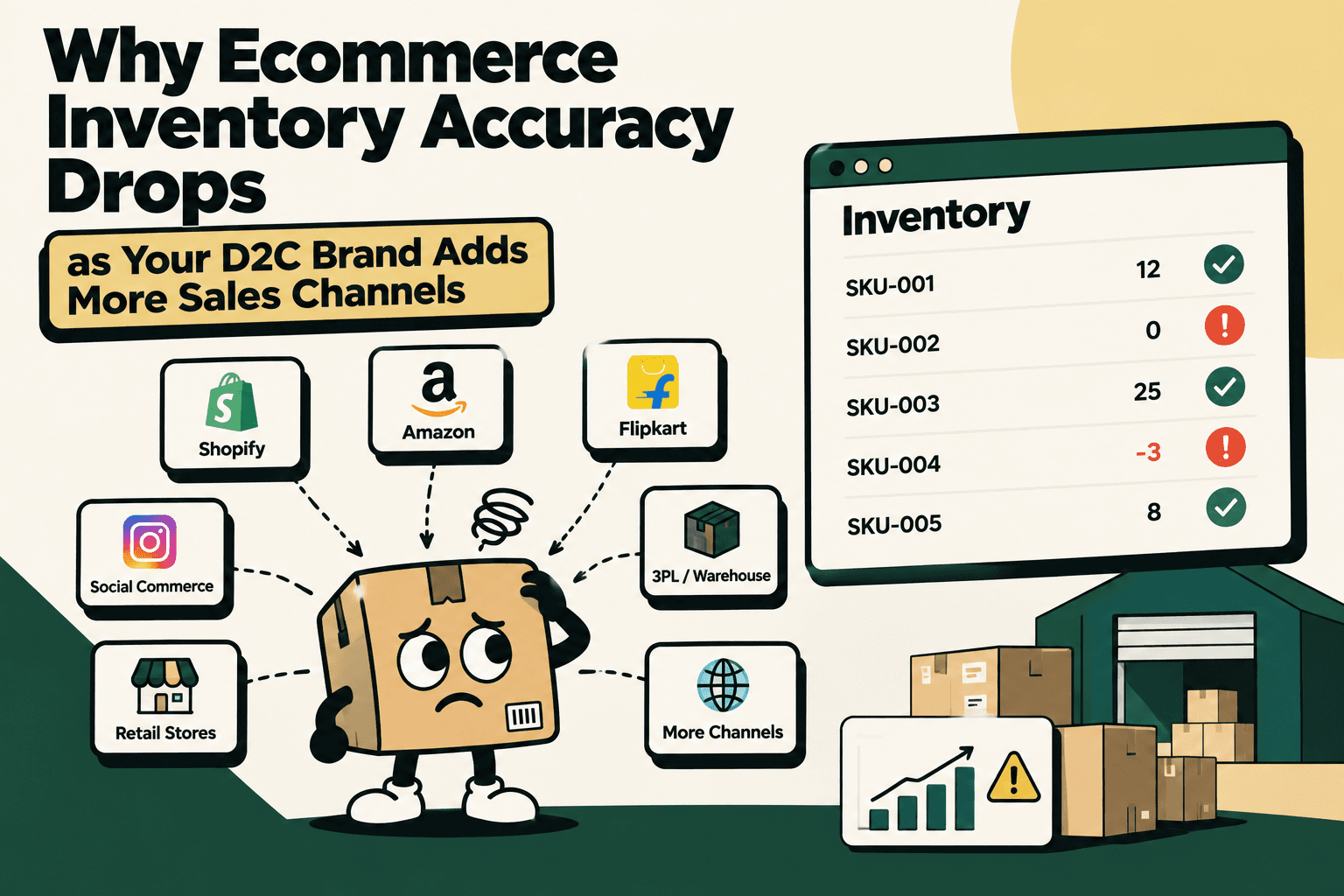
Why Ecommerce Inventory Accuracy Drops as Your D2C Brand Adds More Sales Channels
Inventory accuracy usually deteriorates as a D2C brand adds sales channels because more systems begin changing the same inventory pool. The problem is not simply that the business has more SKUs or more units. It is that every additional channel, warehouse, marketplace, 3PL and fulfillment workflow introduces another place where inventory can be sold, reserved, cancelled, returned, transferred or adjusted.
A single-channel operation might look like warehouse → ecommerce store → customer. A growing D2C operation can become warehouse → Shopify + Amazon + marketplaces + social commerce + retail + quick commerce + 3PLs. The inventory may be physically correct while the digital view is already wrong.
Shopify's current guidance on multichannel inventory management similarly emphasizes synchronized product, inventory and order data across channels and locations as a way to reduce overselling, stockouts and fulfillment problems. Shopify's multichannel inventory guide and its current centralized inventory guidance both describe centralized, synchronized inventory as a foundation for multichannel operations.
The Core Problem: More Sales Channels Create More Inventory Events
The most useful way to understand inventory accuracy is to stop thinking of inventory as a static number.
Inventory is a constantly changing state.
A unit can move through purchase order → goods received → available stock → reservation → sale → pick → pack → shipment → cancellation → return → inspection → restock → transfer → damage → adjustment.
Now introduce five sales channels, three fulfillment locations and hundreds of SKUs. Each event has to be recorded, mapped and propagated to the systems that depend on it.
That means inventory accuracy becomes an integration and event-management problem, not merely a warehouse counting problem.
1. Every New Sales Channel Creates Another Inventory Data Source
When a D2C brand sells through one storefront, inventory changes may be relatively easy to follow. Once the brand expands to marketplaces, retail, social commerce, quick commerce or additional storefronts, the same SKU can be affected by transactions originating in different systems.
For example:
- Amazon records a sale.
- Shopify records a website order.
- A retail store sells the same SKU through POS.
- A 3PL receives a cancellation.
- A warehouse processes a damaged unit.
- A returns team receives a product that may or may not be immediately sellable.
If those events do not reach the inventory source of truth reliably, each platform can develop its own version of reality.
This is why multichannel inventory management is fundamentally different from maintaining several independent inventory spreadsheets. The objective is not merely to know the stock level on each channel. The objective is to maintain a consistent inventory state across the channels that depend on it.
2. Inventory Is More Than “How Many Units Do We Have?”
A common inventory mistake is treating physical stock as the same thing as sellable stock.
Consider a warehouse with 100 units of a SKU. That does not necessarily mean 100 units are available for a new customer.
You may have:
- 100 units physically on hand
- 25 units already committed to open orders
- 5 units damaged or awaiting inspection
- 10 units allocated to another fulfillment location
- 60 units genuinely available for new orders
The exact quantities will vary by business, but the principle is consistent: on-hand, reserved, committed, damaged, in-transit and available inventory are different operational states.
If a marketplace sees 100 units while the actual sellable quantity is 60, the channel can accept orders the fulfillment operation cannot reliably complete.
Current Shopify inventory guidance also distinguishes inventory by locations and emphasizes the need to know what stock is available at each location rather than treating all physical inventory as universally interchangeable.
3. Synchronization Delays Create Overselling
One of the simplest ways to understand multichannel inventory failure is to look at timing.
Imagine a product has five units available.
- Amazon sells three units.
- The central inventory system has not yet updated Shopify.
- The website still displays five units.
- A customer purchases four units.
- The synchronization process finally updates the other channels.
The physical warehouse never had seven units. The problem was that two sales channels were acting on different versions of the inventory state.
This is why inventory accuracy is partly a latency problem. A correct number that arrives too late can still produce an incorrect customer outcome.
Shopify's multichannel guidance explicitly identifies inventory synchronization between channels as a key operational challenge, while its centralized inventory guidance describes real-time stock synchronization as a mechanism for reducing overselling.
4. Multiple Warehouses Make “Total Inventory” Misleading
Adding locations introduces another layer of complexity.
| Location | Physical Stock |
|---|---|
| Delhi warehouse | 500 |
| Mumbai 3PL | 300 |
| Bengaluru 3PL | 200 |
| Retail stores | 150 |
| Total | 1,150 |
The business may have 1,150 units physically distributed across its network, but that does not mean every channel can promise every unit to every customer.
A customer in Bengaluru may require inventory that can meet a delivery commitment from the Bengaluru 3PL. A retail store may need to retain a minimum quantity. A marketplace may have a channel-specific allocation. A wholesale order may have already reserved part of the stock.
So the useful question changes from “How much inventory do we have?” to “How much sellable inventory do we have, where is it, who can sell it, and under what fulfillment rules?”
Shopify's current multi-location documentation and inventory guidance support this location-aware model, where inventory is tracked by physical or fulfillment location rather than treated as one undifferentiated number.
5. Returns Can Temporarily Make Digital Inventory Look Better Than Physical Inventory
Returns create a different type of inventory discrepancy.
A return can follow a sequence such as:
Customer requests return → return approved → product shipped back → 3PL receives product → product inspected → product restocked → inventory becomes sellable.
The product may physically arrive before the system marks it as available. Conversely, a system can mark inventory as returned before the warehouse has inspected it and determined that it is actually sellable.
This distinction matters because returned does not automatically mean available.
A damaged, incomplete or quality-failed product should not necessarily become available inventory simply because a return transaction has been recorded.
A reliable inventory workflow therefore needs explicit state transitions and ownership rules for returns rather than a single “returned” status.
6. Spreadsheets Eventually Become the Integration Layer
Spreadsheets are not inherently bad. They are often useful during the early stages of a D2C operation.
The problem appears when people begin using spreadsheets to compensate for missing system connections.
A growing operation may rely on:
- Excel or Google Sheets
- CSV exports from marketplaces
- Warehouse reports
- 3PL inventory files
- Manual reconciliation
- WhatsApp updates
- Marketplace dashboards
At that point, people are effectively acting as middleware between disconnected systems.
Shopify's 2025 multichannel inventory guide cites a Veeqo survey in which 27% of surveyed U.S. ecommerce sellers reported using spreadsheets for inventory management. The important operational lesson is not that spreadsheets are always wrong. It is that manual reconciliation becomes increasingly fragile as transaction volume, locations and channels grow.
The failure mode is not the spreadsheet itself. It is the absence of an automated system of record and event flow.
7. SKU Mapping Can Silently Break Inventory Accuracy
One of the most underestimated causes of inventory mismatch is product identity.
The same physical product can have different identifiers across systems:
- Shopify: TSHIRT-BLK-M
- Marketplace: B0ABC123
- ERP: SKU-10482
- 3PL: TSBLKM
If those identifiers are mapped incorrectly, a valid order can deduct stock from the wrong product or fail to deduct inventory altogether.
This creates a particularly dangerous situation:
Physical inventory is accurate → SKU mapping is wrong → digital inventory is inaccurate.
That is why inventory integration should begin with product and variant master-data mapping before attempting to automate every downstream workflow.
8. Inventory Accuracy Declines as Operational Events Multiply
Every new channel increases the number of places where inventory can change.
Consider these events:
- Purchase order received
- Goods received into warehouse
- Sale
- Cancellation
- Pick
- Pack
- Shipment
- Return
- Inspection
- Restock
- Transfer
- Damage adjustment
- Manual correction
Now multiply those events across several channels, locations and fulfillment partners.
The number of synchronization points grows quickly. This is why adding a sales channel is not only a marketing decision. It is also a systems-integration decision.
What an Accurate Multichannel Inventory Architecture Looks Like
The scalable model is not “one spreadsheet for each channel.” It is a shared inventory architecture with clearly defined ownership.
Sales channels → inventory/order layer → warehouses and 3PLs
The central layer should know which system owns which piece of data, how events are received, how inventory is reserved, and how updates are propagated.
For example:
- Commerce platform: customer orders and channel transactions
- Inventory or ERP layer: stock state, allocations and inventory movements
- WMS: physical warehouse execution
- 3PL: external fulfillment inventory and shipment events
- Returns system: reverse-logistics state
- Marketplace connectors: channel-specific order and inventory synchronization
The important design principle is that each system has a defined role instead of allowing multiple systems to independently overwrite the same inventory value.
What Should Be Automated?
Automation should focus on the events that are frequent, structured and costly to manage manually.
| Workflow | What to automate |
|---|---|
| Inventory synchronization | Push approved inventory changes to connected channels after relevant events |
| SKU mapping | Maintain canonical product and variant identifiers across systems |
| Reservations | Move inventory into reserved or committed states based on order rules |
| Returns | Update inventory only after the defined return and inspection conditions are met |
| Reconciliation | Compare central inventory with warehouse and 3PL reports and flag variances |
| Order routing | Apply location, stock and fulfillment rules to select the appropriate fulfillment point |
| Exception monitoring | Alert teams when synchronization fails, mappings break or quantities diverge |
The goal is not to automate every inventory decision. It is to remove repetitive data movement while keeping sensitive adjustments and exceptions visible to humans.
Rules vs AI vs Human Decisions
Inventory automation works best when different technologies have different responsibilities.
| Decision type | Best mechanism |
|---|---|
| Deduct one unit after a confirmed sale | Deterministic automation |
| Map a known SKU to a canonical identifier | Rules and master data |
| Detect a failed synchronization pattern | Automation plus monitoring |
| Interpret an unstructured warehouse exception | AI-assisted classification |
| Decide whether a high-value discrepancy requires investigation | AI recommendation plus human approval |
| Approve a sensitive inventory adjustment | Human decision with audit trail |
AI should not replace deterministic inventory logic where a clear rule already exists. If the instruction is “when a confirmed order is created, reserve one unit,” conventional workflow automation is generally more appropriate than asking a language model to make the decision.
AI becomes more useful around interpretation, anomaly detection, exception classification, operational summaries and workflows that require information from several systems.
How to Prioritize Inventory Automations
Not every inventory problem deserves an integration project.
A practical prioritization model is:
volume × frequency × manual effort × error cost × revenue impact ÷ implementation complexity
This is a practical decision framework, not an industry-standard formula.
Use it to compare potential workflows.
- High volume + high frequency: prioritize synchronization and reconciliation.
- High error cost: prioritize overselling and reservation controls.
- High manual effort: automate repetitive exports and cross-system updates.
- High implementation complexity: consider a smaller pilot before building a full integration.
- Low volume + low impact: keep the process manual until there is a stronger business case.
A Practical Implementation Roadmap
1. Map the Current Inventory Workflow
Document every system that touches inventory and every event that changes stock.
Do not start with software selection. Start with the workflow.
For each event, record the source system, destination system, expected latency, responsible team and failure behavior.
2. Define the Source of Truth
Decide which system owns each important data type.
For example, one system may own the canonical SKU, another may execute warehouse movements, and another may manage financial valuation.
The goal is not necessarily one application for everything. The goal is one clearly defined ownership model.
3. Build a Canonical SKU Map
Create a master mapping between product IDs, variants, barcodes, marketplace IDs, ERP codes and 3PL identifiers.
Test the mapping against real orders before scaling it.
4. Separate Inventory States
Define explicit states for on-hand, available, reserved, committed, damaged, in-transit and awaiting inspection inventory.
This prevents the common mistake of treating every physical unit as immediately sellable.
5. Establish Event-Based Synchronization
Identify the events that should trigger inventory updates.
Examples include confirmed sale, cancellation, return receipt, restock, transfer and warehouse adjustment.
Where supported, use APIs and webhooks rather than recurring manual exports.
6. Add Guardrails
Automation should not silently overwrite suspicious data.
Useful guardrails include:
- negative-inventory thresholds
- unexpected quantity-change alerts
- SKU mapping failure alerts
- duplicate-event detection
- warehouse-versus-system variance thresholds
- manual approval for sensitive adjustments
7. Pilot One Workflow
Do not attempt to integrate every channel and warehouse simultaneously.
Start with a high-volume workflow such as inventory synchronization for a limited set of SKUs and one or two channels.
Measure the baseline first, then compare the automated workflow against the previous process.
8. Measure the Operational Result
Track metrics such as:
- inventory accuracy rate
- inventory variance by SKU
- overselling incidents
- stockout incidents
- manual reconciliation hours
- failed synchronization events
- order cancellation caused by inventory mismatch
- time required to resolve discrepancies
The objective is not simply “more automation.” The objective is fewer inventory errors, faster reconciliation and more reliable fulfillment decisions.
What Common Inventory Automation Projects Get Wrong
Automating Before Mapping the Process
If the underlying workflow is unclear, automation can simply make a bad process run faster.
Assuming One Inventory Number Is Enough
On-hand stock, available stock and reserved stock serve different operational purposes. Combining them creates misleading availability.
Ignoring SKU Master Data
Even a technically reliable API integration can produce bad results if the product identifiers do not match.
Using Batch Synchronization for Fast-Moving SKUs
Periodic exports can create avoidable windows where channels act on stale data. The appropriate synchronization model depends on transaction volume, channel capabilities and business risk.
Removing Human Review From Exceptions
High-value discrepancies, unexplained stock movements and unusual adjustments should remain visible to an accountable operator.
Measuring Only Automation Percentage
A workflow that automatically processes 95% of events is not necessarily successful if the remaining 5% create expensive fulfillment failures. Measure business outcomes, not just the percentage of tasks automated.
Where AI Fits Into Ecommerce Inventory Infrastructure
AI has a useful role, but it should sit on top of reliable operational data rather than compensate for missing fundamentals.
An AI layer can help classify inventory exceptions, summarize discrepancies, identify unusual patterns, explain why a SKU's availability changed, prioritize reconciliation tasks and coordinate actions across connected systems.
For example, an operations team might receive an alert that a SKU differs by 37 units between the central system and a 3PL. Instead of simply displaying the discrepancy, an AI workflow could gather recent order, return, transfer and adjustment events, identify likely causes and prepare a concise investigation summary for human review.
The AI is not inventing the inventory number. It is helping the team understand the operational evidence around the number.
How Five Anchor Fits Into the Problem
For a growing D2C brand, the underlying problem is usually not “we need another inventory dashboard.” It is that ecommerce channels, ERP systems, warehouses, 3PLs and order workflows are not operating from a sufficiently coordinated data layer.
Five Anchor's Commerce Infrastructure work is relevant when the solution requires marketplace integrations, ERP integrations, order processing automation, inventory synchronization, warehouse or shipping integrations and custom ecommerce workflows.
A practical implementation can begin with workflow mapping and baseline metrics, then establish SKU and inventory ownership, connect the required systems, automate high-volume events, add exception monitoring and measure the resulting change in inventory accuracy and reconciliation effort.
The objective is not to force every D2C operation into one software platform. It is to create a reliable operating layer between the systems the business already depends on.
The Business Outcome to Aim For
Better inventory accuracy has a broader effect than cleaner stock reports.
When inventory data is reliable, teams can make better decisions about:
- which products are genuinely available
- where inventory should be positioned
- which orders can be fulfilled
- when replenishment is required
- which discrepancies require investigation
- how much manual reconciliation is necessary
It also reduces the operational gap between what the customer sees and what the business can actually fulfill.
That is the real purpose of multichannel inventory infrastructure: the availability shown to customers should remain closely aligned with the inventory the operation can actually deliver.
Frequently Asked Questions
Why does inventory accuracy decrease as a D2C brand adds sales channels?
Inventory accuracy decreases because more channels create more transactions, systems and synchronization points. Sales, cancellations, returns, reservations and adjustments must move between systems consistently. If synchronization, mapping or inventory ownership is weak, the channels begin working from different inventory states.
What causes overselling across ecommerce channels?
Overselling can occur when two or more channels act on stale inventory data, when reserved inventory is treated as available, when SKU mappings are incorrect, or when inventory updates fail to propagate after a transaction.
Should ecommerce inventory be centralized?
Most growing multichannel operations benefit from a centralized inventory view or another clearly defined inventory source of truth. That does not always mean physically storing every unit in one warehouse. It means maintaining a reliable operational view of inventory across locations and channels.
How do multiple warehouses affect ecommerce inventory accuracy?
Multiple warehouses make total inventory less useful because units are distributed across locations with different fulfillment capabilities and commitments. Inventory systems need location-level visibility and rules for allocation, reservation and order routing.
How do returns affect inventory accuracy?
Returns can create discrepancies because a returned item is not necessarily immediately sellable. The workflow should distinguish between return initiated, return received, inspection completed and inventory restocked.
Can AI improve ecommerce inventory accuracy?
AI can improve inventory operations by helping detect anomalies, classify exceptions, summarize discrepancies and coordinate workflows across connected systems. However, deterministic inventory rules, reliable integrations and accurate master data should remain the foundation.
What should a D2C brand automate first?
Start with high-volume, repetitive and relatively deterministic workflows such as inventory synchronization, SKU mapping, reservation updates, reconciliation alerts and clearly defined inventory events. Pilot one workflow before expanding across every channel and warehouse.
Final Takeaway
Inventory accuracy does not usually decline because a D2C brand has too much inventory. It declines because the number of systems, locations, transactions and synchronization points grows faster than the infrastructure managing them.
Every new sales channel creates another place where inventory can be sold, reserved, cancelled, returned or updated. Every new warehouse adds another location that must be represented correctly. Every new marketplace adds another product and order-data model that may need mapping.
The scalable answer is therefore not more spreadsheets or more manual reconciliation. It is a reliable inventory architecture with clear data ownership, canonical SKU mapping, synchronized inventory events, location-aware availability, automated reconciliation and human oversight for exceptions.
For D2C brands approaching that complexity, the practical next step is to map the inventory events that currently require manual intervention, measure where discrepancies occur, and automate the smallest high-impact workflow first. Once that foundation is reliable, AI and broader ecommerce automation can add intelligence without becoming another source of operational uncertainty.
Key Takeaways
- •Inventory accuracy becomes harder as more systems change the same inventory pool.
- •On-hand, available, reserved, committed, damaged and in-transit inventory should be treated as different operational states.
- •Synchronization latency can cause overselling even when physical warehouse counts are correct.
- •Multiple warehouses make total inventory less useful without location-aware availability and allocation rules.
- •Returns should not automatically become sellable inventory before receipt and inspection.
- •SKU mapping is a foundational requirement for reliable multichannel inventory synchronization.
- •AI is most useful for exception classification, anomaly detection and workflow coordination after core inventory rules and integrations are reliable.
- •The best first automation is usually a high-volume, repetitive workflow with measurable error and labor impact.
Inventory Management Approaches for Growing D2C Brands
| Manual / Channel-Specific | Centralized / Integrated | Human Oversight |
|---|---|---|
| Inventory Sync Frequency | 15–30 min batch polling (high oversell risk) | Sub-second atomic locking (<450ms) |
| Concurrent Drop Resilience | Fails under concurrency; causes negative stock balance | Redis atomic reservation queue guarantees exact counts |
| Error Handling & Retries | Silent failure; manual CSV audit needed | Dead-letter queues with automated exponential retry |
| Fulfillment Routing Speed | 2–4 hours delayed batch export to 3PL warehouse |