D2C brands do not usually hit an operational ceiling because they have too few people. They hit it because too many people are coordinating too many repetitive workflows across too many systems.
Manual operations are often an advantage in the early stages of a D2C business. A founder can inspect unusual orders, an operations manager can update a spreadsheet, a support agent can remember customer context, and someone in finance can reconcile payments manually. Humans stay close to transactions, learn quickly and can change processes without waiting for a technology project.
Growth changes the economics.
More orders create more fulfillment events and exceptions. More SKUs create more inventory decisions. More channels create more reconciliation. More customers create more support conversations, returns and refunds. More suppliers create more purchase-order and replenishment coordination. Eventually, people stop spending most of their time making decisions and start spending it moving information between systems.
That is the real scaling problem. D2C brands do not necessarily outgrow their people. They outgrow manual coordination.
AI automation for ecommerce addresses that problem by connecting systems, automating predictable execution, using AI for interpretation and bounded decisions, and keeping humans responsible for exceptions and high-impact judgment.
Why do D2C brands outgrow manual operations?
D2C brands outgrow manual operations when transaction volume and operational complexity increase faster than their teams can coordinate them. There is no universal revenue threshold at which this happens. The trigger depends on order volume, SKU count, sales channels, fulfillment model, customer-service intensity, exception rate and the number of systems involved.
A useful distinction is between volume and coordination complexity. A brand can double order volume without doubling its operational burden if every order follows the same predictable path. But when exceptions, channels, SKUs, payment states, customer requests and fulfillment conditions multiply, the number of decisions and handoffs can grow much faster than revenue.
Illustrative scenario: If a D2C brand processes 500 orders per day and each order requires five minutes of manual handling, the workflow represents approximately 41.7 hours of human handling per day. That is not an industry benchmark; it simply demonstrates how a small manual task can become structurally expensive as volume rises.
The operational ceiling is therefore created by a mismatch: revenue can compound through acquisition, repeat purchases, new channels and larger product ranges, while a manual process often requires another human action for each additional transaction.
The five signals that manual ecommerce operations are becoming a bottleneck
1. People are becoming the integration layer
If employees regularly copy information from a commerce platform into an ERP, spreadsheet, warehouse system, CRM, helpdesk or finance system, the business is using human attention to compensate for disconnected technology.
This is operational debt. The employee may appear to be performing a simple administrative task, but the real work is maintaining data consistency between systems. As volume increases, the same handoff repeats thousands of times.
2. Exceptions consume more time than normal transactions
Healthy operations should make the normal path easy and reserve human attention for unusual cases. Manual businesses often do the opposite: people touch almost every transaction because the system cannot distinguish ordinary events from exceptions.
For example, an order may require a manual check because the payment status, inventory status, address, fraud signal or fulfillment instruction lives in another system. The result is not just labor cost. It is slower order processing and greater dependence on individual knowledge.
3. Reporting becomes a recurring data-assembly exercise
When management meetings begin with employees exporting spreadsheets, cleaning columns, reconciling marketplace payouts and explaining why different systems show different numbers, reporting has become an operational workflow rather than a decision-support capability.
The problem is usually upstream. Analytics cannot be consistently reliable when order, inventory, marketplace, finance and customer data are fragmented or delayed.
4. Customer support becomes repetitive context gathering
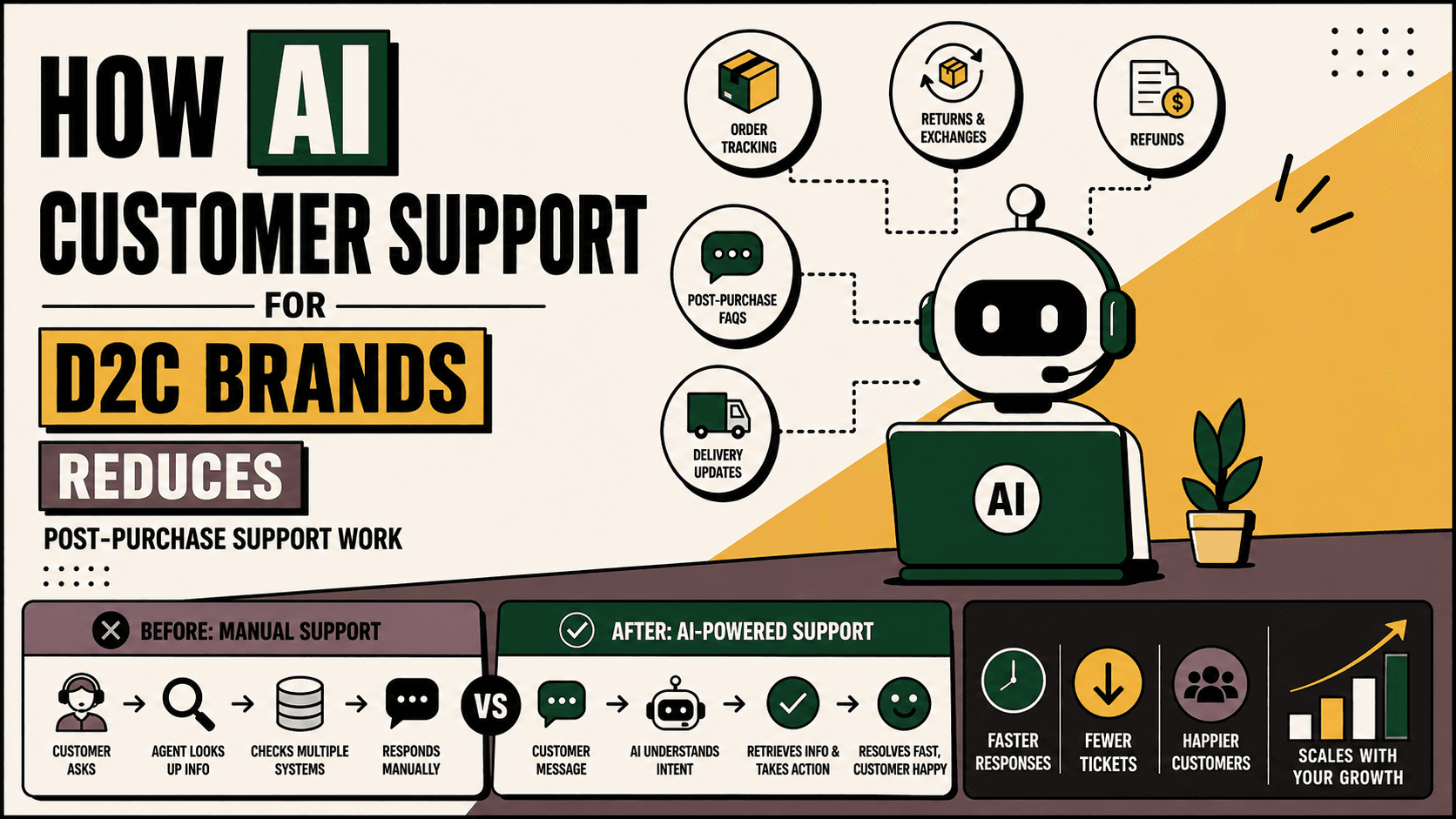
Support teams can spend large amounts of time answering questions that require little judgment but significant context gathering: Where is my order? Has my return been received? What is the refund status? Can I exchange this product? What warranty applies?
The opportunity is not to automate empathy. It is to automate retrieval, classification, status checks and approved actions so that agents spend more time on cases where judgment or relationship management matters.
5. Growth requires headcount before it requires capability
If every increase in order volume, marketplace count or SKU count requires proportional administrative hiring, the operating model is scaling linearly when the business needs leverage.
Adding people can still be the right answer when demand genuinely requires more judgment, relationships or physical execution. The warning sign is when additional headcount primarily absorbs repetitive coordination that software could perform reliably.
What does AI automation for ecommerce actually mean?
AI automation for ecommerce is the redesign of an operational workflow so that software handles predictable execution, AI handles selected interpretation or bounded decisions, and humans control exceptions and high-impact actions.
That definition matters because not every ecommerce workflow needs AI. Many tasks are better handled by deterministic automation. If a payment is confirmed, an order should move to the next state according to a defined rule. If inventory falls below an approved threshold, a replenishment workflow can be triggered. If a shipment webhook reports delivery, the order status can be updated automatically.
AI becomes useful when the workflow requires interpretation, classification, summarization, natural-language interaction or decisions based on multiple contextual signals.
| Workflow layer | Best-fit approach | Typical role |
|---|---|---|
| Predictable execution | Rules and APIs | Move data, update states, trigger actions |
| Context interpretation | AI | Classify requests, summarize context, interpret unstructured information |
| Bounded decisions | Rules plus AI | Recommend or execute approved actions within defined thresholds |
| High-impact judgment | Human approval | Approve exceptions, refunds, sensitive cases and strategic decisions |
The practical principle is simple: do not use AI where a reliable rule is enough, and do not use a rule where the workflow genuinely requires contextual interpretation.
Where should D2C brands automate first?
The best first automation is rarely the most impressive AI use case. It is usually a high-volume, repetitive, measurable workflow that consumes substantial human time, touches multiple systems or creates meaningful error and revenue risk while remaining safe enough to automate.
A useful prioritization model is:
Volume × frequency × manual effort × error cost × revenue impact ÷ implementation complexity
This is a practical decision framework, not an industry-standard formula. Its purpose is to force a business to compare opportunities economically rather than choosing automation because a workflow happens to be easy to demonstrate.
Order processing
Order processing is often a strong starting point because it sits directly on the transaction path. A robust workflow can capture the order, validate required fields, check payment and inventory states, route fulfillment, update the ERP and notify downstream systems without requiring employees to copy information between platforms.
The KPI should be tied to the bottleneck: processing time, exception rate, order error rate, manual touches per order or revenue leakage. The objective is not simply fewer clicks. It is a faster and more reliable transaction path.
Inventory automation
Inventory automation should move beyond periodic spreadsheet snapshots. A connected workflow can combine sales velocity, current stock, open purchase orders, fulfillment status and replenishment rules to provide a more timely view of inventory health.
AI can support demand interpretation or anomaly detection, but replenishment decisions with material financial consequences should remain bounded by explicit policies and approval thresholds until the system has demonstrated reliability.
Deloitte's retail research identifies AI forecasting, inventory management, delivery and supply routes, warehouse automation and real-time inventory visibility as important areas of retail technology investment. It also emphasizes that fragmented data and outdated systems can limit the value of AI. Deloitte 2025 Retail Industry Outlook
AI customer support
Customer support is a strong AI candidate when a large share of demand consists of repetitive questions that require access to structured order and customer data.
A practical workflow can classify the request, retrieve order information, identify the applicable policy, draft or deliver a response, execute approved low-risk actions and escalate cases that cross a defined threshold.
Recent McKinsey research reports that generative AI copilots can reduce customer-service handling time by 40% to 60% in the cases studied, while citing a leading sportswear company where AI copilots reduced handling time by more than 40% and improved first-contact resolution. McKinsey, AI-powered e-commerce
The lesson is not that every support ticket should be handled by an AI agent. It is that repetitive context gathering and low-risk resolution can be separated from cases requiring human judgment.
Returns, refunds and warranty operations
Returns often combine policy interpretation, order lookup, product information, customer communication, warehouse status and financial action. That makes them particularly suitable for workflow redesign.
AI can classify the request and summarize the case, while deterministic rules determine eligibility and system integrations execute approved actions. Human approval can remain mandatory for exceptions such as unusually high-value refunds, suspected abuse or policy overrides.
Reporting and ecommerce intelligence
Operational intelligence becomes valuable when managers can see the same trusted data without manually assembling it. A useful system can consolidate marketplace orders, store transactions, inventory, payouts, returns, margins and operational exceptions into a consistent reporting layer.
Five Anchor's E-Commerce Intelligence capability is relevant here because the problem is not simply dashboard creation. The useful architecture connects operational systems so that GMV, margin, SKU health, inventory position, marketplace performance and reconciliation data can be interpreted in context.
AI agents vs traditional ecommerce automation
Traditional automation follows predefined conditions. AI-agent workflows can interpret information, choose among approved actions and manage more variable paths, but they require stronger controls.
| Feature | Traditional ecommerce automation | AI-assisted workflow |
|---|---|---|
| Logic | Predefined business rules | Rules plus contextual reasoning |
| Inputs | Mostly structured data | Structured and unstructured information |
| Exceptions | Usually escalated | Selected exceptions can be classified or resolved within guardrails |
| Best use | Predictable transactions | Variable, context-rich workflows |
| Primary risk | Broken rules or integration failures | Incorrect interpretation or action |
AI agents therefore should not be treated as replacements for workflow engineering. The strongest architecture combines APIs, webhooks, deterministic business rules, AI models, orchestration, logging, monitoring and human escalation.
Real-world evidence: what leading retailers are doing
Case study: Zalando. Zalando provides a useful example because its AI work extends beyond customer-facing chat. McKinsey reports that AI-driven personalization contributed about 20% of recent revenue growth and reduced return rates by up to 7%. The same analysis reports that Zalando reduced image-creation timelines from six to eight weeks to three to four days, with about 70% of editorial content AI-generated by the fourth quarter of 2024. McKinsey, Rewiring Retail in Europe
Lesson: AI value can emerge from multiple connected workflows, including personalization, content operations and fulfillment, rather than from a single chatbot.
Case study: a national retail organization documented by Deloitte. Deloitte describes a retail organization that implemented a cloud-based supply-chain backup system using AI-powered forecasting. The system was designed to provide intelligence for human decision-makers rather than automatically take control of the operation. Deloitte reports that the project moved from discovery to implementation in less than 12 months, reduced recovery time from up to 72 hours to minutes, and produced predictive metrics that were more accurate than the existing production system in side-by-side tests. Deloitte case study
Lesson: The architecture did not remove people from the decision loop. It gave them better intelligence and a faster operational response.
These examples support a broader point: AI creates more operational value when it is connected to the workflow where decisions and actions actually occur.
The technology stack behind practical AI ecommerce automation
A reliable automation system is usually a stack rather than a single AI tool.
- Commerce systems: Shopify, marketplaces and other transaction sources provide order and customer events.
- Operational systems: ERP, warehouse, shipping, CRM, helpdesk and finance systems hold the states needed to execute workflows.
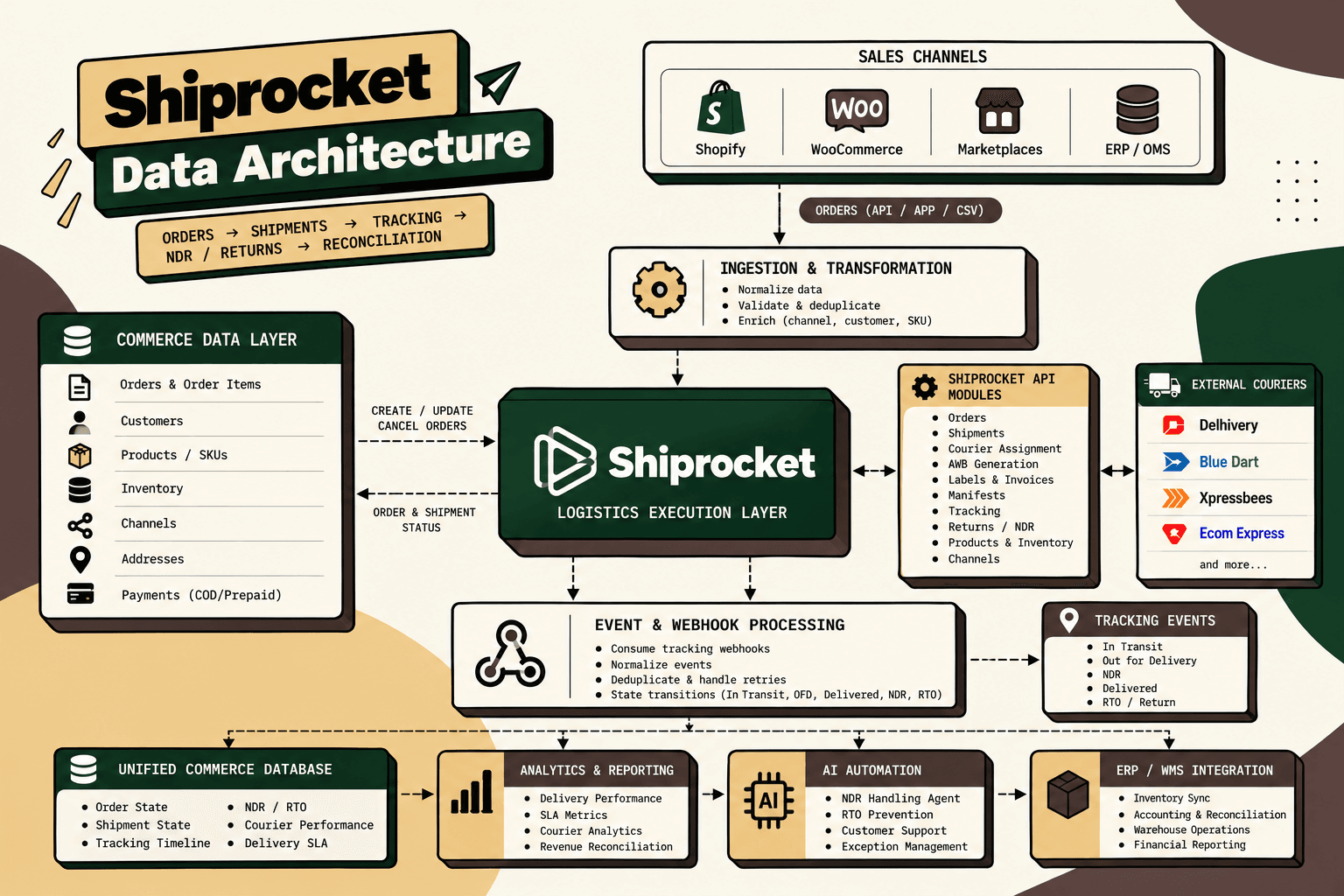
- Integration layer: APIs and webhooks move events between systems without relying on manual exports.
- Orchestration: Workflow logic determines what should happen, when and under which conditions.
- AI layer: Models interpret text, classify cases, summarize context, detect patterns or recommend bounded actions.
- Guardrail layer: Permissions, thresholds, validation, retries, fallbacks and human approval control what automation is allowed to do.
- Observability: Logs, alerts and performance metrics reveal whether the workflow is actually reliable.
Five Anchor's Commerce Infrastructure service maps naturally to this architecture by connecting marketplace, ERP, inventory, warehouse, shipping and financial workflows and adding custom AI workflows where interpretation or decision support is useful.
How to implement AI automation for ecommerce: a practical framework
1. Map the workflow
Document the trigger, inputs, systems, decisions, actions, exceptions, human handoffs and output. Do not begin with the AI tool. Begin with the work.
2. Establish a baseline
Measure volume, frequency, manual time, error rate, response time, operational cost and revenue impact. Without a baseline, it is difficult to distinguish an impressive demo from a meaningful business improvement.
3. Prioritize the bottleneck
Rank workflows using economic impact and implementation complexity. High-volume repetitive work with measurable friction is usually a better first candidate than a strategically important but highly ambiguous process.
4. Classify every step
For each workflow step, decide whether it belongs to deterministic automation, AI, human approval or human-only work.
- Use deterministic automation for predictable state changes.
- Use AI for interpretation, classification and bounded contextual decisions.
- Use human approval for high-impact actions and policy exceptions.
- Keep strategic, sensitive or accountability-heavy decisions human-controlled.
5. Connect the systems
Use APIs, webhooks and orchestration to connect the required commerce, ERP, inventory, warehouse, shipping, CRM, helpdesk and analytics systems. Avoid creating another isolated automation that produces a new data silo.
6. Add guardrails before scaling
Define validation rules, permissions, approval thresholds, fallbacks, retry behavior, logging, monitoring and exception handling. AI should not have unrestricted authority simply because a workflow is technically possible.
7. Pilot one workflow
Start with one high-volume, low-risk workflow. Prove reliability before expanding to more processes.
8. Measure the business result
Track the metric that the workflow was intended to improve: processing time, hours saved, error rate, response time, ticket deflection, conversion, revenue leakage, inventory health, operational cost or customer satisfaction.
9. Scale only after reliability is demonstrated
Once the workflow performs consistently, expand the scope, add new channels or introduce more sophisticated AI decisioning. Scaling an unreliable automation only scales its failure modes.
What should remain human?
The objective of automation is not maximum autonomy. It is better allocation of human attention.
Humans should generally remain responsible for decisions involving significant financial exposure, sensitive customer situations, ambiguous policy interpretation, legal or compliance implications, strategic trade-offs and exceptions that fall outside tested operating boundaries.
For example, an AI system can summarize a high-value refund case and identify the relevant order, previous interactions and applicable policy. A human can then approve the refund when the financial or customer-risk threshold requires judgment.
This human-in-the-loop design is especially important because AI systems can produce confident but incorrect interpretations. Good automation therefore makes uncertainty visible and provides an escalation path instead of pretending every decision can be automated safely.
What can go wrong with ecommerce AI automation?
Poor data quality
AI cannot compensate for contradictory inventory counts, incomplete customer records or inconsistent order states indefinitely. Data quality is part of the automation project, not a separate concern.
Disconnected integrations
An AI layer cannot fix an unreliable integration. Failed webhooks, stale data, schema changes and missing retries can create operational problems that are harder to diagnose once automation is distributed across multiple systems.
Over-automation
Automating a process before understanding its exceptions can make the business faster at making the wrong decision. Start with the workflow map and approval boundaries.
Hidden maintenance costs
Automations require monitoring, model updates, integration maintenance, policy changes and exception handling. The ongoing operating cost should be included in the ROI calculation.
Security and privacy
Customer, payment, order and support data should only be exposed to systems and models that have an appropriate security and access-control design. Permissions should follow the minimum access required for the workflow.
Change management
Automation changes employee responsibilities. Teams need clear escalation rules, training and ownership. Otherwise, employees may recreate manual workarounds around the new system.
A simple ROI model for ecommerce automation
Automation ROI should be calculated from the economics of the workflow rather than from the number of automated tasks.
A practical model is:
Annual benefit = labor capacity released + error-cost reduction + revenue leakage reduction + measurable customer or conversion benefit − ongoing automation cost
The model should distinguish capacity from actual cash savings. If automation frees 1,000 employee hours, the business has created capacity. That does not automatically mean payroll falls by the cost of those hours.
Similarly, an improvement in response time may create customer value without producing an immediately measurable revenue increase. The correct approach is to define the expected KPI before deployment and measure the actual change afterward.
Illustrative example: If a workflow consumes 30 hours of manual effort per week and automation reliably removes 20 of those hours, the initial benefit is 20 hours of recovered capacity per week. The business can then determine whether those hours are redeployed to revenue-generating work, service improvement, analysis or simply reduced operational strain.
Where Five Anchor fits
For a D2C business, the technology challenge is rarely just selecting an AI model. The harder problem is connecting the model to the real operating environment: commerce platforms, marketplaces, ERP, inventory, warehouse, shipping, customer operations and reporting.
Five Anchor approaches this as an infrastructure problem. The work can begin with workflow mapping and baseline measurement, continue through system integration and AI-agent design, and include guardrails, human escalation, deployment and ongoing measurement.
The relevant service depends on the bottleneck. Commerce Infrastructure fits transaction, ERP, inventory, warehouse and financial workflows. AI-Powered Customer Operations fits support, returns, warranty and post-purchase workflows. E-Commerce Intelligence fits operational reporting, omnichannel visibility, SKU health, reconciliation and decision support.
The important principle is to implement the smallest reliable workflow first, prove the business outcome and then expand the architecture.
The real goal is operating leverage
The best outcome of ecommerce automation is not that a business has more AI. It is that the business can handle more complexity without requiring a proportional increase in manual coordination.
That means more orders can move through the transaction path without creating equivalent administrative work. More customer requests can be handled without forcing agents to gather the same information repeatedly. More channels can be reconciled without adding another spreadsheet process. More inventory data can become decision-ready without waiting for a weekly report.
That is operating leverage: increasing the capacity of the business while keeping human attention focused on decisions where it creates the most value.
Conclusion: D2C brands need better operating architecture, not simply more automation
D2C brands outgrow manual operations when the number of transactions, systems, exceptions and decisions grows faster than people can coordinate them.
The answer is not to automate everything with AI. It is to redesign the operating model. Use rules for predictable execution. Use APIs and webhooks to connect systems. Use AI for interpretation and bounded decisions. Keep humans responsible for high-impact exceptions. Add guardrails and monitoring. Measure the business outcome. Then scale what works.
The strongest ecommerce automation programs therefore begin with a workflow problem, not an AI feature. They ask what work is consuming human attention, why the work exists, which systems are involved, which decisions are predictable, where uncertainty enters and what metric should improve.
When those questions are answered clearly, AI automation for ecommerce becomes much less about adding another tool and much more about building an operating system that can support the next stage of D2C growth.
Key Takeaways
- •D2C brands usually outgrow manual coordination before they outgrow their people.
- •The best automation target is a high-volume, repetitive and measurable workflow with meaningful operational friction.
- •Deterministic rules should handle predictable execution while AI handles selected interpretation and bounded decisions.
- •Human approval should remain for high-impact exceptions, sensitive cases and decisions requiring accountability.
- •Reliable ecommerce automation requires connected systems, guardrails, monitoring, measurement and ongoing maintenance.
- •The real goal is operating leverage: more transaction and operational capacity without proportional growth in manual coordination.
Manual Ecommerce Operations vs AI-Enabled Workflows
| Workflow | Manual Operations | AI-Enabled Workflow |
|---|---|---|
| Inventory Sync Frequency | 15–30 min batch polling (high oversell risk) | Sub-second atomic locking (<450ms) |
| Concurrent Drop Resilience | Fails under concurrency; causes negative stock balance | Redis atomic reservation queue guarantees exact counts |
| Error Handling & Retries | Silent failure; manual CSV audit needed | Dead-letter queues with automated exponential retry |
| Fulfillment Routing Speed | 2–4 hours delayed batch export to 3PL warehouse | Instantaneous automated webhook dispatch (<90 sec) |