WhatsApp AI Sales Agent vs AI Shopping Assistant: Which Ecommerce Use Case Needs Which Agent?
Ecommerce AI is moving beyond simple chatbots toward agents that can understand intent, recommend products, continue conversations and support purchase decisions. That creates a practical question for D2C and ecommerce teams: should you deploy a WhatsApp AI Sales Agent, an AI Shopping Assistant, or both?
The distinction is straightforward:
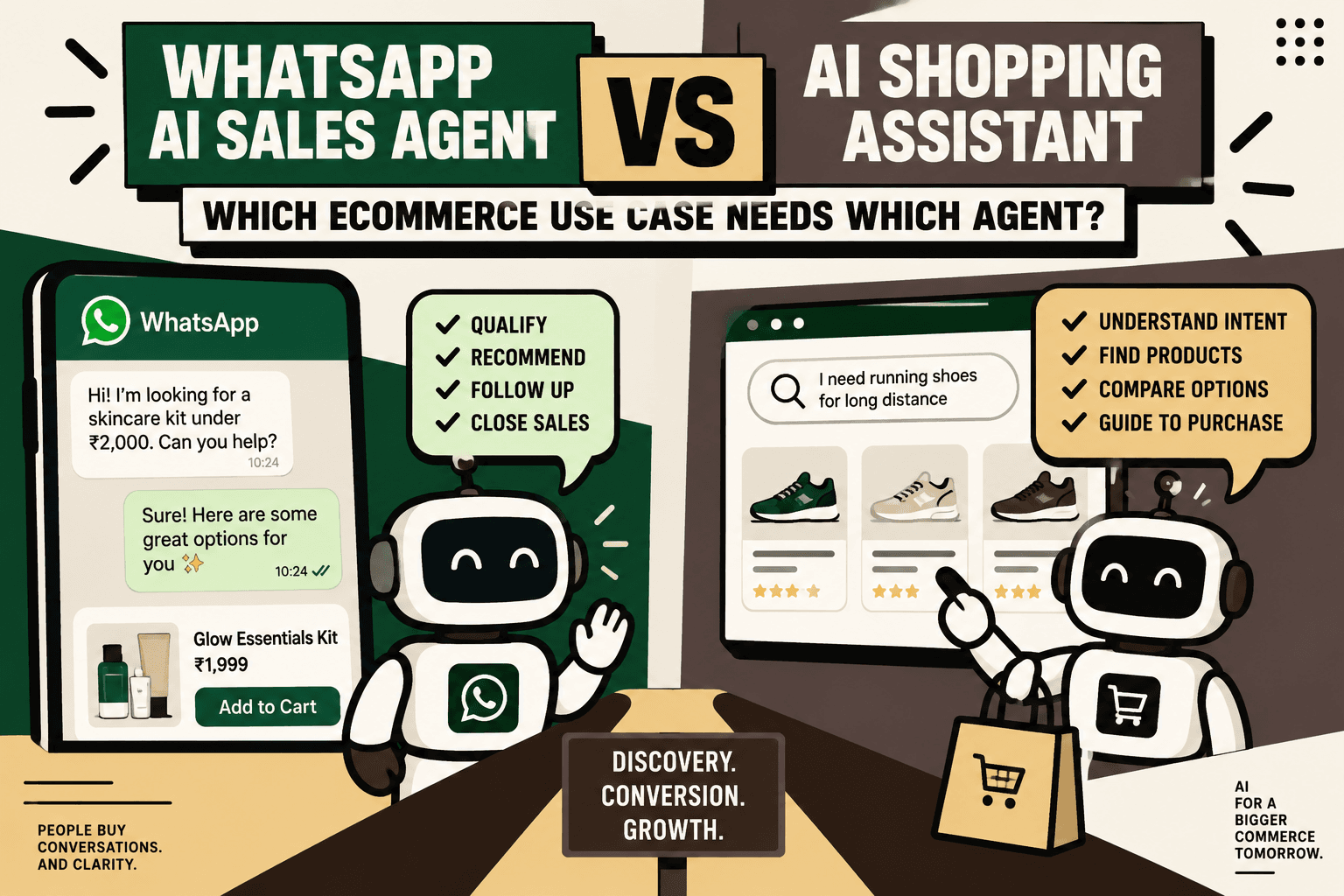
A WhatsApp AI Sales Agent is a conversation-to-conversion engine. An AI Shopping Assistant is an intent-to-product engine.
The difference matters because the two agents solve different commercial bottlenecks. One is designed around sales conversations, qualification and follow-up. The other is designed around product discovery, comparison and guided shopping.
The right choice should therefore begin with the workflow that is costing the business time, conversion or revenue—not with the AI technology itself.
The Real Problem Is Choosing the Right Workflow
Ecommerce teams often approach AI from the interface backward. They see conversational commerce and ask whether they should add an AI chatbot, a WhatsApp bot or a shopping assistant.
A better question is: where does the customer journey currently lose momentum because the business cannot respond intelligently or quickly enough?
Consider two ecommerce businesses.
The first receives a large volume of WhatsApp inquiries. Customers ask about product suitability, pricing, availability, delivery, discounts and recommendations. Sales staff repeatedly answer similar questions, qualify leads and manually follow up with warm prospects.
The second has a large product catalog. Customers know the outcome they want but do not necessarily know which SKU fits their needs. They search using natural language, compare similar products and struggle with filters that require them to understand the store's catalog terminology.
Both businesses can use AI. But they have different problems.
- Sales conversation bottleneck: choose a WhatsApp AI Sales Agent.
- Product discovery bottleneck: choose an AI Shopping Assistant.
- End-to-end commerce bottleneck: consider connecting both as specialized agents.
WhatsApp AI Sales Agent: Best for Conversational Selling
A WhatsApp AI Sales Agent operates inside a messaging-led customer journey. Its job is not simply to answer questions. It should help move a commercial conversation forward.
A typical workflow looks like:
Customer message → intent detection → qualification → product or offer retrieval → recommendation → objection handling → purchase action → human escalation or follow-up.
WhatsApp supports business catalogs and shopping interactions, making the channel suitable for conversational commerce. The exact commerce capabilities available depend on the business setup and applicable platform policies.
Example: A Customer Wants a Skincare Kit
Customer: “I need a skincare kit for acne-prone skin under ₹2,000.”
A sales agent can understand the requirement, ask qualifying questions, retrieve suitable products, explain why they fit, handle objections and help move the customer toward purchase.
- Understand the customer's requirement.
- Ask only the questions needed to qualify the request.
- Retrieve eligible products and current information.
- Recommend suitable options.
- Explain the recommendation.
- Handle approved sales objections.
- Support the purchase workflow.
- Escalate when human judgment is required.
Best Use Cases for a WhatsApp AI Sales Agent
- Lead qualification
- High-intent product inquiries
- Product questions
- Abandoned-cart follow-up
- Repeat purchases
- Cross-selling and upselling
- Promotional conversations
- Sales-assisted commerce
- Customer reactivation
- Dealer or distributor sales
- Businesses where customers already prefer WhatsApp
Primary KPI: conversion and revenue per qualified conversation.
AI Shopping Assistant: Best for Product Discovery
An AI Shopping Assistant is focused more directly on the shopping experience. Instead of waiting for a shopper to know exactly which product they want, it helps translate a need into relevant products.
A typical workflow looks like:
Shopper need → clarifying questions → catalog retrieval → filtering → comparison → recommendation → add to cart → checkout.
Shopify describes AI personal shoppers as conversational interfaces that help customers discover and buy products using contextual information. Google Cloud's commerce AI materials similarly describe systems that interpret shopping intent and use product catalog information to support conversational product discovery.
Example: A Shopper Needs Running Shoes
Shopper: “I need running shoes for daily 5K runs. I overpronate and don't want to spend more than ₹8,000.”
A Shopping Assistant can translate that natural-language requirement into product attributes, retrieve relevant products, compare options and explain the trade-offs.
- Understand the shopper's goal.
- Extract important constraints such as use case, budget and preferences.
- Retrieve relevant products from the catalog.
- Filter out products that do not satisfy required criteria.
- Compare suitable options.
- Explain the trade-offs.
- Recommend products.
- Guide the shopper toward cart or checkout.
Best Use Cases for an AI Shopping Assistant
- Large product catalogs
- Complex product selection
- High-consideration purchases
- Product comparison
- Personalized recommendations
- Website search replacement
- Guided selling
- Product discovery
- Bundling
- Cross-category recommendations
Primary KPI: product discovery, add-to-cart and assisted conversion.
WhatsApp AI Sales Agent vs AI Shopping Assistant
| Dimension | WhatsApp AI Sales Agent | AI Shopping Assistant |
|---|---|---|
| Primary objective | Convert customer conversations into sales | Convert shopping intent into product discovery and purchase |
| Primary environment | WhatsApp and messaging-led commerce | Website, app, search or conversational shopping interface |
| Typical starting point | A customer starts a conversation | A shopper describes a need or buying goal |
| Lead qualification | Strong fit | Secondary use case |
| Product discovery | Useful within a conversation | Core capability |
| Follow-up | Core capability | Usually secondary |
| Objection handling | Core capability | Useful but less central |
| Product comparison | Useful | Core capability |
| Human sales handoff | Often important | Usually less central |
| Best primary KPI | Revenue or conversion per qualified conversation | Product discovery, add-to-cart and assisted conversion |
When Should You Choose a WhatsApp AI Sales Agent?
Answer: Choose a WhatsApp AI Sales Agent when your main bottleneck is sales conversation, qualification, follow-up or conversion.
Explanation: The agent is most valuable when customers already engage with the business through messaging and sales staff spend substantial time answering repetitive questions or chasing opportunities.
Example: A customer asks whether a product is suitable for their use case, whether it is available, whether delivery is possible to their location and whether there is an approved offer. Instead of moving between disconnected systems and employees, the agent can retrieve the relevant information, guide the conversation and escalate exceptions.
Implication: The value comes from reducing friction in an existing commercial conversation, not from simply adding an AI interface.
Action: Measure qualified conversations, response time, handling time, conversion, follow-up completion, escalation rate and revenue per qualified conversation before deploying the agent.
Signals That WhatsApp Is the Better Starting Point
- Customers already use WhatsApp heavily.
- Sales staff answer many repetitive product questions.
- Warm leads are not followed up consistently.
- Customers frequently ask for recommendations before purchasing.
- Sales conversations involve repeated qualification steps.
- Repeat purchases can be triggered from prior customer context.
When Should You Choose an AI Shopping Assistant?
Answer: Choose an AI Shopping Assistant when the main bottleneck is helping shoppers find and select the right product.
Explanation: Traditional keyword search assumes shoppers know the language of the catalog. Real shoppers often describe an outcome, preference, problem or occasion instead.
Example: A shopper may ask for an outfit for a beach wedding, a laptop for video editing under a particular budget, or running shoes for a specific training pattern. The assistant can translate the request into structured product requirements and retrieve suitable products.
Implication: The quality of the experience depends heavily on catalog structure. AI cannot reliably recommend products when attributes, variants, pricing or availability are incomplete or stale.
Action: Start with one product category where attributes are well structured, then measure search exits, assisted discovery, add-to-cart and conversion.
Signals That a Shopping Assistant Is the Better Starting Point
- The catalog contains hundreds or thousands of SKUs.
- Products have many attributes or variants.
- Customers frequently compare similar products.
- Keyword search produces too many irrelevant results.
- Customers describe needs rather than product names.
- Product selection requires explanation or trade-off analysis.
The Strongest Architecture May Use Both
The choice does not have to be either-or for a mature ecommerce operation.
A more complete architecture can assign each agent a specific stage of the customer journey:
AI Shopping Assistant → discovery → recommendation → comparison → add to cart → WhatsApp AI Sales Agent → objection handling → follow-up → conversion → retention.
Stage 1: Discovery
The shopper arrives on the website and describes what they need. The Shopping Assistant asks relevant questions and recommends products from the catalog.
Stage 2: Decision
The shopper compares two products. The assistant explains the trade-offs based on reliable product information.
Stage 3: Conversion
The shopper is interested but not ready to purchase. The experience can offer a continuation through WhatsApp where appropriate.
Stage 4: Follow-Up
The WhatsApp AI Sales Agent can continue the conversation, answer approved questions, handle objections and trigger an appropriate follow-up workflow.
This architecture avoids asking one generic agent to own every stage. Each agent has a narrower responsibility and can be evaluated against the outcome it is supposed to influence.
How to Implement the Right Agent
1. Map the Workflow
Document the trigger, customer input, systems consulted, decisions made, actions taken, exceptions and human handoffs.
For WhatsApp, map message received, intent, qualification, product recommendation, objection, cart or order action, follow-up and escalation.
For Shopping Assistants, map shopper intent, clarification, catalog retrieval, filtering, comparison, recommendation, add-to-cart and checkout.
Common failure: selecting an AI product before defining the workflow.
Expected result: a clear agent brief tied to a measurable business bottleneck.
2. Establish a Baseline
For WhatsApp sales, measure response time, qualified conversations, handling time, conversion, follow-up completion, escalation and revenue per qualified conversation.
For shopping discovery, measure search exits, zero-result searches, product engagement, add-to-cart rate, assisted conversion and product-selection friction.
3. Separate Rules, AI and Human Decisions
Use rules for: approved discounts, eligibility, inventory checks, mandatory disclosures, routing and deterministic conditions.
Use AI for: natural-language understanding, intent extraction, contextual explanations, product matching and conversation management.
Use humans for: unusual commercial negotiations, policy exceptions, sensitive cases, high-value commitments and ambiguous situations requiring accountability.
4. Build the Data Layer
A reliable agent needs access to the business information required by its workflow.
- Product catalog
- Product attributes and variants
- Pricing
- Inventory
- Customer history
- Orders
- Shipping information
- Promotions
- Policies
- CRM information where required
Common failure: connecting an LLM directly to incomplete or stale product information and expecting it to behave like a commerce system.
Expected result: the agent retrieves authoritative information rather than guessing.
5. Start With the Smallest Viable Workflow
A WhatsApp pilot might handle product qualification, approved recommendations and sales escalation.
A Shopping Assistant pilot might cover discovery for one product category with well-structured attributes.
Keep the initial workflow narrow enough to evaluate every automated decision.
6. Add Guardrails and Human Approval
Define what the agent can say, what information it can access, which actions it can execute and when it must stop.
Sales agents should have explicit discount, escalation and recommendation rules. Shopping Assistants should only recommend products supported by reliable catalog and availability information.
Human approval should be designed into the workflow rather than treated as an emergency fallback.
7. Connect Commerce Systems
A useful agent requires more than an AI model. It needs access to the systems containing the facts required to complete its workflow.
- Customer channel: WhatsApp, website or app
- Agent layer: intent interpretation, conversation management and orchestration
- Commerce layer: ecommerce platform, catalog, pricing and cart
- Operational systems: ERP, inventory, OMS, WMS, shipping and CRM
- Control layer: rules, permissions, logging, escalation and monitoring
APIs and webhooks can connect the agent to the systems that hold current business state. The architecture should reflect the existing commerce stack rather than forcing every business into the same integration pattern.
8. Measure the Workflow, Not the Bot
Conversation volume is not a business outcome.
For a WhatsApp Sales Agent, measure whether qualified conversations progress further, whether follow-up becomes more consistent and whether sales staff spend less time on repetitive work without degrading customer experience.
For a Shopping Assistant, measure whether shoppers find relevant products more efficiently and whether assisted sessions improve commercial outcomes.
- Conversion rate
- Revenue per qualified conversation
- Add-to-cart rate
- Assisted conversion rate
- Response time
- Human escalation rate
- Resolution rate
- Recommendation acceptance
- Average handling time
- Error or correction rate
9. Monitor Exceptions
Production behavior will reveal cases that were not visible during design.
Monitor incorrect product claims, stale availability, incorrect pricing, inappropriate recommendations, failed integrations, unnecessary escalations, repeated conversations and customers who abandon after AI interactions.
Fix each problem at the right layer. Some issues require better prompts or models. Others require improved catalog data, deterministic rules, integration changes or human routing.
Where Agentic Commerce Is Heading
The distinction between these agents is becoming more important as ecommerce moves toward agentic commerce, where AI participates in product discovery, comparison, cart management and other parts of the shopping journey.
Google has introduced initiatives around conversational and agent-driven shopping, while Shopify and Google Cloud have both published material describing AI-assisted product discovery and conversational commerce. The supplied research also identifies growing interest in both customer-facing shopping agents and merchant-oriented agents.
The strategic question is therefore changing from “Should we add an AI chatbot?” to “Which part of our commerce journey should an AI agent own?”
How Five Anchor Fits the Problem
For a D2C brand, the agent itself is only one part of the implementation. The commercial workflow also needs the right integrations, data access, guardrails, escalation logic and measurement.
Problem: customer conversations or product discovery are constrained by repetitive manual work and fragmented commerce data.
Solution: assign specialized AI agents to specific workflows rather than deploying one generic assistant.
Implementation: map the workflow, connect the ecommerce platform and operational systems, define rules and permissions, add AI where interpretation is useful, and create human escalation for exceptions.
Business outcome: the intended result is faster customer response, more consistent assisted selling, less repetitive operational work and better visibility into where customers encounter friction. Actual commercial impact should be measured from a baseline.
As an AI infrastructure partner for D2C and ecommerce businesses, Five Anchor can implement workflows that connect AI-powered customer operations with commerce systems, including WhatsApp or chat experiences, product and order data, CRM processes, returns or other operational workflows. The appropriate architecture depends on the workflow and systems already in use.
Decision Framework
Choose a WhatsApp AI Sales Agent If Your Bottleneck Is Sales Conversations
- You need faster responses to buying inquiries.
- Sales staff spend too much time answering repetitive questions.
- Warm leads are not followed up consistently.
- Customers already prefer WhatsApp.
- You need qualification, objection handling and human sales handoff.
Choose an AI Shopping Assistant If Your Bottleneck Is Product Discovery
- Your catalog is large or complex.
- Customers struggle to find the right SKU.
- Product comparison is important.
- Shoppers describe needs rather than product names.
- You want to reduce product-selection friction.
Choose Both If the Bottleneck Spans the Customer Journey
If customers struggle first to discover products and later need sales assistance, specialized agents can work together. The Shopping Assistant can own discovery and comparison, while the WhatsApp Sales Agent can own conversation continuity, follow-up and assisted conversion.
Bottom Line
WhatsApp AI Sales Agents are conversation-to-conversion engines.
AI Shopping Assistants are intent-to-product engines.
Neither is universally better.
For a D2C brand with strong WhatsApp engagement and a sales-heavy customer journey, start by evaluating the WhatsApp AI Sales Agent use case.
For a brand with a large catalog and significant product-discovery friction, start by evaluating the AI Shopping Assistant use case.
For larger ecommerce operations, connect both into a coordinated AI commerce layer so the customer can move from discovery → recommendation → conversation → purchase → retention without repeatedly starting over.
The goal is not to give one AI agent responsibility for everything. The goal is to give each agent a clearly defined job, reliable data, controlled permissions, measurable outcomes and an appropriate human escalation path.
FAQs
What is a WhatsApp AI Sales Agent?
A WhatsApp AI Sales Agent is an AI-powered conversational system designed to support sales activity inside WhatsApp. It can understand customer intent, qualify inquiries, answer product questions, recommend suitable products, handle common objections, support purchase workflows, follow up with prospects and escalate conversations to human sales staff when judgment is required.
What is an AI Shopping Assistant?
An AI Shopping Assistant is a conversational product-discovery system that helps shoppers identify suitable products based on their needs, preferences, budget and context. It can interpret natural-language requests, retrieve relevant catalog items, compare products, explain trade-offs and guide the shopper toward add-to-cart or checkout.
Is a WhatsApp AI Sales Agent the same as a WhatsApp chatbot?
No. A basic chatbot may answer predefined questions or route users through fixed menus. A sales agent is designed around a commercial workflow that includes understanding intent, qualifying opportunities, retrieving reliable business data, supporting conversion and escalating exceptions.
When should an ecommerce brand choose a WhatsApp AI Sales Agent?
Choose one when customer conversations are consuming significant sales-team capacity or when opportunities are lost because inquiries, follow-ups and objections are handled inconsistently.
When should an ecommerce brand use an AI Shopping Assistant?
Use one when product discovery is the main friction, particularly for large catalogs, products with many attributes or variants, technical products, high-consideration purchases and shoppers who do not know which SKU meets their needs.
Can both agents work together?
Yes. A Shopping Assistant can handle discovery and comparison while a WhatsApp AI Sales Agent continues the journey through assisted selling, objection handling, follow-up and retention. The two systems should share reliable product, pricing, inventory, customer and order information where required.
What data does an ecommerce AI agent need?
Depending on the workflow, an agent may need product catalog data, attributes, variants, pricing, inventory, customer history, orders, shipping information, promotions, policies and CRM records. Access should be limited to the information and actions required by the workflow.
What should an AI sales agent not do autonomously?
High-risk or commercially sensitive actions should normally have explicit rules or human approval. Examples include unapproved discounts, unusual refunds, policy exceptions, irreversible order changes, high-value commitments and decisions involving incomplete information.
Key Takeaways
- •A WhatsApp AI Sales Agent is best when the commercial problem is slow or inconsistent sales conversations, follow-up and conversion.
- •An AI Shopping Assistant is best when customers struggle to discover, compare or select the right product from a large or complex catalog.
- •WhatsApp is especially useful for lead qualification, high-intent inquiries, abandoned-cart follow-up, repeat purchases, cross-selling and human sales escalation.
- •Shopping assistants are especially useful for natural-language product discovery, guided selling, comparison and personalized recommendations.
- •The strongest architecture for mature ecommerce brands may connect both agents as specialized parts of the same commerce journey.
- •Agent quality depends on reliable catalog, inventory, pricing, customer and order data.
- •Rules should handle deterministic decisions, AI should handle interpretation and context, and humans should handle exceptions requiring judgment or accountability.
WhatsApp AI Sales Agent vs AI Shopping Assistant
| WhatsApp AI Sales Agent | AI Shopping Assistant | Primary Decision Signal |
|---|---|---|
| Inventory Sync Frequency | 15–30 min batch polling (high oversell risk) | Sub-second atomic locking (<450ms) |
| Concurrent Drop Resilience | Fails under concurrency; causes negative stock balance | Redis atomic reservation queue guarantees exact counts |
| Error Handling & Retries | Silent failure; manual CSV audit needed | Dead-letter queues with automated exponential retry |
| Fulfillment Routing Speed | 2–4 hours delayed batch export to 3PL warehouse |