For ecommerce brands, the sale often starts the next support workload.
Customers want to know where their order is, when it will arrive, whether they can change an address, how to return an item, when a refund will arrive, or what to do when tracking says delivered but the package is missing.
These questions are repetitive, but they still require access to real order and operational data. A useful WhatsApp AI chatbot for ecommerce therefore needs to do more than generate replies. It needs to connect the conversation to the systems that contain the answer.
The practical architecture is:
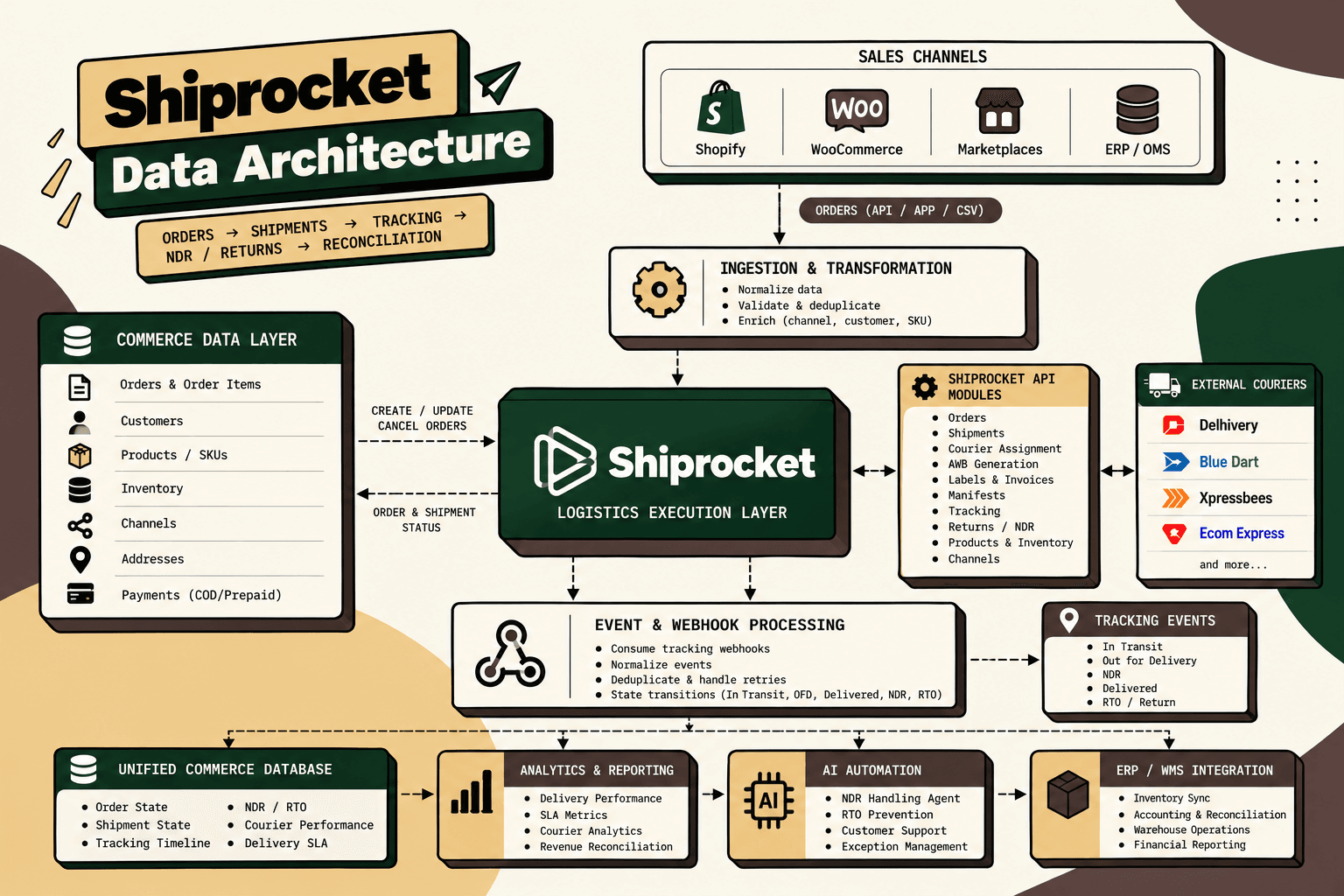
WhatsApp → AI conversation layer → Shopify/ERP → Shipping → Returns/Refunds → Human escalation
That changes the workflow from “customer asks a question, agent searches for an answer” to “customer asks a question, the system retrieves the relevant information and completes an approved action.”
WhatsApp Business services support business-customer conversations, and Meta's Business Platform policies explicitly allow automated responses during the customer-service window while requiring clear escalation options when human help is needed. WhatsApp Business Messaging Policy
What Is a WhatsApp AI Chatbot for Ecommerce?
Answer: A WhatsApp AI chatbot for ecommerce is a conversational system that uses WhatsApp as the customer interface and connects to ecommerce, order, shipping, returns or other operational systems to answer questions and, where permitted, trigger workflows.
Explanation: A basic chatbot can answer predefined questions. A connected AI chatbot can understand natural-language requests, retrieve customer-specific information and route the conversation into a workflow.
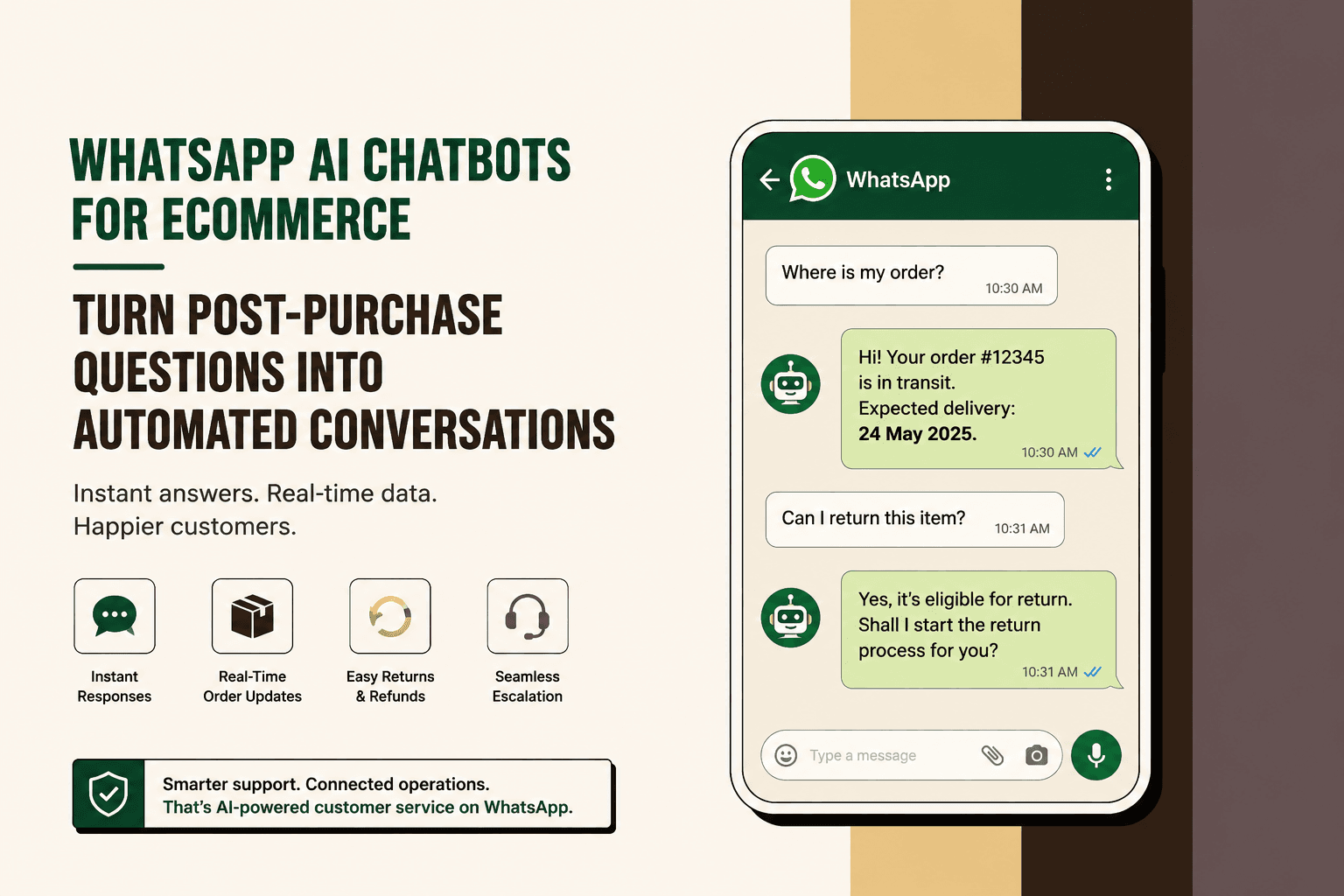
Example: Instead of sending a customer to a tracking page, the customer can ask, “Where is my order?” The system can identify the relevant order, retrieve its current status and return the information conversationally.
Implication: The support interaction becomes a data-retrieval workflow rather than a knowledge-base lookup.
Action: Start by connecting the highest-volume post-purchase questions to reliable data sources before expanding into more complex actions.
Why Post-Purchase Questions Are a Strong Automation Opportunity
Post-purchase support contains a useful combination of characteristics for automation: many requests are repetitive, the required information is often structured, and the desired outcome is usually well defined.
- Order status
- Delivery estimates
- Tracking information
- Return eligibility
- Exchange requests
- Refund status
- Cancellation requests
- Address-change questions
- Basic product or policy questions
The challenge is that the answer may live in a different system for every question.
Order information may be in Shopify or an OMS. Inventory may be managed by an ERP or WMS. Shipment events may come from a carrier or 3PL. Return status may live in a returns platform. The chatbot becomes useful only when it can access the right operational context.
The Difference Between a Chatbot and a Connected Support Workflow
| Capability | Basic chatbot | Connected AI workflow |
|---|---|---|
| FAQ answers | Yes | Yes |
| Customer-specific order data | Usually limited | Retrieved from connected systems |
| Order tracking | Provides a link | Can retrieve current status |
| Returns | Explains policy | Can check eligibility and start approved workflows |
| Refund questions | Provides general information | Can retrieve permitted refund status |
| Exceptions | Usually escalated | Can classify and route approved exceptions |
| Actions | Limited | Can trigger approved system actions |
The distinction matters. If the chatbot cannot access current business data or perform approved actions, it remains primarily a conversational FAQ layer.
How a Post-Purchase WhatsApp Conversation Works
1. The customer starts the conversation
The customer sends a natural-language request such as “Where is my order?” or “I need to return my shoes.”
2. The AI identifies the intent
The system determines whether the customer is asking about tracking, delivery, returns, exchanges, refunds, cancellations or another supported workflow.
3. The system identifies the relevant customer and order
The workflow should verify which customer and order the request relates to before exposing private order information or taking an action.
4. The AI retrieves current data
The system calls the appropriate operational source rather than relying on the model's stored knowledge.
5. Business rules are applied
Eligibility, refund limits, return windows and other deterministic policies should be enforced through business logic rather than left entirely to the language model.
6. The workflow responds or acts
The AI explains the result in natural language and can trigger an approved action where the workflow allows it.
7. Exceptions go to humans
When the request falls outside policy, the data is incomplete or the financial or customer impact is significant, the conversation should move to a human support agent.
Example: Turning “Where Is My Order?” Into an Automated Conversation
Customer: Where's my order?
AI: I can check that. Please confirm the order you're asking about.
System: Retrieve the customer's eligible order and current fulfillment or carrier status.
AI: Your order is currently in transit. The latest tracking event was recorded by the carrier today.
The important part is not the wording of the response. The important part is the workflow behind it.
The chatbot must retrieve current information from an approved source. It should not invent a delivery date simply because a customer asks for one.
Example: Turning a Return Request Into a Workflow
Customer: I want to return the shoes I bought.
AI: I can check whether the order is eligible for return.
System: Retrieve the order, item, purchase date and applicable return rules.
AI: Your item is eligible under the current return policy. Would you like to start the return?
Customer: Yes.
System: Create or initiate the approved return workflow.
AI: Your return request has been created. I’ll provide the next available return instruction.
This is where a chatbot becomes an operational interface. The customer does not need to navigate several systems because the conversation coordinates the workflow.
What Should Be Automated and What Should Stay Human?
The safest architecture does not attempt to automate every support decision.
| Workflow | Recommended approach | Reason |
|---|---|---|
| Order tracking | Automate | Structured status data is usually available |
| Delivery updates | Automate with current carrier data | Low ambiguity when tracking data is reliable |
| Return-policy questions | Automate | Policy can be expressed as deterministic rules |
| Simple return initiation | Automate with validation | Clear eligibility and defined action |
| High-value refund exception | Human approval | Higher financial impact |
| Fraud or identity concern | Human review | Higher security and risk requirements |
| Ambiguous complaint | AI triage plus human escalation | Requires contextual judgment |
The objective is not maximum automation. It is appropriate automation.
The Architecture Behind a WhatsApp Ecommerce AI Chatbot
A production workflow normally has several distinct layers.
Customer channel
WhatsApp provides the conversational interface where the customer asks questions and receives responses.
AI conversation layer
The AI interprets intent, gathers missing information, maintains conversational context and decides which approved workflow should be invoked.
Commerce and operational integrations
The workflow connects to Shopify, an ERP, OMS, WMS, shipping platforms, returns systems or other approved data sources.
Business rules
Rules determine what the AI is allowed to do. For example, a return may require an eligible order, an eligible item and a valid return window.
Action layer
Approved workflows can create return requests, retrieve tracking information, update permitted records or trigger customer communications.
Human escalation
Complex, risky or unresolved requests move to a human with the conversation context preserved.
Five Anchor POV: The most important architecture decision is not which AI model generates the reply. It is which operational systems the agent can access, which actions it can perform and where human approval is mandatory.
How Shopify, ERP and Shipping Data Fit Together
A post-purchase chatbot is only as accurate as the data it can retrieve.
A typical workflow may look like:
- Shopify or another commerce platform provides order information.
- The ERP or inventory system provides relevant operational data.
- The warehouse or OMS provides fulfillment status.
- The shipping or carrier system provides tracking events.
- The returns platform provides return status and eligibility information.
- The AI combines the permitted information into a customer-facing response.
This is why a WhatsApp chatbot should not be treated as a standalone customer-service application. It is an interface over an ecommerce operations stack.
Post-Purchase Questions That Make Good First Automations
A useful starting point is to rank support requests by volume, repetition, data availability and action complexity.
| Question | Automation potential | Primary dependency |
|---|---|---|
| Where is my order? | High | Order and tracking data |
| When will it arrive? | High | Carrier or fulfillment data |
| How do I return this? | High | Return policy |
| Is my item eligible for return? | High with rules | Order and policy data |
| What is my refund status? | High with integration | Returns and finance data |
| Can I change my address? | Medium | Order status and policy |
| My package says delivered | Medium | Carrier and exception workflow |
| I want a special refund exception | Low | Human judgment |
A Practical Implementation Framework
Building the chatbot should start with the workflow rather than the AI model.
- Map: Document the customer trigger, required information, systems involved, decisions, actions, exceptions and human handoffs.
- Baseline: Measure message volume, response time, manual handling time, escalation rate and the operational cost of the existing process.
- Prioritize: Compare candidate workflows using volume × frequency × manual effort × error cost × revenue impact ÷ implementation complexity. This is a practical prioritization model, not an industry-standard formula.
- Classify: Decide which steps should be deterministic automation, AI-assisted, human-approved or human-only.
- Connect: Integrate WhatsApp with the commerce, ERP, shipping, returns and support systems required for the selected workflow.
- Guardrail: Define permissions, validation, escalation thresholds, retries, logging and monitoring.
- Pilot: Start with one high-volume, low-risk post-purchase workflow.
- Measure: Track response time, ticket deflection, automation completion, escalation rate, error rate and customer satisfaction.
- Scale: Expand into returns, exchanges, cancellations and other workflows only after the initial flow is reliable.
WhatsApp-Specific Guardrails Matter
Automation on WhatsApp is subject to platform policies as well as the brand's own privacy, consent and customer-service requirements.
Meta's WhatsApp Business Messaging Policy states that businesses need appropriate consent for messages, must respect opt-outs, and should provide clear escalation options such as human support when needed. It also specifies rules around business-initiated conversations and approved message templates. WhatsApp Business Messaging Policy
For ecommerce teams, this means the implementation should include more than the AI prompt. Consent management, permissions, customer identification, escalation and message-policy compliance belong in the architecture.
What AI Should Not Do
There are several failure modes worth designing against from the beginning.
Do not let AI invent order information
Current order, delivery and refund information should come from connected systems.
Do not let AI override business rules
If an item is outside a defined return window, the model should not independently invent an exception.
Do not give broad system access
Agents should receive the minimum permissions required for their workflows.
Do not hide uncertainty
If tracking data is missing or contradictory, the customer should be told that the information cannot currently be confirmed and the case should be escalated where appropriate.
Do not eliminate human support
Complex complaints, sensitive cases, financial exceptions and unresolved issues need a clear human path.
How to Measure Whether the Chatbot Is Working
The success of a WhatsApp AI chatbot should be measured at the workflow level rather than by message count alone.
- First-response time: How quickly does the customer receive a useful response?
- Automation completion rate: How often does the workflow complete without human intervention?
- Escalation rate: Which requests still require a human?
- Error rate: How often does the system provide incorrect or incomplete information?
- Ticket deflection: How many requests no longer become traditional support tickets?
- Resolution time: How long does it take to resolve a post-purchase issue?
- Customer satisfaction: Does automation improve or damage the customer experience?
- Operational effort: How much manual support work is actually removed?
A high automation rate is not automatically a good result. If customers receive incorrect answers or become frustrated by the bot, the business has optimized the wrong metric.
Illustrative Scenario: From Ticket Queue to Conversation
Illustrative scenario: Suppose a D2C brand receives 300 post-purchase questions per day, and a large share involves order tracking, delivery and return-policy requests. If the brand can safely automate a portion of those workflows, the potential value comes from reducing repetitive agent handling while giving customers faster access to current information.
The actual benefit depends on the brand's request mix, average handling time, integration complexity, escalation rate and customer experience. The scenario should therefore be measured against a real baseline rather than treated as a guaranteed savings estimate.
Where Five Anchor Fits
Problem: A D2C brand may already have WhatsApp, Shopify, an ERP, shipping systems and a support team, but customers still need to ask an employee for information that exists somewhere in those systems.
Architecture: The better approach is to connect the WhatsApp conversation layer to ecommerce and operational systems so the AI can retrieve current information and invoke approved workflows.
Implementation: Five Anchor's AI-powered customer operations work can include WhatsApp AI chat operations, customer self-service, automated customer communication, ticket automation and returns or exchange workflows. Its commerce infrastructure capabilities can connect the customer-facing workflow to Shopify, ERP, inventory, warehouse and shipping systems.
Outcome: The goal is to move repetitive post-purchase requests from manual ticket handling into measurable conversational workflows while keeping high-risk exceptions with human agents.
Start With One Conversation, Not an Entire Support Department
The strongest first use case is usually narrow.
For example, begin with “Where is my order?”.
- Connect WhatsApp.
- Identify the customer securely.
- Retrieve the relevant order.
- Retrieve current fulfillment or tracking information.
- Return the status conversationally.
- Escalate when the data is missing or the customer reports an exception.
- Measure completion, accuracy, escalation and satisfaction.
Once that workflow is reliable, add returns, exchanges, refund-status questions and other high-volume requests.
Conclusion
WhatsApp AI chatbots for ecommerce are most valuable when they stop being simple answer engines and become interfaces to post-purchase operations.
The customer asks a question in natural language. The system identifies the intent, retrieves current information, applies business rules, performs an approved action when appropriate and escalates exceptions to a human.
That is the difference between adding an AI chatbot to customer support and building an AI-powered customer operation.
The goal is not to automate conversations. It is to automate the workflow behind the conversation.
Key Takeaways
- •A useful WhatsApp AI chatbot should connect conversations to live ecommerce and operational data.
- •Order tracking, delivery questions and simple return workflows are strong candidates for early automation.
- •AI should interpret customer intent while deterministic business rules control eligibility and permissions.
- •The chatbot needs access to Shopify, ERP, shipping, returns or other systems where the required information lives.
- •High-risk refunds, ambiguous complaints and sensitive exceptions should retain human approval.
- •WhatsApp-specific consent, messaging and escalation requirements belong in the implementation architecture.
- •Measure response time, automation completion, escalation, accuracy, ticket deflection and customer satisfaction rather than message volume alone.
Basic Chatbot vs Connected Ecommerce AI Workflow
| Capability | Basic Chatbot | Connected AI Workflow |
|---|---|---|
| Inventory Sync Frequency | 15–30 min batch polling (high oversell risk) | Sub-second atomic locking (<450ms) |
| Concurrent Drop Resilience | Fails under concurrency; causes negative stock balance | Redis atomic reservation queue guarantees exact counts |
| Error Handling & Retries | Silent failure; manual CSV audit needed | Dead-letter queues with automated exponential retry |
| Fulfillment Routing Speed | 2–4 hours delayed batch export to 3PL warehouse | Instantaneous automated webhook dispatch (<90 sec) |