Shiprocket's AI Strategy Is Expanding Beyond Shipping
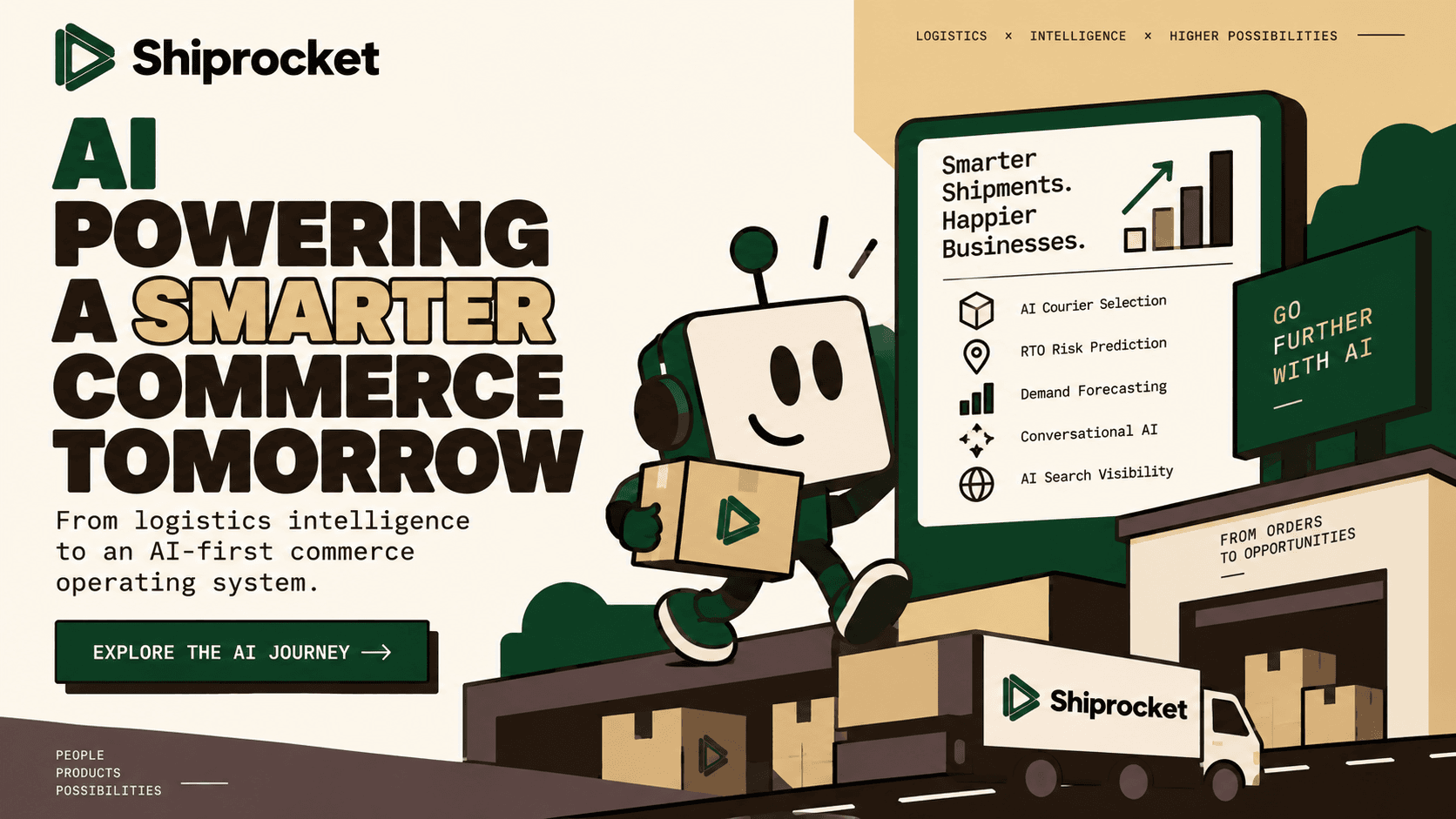
Shiprocket's artificial intelligence strategy is increasingly visible across three connected areas: logistics intelligence, AI-powered merchant workflows and a broader ambition to make commerce operations more conversational and automated.
The shift matters because Shiprocket historically operated around shipping and ecommerce enablement. Its newer AI initiatives indicate a broader direction: use data and AI not only to move an order, but to help decide what should happen before, during and after the shipment.
Publicly available Shiprocket material shows this progression across products and initiatives including Shiprocket Sense, RADAR, conversational analytics, AI copilots and the newer AITLAS platform. Recent reporting also describes plans to invest in AI and emerging businesses as Shiprocket expands beyond its core shipping business. Business Standard's August 2026 report quotes Shiprocket CEO Saahil Goel describing an ambition to bring an AI experience to merchants and reduce dependence on multiple software interfaces.
The strategic progression can be summarized as:
Shipping infrastructure → logistics intelligence → prediction → recommendations → conversational interfaces → agentic workflows → broader commerce operating infrastructure.
This article examines what that strategy means, where Shiprocket is applying AI, how its products fit together, what the approach reveals about the future of ecommerce infrastructure, and where a broader AI infrastructure layer fits into the picture.
What Is Shiprocket's AI Strategy?
Answer: Shiprocket's publicly visible AI strategy combines predictive logistics intelligence, merchant-facing AI assistants, operational automation and AI-powered commerce tools. The direction is moving from using AI to optimize individual shipping decisions toward using AI as an interface and decision layer across a wider set of merchant workflows.
The strategy can be understood through three layers:
- Predict: identify delivery, RTO, courier, address and demand-related risks.
- Recommend: turn operational data into courier, shipping and merchant decisions.
- Act: use conversational AI, copilots and increasingly agentic workflows to execute or coordinate tasks.
This interpretation is supported by Shiprocket's own product material. Its RADAR product focuses on real-time courier intelligence, while Shiprocket's product updates describe conversational analytics and AI-powered operational tools. More recently, AITLAS extends the AI strategy into brand visibility and AI search. Shiprocket's RADAR overview and Shiprocket's AITLAS announcement provide examples of this wider direction.
1. AI-Powered Logistics Optimization
The most direct application of AI in Shiprocket's business is logistics.
Traditional logistics decisions often rely on fixed rules, historical averages or manual operator judgment. An AI-enabled logistics platform can incorporate more variables and respond to changing operational conditions.
Shiprocket's published AI material identifies applications including courier selection, route optimization, demand forecasting, shipment tracking and weight intelligence. The practical objective is not simply to automate a shipping screen. It is to improve the decision made for each shipment.
Courier Selection
Courier performance varies by location, capacity, shipment volume and operating conditions. A courier that performed well for a particular pincode yesterday may not be the best option under different conditions today.
AI and real-time data can therefore support courier allocation using signals such as serviceability, delivery performance, SLA adherence, historical behavior and current network conditions.
This changes the operational question from:
Which courier do we normally use?
to:
Which available courier is most appropriate for this shipment under current conditions?
Route and Delivery Optimization
AI can also support route and delivery decisions by analyzing operational data and identifying patterns that are difficult to manage manually at scale.
The important point is that logistics optimization is fundamentally a decision problem. The value of AI comes from improving decisions using data, not from adding a chatbot to an existing shipping workflow.
Demand Forecasting
Demand forecasting extends the AI strategy upstream from shipping.
If a merchant can estimate future demand more effectively, the business can make better decisions about inventory, replenishment and fulfillment capacity. Shiprocket's published material on AI demand planning describes AI as a way to improve forecasting and reduce planning risk.
Shiprocket's AI demand-planning article provides its perspective on this application.
2. Shiprocket Sense and the Move From Prediction to Prevention
A second layer of Shiprocket's AI strategy focuses on preventing delivery problems before they become operational failures.
Shiprocket Sense is positioned around data intelligence for areas such as address validation, address standardization, RTO-risk prediction, fraud or risk intelligence and delivery-time estimation.
The strategic importance is that predictive intelligence becomes useful when it is inserted into the transaction workflow.
For example, identifying an order with elevated RTO risk before fulfillment can potentially create an opportunity for an intervention. The exact intervention depends on the merchant's policies and the system integration available.
This creates a useful progression:
Historical data → risk prediction → intervention → measured outcome.
Shiprocket also positions Sense capabilities through APIs, which allows intelligence to become part of another ecommerce application's workflow rather than remaining confined to a dashboard.
Shiprocket Sense provides the company's current product description of this intelligence layer.
3. RADAR: Turning Delivery Data Into Operational Decisions
RADAR is another important example of Shiprocket's AI strategy because it moves from historical reporting toward real-time courier intelligence.
According to Shiprocket, RADAR analyzes courier performance at the courier-pincode level and surfaces signals such as SLA adherence, delivery attempts, NDR reattempt performance and RTO-related behavior.
Its stated purpose is to help sellers identify delivery risks earlier and make more informed courier decisions.
Shiprocket's RADAR documentation describes the product as an AI-powered courier intelligence system that uses live shipment signals to identify delivery risks.
Why Real-Time Intelligence Matters
Courier performance is not static. It can change with shipment volume, regional capacity, hub workload and last-mile conditions.
A historical dashboard tells a seller what happened. A predictive system attempts to identify what is changing now and what may happen next.
That difference is strategically important because the commercial value of logistics intelligence often comes from intervening before a problem reaches the customer.
RADAR therefore illustrates a broader pattern in Shiprocket's AI strategy:
Reporting → intelligence → early warning → operational decision.
4. Conversational AI and Merchant Copilots
The next layer is the interface between merchants and their data.
Instead of requiring a seller to navigate several reports, filters and operational screens, conversational AI allows the user to ask questions in natural language.
Shiprocket's product updates describe Trends as a conversational ecommerce analytics experience where sellers can ask natural-language questions about their ecommerce data.
For example, a merchant could ask a system to analyze delivery performance, RTO or COD data rather than manually constructing a report.
Shiprocket has also described AI FAQ and support capabilities, Data Copilot and Co-finder in its TechSphere material. These initiatives point toward a broader product-design principle: AI becomes an interface through which merchants access the underlying commerce platform.
Shiprocket TechSphere provides the company's product and technology context for these AI experiences.
Why the Interface Matters
A dashboard exposes data. A conversational interface exposes questions.
That distinction matters because merchants do not necessarily think in database fields. They think in business questions:
- Which courier is causing the most delivery problems?
- Which pincodes have the highest RTO risk?
- Where are delivery delays increasing?
- What happened to COD performance this week?
- Which shipments need attention?
An AI interface can translate these questions into queries against the underlying data and return an explanation in business language.
The reliability of that experience, however, still depends on data quality, permissions, system connectivity and the ability to distinguish facts from generated interpretation.
5. From Copilots to Agentic AI
Generative AI changes the interaction model, but agentic AI changes the workflow model.
A copilot generally assists a human with information or recommendations. An agentic workflow can potentially interpret an objective, determine the required steps, interact with connected systems and execute approved actions.
Shiprocket's 2026 messaging explicitly references an “Agentic Era,” signaling an interest in moving AI beyond simple assistance toward more active business workflows.
The distinction can be illustrated with an ecommerce delivery problem.
Traditional dashboard: shows that a courier's performance has deteriorated.
AI copilot: tells the merchant that delivery performance has deteriorated and identifies the affected pincodes.
Agentic workflow: identifies the affected shipments, evaluates the available courier options according to predefined rules, recommends or executes an approved reassignment, and records the operational action.
The exact level of autonomy depends on the product and permissions. The important strategic shift is from AI answering a question to AI participating in the workflow that follows the question.
6. AITLAS Expands Shiprocket's AI Strategy Beyond Logistics
One of the most significant recent developments is that Shiprocket's AI activity is no longer limited to shipping and logistics.
Shiprocket has launched AITLAS, an AI visibility platform focused on how brands appear across AI search and answer engines. Its published material describes RADAR for monitoring AI visibility and HYDRA for AI-optimized content execution.
Shiprocket AITLAS describes monitoring across platforms including ChatGPT, Gemini, Google AI Overviews, Google AI Mode, Perplexity and Microsoft Copilot.
This matters strategically because it moves Shiprocket into another layer of ecommerce infrastructure: customer discovery.
The traditional ecommerce stack can be represented as:
Discovery → Storefront → Checkout → Payment → Order → Fulfillment → Shipping → Delivery → Returns.
AI visibility introduces another layer before the purchase:
AI discovery → recommendation → merchant or product selection → storefront → transaction → fulfillment.
AITLAS therefore expands the strategic footprint from physical commerce execution into AI-mediated customer acquisition.
7. The Emerging Shiprocket AI Stack
Viewed together, Shiprocket's public AI initiatives can be organized into several layers.
| Layer | Example | Primary Function |
|---|---|---|
| AI visibility | AITLAS | Monitor and improve brand visibility in AI search |
| Generative AI | Merchant copilots and conversational experiences | Natural-language access to ecommerce information and tasks |
| Predictive intelligence | Sense and RADAR | Predict risk and identify operational patterns |
| Logistics intelligence | Courier and delivery optimization | Improve shipment-level decisions |
| Operational automation | AI-assisted workflows | Move from recommendation toward execution |
| Commerce infrastructure | Shipping, checkout, engagement and merchant systems | Connect the broader ecommerce operating environment |
This makes Shiprocket's AI strategy broader than a single AI product. It is better understood as an attempt to introduce intelligence at multiple points in the ecommerce operating chain.
8. The Strategic Progression: Predict, Recommend, Act
A useful way to understand Shiprocket's AI direction is to separate intelligence into three stages.
Stage 1: Predict
AI analyzes historical and real-time data to estimate what may happen.
Examples include:
- RTO risk.
- Courier performance risk.
- Delivery delays.
- Demand patterns.
- Address-related delivery problems.
Stage 2: Recommend
The system converts predictions into recommended decisions.
Examples include:
- Courier selection.
- Shipment intervention.
- Operational prioritization.
- Merchant recommendations.
- Analytics-driven actions.
Stage 3: Act
AI increasingly participates in the workflow itself.
Examples can include:
- Conversational task execution.
- AI-assisted merchant operations.
- Automated content execution.
- Connected operational workflows.
- Agentic decision-making within defined boundaries.
The strategic value increases as the system moves closer to action, but so does the requirement for reliable data, permissions, monitoring and human oversight.
9. Why Shiprocket's Data Scale Matters to Its AI Strategy
AI systems become more useful when they have access to relevant, structured and sufficiently large operational datasets.
Logistics generates many different signals: courier performance, pincodes, delivery attempts, NDR events, RTO outcomes, shipment weights, fulfillment states and delivery timelines.
That creates a potentially valuable feedback loop:
Shipment data → model or intelligence → decision → shipment outcome → new data.
The strength of such a loop depends on data quality and the relevance of the available signals. More data alone does not guarantee better AI decisions. The data must also be timely, correctly associated with business events and used within an appropriate decision framework.
Shiprocket's RADAR material specifically emphasizes the relationship between live shipment signals and high shipment volume when identifying courier-performance patterns. Shiprocket's RADAR explanation provides the company's description of this approach.
10. Shiprocket's AI Strategy Is Also an Interface Strategy
One of the deeper implications of Shiprocket's AI direction is that AI is becoming an alternative interface to business software.
Traditionally, merchants interact with ecommerce systems through menus, dashboards, filters and forms.
AI changes that model to:
Intent → natural-language request → system interpretation → data retrieval → recommendation or action.
Instead of opening a dashboard and searching for a report, the merchant asks a question.
Instead of manually comparing operational data, the merchant asks the system to identify the relevant pattern.
Instead of remembering which screen contains a particular setting, the merchant may increasingly describe the desired outcome.
This does not mean dashboards disappear. It means the interface layer can become more flexible.
11. What Remains Difficult for an AI-First Commerce Platform
AI strategy is not only about capabilities. It is also about the operational constraints that determine whether those capabilities work reliably.
Data Quality
An AI system cannot produce reliable operational intelligence from incomplete or inconsistent source data.
Order status, courier events, inventory state and customer information need consistent identifiers and timely synchronization.
System Integration
AI becomes more useful when it can interact with the systems where business actions actually occur. A recommendation without an execution path can still leave manual work behind.
Permissions
Agentic systems require explicit boundaries. The system should know which actions it can perform automatically, which require confirmation and which must always be escalated.
Monitoring
Predictive and generative systems need ongoing monitoring. Business conditions change, integrations fail and models can produce unexpected outputs.
Human Oversight
High-impact actions should not automatically become autonomous simply because the underlying technology can technically perform them.
The relevant question is not “Can AI do this?” It is “What level of autonomy is appropriate for this business decision?”
12. What Shiprocket's AI Strategy Means for D2C Brands
For D2C businesses, the implications go beyond shipping.
AI can increasingly connect decisions across the ecommerce lifecycle:
Customer discovery → product selection → checkout → order processing → inventory → fulfillment → courier allocation → delivery → NDR → RTO → returns → customer support → analytics.
The opportunity is to reduce the number of disconnected operational decisions.
For example, a delivery-risk prediction is more valuable if it can influence a downstream action. An AI-generated insight is more useful if the merchant can act on it without manually translating the recommendation into another workflow.
This is where AI infrastructure becomes different from an AI feature.
13. AI Feature vs AI Infrastructure
An AI feature adds intelligence to one part of an existing product.
AI infrastructure connects intelligence to the systems and workflows that operate the business.
| Dimension | AI Feature | AI Infrastructure |
|---|---|---|
| Primary purpose | Add intelligence to one workflow | Connect intelligence across workflows |
| Data | Usually focused on one data domain | Combines relevant operational data sources |
| Action | May provide a recommendation | Can connect recommendation to execution |
| Integration | Often product-specific | Designed around the operating stack |
| Human role | Usually remains central to execution | Can shift humans toward exceptions and approvals |
| Scaling | Expand individual features | Expand reusable workflows and orchestration |
This distinction is useful when evaluating Shiprocket and the wider ecommerce AI market. The strategic question becomes how much of the merchant's operating environment can be connected through an intelligent layer.
14. Where Five Anchor Fits Into This Landscape
Five Anchor approaches ecommerce AI from the broader infrastructure layer: connecting commerce platforms, marketplaces, ERP, inventory, customer operations and intelligence through AI agents, automation and integrations.
The overlap with Shiprocket's direction is most visible around operational intelligence and workflow automation, but the implementation scope can extend across a merchant's wider technology stack.
Problem: D2C operations often span Shopify or marketplaces, ERP, inventory, warehouses, shipping providers, customer support, returns and financial systems.
Architecture: an AI infrastructure layer can connect these systems, normalize relevant information and route decisions to the appropriate workflow.
Implementation: Five Anchor's Commerce Infrastructure services include marketplace and ERP integrations, order processing automation, inventory synchronization, warehouse and shipping integrations and custom AI workflows. Its AI-Powered Customer Operations work includes AI chat and voice operations, returns and exchange automation, customer self-service and ticket automation.
Business outcome: the objective is to make operational workflows more connected and measurable, while keeping human approval where the business requires it.
This creates a useful distinction: Shiprocket's AI strategy demonstrates how intelligence can be embedded deeply into logistics and merchant workflows, while a broader ecommerce AI infrastructure approach can connect multiple operational systems around the merchant's entire order lifecycle.
For a D2C brand, the implementation question is therefore not necessarily whether to use one AI system or another. It is which workflows require logistics intelligence, which require commerce orchestration, which require customer-operation automation and how those systems should exchange data.
15. A Practical AI Architecture for D2C Operations
A broader D2C AI architecture can be represented as:
Customer and Sales Channels → Commerce Platform → ERP → Inventory → OMS/WMS → Shipping and 3PL → Tracking → Returns → Customer Operations → Analytics → AI Orchestration.
AI can operate at several points across this architecture.
- Prediction: identify risks or future states.
- Classification: determine what type of request or operational event occurred.
- Recommendation: suggest an appropriate next action.
- Execution: perform an approved system action.
- Communication: explain the result to customers or operators.
- Monitoring: measure whether the workflow achieved the intended outcome.
The architecture should preserve clear ownership of truth. ERP, commerce, inventory and shipping systems remain authoritative for their respective operational records.
16. How to Evaluate an Ecommerce AI Strategy
Companies evaluating AI platforms should avoid judging them only by the quality of their demonstrations.
A useful evaluation framework is:
- Data: What operational data can the system access?
- Integration: Which systems can it connect to?
- Intelligence: What can it predict, classify or recommend?
- Action: Which workflows can it execute?
- Permissions: How is autonomy controlled?
- Monitoring: Can decisions and failures be audited?
- Human escalation: What happens when the AI is uncertain?
- Measurement: Which business KPIs demonstrate that the system is actually improving operations?
This framework is more useful than simply asking whether a platform “uses AI.”
17. A Practical Automation Prioritization Model
Not every ecommerce workflow should be automated immediately.
A practical prioritization model is:
Volume × Frequency × Manual Effort × Error Cost × Revenue Impact ÷ Implementation Complexity.
This is a practical framework, not an industry-standard formula.
High-volume order-status requests may score highly because they occur frequently, consume repetitive human effort and have relatively predictable resolution paths.
A complex high-value dispute may require more human judgment and therefore be better suited to AI-assisted triage rather than fully autonomous execution.
The purpose of the model is to prioritize workflows based on business value and implementation reality, rather than choosing automation simply because a use case is technically interesting.
18. The Most Important Shift: From Analytics to Action
Shiprocket's AI strategy illustrates a wider transition taking place across ecommerce technology.
First, businesses digitized their operational records.
Then they built dashboards to understand those records.
Next, predictive systems began identifying patterns and risks.
Now, AI interfaces can interpret natural-language questions and increasingly participate in operational workflows.
The progression is:
Data → dashboard → prediction → recommendation → action.
The final stage is the most operationally significant because action creates measurable business consequences.
It also creates the greatest requirement for guardrails.
19. What Shiprocket's Strategy Signals for Ecommerce Technology
Shiprocket's AI direction suggests that ecommerce infrastructure is becoming less about individual software categories and more about connected decision systems.
Shipping, checkout, customer engagement, analytics, advertising, fulfillment and merchant operations can increasingly be connected through shared data and AI interfaces.
The strategic advantage of such a model is not simply that a merchant has more AI features. It is that the merchant can make decisions with more context and potentially reduce the number of disconnected operational steps.
At the same time, the strategy creates a new set of technical requirements: reliable APIs, consistent identifiers, event-driven integrations, data governance, observability, permission management and human approval workflows.
AI does not remove the need for infrastructure. It makes good infrastructure more important.
20. Implementation Lessons for D2C Brands
Businesses looking to adopt a similar AI strategy should start with workflows rather than models.
Step 1: Map the Workflow
Document the current process from customer or operational trigger to final outcome.
Step 2: Identify the Data Sources
List the systems that contain the information required to make each decision.
Step 3: Separate Rules From AI
Use deterministic rules where the business logic is clear. Use AI where interpretation, classification or contextual reasoning adds value.
Step 4: Define the Action Boundary
Specify which actions the system can perform automatically and which require human confirmation.
Step 5: Build the Smallest Viable Workflow
Start with one high-volume use case rather than attempting to automate the entire operation.
Step 6: Establish Baseline Metrics
Measure handling time, resolution rate, errors, escalations, repeat contacts and relevant financial outcomes before deployment.
Step 7: Monitor Exceptions
Review cases where the AI was uncertain, incorrect or unable to complete the workflow.
Step 8: Expand Carefully
Once the first workflow is reliable, connect adjacent workflows and reuse the underlying integration and governance architecture.
21. Risks in an AI-First Commerce Strategy
An AI-first strategy introduces meaningful operational risks if implemented without controls.
Hallucination Risk
Generative AI can produce plausible but incorrect information. Operational systems should therefore remain the source of truth for order, inventory, payment and shipment facts.
Integration Failure
An AI agent cannot reliably complete a workflow when an underlying API is unavailable, stale or inconsistent.
Over-Automation
Not every decision should be autonomous. High-impact refunds, security-sensitive account changes and exceptional customer disputes may require human approval.
Hidden Maintenance Costs
AI workflows require monitoring, prompt or policy updates, integration maintenance, testing and ongoing review.
Data Governance
Connecting more systems creates more responsibility around access control, privacy, data retention and auditability.
The objective should therefore be controlled automation, not maximum automation.
22. Shiprocket AI Strategy: Key Takeaways
- Shiprocket's AI strategy is expanding from shipping optimization toward broader merchant and commerce workflows.
- Shiprocket Sense and RADAR illustrate the predictive-intelligence layer, particularly around delivery, courier and RTO-related decisions.
- Conversational analytics and merchant copilots show the move toward natural-language interfaces for ecommerce operations.
- Agentic AI represents the next step from recommendations toward workflow execution, subject to system integrations and permissions.
- AITLAS expands Shiprocket's AI footprint into AI search visibility and customer discovery.
- The strategic progression can be understood as predict → recommend → act.
- For D2C brands, the underlying infrastructure remains critical because AI depends on reliable data, integrations, permissions and monitoring.
Frequently Asked Questions
What is Shiprocket's AI strategy?
Shiprocket's publicly visible AI strategy combines predictive logistics intelligence, AI-powered merchant tools, conversational interfaces, workflow automation and newer AI products aimed at broader ecommerce operations. The direction extends beyond shipping toward an AI-enabled operating layer for merchants.
How does Shiprocket use AI in logistics?
Shiprocket uses AI and data intelligence across areas including courier performance, delivery risk, RTO prediction, address intelligence, demand planning and merchant analytics. RADAR is one example of an AI-powered courier intelligence product.
What is Shiprocket RADAR?
RADAR is Shiprocket's AI-powered courier intelligence system. Shiprocket describes it as using real-time shipment signals at courier and pincode level to identify delivery risks and support proactive courier decisions.
What is Shiprocket Sense?
Shiprocket Sense is an intelligence layer covering capabilities such as address intelligence, RTO-risk prediction and other shipment-related risk signals. Shiprocket also provides API-oriented access to parts of this intelligence.
Is Shiprocket using generative AI?
Yes. Shiprocket has publicly described conversational AI, merchant copilots and other generative-AI experiences. Its product material also describes natural-language interaction with ecommerce data and operational workflows.
What is Shiprocket's agentic AI strategy?
Shiprocket's 2026 messaging describes an “Agentic Era,” reflecting a move toward AI that can act as a collaborator rather than only provide information. The practical level of autonomy depends on the workflow, integrations, permissions and product implementation.
What is Shiprocket AITLAS?
AITLAS is Shiprocket's AI visibility platform for monitoring and improving how brands appear across AI search and answer engines. Its published architecture includes RADAR for AI visibility intelligence and HYDRA for AI-optimized content execution.
What does Shiprocket's AI strategy mean for D2C brands?
It suggests that ecommerce platforms are increasingly combining logistics, analytics, customer engagement and AI decision-making into connected operating environments. D2C brands should evaluate AI not only by individual features but by data access, integrations, workflow execution, permissions and measurable business outcomes.
Conclusion
Shiprocket's artificial intelligence strategy is broader than adding AI to shipping.
The visible direction moves through several stages: logistics optimization, risk prediction, real-time intelligence, conversational analytics, merchant copilots, agentic workflows and, more recently, AI-powered brand visibility.
That progression reflects a larger change in ecommerce infrastructure. The next generation of platforms will not only store operational data or display it in dashboards. They will increasingly interpret that data, recommend decisions and participate in approved workflows.
For D2C brands, the important lesson is not simply to adopt more AI. It is to build the infrastructure that allows AI to operate safely and usefully.
The strategic model is straightforward: connect the data, understand the workflow, define the decision boundary, automate where the rules are clear, keep humans involved where judgment matters, and measure the operational outcome.
That is the foundation for moving from AI as a feature to AI as part of the commerce operating system.
Key Takeaways
- •Shiprocket's AI strategy is moving beyond shipping optimization toward a broader AI-enabled commerce operating layer.
- •Shiprocket Sense and RADAR demonstrate the use of predictive and real-time intelligence for delivery, courier and RTO-related decisions.
- •Conversational AI and merchant copilots turn ecommerce data and workflows into natural-language interfaces.
- •Shiprocket's agentic AI direction points toward AI systems that can participate in operational workflows rather than only provide recommendations.
- •AITLAS expands Shiprocket's AI footprint into AI search visibility and customer discovery.
- •For D2C businesses, AI infrastructure, integrations, permissions, monitoring and human oversight remain essential to reliable automation.
Shiprocket AI Strategy: Intelligence Layers
| Traditional Ecommerce Operations | AI-Enabled Operations | Strategic Shift |
|---|---|---|
| Inventory Sync Frequency | 15–30 min batch polling (high oversell risk) | Sub-second atomic locking (<450ms) |
| Concurrent Drop Resilience | Fails under concurrency; causes negative stock balance | Redis atomic reservation queue guarantees exact counts |
| Error Handling & Retries | Silent failure; manual CSV audit needed | Dead-letter queues with automated exponential retry |
| Fulfillment Routing Speed | 2–4 hours delayed batch export to 3PL warehouse |