Logistics Automation for D2C Ecommerce: The Real Problem Is Not Shipping
For a growing D2C brand, logistics rarely breaks because one courier is too slow or one warehouse process is inefficient. It breaks because too many operational decisions sit between the moment an order is placed and the moment that order is delivered, returned, reconciled and restocked.
The workflow can involve the storefront, inventory system, warehouse, shipping platform, multiple courier partners, tracking events, customer communication, NDR management, RTO prevention, returns, refunds and financial reconciliation. When these systems are disconnected, operations teams end up moving information between tools, checking exceptions manually and reacting after a problem has already become expensive.
Logistics automation for D2C ecommerce means connecting these operational systems so that routine decisions and actions happen automatically, while exceptions and high-impact decisions are routed to people. The goal is not simply faster shipping. The goal is a more reliable operating system for the entire order lifecycle.
Research into current D2C logistics platforms shows a similar movement toward automated order processing, courier allocation, fulfillment, tracking, NDR/RTO management, returns and inventory synchronization. eShipz's D2C logistics overview and Shopify's ecommerce logistics guidance both emphasize automation across multiple stages of ecommerce fulfillment. :contentReference[oaicite:0]{index=0}
This creates a useful shift in how D2C founders should think about logistics technology: from buying another shipping tool to designing an automated logistics workflow.
What Is Logistics Automation in D2C Ecommerce?
Answer: Logistics automation is the use of software, integrations, rules and, where appropriate, AI to automatically coordinate ecommerce orders, inventory, fulfillment, shipping, tracking, delivery exceptions, returns and related operational actions.
Explanation: Traditional logistics operations often treat each activity as a separate task. An order is processed in one system, inventory is checked somewhere else, a courier is selected in another platform and customer communication may happen through a CRM or support system. Automation connects these steps around the order as the central operational object.
Example: Instead of an operations executive manually checking an order, confirming stock, selecting a courier, creating a shipment and sending tracking information, the system can reserve inventory, trigger fulfillment, select an eligible courier according to predefined rules, create the shipment and send the customer an automated update.
Implication: The largest opportunity is not automating isolated tasks. It is removing unnecessary human handoffs between connected tasks.
Action: Map the complete order lifecycle before selecting automation software. Identify every trigger, system, decision, action, exception and human handoff.
The D2C Logistics Workflow You Actually Need to Automate
A useful D2C logistics architecture can be viewed as:
Order → Inventory → Warehouse → Courier → Delivery → NDR/RTO → Returns → Restocking
The automated version becomes:
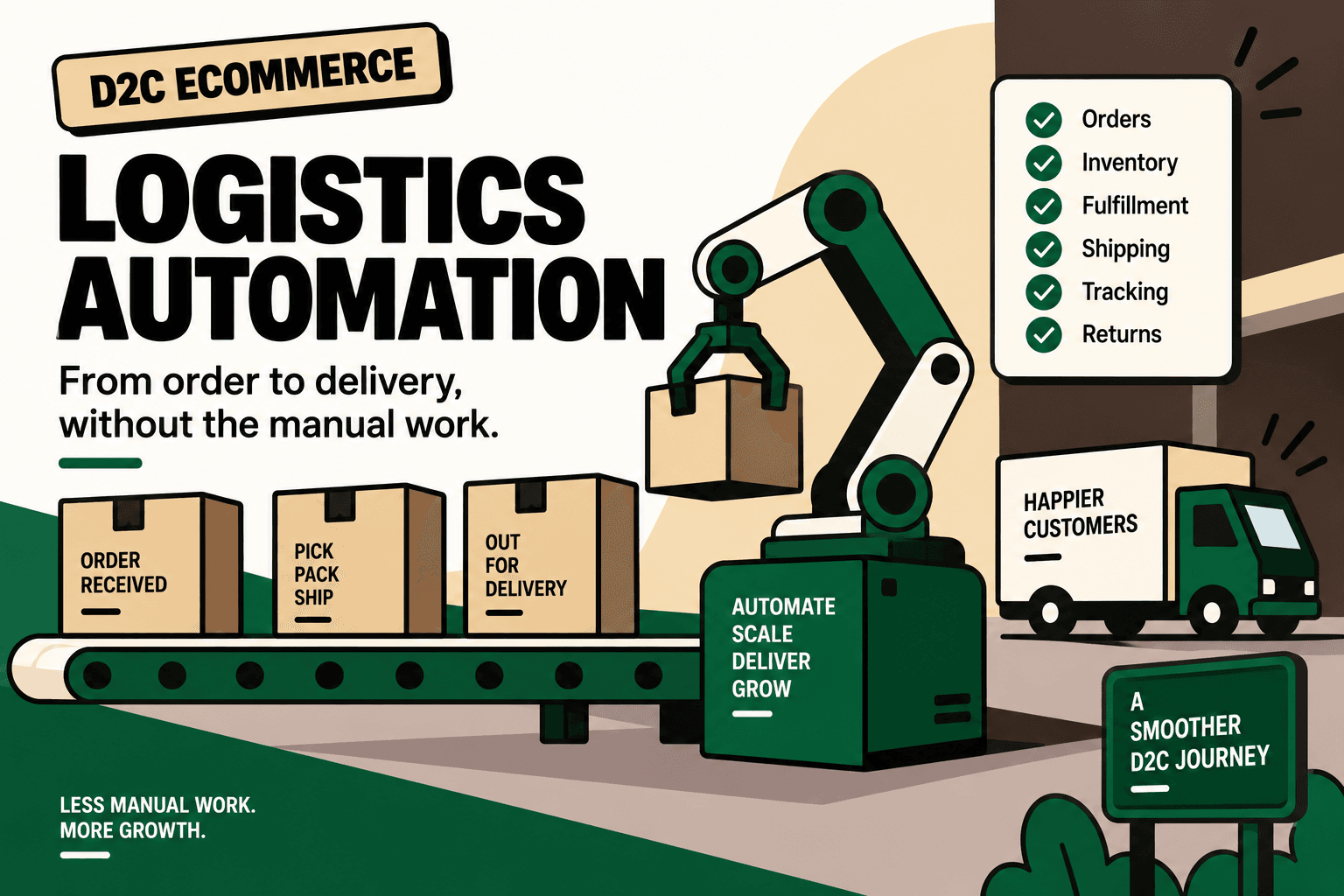
Order received → inventory reserved → fulfillment triggered → courier selected → shipment created → customer notified → exceptions handled → return processed → inventory updated
The distinction matters. A brand may already have software for every individual step and still have a highly manual logistics operation if those systems do not exchange data reliably.
| Stage | Manual workflow | Automated workflow |
|---|---|---|
| Order processing | Orders checked and processed manually | Orders flow automatically from connected channels |
| Inventory | Availability checked across systems | Inventory is synchronized and reserved automatically |
| Fulfillment | Warehouse instructions created manually | Fulfillment is triggered from order and inventory events |
| Courier allocation | Operations team chooses a carrier | Rules select an eligible carrier based on defined criteria |
| Tracking | Status checked manually | Shipment events synchronize automatically |
| NDR | Issues discovered after failed delivery attempts | Exceptions trigger predefined intervention workflows |
| Returns | Return requests handled case by case | Approved returns trigger reverse logistics and downstream actions |
| Restocking | Warehouse updates inventory after processing | Approved QC outcomes can trigger inventory updates automatically |
Why Manual Logistics Becomes Expensive as a D2C Brand Scales
Manual logistics creates more than administrative work. It introduces coordination cost into every order.
Consider a simple workflow. An order arrives through Shopify. The team checks stock, confirms the correct warehouse, creates fulfillment instructions, chooses a courier, generates a label, sends tracking information and watches the shipment. If the customer is unavailable, the team then has to react to an NDR event. If delivery fails, another workflow starts around RTO. If the customer requests a return, reverse logistics begins.
None of these tasks is necessarily difficult in isolation. The problem is repetition and dependency. A small error early in the chain can create multiple downstream tasks.
Five Anchor POV: For D2C operators, the important unit of automation is the workflow rather than the individual task. Automating label creation while leaving inventory synchronization, exception handling and customer communication disconnected can reduce one manual step without materially reducing operational complexity.
Seven Logistics Processes D2C Brands Should Automate
1. Automated Order Processing
Answer: Orders from ecommerce storefronts and marketplaces should enter a common operational workflow without requiring an employee to manually re-enter or reconcile routine order information.
Order automation can validate the order, identify the fulfillment location, reserve available inventory, apply shipping rules and trigger the next operational step.
Platforms serving D2C brands increasingly position centralized order processing as a core part of ecommerce logistics automation. eShipz's D2C logistics solution is one example of this approach.
What should remain human: unusual orders, fraud-related exceptions, conflicting inventory signals and orders that violate defined business rules.
2. Inventory Synchronization
Inventory becomes a logistics problem when the storefront, warehouse and marketplace systems do not agree on what is available.
Automated inventory synchronization keeps stock information aligned across relevant commerce and operational systems. This is particularly important for brands selling through multiple channels because a single inventory position may influence several storefronts simultaneously.
Implementation rule: define one authoritative inventory source or a clear inventory hierarchy before automating synchronization. Otherwise, automation can move incorrect inventory data faster.
3. Automated Courier Allocation
Courier selection can be treated as a rules-based decision instead of a manual operational task.
Potential inputs include destination, serviceability, delivery performance, cost, shipment characteristics and the brand's service requirements. Current logistics platforms increasingly use automated courier allocation as part of D2C shipping workflows. RapidShyp and eShipz are examples of platforms operating in this category.
Important: courier allocation does not have to mean choosing the cheapest carrier. A better rule may optimize for the lowest expected operational cost while respecting serviceability and delivery performance requirements.
4. Warehouse and Fulfillment Automation
Once an order is validated and inventory is available, the next question is how quickly and reliably the warehouse can execute the order.
Fulfillment automation can connect order information with warehouse instructions, pick-pack-ship workflows and inventory updates. This becomes more important when a D2C brand operates multiple fulfillment locations.
Platforms such as WareIQ and eHandler position fulfillment and warehousing as important components of D2C logistics operations.
5. Real-Time Tracking and Customer Communication
Tracking should not require an operations executive to repeatedly open courier portals and manually update customers.
Shipment events can be synchronized into a central operational layer and used to trigger customer communications. The exact communication channel may vary, but the underlying principle is the same: an operational event should create the appropriate next action automatically.
This reduces the gap between what the courier knows and what the customer knows.
Delhivery's D2C logistics offering highlights shipment visibility and delivery-related capabilities for D2C businesses.
6. NDR and RTO Automation
Answer: NDR automation is the use of predefined rules, shipment signals and, where appropriate, AI to identify delivery exceptions and initiate an intervention workflow.
NDR is operationally important because a failed delivery attempt can trigger customer communication, reattempt coordination and eventually an RTO process.
Rather than treating every NDR as an identical ticket, an automated system can classify the event, determine the appropriate action and escalate cases that require human intervention. Delhivery's D2C solution information describes NDR and RTO-related capabilities for D2C brands.
Human approval should remain: for unusual customer requests, high-value shipments, ambiguous delivery situations and exceptions where automated action could create disproportionate financial or customer risk.
7. Returns and Reverse Logistics
Returns automation should extend beyond approving a return request.
A complete workflow can connect the return request, eligibility rules, reverse pickup, shipment tracking, warehouse receipt, quality checks, restocking, exchange or refund processing and customer communication.
Current D2C logistics platforms increasingly treat returns as an integrated operational workflow rather than a separate support process. MetaPort's D2C returns automation overview illustrates this broader approach.
Rules vs AI vs Human Decisions in Logistics Automation
Not every logistics decision should be handed to AI. In many D2C workflows, deterministic automation is safer and easier to maintain for predictable decisions.
| Decision | Best starting point | Human involvement |
|---|---|---|
| Order validation | Deterministic rules | Exceptions only |
| Inventory reservation | Deterministic automation | Conflict resolution |
| Courier allocation | Rules and scoring | Policy changes and exceptions |
| Tracking updates | Event-driven automation | Customer escalations |
| NDR classification | Rules plus AI where useful | Ambiguous or high-risk cases |
| Return eligibility | Business rules | Policy exceptions |
| Return reason interpretation | AI-assisted classification | Disputed or unusual cases |
| Refund approval | Rules with thresholds | High-value exceptions |
The practical principle is simple: use rules for predictable decisions, AI for interpretation and classification where it adds value, and people for judgment-heavy or high-impact exceptions.
How to Prioritize D2C Logistics Automation
Do not begin by asking, “What can we automate?” Begin by asking, “Which workflow creates the greatest operational burden relative to its implementation complexity?”
A useful practical prioritization model is:
Volume × Frequency × Manual Effort × Error Cost × Revenue Impact ÷ Implementation Complexity
This is a practical decision framework, not an industry-standard formula.
| Workflow | Automation priority | Why |
|---|---|---|
| Order entry | High | High frequency and predictable logic |
| Inventory synchronization | High | Cross-system dependency and potential operational errors |
| Courier allocation | High | Repeated decision with measurable inputs |
| Tracking communication | High | Event-driven and repetitive |
| NDR intervention | High | Exception volume can consume operations capacity |
| Complex customer disputes | Low initially | Requires judgment and context |
| High-value refund decisions | Low initially | Financial and customer risk requires stronger controls |
How to Calculate the Business Case
Comparing the price of logistics software with the salary of an operations employee is usually too simplistic.
A better business case considers the cost of the existing workflow and the cost of operating the automated workflow.
Current workflow cost can include:
- Operations hours spent processing orders
- Manual reconciliation
- Error correction
- Customer support caused by poor shipment visibility
- RTO-related operational effort
- Inventory discrepancies
- Revenue leakage from preventable operational failures
- Management time spent monitoring exceptions
Automated workflow cost can include:
- Software
- API and integration work
- Implementation
- Data infrastructure
- Monitoring
- Maintenance
- Human oversight
- Exception handling
The correct KPI is not simply “hours saved.” It may be cost per fulfilled order, order processing time, error rate, inventory accuracy, NDR resolution rate, RTO rate, return processing time, customer response time or operational cost per order.
Illustrative scenario: If a D2C brand processes 500 orders per day and a repetitive manual process takes five minutes per order, the process represents approximately 41.7 hours of human handling per day. The calculation does not claim that five minutes is an industry benchmark; it simply shows why small per-order tasks can become significant at scale.
What a Scalable D2C Logistics Architecture Looks Like
A scalable architecture generally has five layers.
- Commerce layer: Shopify, marketplaces or other sales channels generate orders.
- Operational data layer: inventory, customer, product and order information is normalized.
- Orchestration layer: rules and workflow logic determine what happens next.
- Execution layer: warehouse, courier, tracking, returns and customer communication systems perform actions.
- Intelligence layer: dashboards, analytics and AI-assisted workflows identify exceptions, trends and optimization opportunities.
APIs and webhooks are typically useful for event-driven communication between these systems. The architecture should also define which system owns each data object so that automation does not create competing versions of the truth.
How to Implement Logistics Automation Without Breaking Operations
1. Map the Workflow
Document the current process from order creation through delivery and returns. Capture triggers, inputs, systems, decisions, actions, exceptions, human handoffs and outputs.
2. Establish a Baseline
Measure order volume, processing time, manual hours, error rates, response time, exception volume, RTO-related workload, return processing time and relevant customer metrics.
3. Identify the Bottleneck
Do not automate every step simultaneously. Find the workflow that is high-volume, repetitive, measurable and sufficiently stable to automate.
4. Classify Each Decision
Separate deterministic rules, AI-assisted decisions, human approval and human-only decisions. This prevents AI from being used where a simple rule is more reliable.
5. Connect the Systems
Identify the commerce platform, ERP, inventory system, warehouse system, shipping platforms, courier APIs, CRM or helpdesk and communication channels involved in the workflow.
6. Add Guardrails
Define validation rules, permissions, approval thresholds, retries, fallbacks, logging, monitoring and exception handling before enabling autonomous actions.
7. Start With One Small Workflow
A sensible first pilot might be automated order routing, inventory synchronization or shipment-status communication. The best starting point is usually high-volume and low-risk rather than strategically impressive.
8. Measure the Pilot
Compare the baseline with the automated workflow. Track processing time, hours saved, error reduction, response time, operational cost and any customer or revenue metric directly affected by the workflow.
9. Scale Only After Reliability
Once the workflow performs reliably, extend the same architecture to adjacent processes such as NDR, RTO, returns, exchanges, reconciliation and operational reporting.
Where AI Adds Value to Logistics Automation
AI is most useful when the workflow contains information that is difficult to handle with rigid rules alone.
- Classifying unstructured NDR or customer messages
- Interpreting return reasons
- Summarizing operational exceptions
- Prioritizing cases for human intervention
- Detecting patterns across operational data
- Generating customer communication from structured shipment events
- Supporting operational analysis across multiple data sources
AI should not replace deterministic systems simply because AI is available. If a rule can reliably determine that a shipment is eligible for a specific carrier, a rule may be preferable. If the system needs to interpret an ambiguous customer message about a failed delivery, AI may provide more value.
Five Anchor POV: The strongest D2C AI architecture is usually hybrid. Commerce and logistics systems provide structured data, deterministic automation handles predictable actions, AI interprets selected unstructured information, and humans remain responsible for high-impact exceptions.
What Can Go Wrong With Logistics Automation?
Bad Data
Automation amplifies the quality of its inputs. Incorrect inventory, incomplete addresses, inconsistent SKU identifiers or conflicting order statuses can cause automated workflows to produce incorrect outcomes at scale.
Integration Fragility
A workflow that depends on several APIs can fail when one external system changes its behavior, experiences downtime or returns unexpected data. Integrations need retries, fallbacks, logging and monitoring.
Over-Automation
Not every exception should be resolved automatically. High-value orders, disputed returns, unusual customer requests and financially significant decisions often need human review.
Invisible Maintenance Costs
Automation requires ongoing ownership. APIs change, business rules evolve, courier performance changes, new sales channels are added and fulfillment policies are updated.
Lack of Monitoring
A workflow that silently fails can be worse than a manual workflow because the team may not notice the failure until customers or revenue are affected. Every critical automation should have observable success and failure states.
Where Five Anchor Fits Into the D2C Logistics Stack
Five Anchor is positioned as AI Infrastructure for D2C & E-Commerce, with a focus on connecting commerce platforms, operational systems, automation and intelligence.
For logistics-heavy D2C operations, the relevant architecture can span marketplace and storefront integrations, ERP connections, order processing, inventory synchronization, warehouse and shipping integrations, automated customer communication and operational dashboards. These capabilities sit within Five Anchor's broader Commerce Infrastructure and E-Commerce Intelligence service areas. :contentReference[oaicite:1]{index=1}
The implementation should start with the operational problem rather than the technology. Five Anchor's implementation model is to audit the operation, map workflows and systems, identify high-value automation opportunities, design the architecture, connect systems, implement automation and AI agents where appropriate, add guardrails and human escalation, then measure and improve the workflow. :contentReference[oaicite:2]{index=2}
For a D2C brand, that might mean connecting Shopify to the ERP and inventory layer, orchestrating fulfillment and courier workflows, creating automated exception handling, routing customer-impacting issues to the right team and consolidating logistics metrics into an operational dashboard.
Metrics to Track After Automation
Automation should be evaluated through operational outcomes, not the number of workflows that have been automated.
| Metric | What it tells you | Why it matters |
|---|---|---|
| Order processing time | Speed of order-to-fulfillment handoff | Shows whether manual coordination is decreasing |
| Manual hours per order | Human effort required | Shows operational capacity released |
| Error rate | Frequency of operational mistakes | Measures workflow reliability |
| Inventory accuracy | Agreement between actual and system stock | Protects fulfillment and sales operations |
| NDR resolution time | Time required to act on delivery exceptions | Shows exception-handling efficiency |
| RTO rate | Share of orders returned to origin | Connects delivery operations with potential revenue leakage |
| Return processing time | Time from return initiation to resolution | Shows reverse-logistics performance |
| Operational cost per order | Total logistics operating cost relative to volume | Creates a clearer automation business case |
The Strategic Shift: From Shipping Software to Logistics Infrastructure
Shipping software solves a specific part of the ecommerce workflow. Logistics infrastructure connects the decisions around that workflow.
That distinction becomes important as D2C brands add marketplaces, warehouses, courier partners, product lines and customer-service channels. Each new system can create another integration point and another opportunity for inconsistent data.
The more mature model is therefore:
Commerce event → operational data → decision → automated action → exception monitoring → human escalation → measurement
This model is more durable because it does not depend on one vendor performing every function. It focuses on how the brand's systems exchange information and how decisions are executed.
Final Takeaway
Logistics automation for D2C ecommerce is not primarily about automating shipping. It is about connecting the complete order lifecycle so that predictable work happens automatically and exceptions reach the right human at the right time.
The highest-value starting points are usually repetitive, high-volume workflows such as order processing, inventory synchronization, courier allocation, fulfillment triggers, tracking communication, NDR management and returns. AI can add another layer where interpretation, classification or prioritization is genuinely difficult to express through deterministic rules.
The implementation sequence matters: map the workflow, establish a baseline, prioritize the highest-value bottleneck, classify rules versus AI versus human decisions, connect the systems, add guardrails, pilot one workflow, measure the result and only then scale.
For D2C businesses, that approach turns logistics from a collection of manual operational tasks into an integrated infrastructure layer that can support higher order complexity without simply adding more coordination work.
Key Takeaways
- •D2C logistics becomes difficult when order, inventory, warehouse, courier, tracking and returns systems operate as disconnected workflows.
- •The goal of logistics automation is to automate the complete order lifecycle, not just shipping-label creation.
- •Deterministic rules are usually best for predictable decisions, while AI is more useful for classification, interpretation and prioritization.
- •High-volume, repetitive and measurable workflows such as order processing, inventory synchronization and shipment communication are strong automation candidates.
- •Human approval should remain for ambiguous, high-value or financially significant exceptions.
- •A reliable implementation starts with workflow mapping and baseline metrics before integrations and automation are deployed.
- •Logistics automation should be measured through operational outcomes such as processing time, error rate, inventory accuracy, RTO workload and cost per order.
Manual vs Automated D2C Logistics
| Manual Workflow | Automated Workflow | Business Implication |
|---|---|---|
| Inventory Sync Frequency | 15–30 min batch polling (high oversell risk) | Sub-second atomic locking (<450ms) |
| Concurrent Drop Resilience | Fails under concurrency; causes negative stock balance | Redis atomic reservation queue guarantees exact counts |
| Error Handling & Retries | Silent failure; manual CSV audit needed | Dead-letter queues with automated exponential retry |
| Fulfillment Routing Speed | 2–4 hours delayed batch export to 3PL warehouse | Instantaneous automated webhook dispatch (<90 sec) |