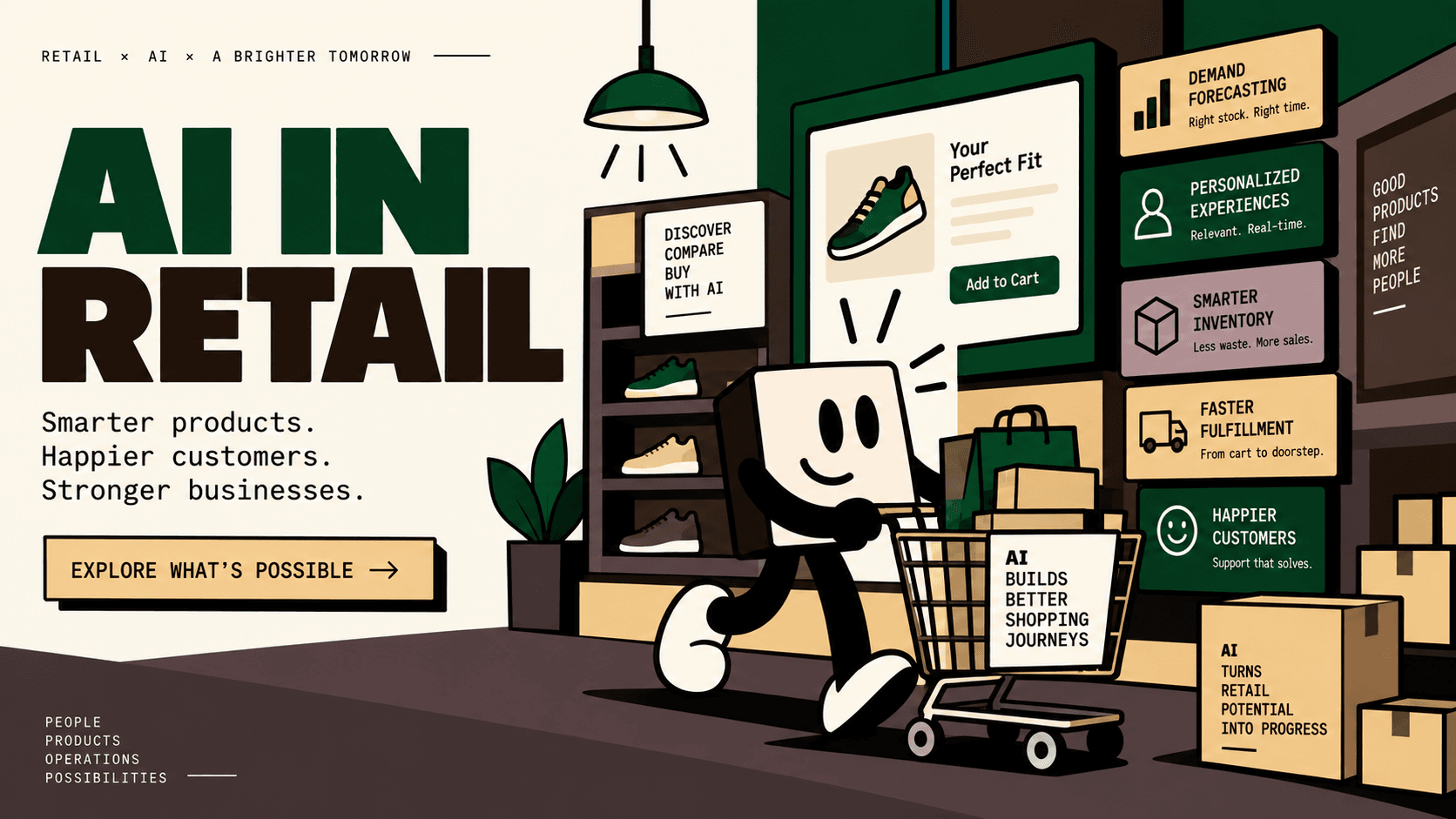
AI in retail is no longer limited to product recommendations or customer-service chatbots. Retailers are applying artificial intelligence across demand forecasting, inventory management, personalization, merchandising, supply chains, pricing, customer support, loss prevention and increasingly the buying journey itself. Shopify's 2026 retail AI guide identifies these as major application areas.
The more important shift is architectural. Retailers are moving from isolated AI features toward systems that can observe operational data, interpret context, make decisions and trigger actions across connected commerce workflows. That means the opportunity is not simply to add AI to a storefront. It is to build an AI-enabled operating layer connecting the customer, storefront, commerce platform, ERP, inventory, warehouse, shipping, customer operations and returns.
Answer: AI in retail is the application of machine learning, predictive analytics, generative AI and increasingly agentic AI to improve customer experiences and retail operations. The highest-value applications typically sit where large volumes of data, repetitive decisions and measurable business outcomes intersect.
What Is AI in Retail?
AI in retail means using artificial intelligence to analyze information, predict outcomes, generate recommendations or execute approved actions across the retail value chain.
That can range from a relatively simple recommendation engine to an AI agent that identifies a customer's request, retrieves order information, checks business rules, selects an approved action and updates a connected system.
For an ecommerce or D2C business, the operating model can be represented as:
Customer → AI discovery → Storefront → Commerce platform → ERP → Inventory → Warehouse → Shipping → Customer support → Returns
The important distinction is that AI does not have to replace every system in this chain. Instead, it can become an intelligence layer that works with existing systems.
Why AI in Retail Is Changing the Buying Journey
One of the clearest changes is that AI is becoming part of product discovery. Deloitte's Q1 2026 retail and consumer trends report says 23% of consumers already use generative AI for product discovery while shopping, and 35% of those users say they use it to speed up shopping. The report also describes the emerging integration of discovery and checkout directly into large-language-model interfaces. Deloitte, Q1 2026 Emerging Retail and Consumer Trends
This creates a different retail journey. A customer may begin with a natural-language question instead of a keyword search, compare products conversationally, ask follow-up questions and eventually complete a purchase without navigating a traditional website in the same way.
Shopify's 2026 retail research similarly describes the emergence of machine customers and AI-assisted shopping, while highlighting use cases ranging from personalization and demand forecasting to frictionless checkout and customer service. Shopify, AI in Retail
Implication: Retailers increasingly need product information, inventory information, pricing rules, availability and checkout infrastructure that machines can interpret reliably, not just interfaces designed for human browsing.
10 Major AI Use Cases in Retail
1. AI Demand Forecasting
Answer: AI demand forecasting uses historical sales, seasonality, trends and other available signals to estimate future demand.
Traditional forecasting often relies on historical averages, spreadsheets and manual adjustments. AI can process more variables and identify patterns that are difficult to evaluate manually.
For retailers, the practical objective is not simply a more sophisticated forecast. It is better operational decisions: how much to purchase, where to position stock, when to replenish and which products require closer attention.
Example: Shopify's retail AI research describes demand forecasting as a major application and cites Doe Beauty as an example of a retailer using Shopify automation and AI-driven tools to manage inventory across its supply chain. Shopify reports that the company saves $30,000 per week and approximately four hours of work through Shopify Flow and automation. This is a company example reported by Shopify, not an independent benchmark. Shopify retail AI research
Action: Start by identifying the SKUs where forecast errors have the greatest commercial impact. Establish a baseline for forecast accuracy, stockouts, excess inventory and replenishment time before automating decisions.
2. AI Inventory Management
AI inventory management combines sales, inventory and operational signals to identify stock risks and support replenishment decisions.
The important distinction is between visibility and action. A dashboard that tells an operator a SKU is running low is useful. A connected workflow that detects the risk, evaluates replenishment rules, checks supplier constraints and creates an approved replenishment action is more operationally valuable.
Shopify's research describes AI-driven inventory management as a common retail application and gives Target's Inventory Ledger as an example of machine-learning and IoT-supported inventory processing across stores. Shopify retail AI research
Implementation rule: Keep deterministic inventory rules deterministic. Use AI where interpretation, prediction or prioritization is required, and require approval for large inventory adjustments or other high-impact actions.
3. Personalization and Product Recommendations
Personalization uses customer behavior, purchase history, product attributes and contextual signals to determine which products, offers or content should be presented to a shopper.
The strongest personalization systems are not simply recommendation widgets. They connect customer context with real-time product availability, pricing, promotions and business constraints.
For example, recommending an out-of-stock product creates a poor experience even if the recommendation model is technically accurate. AI personalization therefore depends on connected operational data as much as model quality.
Shopify identifies personalization and customer analysis among major retail AI applications. Shopify, AI in Retail
4. AI Shopping Assistants
AI shopping assistants let customers ask questions in natural language and receive contextual help with product discovery, comparison and selection.
A traditional chatbot might answer, “This product is available in three sizes.” An AI shopping assistant can potentially interpret a more complex request such as, “I need a lightweight jacket for a rainy commute, under this budget, and I prefer something machine washable,” then search structured product information and return relevant options.
The quality of this experience depends heavily on product data. Attributes, specifications, availability, variants, policies and pricing need to be accurate enough for an AI system to use safely.
GEO implication: As shoppers increasingly discover products through AI interfaces, retailers need structured, complete and machine-readable product information so that products can be accurately understood and represented in conversational environments.
5. AI Customer Service
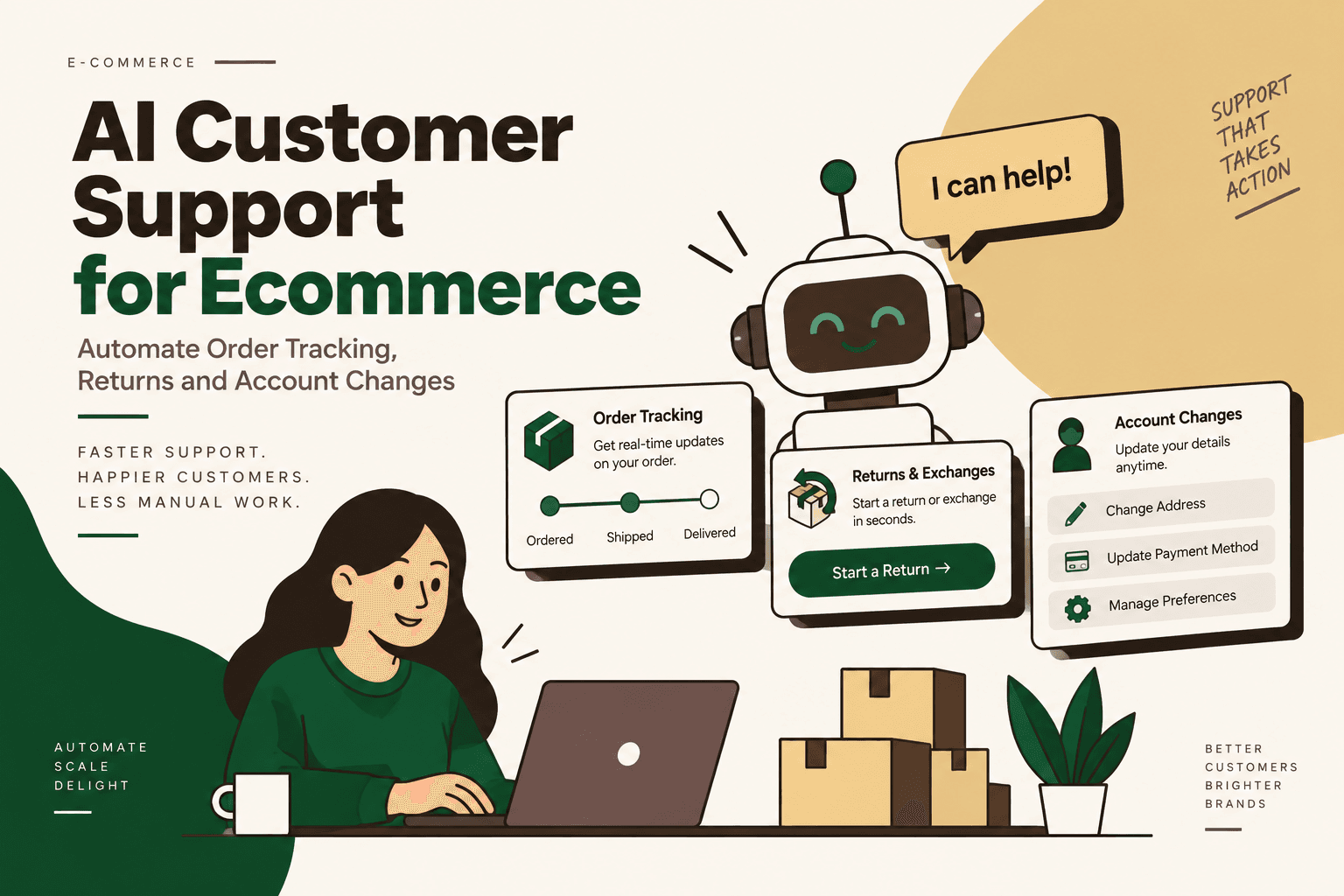
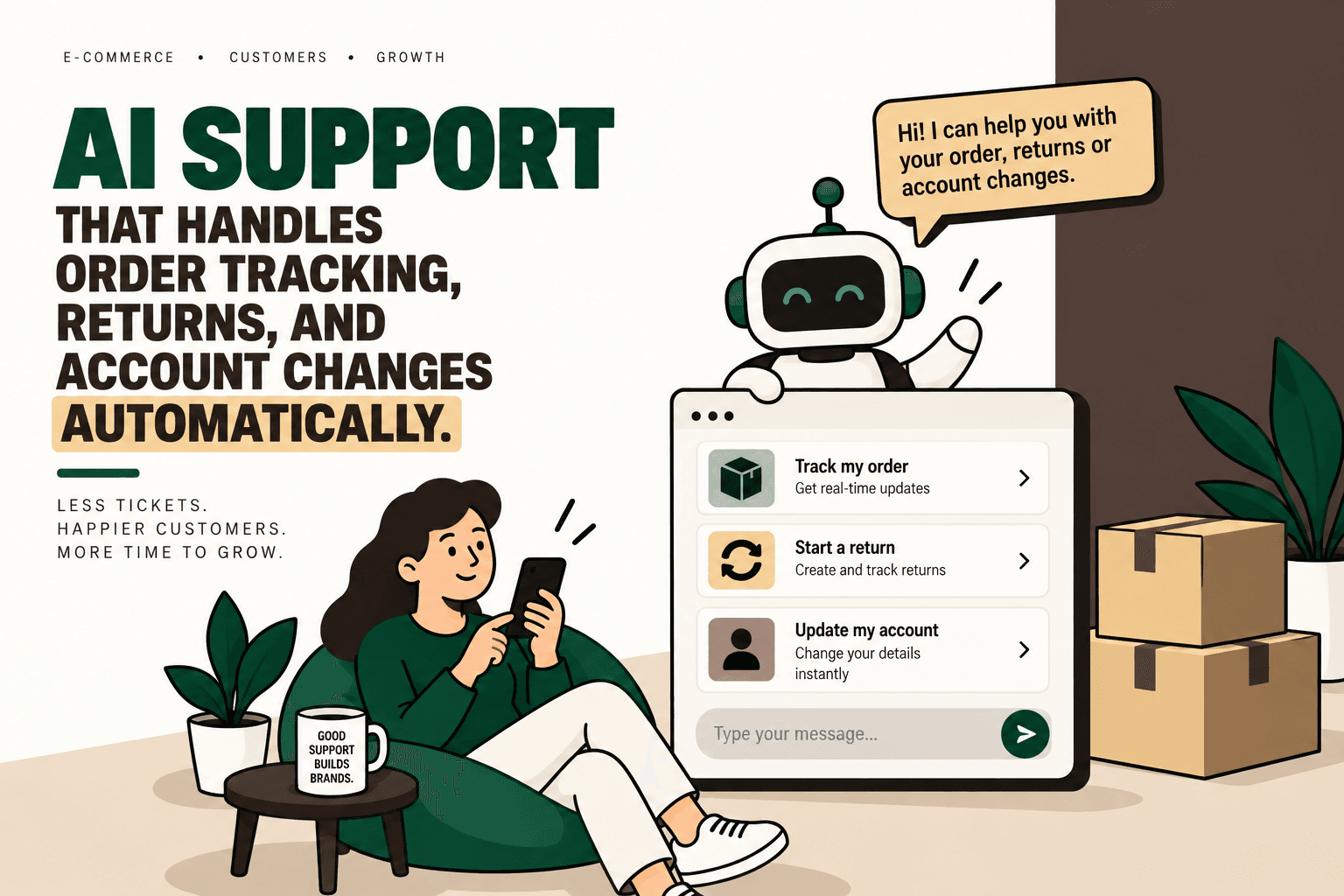
AI customer service can automate repetitive questions about order tracking, delivery status, returns, exchanges, product information and account support.
The biggest operational distinction is between answering and acting.
A basic chatbot can explain a return policy. A connected AI support agent can identify the customer, retrieve the relevant order, check eligibility against approved rules, initiate the return and notify the customer.
That requires integrations with commerce platforms, order-management systems, shipping systems, payment systems and customer-service platforms. Without those connections, the AI may sound intelligent while still requiring humans to perform the actual work.
Five Anchor POV: For D2C brands, the useful unit of AI customer service is not the conversation. It is the completed workflow. The implementation question should therefore be, “Which customer operations can AI safely complete end to end?” rather than simply, “Which chatbot should we deploy?”
6. AI Supply Chain Optimization
AI can support supply-chain decisions by analyzing demand, inventory, supplier information, logistics signals and operational constraints.
NVIDIA's 2026 retail survey reports that nine in ten retailers plan to increase AI budgets in 2026, with investment extending across agentic AI, physical AI, forecasting, customer analytics, shopping assistants and supply-chain automation. NVIDIA, State of AI in Retail and CPG Survey 2026
For an ecommerce business, this can mean connecting demand signals with procurement, inventory allocation, fulfillment and logistics decisions instead of optimizing each function independently.
7. Dynamic Pricing and Promotion Optimization
AI can analyze demand, inventory, promotions and other market signals to support pricing and promotional decisions.
However, pricing is a high-impact area where automation needs clear boundaries. A model can recommend a price while deterministic rules define minimum margins, approved discount ranges, promotional constraints and escalation thresholds.
Human role: Merchandising and commercial teams should retain control over strategic pricing decisions, exceptional promotions and policies where brand, regulatory or customer-trust considerations outweigh purely predictive optimization.
8. Fraud and Loss Prevention
AI can identify anomalous transactions, suspicious behavior and unusual patterns across ecommerce and physical retail environments.
Fraud systems are especially dependent on false-positive management. A model that flags too many legitimate transactions can create customer friction and operational workload.
The right implementation therefore measures both detection performance and the downstream cost of unnecessary interventions.
9. Visual and Physical Retail AI
Computer vision and other forms of physical AI can support shelf monitoring, stock-gap detection, store analytics and operational monitoring.
This extends AI beyond digital commerce into physical retail environments where the system can interpret images, video or sensor data and convert those signals into operational actions.
The implementation challenge is different from a text-based AI assistant. Physical AI requires reliable hardware, network connectivity, monitoring, privacy controls, data retention policies and clear procedures for what happens when the system is uncertain.
10. Agentic Commerce
Answer: Agentic commerce describes shopping workflows in which AI systems can discover products, evaluate options and increasingly participate in or execute transactions on behalf of consumers.
Deloitte's 2026 research describes direct integration between large-language-model interfaces and retail discovery and checkout. Deloitte, Q1 2026 Emerging Retail and Consumer Trends
This changes what a retailer needs to optimize. The storefront is no longer necessarily the only interface through which a customer discovers or purchases a product.
Retailers therefore need reliable product feeds, inventory availability, pricing information, fulfillment data, policies and transaction infrastructure that can work with AI-driven interfaces.
AI in Retail: From Features to an Operating Layer
The common mistake is to treat each AI use case as a separate project.
One team implements a recommendation engine. Another adds a customer-service chatbot. Operations deploys demand forecasting. Marketing introduces generative content. None of these systems necessarily share context or trigger actions across the commerce operation.
TCS's Global Retail Outlook 2026 highlights this gap. Its research, based on more than 800 senior retail executives across 18 countries, reports that 85% had not begun implementing or planning multi-agent AI systems, while 24% were using AI for autonomous decision-making. TCS argues that the challenge is increasingly architectural and organizational rather than simply technical. TCS Global Retail Outlook 2026
Five Anchor POV: The practical implication for D2C businesses is that AI projects should be evaluated as workflows, not just software features. If the AI cannot access the data required for a decision or cannot safely trigger the required action, its operational value is limited.
The AI Retail Infrastructure Model
A connected retail AI architecture can be organized into five layers:
- Experience layer: storefront, mobile app, WhatsApp, voice, chat and AI shopping interfaces.
- Commerce layer: Shopify, marketplaces, order management and checkout.
- Operational layer: ERP, inventory, warehouse, shipping, returns and finance.
- Intelligence layer: forecasting, recommendations, classification, anomaly detection and generative AI.
- Orchestration layer: agents, rules, permissions, approvals, logging, monitoring and exception handling.
The orchestration layer is what turns isolated AI capabilities into an operating workflow.
AI vs Automation vs Human Decisions
Not every retail workflow needs AI. A useful architecture separates deterministic automation from AI and human judgment.
| Decision type | Recommended approach | Example |
|---|---|---|
| Predictable rule | Deterministic automation | Send tracking notification when shipment status changes |
| Pattern recognition | AI | Predict which SKUs may experience demand spikes |
| Contextual recommendation | AI plus rules | Recommend replenishment based on demand and inventory constraints |
| High financial impact | AI recommendation plus human approval | Large refund or major inventory adjustment |
| Ambiguous exception | Human decision | Complex customer dispute involving conflicting records |
This division prevents the common mistake of giving an AI system unnecessary authority simply because it can technically perform an action.
Three Documented Retail AI Examples
Target: Inventory Intelligence
Context: Retail inventory changes rapidly across stores and channels.
Intervention: Shopify's retail AI research describes Target's Inventory Ledger as using machine learning models and IoT devices to provide real-time inventory data across stores.
Reported capability: Shopify says the system can process up to 360,000 inventory transactions per second and handle as many as 16,000 inventory-position requests per second.
Lesson: AI value in retail depends on operational data being available at the speed required by the business. Shopify retail AI research
Sephora: AI-Assisted Personalization
Context: Beauty retail involves high product complexity and customer-specific preferences.
Intervention: Shopify's research describes Sephora using AI and augmented-reality tools for virtual try-ons and personalized skincare recommendations.
Workflow change: Customer information and product characteristics can be used to create more contextual product-selection experiences.
Lesson: Personalization works best when AI is connected to rich product data and customer context rather than operating as a generic recommendation layer. Shopify retail AI research
The Conran Shop: Unified Commerce
Context: The retailer needed a more unified experience across B2B, point-of-sale and online operations.
Intervention: Shopify's research describes a unified commerce implementation across these experiences.
Reported result: Shopify reports a 50% reduction in total cost of ownership, a 54% increase in conversion rates and a 23% increase in email marketing revenue following the replatforming.
Lesson: The example illustrates an important point: AI capabilities become more useful when the underlying commerce architecture is unified. These figures are reported by Shopify and should not be treated as an independent benchmark for all retailers. Shopify retail AI research
How to Implement AI in Retail
Retail AI implementation should begin with a business workflow rather than a model.
1. Map the Workflow
Document the trigger, inputs, systems, decisions, actions, exceptions, human handoffs and outputs.
For example, for automated returns:
Customer request → identity verification → order lookup → return-policy check → eligibility decision → return creation → inventory update → refund workflow → customer notification
This immediately exposes which systems the AI must access and which actions require permissions.
2. Establish a Baseline
Measure the current process before automating it. Relevant metrics include volume, frequency, manual time, error rate, response time, processing cost, conversion, revenue leakage and customer satisfaction.
3. Prioritize the Right Use Cases
A practical prioritization model is:
Volume × Frequency × Manual Effort × Error Cost × Revenue Impact ÷ Implementation Complexity
This is a practical framework, not an industry-standard formula.
A high-volume workflow with repetitive manual work, meaningful error costs and relatively low implementation complexity may be a better pilot than a technically impressive but low-frequency AI application.
4. Classify Each Step
For every workflow step, decide whether it should be handled by deterministic automation, AI, human approval or a human-only process.
5. Connect the Systems
Retail AI often requires integrations across Shopify or other commerce platforms, marketplaces, ERP systems, warehouse systems, shipping providers, CRM platforms, helpdesks, payment systems and analytics.
APIs and webhooks can provide the connectivity, while an orchestration layer controls how information moves between systems.
6. Add Guardrails
Guardrails should cover permissions, validation, approval thresholds, fallback behavior, retries, logging, monitoring and exception handling.
A useful pattern is:
- Low-risk action: AI executes automatically.
- Medium-risk action: AI executes and logs the decision.
- High-risk action: AI prepares the action and requests human approval.
7. Start With One Small Workflow
Do not begin by building one giant retail AI agent. Start with one high-volume, relatively low-risk workflow where success can be measured.
Examples include order-status automation, product-data enrichment, inventory alerts, ticket classification or internal analytics queries.
8. Measure the Result
Track the metric that the workflow was designed to change. Depending on the use case, that might be hours saved, response time, error reduction, ticket deflection, inventory accuracy, processing time, conversion, revenue leakage or customer satisfaction.
9. Scale Only After Reliability Is Proven
Once the workflow performs reliably across normal cases and known edge cases, extend it to additional channels, products, geographies or operational decisions.
What Should Retailers Automate First?
The first automation should usually be a workflow with clear inputs, repeatable decisions, measurable volume and limited downside if an exception is escalated.
| Workflow | Why AI or automation fits | Human control |
|---|---|---|
| Order tracking | High volume and structured status data | Escalate conflicting shipment information |
| Customer FAQ classification | Repetitive questions and predictable knowledge | Escalate unusual or sensitive cases |
| Inventory alerts | Continuous monitoring of structured data | Approval for large stock adjustments |
| Product enrichment | Large volumes of repetitive content and attributes | Review sensitive product claims |
| Demand forecasting | Large historical datasets and recurring decisions | Merchandising approval for major purchasing changes |
| Large refunds | Financial impact requires stronger controls | Human approval |
Data Quality Is the Hidden Dependency
AI cannot compensate indefinitely for fragmented or inaccurate retail data.
If inventory availability is wrong, an AI shopping assistant can recommend unavailable products. If product attributes are incomplete, an AI system can provide incomplete answers. If customer identity is inconsistent across systems, an AI agent may not be able to safely retrieve the correct order.
That is why AI implementation should include a data-readiness review covering product information, customer identity, inventory, order status, pricing, policies, permissions and system ownership.
Shopify's implementation guidance similarly emphasizes data readiness and quality as part of deploying AI in retail. Shopify, AI in Retail
Security, Privacy and Governance
AI shopping and autonomous transaction systems introduce risks around payments, personal data, fraud, transparency and accountability.
Reuters reported in September 2026 that major banks had raised concerns about AI shopping agents potentially mishandling sensitive financial data, enabling fraud or directing consumers toward less secure payment options. The institutions called for stronger transparency, data safeguards and consumer protections. Reuters, September 2026
For retailers, governance should therefore be designed into the workflow rather than added after deployment.
- Limit the data available to each AI system.
- Use role-based permissions for actions.
- Log important decisions and system actions.
- Require approval for high-impact transactions.
- Define fallback behavior when data conflicts.
- Monitor model and workflow performance continuously.
- Maintain clear customer escalation paths.
What AI in Retail Should Not Do
More AI is not automatically better.
A deterministic workflow should not be replaced with a language model simply because an AI system is available. Similarly, a high-risk financial decision should not become autonomous merely because it can be automated.
The right question is not, “Where can we put AI?” It is, “Where does AI create better decisions or lower operational effort while maintaining acceptable risk?”
How Five Anchor Fits Into Retail AI Infrastructure
For D2C and ecommerce businesses, the practical challenge is often not choosing an AI model. It is connecting the model to the systems where commercial work actually happens.
Problem: Retail data and workflows are distributed across storefronts, marketplaces, ERP systems, inventory, shipping, customer support and analytics.
Architecture: An AI infrastructure layer can connect these systems, provide contextual data to AI workflows and control which actions the system is permitted to take.
Implementation: Five Anchor's work can include workflow mapping, marketplace and ERP integrations, inventory synchronization, order-processing automation, customer-service automation, AI agents, human escalation and operational dashboards.
Business outcome: The target is not AI adoption for its own sake. The target is measurable improvement in a specific workflow such as response time, manual effort, inventory visibility, order processing or customer operations.
Five Anchor relevance: This is the role of an AI infrastructure approach: connect commerce systems first, then place AI where prediction, interpretation or action creates measurable operational value.
A Practical Retail AI Roadmap
- Audit: map the commerce and operational systems.
- Identify: find high-volume, repetitive and measurable workflows.
- Baseline: quantify current cost, effort, errors and response times.
- Prioritize: rank opportunities by business value and implementation complexity.
- Design: determine what is rules-based, AI-driven and human-controlled.
- Connect: integrate commerce, ERP, inventory, shipping, support and analytics systems.
- Guardrail: add permissions, validation, approval thresholds and monitoring.
- Pilot: deploy one narrow workflow.
- Measure: compare results against the baseline.
- Scale: extend only after reliability is established.
AI in Retail: Key Takeaway
AI in retail is evolving from isolated prediction and automation features into a connected intelligence layer across the customer and operational journey.
The major use cases include demand forecasting, inventory management, personalization, AI shopping assistants, customer service, supply-chain optimization, dynamic pricing, fraud detection, physical retail intelligence and agentic commerce.
But the implementation challenge is increasingly about infrastructure. Retailers need accurate data, connected systems, clear permissions, measurable workflows and human oversight before AI can safely move from answering questions to making or executing decisions.
For D2C and ecommerce businesses, the most practical starting point is a narrow workflow with clear inputs, measurable outcomes and manageable risk. Build the integration, establish the baseline, add AI where it genuinely improves the workflow, retain human control over high-impact exceptions and scale only after the system proves reliable.
Key Takeaways
- •AI in retail now spans demand forecasting, inventory, personalization, customer service, pricing, supply chains, loss prevention and agentic commerce.
- •The biggest operational opportunity is connecting AI to commerce, ERP, inventory, warehouse, shipping and customer-service systems.
- •AI should not replace deterministic automation or human judgment where rules and risk controls are more appropriate.
- •Retail AI implementation should begin with workflow mapping, baseline metrics, prioritization, integrations, guardrails and a measurable pilot.
- •Data quality, permissions, monitoring and human escalation are foundational requirements for reliable retail AI.
Traditional Retail Automation vs AI-Enabled Retail Operations
| Feature | Traditional Automation | AI-Enabled Operations |
|---|---|---|
| Inventory Sync Frequency | 15–30 min batch polling (high oversell risk) | Sub-second atomic locking (<450ms) |
| Concurrent Drop Resilience | Fails under concurrency; causes negative stock balance | Redis atomic reservation queue guarantees exact counts |
| Error Handling & Retries | Silent failure; manual CSV audit needed | Dead-letter queues with automated exponential retry |
| Fulfillment Routing Speed | 2–4 hours delayed batch export to 3PL warehouse |