What Is Invoice & Financial Automation?
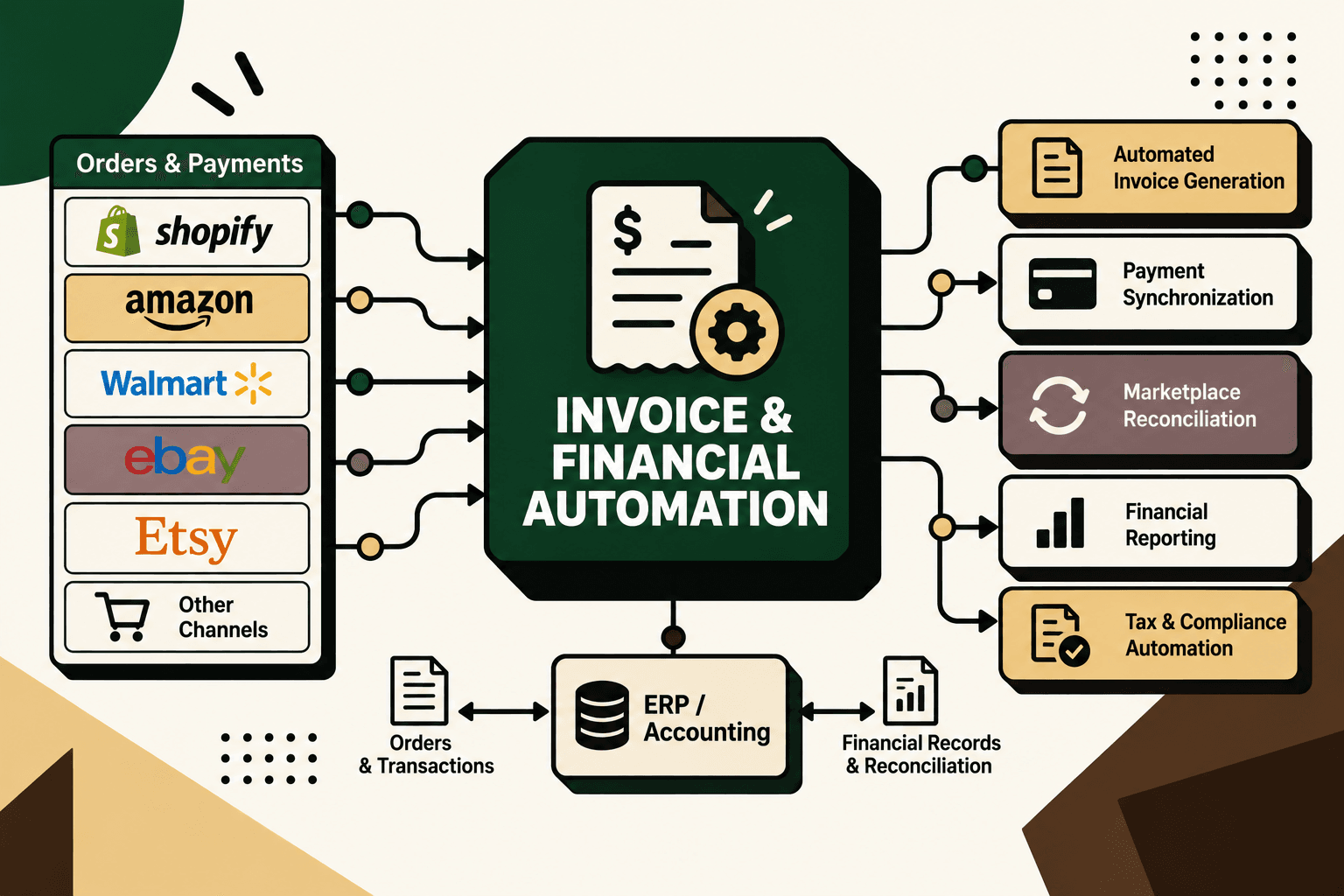
Invoice and financial automation connects commerce, ERP, payment, order and accounting systems to automate financial workflows. Instead of manually creating invoices, matching transactions and reconciling marketplace or payment data, businesses can move financial information automatically between connected systems.
Why Automate Invoice & Financial Workflows?
Growing ecommerce businesses often process transactions across multiple channels, creating repetitive financial work.
- Manual invoice creation.
- Payment and order mismatches.
- Manual reconciliation.
- Duplicate financial entries.
- Delayed financial updates.
- Fragmented marketplace settlements.
Financial automation connects these workflows so finance teams spend less time moving data between systems.
How Financial Automation Works
A connected workflow can link commerce transactions with ERP and financial systems.
Shopify + Marketplaces → Orders & Payments → ERP / Accounting → Invoice → Reconciliation → Reporting
Business rules can determine when invoices are generated, how transactions are matched and which exceptions require review.
Invoice Automation Across Commerce Channels
Orders from Shopify, Amazon, marketplaces and other commerce channels can automatically flow into the financial workflow.
Commerce Order → ERP → Invoice Generation → Customer / Marketplace → Financial Records
This reduces the need for teams to manually create invoices or transfer order information between systems.
Payment & Reconciliation Automation
Financial automation can connect orders, payments, refunds, fees and settlements with ERP or accounting systems.
Order → Payment → Settlement → ERP → Reconciliation
Automated matching can help identify missing transactions, payment differences, refunds and reconciliation exceptions.
ERP & Financial System Integration
ERP platforms can act as the central financial system while commerce platforms provide transaction data.
Shopify + Marketplaces → Integration Layer → ERP / Accounting → Finance & Reporting
The integration should define which system owns invoices, payments, orders and financial records.
Where AI Fits Into Financial Automation
AI can assist with financial exceptions, transaction classification, anomaly detection and reconciliation analysis.
Financial Data → AI Analysis → Exception Detection → Finance Team
Core financial calculations and system records should remain governed by reliable business rules and financial systems, while AI can assist with interpretation and exception handling.
What Five Anchor Can Implement
Five Anchor can connect your commerce and financial workflows. This can include ERP integration, invoice automation, payment synchronization, marketplace reconciliation, order-to-invoice workflows and AI-powered financial exception handling.
Automate the financial workflows behind your ecommerce operation instead of moving transaction data manually.
How to Measure Financial Automation
- Manual invoice-processing volume.
- Invoice-processing time.
- Reconciliation exceptions.
- Payment mismatches.
- Manual financial data entry.
- Refund-processing time.
- Financial reporting latency.
Final Takeaway
Invoice and financial automation connects commerce transactions with the systems responsible for invoicing, payments, reconciliation and reporting.
By connecting Shopify, marketplaces, ERP and financial systems, businesses can reduce repetitive finance operations and create a more connected commerce infrastructure.
Automate your invoice and financial workflows with Five Anchor.
Frequently Asked Questions
What is invoice automation?
Invoice automation uses connected commerce and financial systems to automate invoice creation and related workflows.
Can Shopify orders trigger invoice generation?
Yes. Shopify orders can be connected with ERP or accounting workflows that generate invoices according to defined business rules.
Can marketplace payments be reconciled automatically?
Yes. Marketplace transaction and settlement data can be connected with ERP or accounting systems for automated reconciliation workflows.
Can AI help with financial automation?
Yes. AI can assist with anomaly detection, transaction classification and financial exception handling while core financial records remain controlled by business systems.