What Are Fulfillment by Amazon (FBA) Integrations?
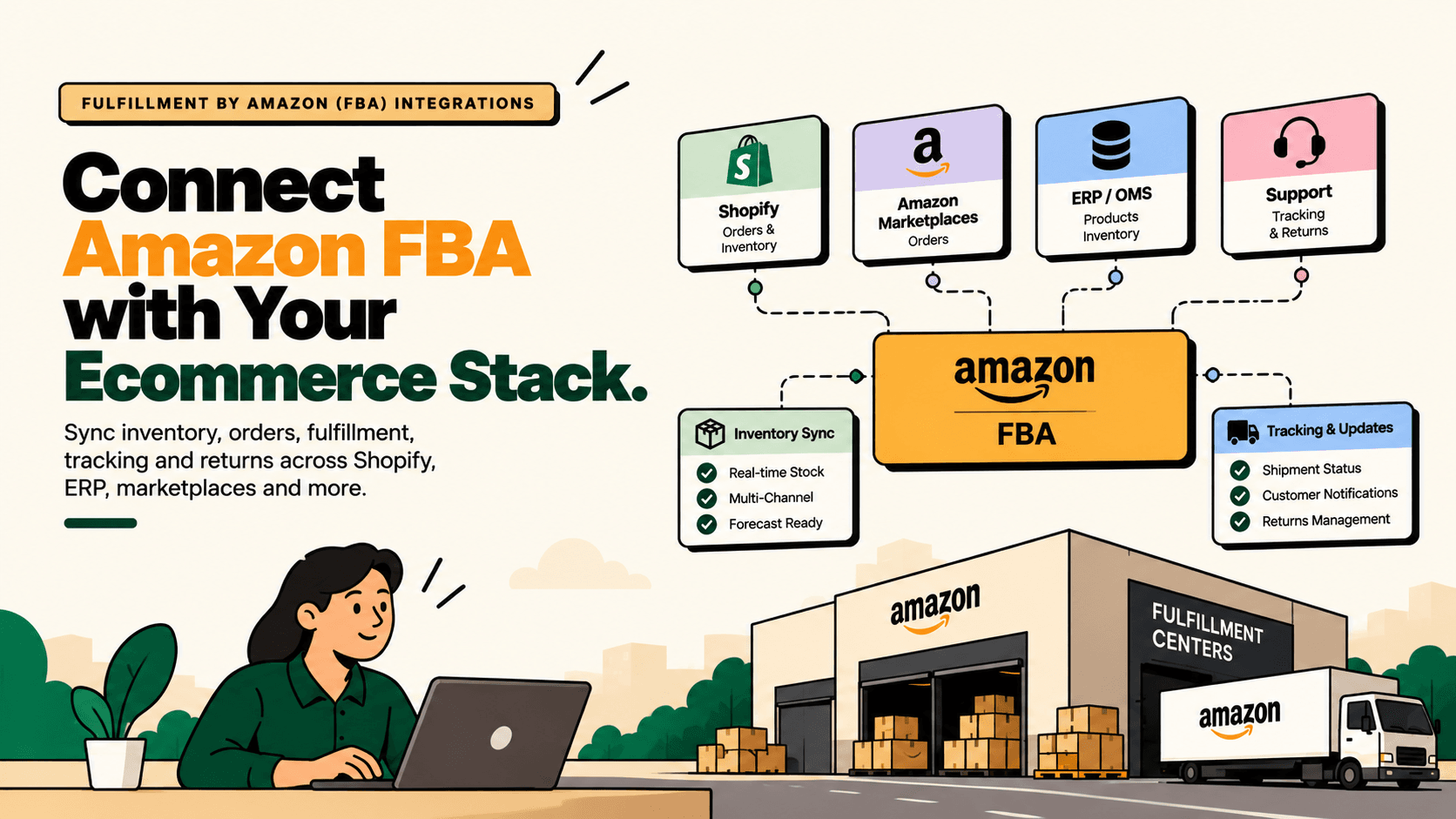
Fulfillment by Amazon (FBA) integrations connect Amazon's fulfillment infrastructure with ecommerce stores, marketplaces, ERP systems, order management platforms, warehouse systems and other business applications. The goal is to move inventory, order, fulfillment, tracking and returns data between systems without forcing operations teams to manage each platform separately.
For a growing ecommerce business, FBA should not be treated only as a warehouse or shipping service. It becomes part of a broader commerce workflow: an order is created, inventory is checked, fulfillment is requested, Amazon processes the shipment, tracking is returned, and the relevant systems are updated.
The research for this topic identifies two closely related integration models: Amazon marketplace/FBA integrations and Amazon Multi-Channel Fulfillment (MCF). Understanding the difference is important when designing the right architecture for a D2C or omnichannel business. :contentReference[oaicite:0]{index=0}
FBA Integration vs. Amazon MCF Integration
FBA and MCF are related but serve different fulfillment scenarios.
FBA primarily supports orders associated with selling through Amazon, while Multi-Channel Fulfillment (MCF) allows businesses to use Amazon's fulfillment network for orders originating from other sales channels.
For example, a brand selling on Amazon and Shopify could have an architecture where Amazon marketplace orders are fulfilled through FBA while eligible Shopify orders are fulfilled through MCF using inventory stored in Amazon fulfillment centers.
Amazon provides an ecosystem of MCF integrations for ecommerce and order-management systems, while its Selling Partner API provides programmatic access to important Amazon seller and fulfillment workflows.
Amazon FBA Multichannel Fulfillment
Amazon SP-API: The Core Integration Layer
For businesses building deeper FBA integrations, Amazon's Selling Partner API (SP-API) is a key technical integration layer.
The research identifies SP-API capabilities across areas including:
- FBA inventory.
- Amazon orders.
- Shipments and tracking.
- Returns and refunds.
- Product listings and catalog information.
- Pricing.
- Reports and analytics.
- Notifications and events.
Amazon also provides a dedicated FBA Inventory API for retrieving inventory information from Amazon fulfillment centers.
This matters because a serious FBA integration is not simply an order import. The integration needs to keep multiple operational states aligned across systems.
What Should an FBA Integration Synchronize?
A useful FBA integration should be designed around the information that the rest of the business needs to operate.
| Data | Why It Matters | Typical Business System |
|---|---|---|
| Inventory | Prevents inaccurate stock availability and supports replenishment planning | ERP, ecommerce platform, OMS |
| Orders | Creates a consistent order record and fulfillment workflow | Shopify, marketplace, OMS, ERP |
| Fulfillment status | Shows whether an order has entered and progressed through fulfillment | OMS, customer support, ERP |
| Tracking | Enables customer communication and post-purchase visibility | Ecommerce platform, support platform |
| Returns | Connects post-purchase activity with inventory and customer workflows | Returns platform, ERP, support |
| Reconciliation data | Supports financial and operational reconciliation | ERP, finance, analytics |
The research specifically recommends treating the FBA connector as a broader commerce integration that synchronizes inventory, orders, fulfillment status, tracking, returns and reconciliation, rather than as a simple shipping connection. :contentReference[oaicite:1]{index=1}
Shopify and Amazon FBA Integration
Shopify is one of the most common systems to connect with Amazon fulfillment because many D2C brands sell through both their own storefront and Amazon.
A simplified workflow looks like this:
Shopify Order → Integration Layer → Amazon FBA or MCF → Pick and Pack → Shipment → Tracking → Shopify
Shopify's Marketplace Connect supports Amazon marketplace order workflows, including FBA fulfillment scenarios. Amazon also provides a dedicated Shopify integration for MCF, allowing eligible Shopify orders to be fulfilled using inventory stored in Amazon fulfillment centers.
Shopify Marketplace Connect fulfillment documentation
Amazon MCF Shopify integration
This distinction is useful for D2C brands. A Shopify-to-FBA integration can support Amazon-related fulfillment, while MCF extends Amazon's fulfillment capability to orders coming from other channels.
How Shopify FBA Integration Works
- Customer places an order. The order originates in Shopify or another connected sales channel.
- The integration identifies the fulfillment route. Business rules determine whether Amazon FBA, MCF, an internal warehouse or another 3PL should fulfill the order.
- Inventory is checked. The integration retrieves the relevant availability information.
- Fulfillment is requested. The order is sent to the appropriate fulfillment workflow.
- Amazon processes the order. The fulfillment network handles the physical pick, pack and shipment process.
- Tracking is returned. Shipment information is synchronized with the relevant commerce systems.
- The customer receives an update. The ecommerce or customer-support system communicates the shipment status.
The technical challenge is keeping these states consistent. If Shopify says an item is available while the operational inventory source says otherwise, the integration has failed at the business level even if the API calls technically succeeded.
FBA ERP Integration
An FBA ERP integration connects Amazon fulfillment data with the financial, inventory and operational records maintained by an ERP.
This becomes increasingly important as an ecommerce company grows because Amazon is usually only one part of the business.
A typical architecture may look like:
Amazon FBA ↔ Integration Layer ↔ ERP ↔ Ecommerce Channels ↔ Customer Operations
The ERP may need information about products, inventory, orders, fulfillment status, financial activity and operational performance. The exact data flow depends on which system is the source of truth for each data type.
That source-of-truth decision should be made before implementation.
Why source-of-truth design matters
Suppose an ERP owns the business's master inventory while Amazon maintains fulfillment-center inventory. The integration needs to define how those quantities are reconciled and how inventory changes are propagated.
Without explicit ownership rules, teams can end up with multiple systems claiming to have the correct quantity.
A robust implementation therefore documents:
- Which system owns product master data.
- Which system owns available-to-sell inventory.
- Which system owns the customer order.
- Which system owns fulfillment status.
- Which system owns financial reconciliation.
- Which system owns return disposition.
FBA Inventory Sync
FBA inventory synchronization is one of the most important components of an Amazon integration.
Amazon's FBA Inventory API provides inventory availability information from Amazon fulfillment centers. That information can be used by connected systems to support inventory visibility and operational decisions.
FBA Inventory API documentation
However, inventory synchronization is not simply about copying one number from Amazon into Shopify or an ERP.
Depending on the business model, different inventory states may matter, including inventory that is fulfillable, inbound, reserved or unfulfillable.
The integration should therefore define which inventory states affect customer-facing availability and which are used only for operational reporting.
Amazon MCF for D2C and Omnichannel Fulfillment
Amazon Multi-Channel Fulfillment becomes particularly relevant when a business wants one fulfillment infrastructure to support multiple sales channels.
The research identifies a model in which Amazon MCF can support D2C and ecommerce channels, including Shopify and WooCommerce, while also connecting with inventory and order-management platforms.
Amazon's MCF ecosystem research identifies more than 100 integrations and names examples including Rithum, Pipe17, ShipStation, Order Desk, Linnworks, Sellercloud, Mirakl, CedCommerce and Base.com.
These examples illustrate an important point: businesses do not necessarily need to build every connection from scratch. The appropriate approach depends on the existing commerce architecture, integration requirements and degree of customization.
FBA Integrations With WooCommerce and Other Channels
FBA and MCF integrations can extend beyond Amazon and Shopify.
A broader commerce stack may include:
- Amazon Seller Central.
- Amazon FBA.
- Amazon MCF.
- Shopify.
- WooCommerce.
- ERP.
- OMS.
- WMS.
- 3PL systems.
- Returns platforms.
- Customer-support systems.
- AI customer-support agents.
The integration layer becomes responsible for orchestrating data between these systems rather than simply connecting two applications.
For example, an order from WooCommerce could be routed through an OMS, fulfilled through Amazon MCF, and then have tracking information returned to WooCommerce while the ERP receives the relevant fulfillment and financial information.
FBA Order Management Integration
As order volume increases, businesses often need an order management system (OMS) between sales channels and fulfillment providers.
The OMS can provide a central layer for decisions such as:
- Which fulfillment location should handle an order?
- Should the order go to FBA, MCF or another warehouse?
- Is sufficient inventory available?
- Should an order be split?
- Does an order require manual review?
- Which shipment status should be shown to the customer?
This makes the architecture more resilient because the ecommerce storefront does not need to contain every fulfillment rule.
FBA Integration With WMS and 3PLs
Businesses with multiple fulfillment locations may operate Amazon FBA alongside internal warehouses and third-party logistics providers.
In that environment, the key challenge is not connecting to Amazon alone. It is orchestrating several fulfillment nodes.
A typical model is:
Sales Channels → OMS / Order Orchestration → Fulfillment Decision → FBA / MCF / WMS / 3PL → Tracking → Customer
The fulfillment decision can be based on inventory availability, geography, service level, channel requirements and business rules.
AI may assist with exception classification or operational analysis, but deterministic business rules should remain responsible for decisions where accuracy and predictability are critical.
FBA Returns Integration
Returns are often where fragmented integrations become visible.
An order may begin in one system, be fulfilled by Amazon, generate a return through another workflow and then require inventory or financial updates in an ERP.
A connected architecture should therefore treat returns as part of the fulfillment lifecycle rather than as an isolated customer-service process.
Amazon's MCF API documentation describes APIs covering parts of the fulfillment lifecycle, including inventory, outbound orders, tracking and returns.
FBA Integration for India
For Indian D2C businesses, the research identifies Amazon's India MCF offering as a relevant option for multichannel fulfillment.
Amazon describes its India MCF offering as supporting D2C and ecommerce channels with a shared inventory pool and fulfillment capabilities covering warehousing, invoicing, logistics and delivery. The supplied research also reports that Amazon states its India MCF network covers more than 20,000 pin codes.
For a business operating Shopify, marketplaces and Amazon together, this can make the integration architecture especially important. The objective is not merely to connect a storefront to Amazon, but to establish consistent inventory and order workflows across channels.
FBA API Integration: When to Build vs. Use an Existing Connector
Not every business needs a custom FBA integration.
An existing connector may be appropriate when the business has conventional requirements and the available integration already supports the required order, inventory, fulfillment and tracking flows.
A custom integration becomes more relevant when the business has complex ERP logic, multiple fulfillment providers, custom inventory rules, marketplace-specific workflows, specialized reconciliation requirements or AI-driven operational processes.
| Requirement | Existing Connector | Custom Integration |
|---|---|---|
| Standard Shopify or marketplace workflow | Often suitable | May be unnecessary |
| Simple inventory synchronization | Often suitable | Useful when business rules are unusual |
| Multiple ERP and fulfillment systems | May require several connectors | Can centralize orchestration |
| Complex routing rules | Depends on connector capabilities | More control over business logic |
| Custom reconciliation | May be limited | Can be designed around finance requirements |
| AI-powered operational workflows | Depends on available APIs and extensions | Allows AI and human-approval workflows to be designed into the architecture |
The right decision should follow the workflow requirements rather than the technology preference.
How to Design an FBA Integration Architecture
A practical FBA integration project should start with workflow mapping.
- Map every sales channel. Document Amazon, Shopify, WooCommerce, marketplaces and any other sources of orders.
- Map fulfillment locations. Identify FBA, MCF, internal warehouses and 3PLs.
- Define system ownership. Decide which platform owns products, inventory, orders, fulfillment status and financial records.
- Document the data flows. Specify which events move from each system to another.
- Define exception rules. Decide what happens when inventory is unavailable, an API fails, an order changes or tracking information is delayed.
- Choose the integration method. Use an existing connector, middleware or custom SP-API implementation according to the requirements.
- Build observability. Track failed API calls, missing events, duplicate orders and inventory mismatches.
- Pilot the highest-volume workflow. Start with a controlled order and fulfillment flow rather than attempting every edge case at once.
- Measure operational outcomes. Track manual effort, order errors, inventory mismatches, fulfillment latency and support contacts.
- Scale after validation. Add returns, additional marketplaces, more fulfillment providers and AI workflows after the core integration is stable.
Where AI Fits Into FBA Integrations
AI should not replace the integration layer. It should operate on top of reliable data and deterministic workflows.
For example, the integration layer can retrieve a shipment status from Amazon. An AI service can then interpret that status and determine whether a customer-support response or internal exception summary is appropriate.
A useful architecture is:
Sales Channels
Shopify · WooCommerce · Amazon · Marketplaces
↓
AI Commerce / Order Orchestration Layer
Order routing · Inventory allocation · Exception handling · Business rules
↓
FBA / MCF Connector
SP-API · FBA Inventory API · Orders · Fulfillment · Tracking · Returns
↓
Amazon Fulfillment Network
Inbound → Storage → Pick → Pack → Ship
↓
Back Office + Customer Operations
ERP · Reconciliation · Analytics · Support AI · Customer communication
This architecture is directly aligned with the research supplied for this topic. :contentReference[oaicite:2]{index=2}
What Five Anchor Could Implement Around FBA
Five Anchor's positioning as AI Infrastructure for D2C & E-Commerce makes FBA integration relevant to its Commerce Infrastructure and E-Commerce Intelligence services.
A practical implementation could start by mapping the brand's sales channels, ERP, inventory ownership, order-management process and fulfillment providers. The integration layer could then connect Amazon SP-API or relevant MCF capabilities with the existing commerce stack.
For example, Five Anchor could implement workflows for inventory synchronization, order processing, fulfillment-status updates, tracking communication, exception handling and reconciliation. AI can be added selectively to classify exceptions, summarize order history, assist customer-support teams or identify operational anomalies.
The key is to keep the system architecture grounded in business ownership rules. AI should not become another disconnected application. It should work with verified order and fulfillment data and escalate decisions that require human judgment.
Common FBA Integration Problems
Inventory mismatches
Inventory can become inconsistent when multiple systems independently calculate availability. Define the source of truth and establish reconciliation rules.
Duplicate orders
Retry logic and asynchronous APIs can create duplicate processing if the integration does not use appropriate idempotency and order-state controls.
Missing fulfillment updates
If tracking or fulfillment events are delayed or fail to synchronize, customer-support teams may see stale information. Integration monitoring should surface these failures.
Overly complex custom logic
Putting every business rule into a single integration can make maintenance difficult. Separate stable system integrations from business decision logic where practical.
No exception workflow
Successful orders are easy to automate. The difficult cases are inventory shortages, order changes, returns, failed API calls and mismatched statuses. Those cases should be designed before production deployment.
How to Measure an FBA Integration
The success of an FBA integration should be measured through operational outcomes rather than the number of API connections created.
- Inventory synchronization accuracy.
- Order-processing error rate.
- Manual order-entry volume.
- Fulfillment-status synchronization time.
- Tracking-update latency.
- Return-processing time.
- Reconciliation exceptions.
- Customer-support contacts related to order status.
- Failed integration events.
- Time required to resolve fulfillment exceptions.
A practical prioritization model for automation is volume × frequency × manual effort × error cost × revenue impact ÷ implementation complexity. This is a practical framework rather than an industry-standard formula. It can help identify which FBA workflows are worth automating first.
FBA Integrations: The Bigger Commerce Infrastructure Picture
The most important insight from the research is that FBA should not be treated as an isolated shipping integration.
Amazon provides the APIs and integration ecosystem needed to connect fulfillment with other parts of the commerce stack. Shopify provides marketplace and fulfillment workflows. MCF extends Amazon fulfillment to additional sales channels. ERP, OMS, WMS and 3PL systems provide additional operational capabilities.
The integration challenge is therefore one of orchestration.
Customer order → inventory decision → fulfillment routing → Amazon FBA or MCF → shipment → tracking → customer communication → returns → reconciliation
When these steps are connected, the business gets more than automated shipping. It gets a consistent operational workflow that can support inventory visibility, order accuracy, customer service and analytics.
Frequently Asked Questions About FBA Integrations
What is an FBA integration?
An FBA integration connects Amazon Fulfillment by Amazon with ecommerce platforms, marketplaces, ERP systems, OMS platforms, WMS systems or other business applications so inventory, orders, fulfillment, tracking and related data can move between systems.
What is the Amazon FBA API?
Amazon's Selling Partner API provides programmatic access to Amazon seller workflows, including FBA-related inventory and other operational capabilities. Amazon also provides a dedicated FBA Inventory API.
Can Shopify integrate with Amazon FBA?
Yes. Shopify provides Marketplace Connect workflows for Amazon orders and FBA fulfillment, while Amazon provides a dedicated MCF integration for Shopify that can support fulfillment of eligible off-Amazon orders.
What is the difference between FBA and MCF?
FBA is primarily associated with fulfillment for Amazon selling, while Multi-Channel Fulfillment allows Amazon's fulfillment network to process orders from other sales channels.
Can FBA integrate with an ERP?
Yes. FBA-related data can be connected to ERP systems through APIs, integration platforms or custom middleware. The implementation should define which system is the source of truth for inventory, products, orders and financial data.
What data should an FBA integration synchronize?
A robust integration can synchronize inventory, orders, fulfillment status, shipment tracking, returns and reconciliation-related information. The exact scope depends on the business architecture.
Can Amazon MCF fulfill Shopify orders?
Amazon provides a Shopify integration for MCF that supports using Amazon fulfillment capabilities for eligible Shopify orders. The specific setup depends on the merchant's region and configuration.
Does Amazon MCF integrate with WooCommerce?
The supplied research identifies WooCommerce among the ecommerce platforms supported within the broader MCF integration ecosystem.
Should an ecommerce company build a custom FBA integration?
Not necessarily. Existing connectors may be appropriate for standard requirements. Custom development becomes more relevant when a business has complex ERP workflows, multiple fulfillment providers, custom inventory rules, reconciliation requirements or specialized automation needs.
Final Takeaway
Fulfillment by Amazon integrations are most valuable when they connect Amazon fulfillment to the entire commerce workflow rather than treating FBA as a standalone shipping system.
Amazon SP-API provides a core programmatic integration layer, while the FBA Inventory API supports inventory visibility. Shopify can connect with Amazon fulfillment workflows, and MCF extends Amazon's fulfillment infrastructure to additional ecommerce channels. The broader ecosystem also includes OMS, ERP, WMS, 3PL and returns integrations.
For growing D2C businesses, the target architecture should synchronize inventory + orders + fulfillment status + tracking + returns + reconciliation and provide clear exception handling when systems disagree.
Once that foundation is stable, AI can add value through order orchestration, exception classification, customer-support assistance and ecommerce intelligence without becoming another disconnected system.
That is the role of an AI commerce infrastructure approach: connect the systems first, establish reliable data flows and business rules, then introduce AI where it improves a measurable operational workflow.
Key Takeaways
- •FBA integrations connect Amazon fulfillment with ecommerce, ERP, OMS, WMS and other operational systems.
- •Amazon SP-API is a core programmatic integration layer for Amazon seller workflows.
- •The FBA Inventory API provides inventory availability information from Amazon fulfillment centers.
- •Shopify can connect with Amazon fulfillment workflows, while MCF extends Amazon fulfillment to eligible non-Amazon orders.
- •A robust FBA integration should synchronize inventory, orders, fulfillment status, tracking, returns and reconciliation.
- •ERP integration requires clear decisions about which system owns products, inventory, orders and financial records.
- •AI should sit on top of reliable integrations and business rules rather than replacing the underlying data architecture.
- •Human oversight remains useful for fulfillment exceptions, reconciliation issues and business decisions that require judgment.
FBA Integration Approaches
| Requirement | Existing Connector | Custom Integration |
|---|---|---|
| Inventory Sync Frequency | 15–30 min batch polling (high oversell risk) | Sub-second atomic locking (<450ms) |
| Concurrent Drop Resilience | Fails under concurrency; causes negative stock balance | Redis atomic reservation queue guarantees exact counts |
| Error Handling & Retries | Silent failure; manual CSV audit needed | Dead-letter queues with automated exponential retry |
| Fulfillment Routing Speed | 2–4 hours delayed batch export to 3PL warehouse | Instantaneous automated webhook dispatch (<90 sec) |