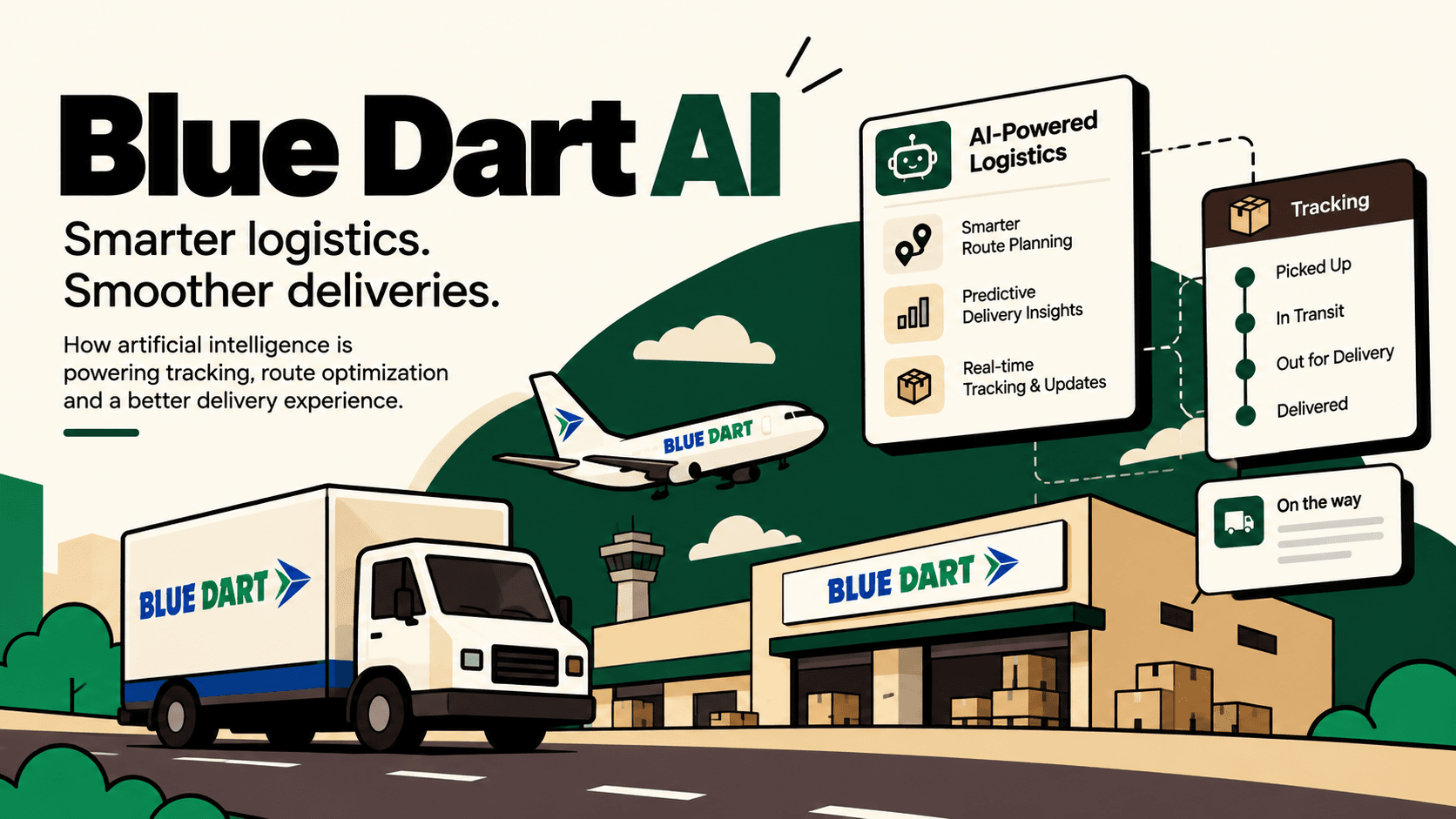
When people search for Blue Dart AI, they may be looking for an AI-powered tracking tool, an AI logistics platform or information about how Blue Dart uses artificial intelligence across its operations. The more accurate picture is broader: Blue Dart is integrating AI with an existing logistics technology stack that includes real-time tracking, automation, cloud computing, big-data analytics and digital shipment systems.
Blue Dart's FY2024–25 annual reporting discusses AI alongside IoT, cloud computing, big-data analytics and automation as technologies transforming transport and supply-chain operations. The report identifies areas such as route optimization, demand forecasting, real-time tracking and sustainability initiatives, while also stating that the company is still working toward fully integrating Generative AI capabilities into its systems.
Blue Dart Annual Report 2024–25
That distinction matters. Blue Dart's AI story is not simply about putting a chatbot on top of parcel tracking. It is about using data and automation across a logistics network where shipment movement, routing, capacity, customer communication and last-mile execution are interconnected.
For ecommerce businesses, the more useful question is therefore not only “What AI does Blue Dart use?” but also “How can Blue Dart's tracking and logistics data become part of an AI-enabled commerce workflow?”
What is Blue Dart AI?
Blue Dart AI refers to the use and planned integration of artificial intelligence within Blue Dart's broader logistics technology environment. Based on the supplied research, this includes AI-related applications such as route optimization, demand forecasting, real-time shipment visibility and sustainability-related initiatives, alongside existing automation and tracking infrastructure.
Blue Dart's own FY2024–25 reporting describes AI and related technologies as part of the transformation of transport and supply-chain operations. However, the same reporting indicates that Generative AI capabilities were still being integrated rather than presenting the company as a fully autonomous AI logistics operation.
This is an important distinction for businesses researching the term. Blue Dart has an established digital logistics infrastructure into which AI capabilities are being integrated; the available research does not support describing Blue Dart itself as an “AI logistics company.”
How Blue Dart's AI strategy fits into its logistics technology
AI becomes useful in logistics because transportation generates large volumes of operational data. Every shipment can produce information about pickup, movement, scans, routing, delivery attempts, exceptions and final delivery.
Blue Dart already operates technology for shipment visibility and scanning. Its DART technology infrastructure supports shipment-status updates through scanning across stages of the delivery process.
Its tracking environment provides customers with shipment-status information, while Blue Dart also provides API-oriented tracking capabilities for businesses.
AI can sit on top of this operational data to identify patterns, forecast demand, support routing decisions, classify exceptions and help determine what action should happen next.
A simplified architecture looks like this:
Shipment events → Logistics data → AI and analytics → Operational decision → Customer or operations workflow
The important point is that AI is only one layer. Reliable automation still depends on accurate shipment events, system integrations, business rules and operational processes.
Blue Dart AI and route optimization
One of the clearest applications of AI in logistics is route optimization.
A delivery network must continuously account for destinations, delivery commitments, shipment characteristics, capacity, traffic conditions and operational constraints. Route planning becomes more complex as shipment volume and geographic coverage increase.
Blue Dart's FY2024–25 reporting identifies route optimization as an area where AI can contribute to logistics operations.
Blue Dart FY2024–25 Management Discussion and Analysis
The role of AI in this context is not necessarily to replace dispatchers or operations teams. It can instead help process more variables and identify route options or operational patterns that would be difficult to evaluate manually.
For an ecommerce business, route optimization can also matter downstream. A brand may not control the carrier's entire route network, but it can use carrier information to understand delivery performance by region, service level, product type or customer segment.
Example: using delivery data beyond tracking
Suppose an ecommerce company ships thousands of orders every month. Its operations team may know whether a package is delivered, but that is only the beginning of the analysis.
An integrated analytics layer could examine:
- Delivery performance by geography.
- Shipment exceptions by carrier or service type.
- Repeated delivery attempts.
- Transit-time patterns.
- Customer support contacts associated with shipment delays.
- Returns associated with delivery problems.
- Orders approaching their promised delivery window.
The business can then move from tracking shipments to managing delivery performance.
AI-powered demand forecasting in logistics
Demand forecasting is another area identified in Blue Dart's AI discussion.
Logistics companies need to anticipate changes in shipment volume because capacity, routing and network planning depend on expected demand. Ecommerce businesses face a related problem: inventory and order demand can change quickly around promotions, seasonal events and marketplace activity.
AI-based forecasting can analyze historical patterns and available operational data to identify likely changes in demand.
For a D2C brand, the useful architecture is not simply “AI predicts demand.” It is:
Sales data + inventory + promotions + order history + shipment data → forecast → replenishment and fulfillment decision.
That creates a connection between logistics intelligence and commerce infrastructure.
For example, if order volume is increasing in a particular region, the business may need to consider inventory positioning, warehouse capacity, carrier allocation and customer delivery promises together rather than treating them as separate decisions.
Real-time shipment tracking is the foundation for AI
AI cannot make useful logistics decisions without reliable operational data. This is why real-time tracking is a foundational part of the Blue Dart technology story.
Blue Dart's TrackDart environment provides shipment tracking and status information, while the company's technology infrastructure uses scanning to update shipment movement through the network.
Blue Dart also provides tracking-related API infrastructure, which is important for ecommerce businesses that want shipment information to appear inside their own systems rather than requiring employees or customers to visit a separate tracking page.
Blue Dart API tracking information
Once shipment events are available programmatically, a business can build workflows around them.
For example:
- Order is created in the ecommerce platform.
- Shipment is created with the carrier.
- Tracking number is returned to the commerce system.
- Shipment events are synchronized.
- AI or rules classify the latest status.
- Customer communication is triggered when appropriate.
- Exceptions are routed to customer operations.
- Analytics systems update delivery-performance metrics.
This is where carrier integration becomes more valuable than a standalone tracking page.
Blue Dart AI and last-mile delivery
Last-mile delivery is where logistics data becomes visible to the customer. A shipment can move efficiently through a network and still create a poor customer experience if delivery communication is unclear or exceptions are handled slowly.
Blue Dart's FY2023–24 reporting describes Smart Assist as providing functional visibility to customers and communicating relevant shipment updates to last-mile delivery teams.
Blue Dart Annual Report 2023–24
This illustrates an important principle: logistics automation is not limited to routing a parcel. It also involves moving the right information to the right person at the right time.
An AI-enabled last-mile workflow can build on that principle by identifying shipment events that require attention.
Normal status: automate the customer update.
Potential delay: identify the shipment and notify the customer or support team.
Repeated delivery attempt: create an exception workflow.
Address or delivery issue: route to the appropriate operational process.
High-value or sensitive order: apply the appropriate human review rules.
The objective is not to automate every customer interaction. It is to automate predictable communication while making exceptions visible earlier.
Blue Dart and Generative AI
Generative AI is different from conventional logistics automation.
Traditional logistics automation can follow predefined rules: when a shipment is scanned, update its status; when an event occurs, trigger a notification; when an order reaches a particular state, move it to the next workflow stage.
Generative AI can interpret unstructured information and generate responses or summaries. That creates opportunities in areas such as customer support, exception classification, internal operational assistance and natural-language analysis.
However, Blue Dart's FY2024–25 reporting indicates that the company was still in the process of fully integrating Generative AI capabilities into its systems.
Blue Dart Annual Report 2024–25
That means content about “Blue Dart Generative AI” should distinguish between documented AI direction and capabilities that are already fully deployed. The available research supports discussing Generative AI as an area Blue Dart recognizes and is integrating, not claiming that every logistics workflow is already powered by autonomous generative AI.
What AI can do with Blue Dart shipment data
For ecommerce companies, the more practical opportunity is often downstream of the carrier.
Blue Dart generates shipment events. The ecommerce business can combine those events with its own order, customer, inventory and support data.
A connected AI workflow might look like:
Shopify / Marketplace → ERP / OMS → Blue Dart → Tracking Events → AI Operations Layer → Customer Support / Notifications / Analytics
That architecture allows the business to use shipment data in context.
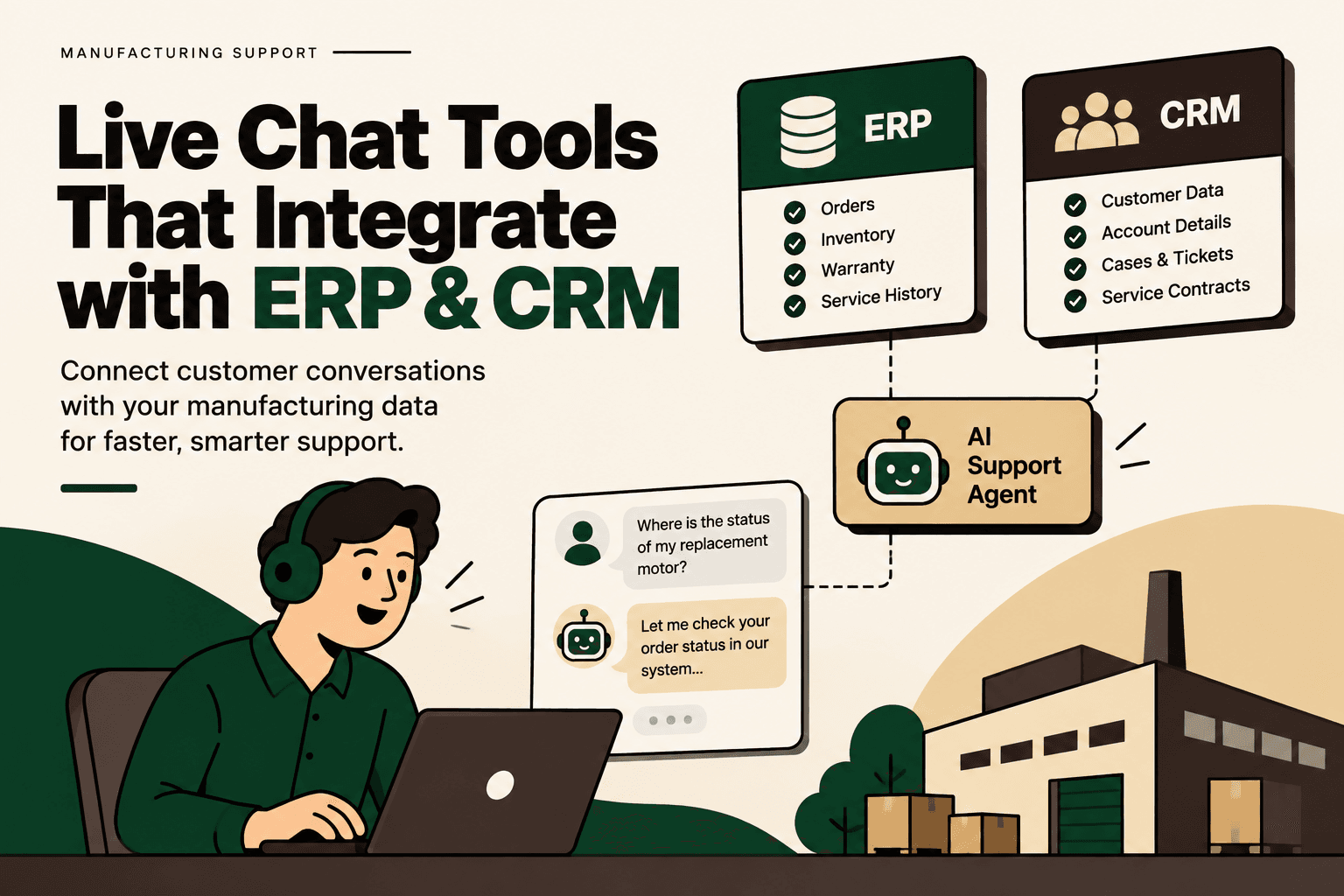
For example, a customer may ask, “Where is my order?” The support system should not need to search through multiple dashboards manually. It can identify the order, retrieve the Blue Dart tracking status, interpret the current shipment event and provide the approved response.
Another workflow could detect that a shipment has remained in the same status longer than the organization's expected threshold. Instead of waiting for the customer to complain, the system can create an internal exception or initiate the appropriate customer communication.
Blue Dart AI for customer support
Shipment-related customer questions are highly repetitive, which makes them suitable for workflow automation.
Common questions include:
- Where is my order?
- When will my shipment arrive?
- Has my shipment been dispatched?
- Why has the delivery been delayed?
- Was a delivery attempt made?
- What is the latest tracking status?
- What should I do if the delivery address needs attention?
A support agent can answer many of these questions by retrieving verified tracking information rather than generating an answer from general language-model knowledge.
This distinction is critical. An AI support system should treat carrier tracking data as an operational source of truth, not as information that the language model is expected to remember.
A controlled support workflow looks like:
- Identify the customer.
- Identify the relevant order.
- Retrieve the Blue Dart tracking number.
- Retrieve the latest carrier status.
- Apply the company's customer-communication rules.
- Generate a concise response from the verified status.
- Escalate if the shipment meets an exception condition.
This reduces hallucination risk because the response is grounded in current operational data.
Where human oversight still matters
More AI does not automatically mean better logistics operations.
Some shipment situations require context that may not be available in a tracking event. A delivery exception may involve a customer commitment, address issue, high-value shipment, regulatory requirement or commercial decision.
A useful operating model divides logistics decisions into four categories:
| Workflow | Automation approach | Human involvement |
|---|---|---|
| Routine tracking update | Automate retrieval and communication | Not normally required |
| Known delivery exception | Detect and route using defined rules | Required when the exception exceeds configured thresholds |
| Complex customer issue | AI gathers context and summarizes the case | Human resolves the case |
| Commercial or high-impact decision | AI can prepare relevant information | Human approval remains required |
The objective is controlled automation. AI should make people faster at resolving exceptions rather than simply removing people from the workflow.
Blue Dart, ERP and ecommerce: the connected commerce model
The largest opportunity for ecommerce businesses is often not the carrier itself but the connection between carrier data and the rest of the commerce stack.
A typical ecommerce architecture may include:
- Shopify or another ecommerce platform.
- Marketplace accounts.
- ERP.
- Order management system.
- Warehouse management system.
- Inventory system.
- Blue Dart and other carrier integrations.
- Customer support platform.
- Returns platform.
- Analytics and reporting.
If these systems operate independently, the operations team has to reconcile them manually. The business may know the order status in one system, the shipment status in another and the customer conversation in a third.
An AI infrastructure layer can connect those events and create a common operational workflow.
Order created → inventory confirmed → shipment booked → Blue Dart tracking synchronized → delivery monitored → exception detected → customer communication → return or support workflow if required.
This is more valuable than simply adding an AI chatbot because the AI is connected to the operational process.
How Five Anchor could use Blue Dart data in an AI commerce workflow
Five Anchor is positioned as AI Infrastructure for D2C & E-Commerce. The Blue Dart use case fits particularly well into the intersection of commerce infrastructure and AI-powered customer operations.
Five Anchor could implement a workflow in which Blue Dart shipment events are connected with ecommerce orders, ERP records, inventory, customer support and operational dashboards. The implementation would begin by mapping the existing order-to-delivery workflow and identifying which systems own the relevant data.
The integration layer could then synchronize approved carrier events into the commerce environment. AI can be introduced where it provides useful interpretation, such as classifying delivery exceptions, summarizing shipment history, preparing customer responses or identifying orders that need human attention.
For example, rather than asking a support employee to check an order-management system and then manually search Blue Dart tracking, the support workflow can retrieve both records automatically and present the relevant context in one place.
The result is not simply “AI tracking.” It is a connected operational workflow in which carrier data becomes actionable business data.
A practical Blue Dart AI architecture for D2C brands
A reference architecture could look like this:
Customer
↓
Shopify / Marketplace
↓
ERP / OMS
↓
Blue Dart Shipment Booking
↓
Blue Dart Tracking Events
↓
AI + Rules Layer
↓
Customer Communication / Support / Operations / Analytics
The AI and rules layer can perform several different jobs.
1. Event interpretation
Convert raw shipment events into business-friendly statuses that customers and operations teams can understand.
2. Exception classification
Identify shipments that require attention based on predefined conditions.
3. Customer communication
Generate approved messages based on verified shipment information.
4. Support assistance
Retrieve order and tracking context so an agent can resolve customer questions without switching between systems.
5. Operational analytics
Combine shipment events with order and customer information to identify recurring delivery patterns.
How to implement Blue Dart AI workflows without over-automating
The implementation should begin with the workflow rather than with an AI model.
- Map the order-to-delivery process. Document where the order begins, where the shipment is booked, where tracking data enters the organization and how exceptions are currently handled.
- Establish a baseline. Measure support contacts about delivery, manual tracking lookups, exception volume, response time and delivery-related escalations.
- Identify the highest-volume workflow. Shipment-status questions are often easier to automate than complex delivery disputes because the underlying data is structured.
- Connect the carrier data. Use the available Blue Dart tracking and API capabilities to bring shipment events into the relevant business systems.
- Define business rules. Decide which shipment events should trigger customer messages, internal alerts or human review.
- Add AI selectively. Use AI for classification, summarization, natural-language responses or operator assistance where those functions add value.
- Add human escalation. Define exactly when the system must stop and transfer the case to a person.
- Pilot one workflow. Start with a measurable use case such as automated shipment-status support.
- Measure the result. Compare automation rate, response time, exception resolution and customer-service workload against the baseline.
- Scale carefully. Add delivery exceptions, returns, proactive notifications and deeper analytics after the first workflow is stable.
What not to automate with Blue Dart AI
There is a temptation to make every logistics process autonomous once tracking data becomes available. That can create unnecessary complexity.
Some decisions should remain governed by explicit business rules and human approval.
- Customer-specific commercial commitments.
- High-value shipment exceptions.
- Disputes involving delivery or payment.
- Requests that require identity verification beyond available data.
- Ambiguous address or recipient situations.
- Policy exceptions.
- Actions that could create financial or contractual exposure.
AI can still assist with these cases by collecting relevant information, summarizing the shipment history and preparing a recommended next step. The final decision can remain with an authorized employee.
How to measure the business impact
AI logistics projects should be evaluated using operational metrics rather than AI usage alone.
Relevant measures include:
- Shipment-status contacts per 1,000 orders.
- Average time required to answer tracking questions.
- Percentage of tracking questions resolved automatically.
- Exception detection time.
- Exception resolution time.
- Manual tracking lookups per order.
- Customer-support handling time.
- Delivery-related escalation volume.
- Return or cancellation events associated with delivery issues.
- Customer satisfaction for delivery-related interactions.
A useful practical prioritization model is:
volume × frequency × manual effort × error cost × revenue impact ÷ implementation complexity
This is a practical framework, not an industry-standard formula. It helps identify workflows where automation may have a meaningful operational effect without assuming every process needs AI.
Blue Dart AI: what the research actually supports
The supplied research supports several specific conclusions.
First, Blue Dart is already operating a substantial digital technology environment for shipment tracking and logistics execution. Its DART technology and tracking systems provide the operational foundation on which more advanced analytics and AI can operate.
Second, Blue Dart's FY2024–25 reporting explicitly discusses AI, IoT, cloud computing, big-data analytics and automation in the context of transport and supply-chain transformation, with route optimization, demand forecasting and real-time tracking among the identified application areas.
Third, Blue Dart recognizes the potential of Generative AI but its FY2024–25 reporting indicates that integration was still underway. Therefore, it would be inaccurate to imply that all Blue Dart logistics workflows are already autonomous or powered by Generative AI.
Fourth, Blue Dart's Smart Assist initiative, described in its FY2023–24 reporting, demonstrates the importance of operational visibility and shipment communication within the last-mile process.
These facts point toward a broader conclusion: Blue Dart's AI opportunity is best understood as the evolution of an existing digital logistics infrastructure, rather than as a standalone AI product.
Frequently asked questions about Blue Dart AI
What is Blue Dart AI?
Blue Dart AI refers to Blue Dart's use and planned integration of artificial intelligence within its broader logistics technology environment. The supplied research identifies route optimization, demand forecasting, real-time tracking and sustainability-related applications among the areas where AI can contribute.
Does Blue Dart use artificial intelligence?
Blue Dart's FY2024–25 annual reporting discusses AI alongside IoT, cloud computing, big-data analytics and automation as technologies transforming transport and supply-chain operations. The same reporting indicates that Generative AI capabilities were still being integrated into its systems.
Does Blue Dart use Generative AI?
Blue Dart's FY2024–25 reporting states that the company recognizes the potential of Generative AI in logistics and is in the process of fully integrating these capabilities into its systems. The research does not support claiming that all Blue Dart operations currently use Generative AI.
How does Blue Dart use AI in logistics?
The supplied research identifies applications including route optimization, demand forecasting, real-time tracking and sustainability initiatives. AI is discussed as part of a broader technology environment that also includes IoT, cloud computing, analytics and automation.
Can ecommerce businesses integrate Blue Dart tracking data?
Blue Dart provides tracking and API-oriented capabilities that can allow shipment information to be incorporated into business workflows. The specific integration approach depends on the business system and the Blue Dart services being used.
Can AI automate Blue Dart customer support?
AI can automate or assist with shipment-status questions when the support system retrieves verified tracking information. More complex delivery exceptions should be routed according to business rules and human-approval requirements.
Final takeaway
Blue Dart AI is best understood as the application and planned expansion of artificial intelligence within an established logistics technology infrastructure.
Blue Dart's research and reporting point to AI applications in areas such as route optimization, demand forecasting, real-time tracking and sustainability, while its existing DART and tracking systems provide the operational data layer. Its Smart Assist initiative also illustrates how digital visibility can extend into last-mile operations.
For ecommerce businesses, the more actionable opportunity is connecting that carrier data to the rest of the commerce stack.
Shopify + ERP + inventory + Blue Dart tracking + AI + customer support can become a connected workflow in which shipment events automatically update operational systems, routine customer questions receive verified answers, exceptions are identified earlier and human teams focus on cases that actually require judgment.
That is where an AI infrastructure approach becomes useful: not by replacing the carrier or pretending every logistics decision can be autonomous, but by connecting carrier data to the systems and workflows that run the commerce business.
For D2C and ecommerce organizations, Five Anchor can apply this approach through ERP and marketplace integrations, shipment-data workflows, AI-powered customer operations, exception handling and operational analytics.
Key Takeaways
- •Blue Dart's AI strategy is part of a broader logistics technology environment rather than evidence that Blue Dart is itself an AI-only logistics company.
- •Blue Dart's FY2024–25 reporting identifies route optimization, demand forecasting, real-time tracking and sustainability-related initiatives as AI application areas.
- •Blue Dart's existing DART and tracking infrastructure provides the shipment-event foundation required for more advanced automation and AI workflows.
- •Blue Dart's reporting says Generative AI capabilities are still being integrated, so claims about fully autonomous Generative AI logistics should be avoided.
- •Smart Assist illustrates how digital shipment visibility can support customers and last-mile delivery teams.
- •Ecommerce businesses can create additional value by connecting carrier tracking events with Shopify, ERP, OMS, inventory, customer support, returns and analytics.
- •AI should use verified carrier data as an operational source of truth rather than relying on language-model memory for shipment status.
Blue Dart AI and Connected Ecommerce Logistics
| Capability | Blue Dart Technology Layer | AI-Enabled Commerce Workflow |
|---|---|---|
| Inventory Sync Frequency | 15–30 min batch polling (high oversell risk) | Sub-second atomic locking (<450ms) |
| Concurrent Drop Resilience | Fails under concurrency; causes negative stock balance | Redis atomic reservation queue guarantees exact counts |
| Error Handling & Retries | Silent failure; manual CSV audit needed | Dead-letter queues with automated exponential retry |
| Fulfillment Routing Speed | 2–4 hours delayed batch export to 3PL warehouse |