What Is an E-Commerce Voice Response System?
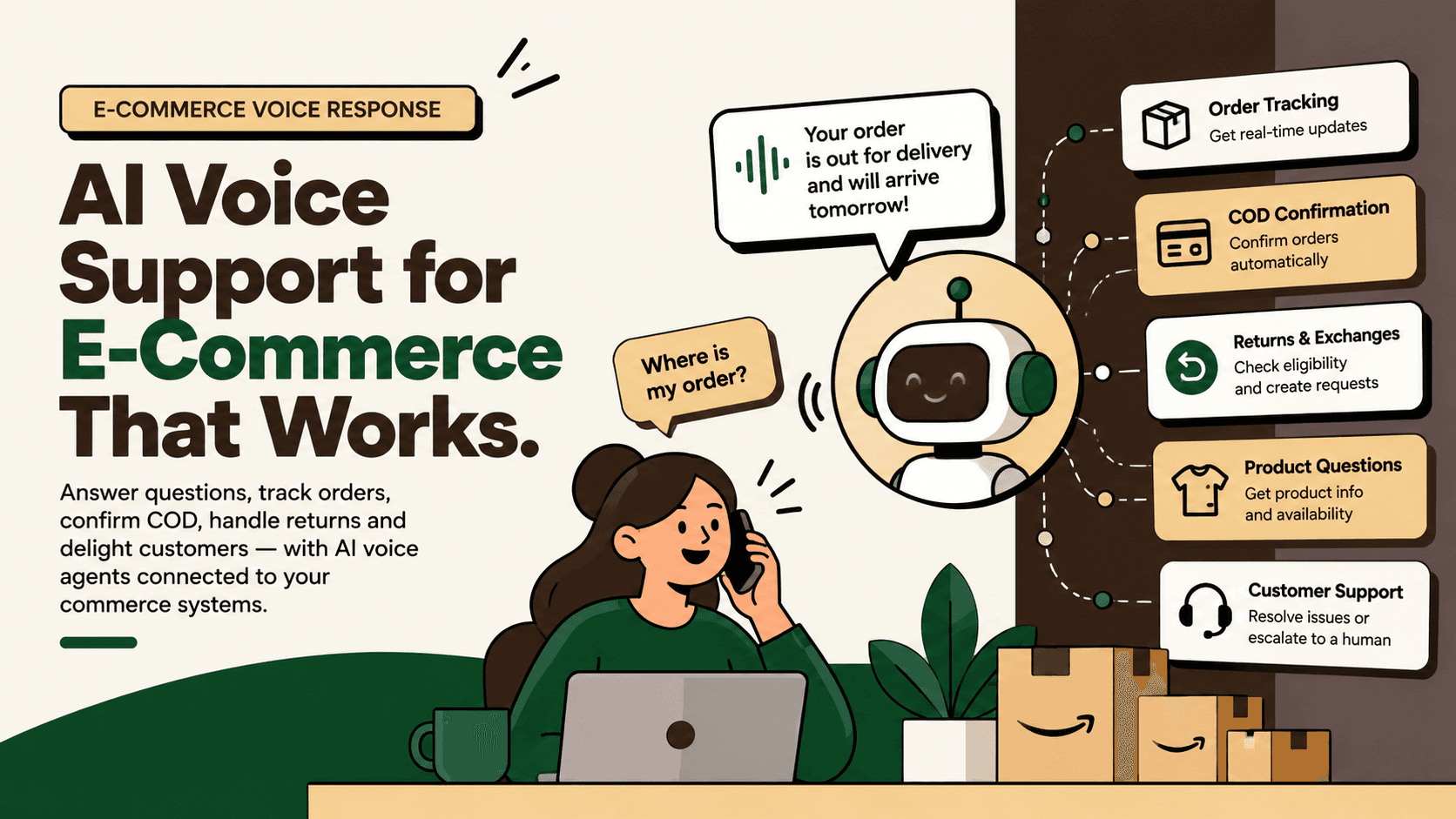
An e-commerce voice response system uses AI voice agents to handle inbound and outbound customer calls across the order lifecycle. Instead of limiting customers to a traditional IVR menu, an AI voice agent can understand conversational requests, retrieve relevant order or customer information, perform supported actions and escalate cases when human intervention is required.
Current ecommerce voice-agent solutions describe use cases including order status, WISMO calls, COD confirmation, returns, exchanges, delivery exceptions, product and inventory questions, refunds, abandoned-cart recovery and post-purchase support. Solutions in the supplied research also describe integrations with ecommerce platforms and operational systems.
LazyRabbit AI voice agent for ecommerce
This changes the role of voice support. Instead of being another disconnected customer-service channel, voice becomes another interface into the commerce infrastructure.
A simplified model is:
Customer call → AI voice agent → customer verification → live commerce data → business rules → action or answer → human escalation when required
Why E-Commerce Businesses Need More Than Traditional IVR
Traditional IVR systems are useful for routing calls, but they generally depend on predefined menus and keypad inputs. A customer may have to select several options before reaching the correct department.
That structure works for simple routing, but ecommerce support often involves questions that depend on current customer and order data.
A customer asking, “Where is my order?” is not asking for a generic FAQ answer. The support system needs to identify the customer, locate the relevant order, retrieve shipment information and communicate the current status.
Similarly, “Can I exchange the shoes I bought last week?” may require checking the order, product, purchase date, exchange policy and current workflow before an answer can be provided.
An AI voice response system can connect the conversation to these underlying systems instead of treating the call as an isolated interaction.
What Can an E-Commerce Voice Response System Automate?
The most useful applications are workflows where the customer's intent is relatively predictable and the required information exists in connected business systems.
1. Order Status and WISMO Calls
WISMO, or “Where Is My Order?”, is a recurring ecommerce support request. A voice agent can identify the customer and retrieve the relevant order and shipment information before responding.
A typical workflow is:
- Customer calls the support number.
- AI identifies the customer's intent.
- The system verifies the customer using the organization's approved process.
- The agent retrieves the relevant order.
- Shipment or fulfillment data is retrieved.
- The agent explains the current status.
- The conversation is logged when required.
The important distinction is that the voice agent should retrieve live information rather than rely on language-model memory for shipment status.
2. COD Confirmation
Cash-on-delivery orders create a different workflow because the business may want to confirm customer intent before dispatch.
An outbound voice agent can contact the customer, confirm the order and address information according to the business's approved process, and flag cancellations or uncertain responses for human review.
The goal is not to make the AI responsible for every dispatch decision. The goal is to collect information consistently and route exceptions before the order moves further into fulfillment.
3. Returns and Exchanges
Returns are another structured support workflow that can benefit from voice automation.
The agent can collect the customer's request, identify the order, check applicable eligibility rules and either initiate the supported return workflow or transfer the case when a human decision is required.
An exchange request might involve:
- Identifying the original order.
- Checking the product and purchase date.
- Checking the applicable return or exchange policy.
- Understanding the customer's requested action.
- Creating or updating the return request when supported.
- Providing the next step.
- Escalating exceptions.
This is more useful than an AI agent that simply reads the return policy to the customer.
4. Delivery Exception Handling
Delivery problems often generate calls because customers want to know what happened and what they should do next.
Examples include delayed shipments, failed delivery attempts and requests to reschedule delivery.
A connected voice system can retrieve the relevant shipment information and follow predefined rules for the next step. Cases outside those rules can be transferred to a human support or operations team.
5. Product and Inventory Questions
Voice agents can answer product-related questions when approved product information is available to the system.
Customers may ask about product specifications, sizes, availability or other catalog information. Ecommerce voice-agent providers describe product and inventory questions as supported use cases.
Brilo AI ecommerce voice-agent use cases
The critical implementation requirement is grounding. The agent should retrieve the current approved product or inventory information rather than invent an answer.
6. Refund and Payment Support
Customers may call about refund status, payment questions or COD details after an order has been placed.
A voice agent can retrieve approved payment or refund information and explain the current status. More sensitive billing disputes or cases requiring authorization should be transferred to an appropriate human workflow.
7. Abandoned Cart Recovery
Voice can also be used proactively rather than only for support.
An outbound voice agent can contact selected high-intent shoppers, ask why they did not complete a purchase, answer approved product or delivery questions and help the customer continue the purchase when the workflow supports it.
This use case requires more careful prioritization than routine support because outbound calls affect customer experience and should be governed by consent, contact policies and clear business rules.
VaniAgent ecommerce voice-agent use cases
8. Post-Purchase Support
After delivery, a voice agent can confirm successful delivery, collect feedback, request a review where appropriate or identify dissatisfaction that needs attention.
This creates a broader lifecycle:
Pre-purchase → purchase → fulfillment → delivery → returns → post-purchase
Instead of deploying separate automation for every stage, the business can build one connected voice layer around the customer and order lifecycle.
How an E-Commerce Voice Response System Works
A modern voice response system can be understood as several layers rather than a single AI model.
Customer → AI Voice Agent → Intent and Verification → Commerce Systems → Fulfillment Systems → Action → Customer or Human Agent
Layer 1: Voice interface
The customer speaks naturally instead of navigating only through keypad menus.
Layer 2: Intent recognition
The system determines whether the customer is asking about an order, delivery, return, product, payment or another supported workflow.
Layer 3: Customer verification
The system applies the organization's approved verification process before accessing customer-specific information or taking actions.
Layer 4: Commerce data
The agent retrieves relevant information from ecommerce, ERP, OMS, CRM, inventory or other connected systems.
Layer 5: Fulfillment data
When the request involves shipping, the system can retrieve information from WMS, shipping or logistics platforms where integrations are available.
Layer 6: Business rules
Rules determine what the system can do automatically, what requires approval and what must be escalated.
Layer 7: Action
The system can answer the customer, update a supported record, initiate an approved workflow or create an escalation.
The Difference Between a Voicebot and an Integrated AI Voice Agent
Not every voice solution has the same operational depth.
A basic voicebot may primarily answer predefined questions or route callers. An integrated AI voice agent can connect the conversation to operational systems and use retrieved information to complete supported workflows.
| Capability | Traditional IVR or Basic Voicebot | Integrated AI Voice Agent |
|---|---|---|
| Call routing | Menu-based routing | Intent-based routing and conversation |
| Order lookup | Usually limited or separate | Can retrieve connected order information |
| Shipment status | May redirect customers to tracking | Can retrieve approved live shipment information |
| Returns | Provides instructions or routes calls | Can support eligibility checks and approved return workflows |
| CRM or helpdesk | Often requires manual entry | Can log or update supported records |
| Exception handling | Usually routes to a department | Can classify, summarize and escalate according to rules |
| Outbound workflows | Often campaign-oriented | Can support contextual order, COD or recovery conversations |
The distinction is architectural. The more useful system is not necessarily the one with the most sophisticated voice model; it is the one that can reliably connect conversation to the business workflow.
Which E-Commerce Systems Should Voice Agents Integrate With?
A voice system becomes substantially more useful when it can retrieve the information required to answer customer questions.
The researched solutions describe integrations and workflows involving ecommerce platforms, order-management systems, ERP, CRM, inventory and shipping infrastructure.
A practical architecture could look like this:
Customer
↓
AI Voice Agent
↓
Intent + Customer Verification
↓
Commerce Layer
Shopify · WooCommerce · Magento · ERP · OMS · CRM · Inventory
↓
Fulfillment Layer
WMS · Shipping Provider · 3PL · Delivery Platform
↓
Action
Answer · Update · Return · COD Confirmation · Escalation
This architecture means the voice system does not have to become the system of record. It becomes an interface into systems that already contain the business data.
Why ERP and OMS Integration Matters
Ecommerce customer support frequently breaks down when the support channel and operational systems are disconnected.
A support agent may see the customer conversation but not the latest inventory state. The ERP may contain financial information while the shipping system contains the latest tracking event. The OMS may know the fulfillment state while the CRM contains the interaction history.
An AI voice system can help only if it can retrieve the appropriate data from these systems.
For example, consider a customer asking, “Can you change my order from medium to large?”
The voice agent should not simply say yes. It needs to determine whether the order is still changeable, whether the requested SKU is available, whether the fulfillment process has already started and whether the business allows that change at the current stage.
This is why voice automation should be designed around business workflows, not around conversations alone.
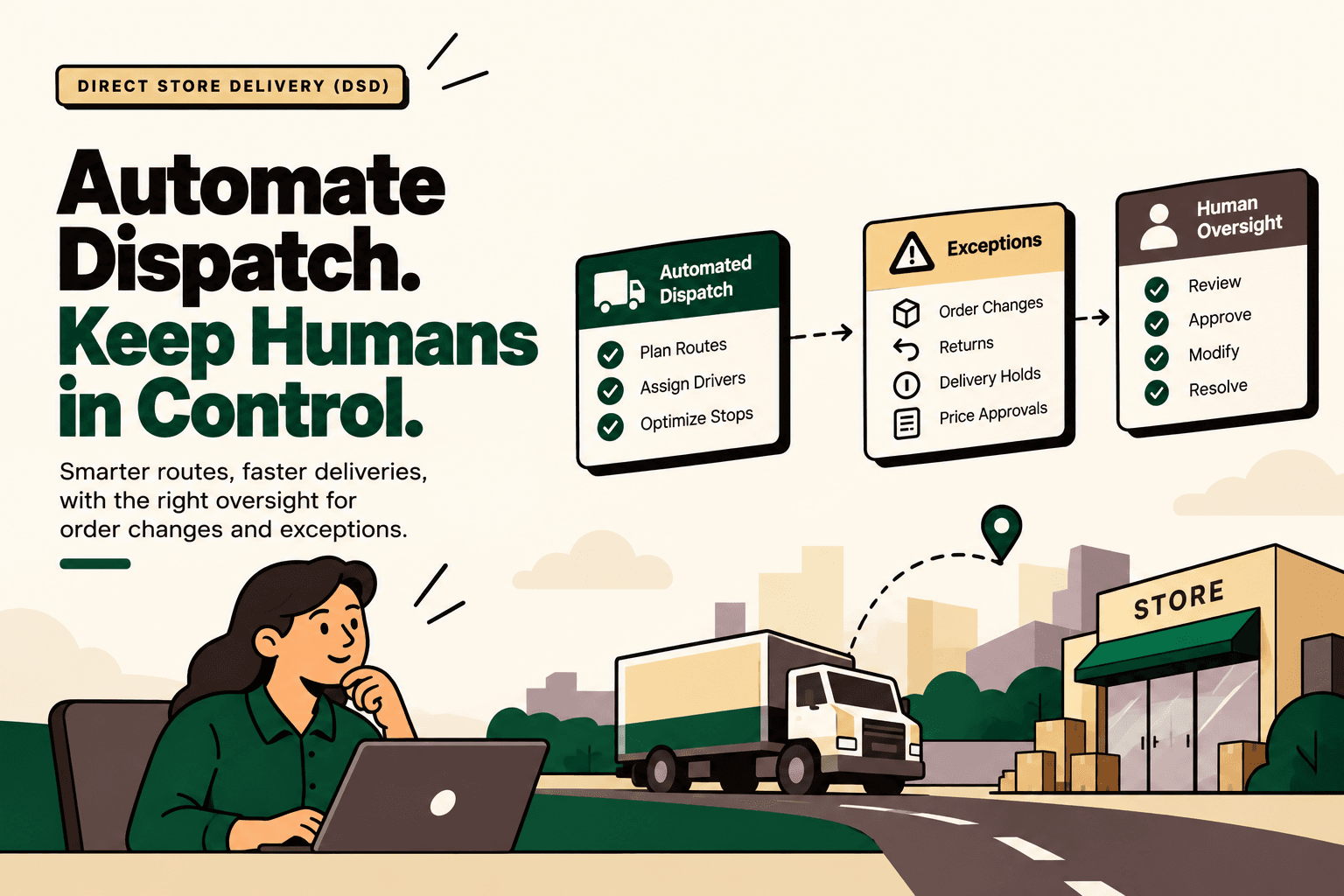
Human Oversight Still Matters
AI voice agents should not automatically control every ecommerce decision.
Some requests are straightforward enough to automate. Others involve ambiguity, financial exposure, policy exceptions or customer-specific judgment.
| Scenario | Automation Role | Human Role |
|---|---|---|
| Order status request | Retrieve and communicate verified status | Handle unusual exceptions |
| COD confirmation | Collect confirmation and flag uncertain responses | Review exceptions and cancellations where required |
| Standard return request | Check rules and initiate supported workflow | Handle policy exceptions |
| Complex refund dispute | Collect information and summarize case | Make the final decision |
| Address or order change | Check whether change is permitted | Approve exceptions or intervene when fulfillment has progressed |
| Customer complaint | Identify intent and summarize context | Resolve sensitive or escalated cases |
The objective is not maximum automation. It is controlled automation with clear escalation boundaries.
What Should Be Automated First?
A common mistake is starting with the most technically impressive workflow rather than the most operationally useful one.
A practical prioritization model is:
volume × frequency × manual effort × error cost × revenue impact ÷ implementation complexity
This is a practical framework, not an industry-standard formula. It helps ecommerce teams compare candidate workflows before investing in implementation.
For many businesses, the initial candidates may include:
- Order-status calls.
- Delivery-status questions.
- COD confirmation.
- Basic return-status questions.
- Routine product-information questions.
- Simple post-delivery feedback.
More complex workflows can follow after the first implementation is stable.
Building an E-Commerce Voice Response System Step by Step
1. Map the customer-call workflows
Start by identifying why customers call. Categorize calls by volume, complexity, required systems and resolution process.
2. Establish a baseline
Measure call volume, average handling time, transfer rate, repeat calls, resolution time and the percentage of calls related to specific intents.
3. Identify the source of truth
For every workflow, determine where the authoritative data lives. Order information may come from the OMS, product information from the catalog system and shipment information from the logistics platform.
4. Define what the AI can access
Use least-privilege access and expose only the data required for each workflow.
5. Separate rules from AI
Use deterministic rules for decisions such as return eligibility, order-change cutoffs and approval thresholds. Use AI for conversation, classification, summarization and other areas where language understanding adds value.
6. Design human escalation
Define exactly when the AI must transfer the customer and what context should be passed to the human agent.
7. Pilot one high-volume workflow
A focused order-status or delivery-support workflow is easier to measure than a voice system attempting to handle every possible customer request from day one.
8. Monitor conversations and outcomes
Review failed resolutions, incorrect intent detection, unnecessary transfers, customer complaints and system errors.
9. Expand gradually
Once the first workflow is reliable, add returns, COD confirmation, product questions, post-purchase workflows and other use cases.
Common Failure Modes in E-Commerce Voice Automation
1. The AI has no live business data
If the agent cannot retrieve current order or inventory information, it cannot reliably answer customer-specific questions.
2. Too much autonomy
Allowing the AI to perform sensitive actions without rules or approval can create operational and customer-service risk.
3. No escalation path
A voice agent should always have a clear route to a human when it reaches the boundary of its authority.
4. Poor customer verification
Customer-specific information should not be exposed simply because someone knows an order number or phone number. Verification should follow the organization's approved security process.
5. Treating AI as the system of record
The voice agent should generally retrieve and act through business systems rather than becoming the authoritative source of order, inventory or financial information.
6. Measuring only call automation
A high percentage of automated calls does not necessarily mean the workflow is successful. Businesses should also measure resolution quality, repeat contacts, escalation quality and operational outcomes.
Security, Privacy and Governance
Voice systems process customer conversations, which can contain personal, order and payment-related information. Integration design therefore needs appropriate access controls, data handling policies, logging and retention practices.
The AI should have access only to the systems and actions required for its assigned workflows. Sensitive operations should have explicit approval boundaries.
Businesses should also determine how calls are recorded, how transcripts are stored, who can access them and how long information is retained. These requirements vary by jurisdiction, industry and the organization's own policies.
How Five Anchor Could Implement E-Commerce Voice Operations
Five Anchor is positioned as AI Infrastructure for D2C & E-Commerce, making ecommerce voice operations a natural extension of its AI-Powered Customer Operations and Commerce Infrastructure capabilities.
A practical implementation could begin with workflow mapping across the ecommerce platform, ERP or OMS, CRM, inventory system and shipping providers. The integration layer would then expose the approved information and actions required by the voice agent.
For example, an order-status voice workflow could retrieve the customer order, query the current fulfillment or shipment status, communicate the approved response and create an escalation when the shipment meets a defined exception condition.
Five Anchor could also connect voice operations with returns, warranty workflows, ticket automation and customer communication while keeping human approval in place for sensitive or ambiguous cases.
The objective is not simply to deploy a voicebot. It is to create a voice interface connected to the operational systems that actually run the ecommerce business.
How to Measure an E-Commerce Voice Response System
The right metrics depend on the workflow, but useful measures include:
- Percentage of calls resolved without human intervention.
- Average handling time.
- Human transfer rate.
- Repeat-contact rate.
- Order-status calls per 1,000 orders.
- COD confirmation completion rate.
- Return-request processing time.
- Delivery-exception resolution time.
- Customer satisfaction after voice interactions.
- Incorrect-action or escalation rate.
- Cost per resolved interaction.
For outbound workflows, additional measures can include successful contact rate, confirmed orders, qualified recovery conversations and downstream conversion. Any claimed improvement should be measured against the organization's own baseline rather than assumed from vendor marketing.
E-Commerce Voice Response System Solutions: What to Look For
The supplied research identifies ecommerce-focused voice solutions including Edesy, LazyRabbit, Brilo AI, VaniAgent, Centricall, TelEcho, AurionX and ElidePro. These vendors describe use cases including order tracking, returns, COD confirmation, cart recovery and customer support.
Edesy, LazyRabbit, Brilo AI, VaniAgent, Centricall, TelEcho, AurionX and ElidePro.
Rather than selecting a solution based only on its voice quality or list of use cases, ecommerce teams should evaluate the integration architecture.
- Commerce integrations: Can it connect to the ecommerce platform?
- ERP and OMS access: Can it retrieve the data required for customer-specific workflows?
- CRM and helpdesk integration: Can conversations and escalations be recorded in the existing support environment?
- Shipping integrations: Can it retrieve relevant delivery information?
- Action capabilities: Can it perform approved actions or only provide information?
- Human handoff: Can it transfer a conversation with sufficient context?
- Guardrails: Can businesses define what the agent is allowed to do?
- Monitoring: Can teams review failures, escalations and outcomes?
- Data controls: Are access, storage and retention requirements supported?
Why Voice Should Become Part of the Commerce Stack
Voice support is often treated as a separate channel: website chat on one side, email on another and phone support somewhere else.
That structure creates duplicated work because each channel needs access to the same customer and order context.
A better architecture treats voice as another interface into the commerce stack.
Website + Chat + Voice + Email
↓
Customer Operations Layer
↓
CRM + OMS + ERP + Inventory + Fulfillment
↓
Business Rules + AI + Human Operations
With this model, a customer can start a conversation through voice and still access the same underlying order and customer context used by other support channels.
Final Takeaway
E-commerce voice response system solutions are most valuable when they connect conversational AI to the systems that run the order lifecycle.
The strongest use cases are not simply answering generic questions. They involve retrieving verified customer and order data, applying business rules and completing supported workflows such as order tracking, COD confirmation, returns, delivery-exception handling and post-purchase support.
The architecture should therefore be designed around the workflow:
Customer → AI Voice Agent → Verification → Commerce Data → Fulfillment Data → Business Rules → Action → Human Escalation
For D2C and ecommerce businesses, Five Anchor can apply this model by connecting AI voice operations with ecommerce platforms, ERP and OMS systems, fulfillment workflows, CRM, returns and customer-support processes.
The practical goal is not to replace every customer-service interaction with AI. It is to automate predictable work, give customers faster access to verified information and give human teams the context they need when a case falls outside the automated workflow.
Key Takeaways
- •AI voice agents can handle structured ecommerce workflows such as order status, WISMO, COD confirmation, returns and delivery exceptions.
- •The value of a voice response system depends heavily on integration with ecommerce, ERP, OMS, CRM, inventory and fulfillment systems.
- •Voice agents should retrieve current business data rather than rely on language-model memory for customer-specific information.
- •Deterministic business rules should govern sensitive decisions such as return eligibility, order changes and approval thresholds.
- •Human escalation remains important for complex complaints, policy exceptions, financial disputes and ambiguous cases.
- •Outbound voice can support COD confirmation and selected abandoned-cart or post-purchase workflows.
- •Voice should be treated as another interface into the commerce infrastructure rather than a disconnected support channel.
Traditional IVR vs. Integrated E-Commerce AI Voice
| Capability | Traditional IVR or Basic Voicebot | Integrated AI Voice Agent |
|---|---|---|
| Inventory Sync Frequency | 15–30 min batch polling (high oversell risk) | Sub-second atomic locking (<450ms) |
| Concurrent Drop Resilience | Fails under concurrency; causes negative stock balance | Redis atomic reservation queue guarantees exact counts |
| Error Handling & Retries | Silent failure; manual CSV audit needed | Dead-letter queues with automated exponential retry |
| Fulfillment Routing Speed | 2–4 hours delayed batch export to 3PL warehouse |