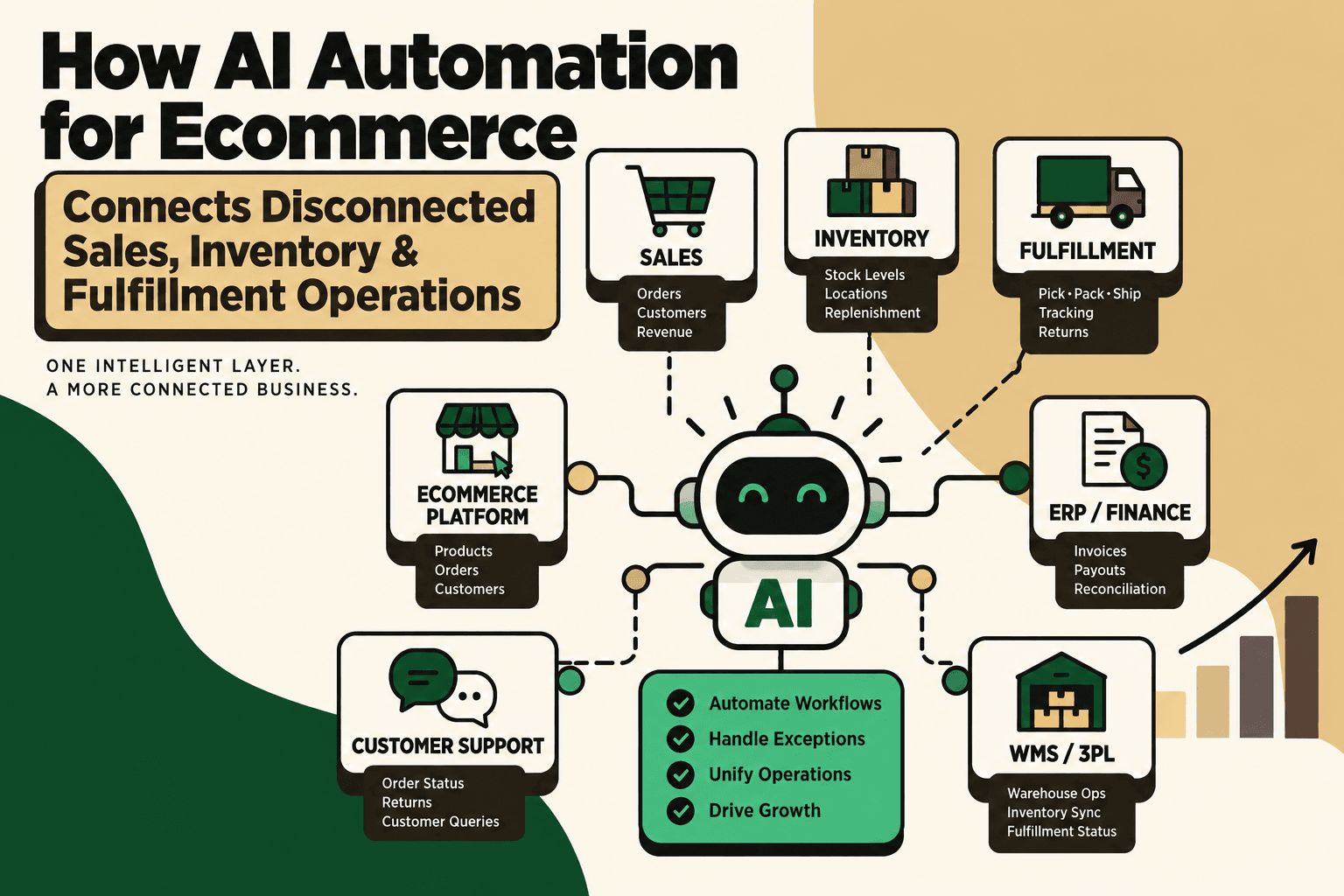
How AI Automation for Ecommerce Connects Disconnected Sales, Inventory & Fulfillment Operations
Modern ecommerce businesses rarely struggle because they lack software. The bigger problem is that their software often does not operate as one system.
A growing D2C brand may have Shopify or another ecommerce platform handling orders, an ERP managing financial and operational data, a WMS controlling warehouse activity, a 3PL handling fulfillment, multiple carriers handling delivery, a CRM storing customer information and separate tools for support, payments and analytics.
Each system may work well independently. The operational problem appears in the handoffs.
An order is created in one system. Inventory is updated somewhere else. The warehouse receives information through another integration. Tracking returns through a carrier platform. Customer support checks a different interface. Finance later reconciles the transaction against payments, refunds and logistics data.
When those connections are slow, incomplete or inconsistent, the business starts compensating with spreadsheets, manual checks, WhatsApp messages, exports and human intervention.
AI automation for ecommerce is most valuable when it connects business events across systems and decides what should happen next.
The goal is not to replace Shopify, ERP, WMS, 3PL or shipping software. The goal is to create an intelligent operational layer that helps those systems work together.
The Ecommerce Operations Problem Is Usually a Handoff Problem
Consider a straightforward ecommerce order.
Customer places order → payment confirmed → inventory reserved → warehouse receives order → order is picked → packed → shipped → tracking is updated → customer is notified → finance reconciles the transaction.
In a connected operation, these events move automatically between systems.
In a fragmented operation, the real workflow may look more like:
Shopify → spreadsheet → ERP → WhatsApp message → WMS → shipping portal → spreadsheet → customer support.
That difference creates operational friction.
- Online inventory can differ from physical warehouse inventory.
- Orders can wait before reaching fulfillment.
- Teams manually reconcile records across systems.
- Low-stock products are identified after the problem appears.
- Customer support lacks current fulfillment information.
- Returns may not immediately update available inventory.
- Finance teams may wait for operational data before reconciliation.
- Exceptions are discovered manually rather than surfaced automatically.
Shopify provides native capabilities for inventory, orders, fulfillment and workflow automation, while its ecosystem supports integrations with external systems such as ERP and fulfillment platforms. The challenge for a scaling operation is often coordinating those capabilities with the rest of the technology stack.
Shopify order management and Shopify inventory management provide useful examples of the underlying commerce capabilities.
What AI Automation Adds Beyond Basic Integration
Traditional integration primarily moves data.
AI automation can interpret that data, identify exceptions and coordinate actions.
For example, a basic workflow might say:
If inventory falls below 10 units → send an email.
An intelligent workflow can consider more context:
Sales velocity is increasing, available inventory is declining, supplier lead time has changed and a marketing campaign is increasing demand → flag the SKU for replenishment review.
The distinction is important. AI should not replace deterministic rules where rules are sufficient. It becomes useful when the workflow requires interpretation across multiple signals.
A practical ecommerce architecture therefore combines:
- Rules: deterministic policies and thresholds.
- Integrations: movement of data and events between systems.
- AI: interpretation, classification, prediction and contextual decision support.
- Automation: execution of approved actions.
- Humans: exceptions, approvals and decisions requiring accountability.
1. Sales Data Becomes an Operational Signal
An order is more than a revenue event. It contains operational information that should influence inventory, fulfillment, customer communication and finance.
Useful order signals can include:
- SKU and quantity
- Order value
- Payment status
- Customer location
- Sales channel
- Delivery priority
- Fulfillment location
- Customer history
- Promotion or campaign source
- Order risk indicators
Instead of treating an order as an isolated transaction, automation turns the event into a trigger for downstream workflows.
Order placed → validate payment → check inventory → determine fulfillment location → reserve stock → create fulfillment task → update ERP → initiate shipping → notify customer.
Shopify's fulfillment architecture uses fulfillment orders and fulfillment-service integrations to support this type of connected order workflow. See the Shopify orders and fulfillment documentation for the platform's integration model.
2. Inventory Stops Being Just a Number
Inventory management becomes difficult when a business treats one number as the complete picture.
A more useful operational view considers:
On-hand inventory + committed inventory + reserved inventory + incoming inventory + unavailable inventory + inventory across locations.
Shopify distinguishes inventory states such as available, committed, unavailable and incoming, illustrating why inventory synchronization is more complex than simply copying a stock number between systems.
An AI automation layer can use these signals to answer operational questions such as:
- Which SKUs are approaching a stockout?
- Which products are selling faster than expected?
- Which warehouse should fulfill an order?
- When should replenishment be reviewed?
- Which products are becoming overstocked?
- Should stock be transferred between locations?
- Which inventory discrepancies need investigation?
The important shift is from reactive inventory management toward more proactive decision support.
AI does not eliminate the need for inventory policies or planners. It can make the information reaching those planners more timely and contextual.
Research from McKinsey has explored AI and machine learning for supply-chain planning, including applications intended to improve forecasting and inventory decisions. Results vary by implementation, data quality and operating model, so ecommerce brands should validate impact against their own baseline rather than assume a universal improvement.
McKinsey's supply-chain planning research provides additional context.
3. AI Connects Inventory With Fulfillment Decisions
Once an order is placed, the next question is not simply whether inventory exists. It is where and how the order should be fulfilled.
Imagine a brand with inventory in Delhi, Mumbai and Bengaluru. A customer orders from Delhi, but the nearest warehouse does not necessarily have the right stock position or fulfillment capacity.
A routing workflow may consider:
- Inventory availability
- Customer location
- Shipping cost
- Promised delivery SLA
- Warehouse capacity
- Carrier availability
- Split-shipment risk
- Historical delivery performance
Traditional rules can handle straightforward cases. AI can become useful when the decision requires interpreting multiple changing signals or identifying patterns in historical performance.
Shopify's fulfillment and order-routing capabilities provide a platform foundation for allocating fulfillment work. AI automation can sit around that foundation when a brand needs additional orchestration across ERP, WMS, 3PL or logistics systems.
4. WMS and 3PL Operations Become Part of the Same Workflow
A common scaling problem occurs after the ecommerce platform receives the order.
The warehouse still needs a reliable operational instruction.
Without automation, teams may export orders, upload files, send messages or manually verify that an order reached the correct fulfillment partner.
A connected workflow looks more like:
Shopify order → automation layer → WMS or 3PL → pick → pack → ship → tracking event → ecommerce platform → customer.
When fulfillment status changes, the event should flow back into the commerce system rather than remaining trapped inside the warehouse or logistics platform.
Shopify's ERP integration guidance describes the broader model in which ecommerce orders can move into operational systems while fulfillment, returns and inventory information flows back into the commerce environment.
Shopify's ecommerce ERP integration guide provides a useful reference for this architecture.
5. AI Is Most Useful When Something Goes Wrong
Basic integrations are good at the happy path.
Real ecommerce operations are dominated by exceptions.
A payment fails. Inventory is short. A warehouse misses an SLA. A carrier delays a shipment. A customer changes an address. A return arrives without the expected item. Two systems disagree about inventory.
These cases often create manual work because the system does not know what to do next.
Order Exceptions
- Payment failure
- Duplicate order
- Address mismatch
- Inventory shortage
- High-risk transaction
- Incomplete customer information
Fulfillment Exceptions
- Warehouse delay
- Carrier delay
- Failed delivery
- SLA breach
- Partial fulfillment
- Missing tracking information
Inventory Exceptions
- Unexpected stock depletion
- Inventory mismatch
- Predicted stockout
- Overstock
- Slow-moving SKU
- Unusual sales velocity
The AI layer should not simply make autonomous decisions about every exception. Its role can be to classify the problem, gather the relevant context, recommend the next action and execute only the actions permitted by policy.
That creates a safer operating model:
Detect → understand → validate → recommend → approve if required → execute → monitor.
6. Customer Support Gets Access to Operational Truth
Disconnected backend systems eventually become a customer-service problem.
Consider a customer asking:
“Where is my order?”
If support does not have current order, warehouse and carrier information, an employee may need to search several systems before responding.
A connected AI support workflow can retrieve the relevant information:
Customer → AI support layer → order status → fulfillment status → carrier status → expected delivery → response.
The same architecture can support questions about:
- Order tracking
- Delivery delays
- Cancellation eligibility
- Return status
- Refund status
- Product availability
- Exchange requests
This is where customer operations and backend operations become connected rather than functioning as separate departments.
Five Anchor's AI-powered customer operations approach can fit into this architecture by connecting customer-facing AI workflows with order, fulfillment, returns and other operational data, while preserving human escalation for cases that require judgment.
7. Returns Complete the Operational Data Loop
The ecommerce workflow does not end at delivery.
Returns can involve support, logistics, warehouse, inventory, finance and customer communication.
A typical return workflow looks like:
Return request → eligibility check → return authorization → pickup → warehouse receipt → inspection → inventory decision → refund or exchange → ERP update → customer notification.
When these systems are disconnected, a return can remain operationally open even after the customer has completed part of the process.
AI can help classify return requests, retrieve order context, identify the relevant policy, route straightforward cases and surface unusual patterns.
For example:
Eligible + low-risk return → automated workflow.
High-value + unusual pattern → human review.
The objective is not to remove the returns team. It is to reserve human attention for cases where it adds the most value.
8. Finance and Reconciliation Become Connected to Operations
Another hidden source of manual work exists between commerce operations and finance.
A finance team may need to reconcile:
Ecommerce orders ↔ payment gateway ↔ ERP ↔ COD transactions ↔ logistics charges ↔ refunds ↔ bank settlements.
When every system represents the transaction differently, reconciliation becomes a manual matching exercise.
Automation can match records using transaction IDs, order IDs, payment references, settlement data and other available identifiers. AI can help classify discrepancies and prioritize exceptions for review.
The practical model is:
Automate matching → identify exceptions → explain discrepancy → route to owner → human resolves unusual cases.
This reduces the need for finance teams to inspect every transaction manually while retaining control over exceptions.
9. Build an Operational Control Layer, Not More Point Integrations
The long-term architecture should not become a collection of unrelated automations.
Instead, think of the ecommerce stack as layers.
| Layer | Primary Responsibility | Example Systems |
|---|---|---|
| Customer and sales channels | Capture demand and customer interactions | Shopify, marketplaces, WhatsApp, website |
| Commerce system | Orders, catalog, cart and commerce state | Ecommerce platform |
| AI and automation layer | Interpret events, coordinate workflows and handle exceptions | AI agents, workflow engine, middleware |
| Business systems | Financial, customer and operational records | ERP, CRM, accounting |
| Inventory and warehouse | Stock and warehouse execution | WMS, inventory systems |
| Fulfillment and logistics | Shipping and delivery execution | 3PLs, carriers, shipping platforms |
| Analytics and control | Monitoring, reporting and decision support | Operational dashboards, MIS and analytics |
The automation layer becomes the connective tissue between these systems.
10. What Should Be Rules, AI or Human?
One of the biggest implementation mistakes is assuming every workflow needs AI.
Some decisions should remain deterministic.
| Decision Type | Best Approach | Reason |
|---|---|---|
| Inventory threshold | Rule | Predictable and deterministic |
| Approved refund eligibility | Rule | Policy should be explicit |
| Customer intent classification | AI | Natural language varies significantly |
| Product recommendation | AI + catalog rules | Requires contextual interpretation and reliable product data |
| Warehouse routing | Rules + optimization | Business constraints need deterministic enforcement |
| Unusual fulfillment exception | AI + human approval | Requires context and accountability |
| High-value commercial exception | Human approval | Business risk may exceed automation tolerance |
More AI is not automatically better. A deterministic rule is often more reliable, cheaper and easier to audit than an AI decision.
11. How to Prioritize Ecommerce Automations
A growing ecommerce business can identify dozens of possible automations. The challenge is deciding what to build first.
A practical prioritization model is:
Priority = volume × frequency × manual effort × error cost × revenue impact ÷ implementation complexity.
This is a practical decision framework, not an industry-standard formula.
High-priority workflows typically have repeated volume, meaningful manual effort, measurable error costs and a clear business outcome.
Examples include:
- Order synchronization
- Inventory synchronization
- Fulfillment status updates
- WISMO and order-status support
- Returns routing
- Payment and payout reconciliation
- Low-stock alerts
- Operational exception detection
Low-volume workflows with complicated edge cases may be better left manual until the business has enough evidence to justify automation.
12. The Smallest Viable Ecommerce Automation Workflow
Do not begin by trying to automate the entire operation.
Choose one workflow with a clear trigger, clear data source, predictable outcome and measurable KPI.
Example: Order-to-Fulfillment Automation
- Trigger: New paid order is created.
- Validate: Confirm payment and required order information.
- Check: Retrieve current inventory by fulfillment location.
- Decide: Select an eligible fulfillment location using defined rules.
- Execute: Create or route the fulfillment task.
- Synchronize: Update ERP and required operational systems.
- Monitor: Watch for fulfillment or shipping exceptions.
- Communicate: Update the customer when the required event occurs.
- Escalate: Route exceptions to the appropriate human owner.
This is much easier to test than an ambition such as “automate ecommerce operations with AI.”
13. Data Quality Determines Automation Quality
An AI layer cannot compensate for fundamentally unreliable operational data.
If the catalog has incorrect SKUs, the inventory system is stale, warehouse locations are inconsistent or customer records cannot be matched, the automation layer may make incorrect decisions using apparently valid information.
Before deployment, establish:
- System of record for each data object
- Unique identifiers across systems
- Data synchronization frequency
- Error-handling rules
- Ownership of master data
- Validation requirements
- Audit logs
- Data retention policies
AI should never be used as a substitute for missing source-of-truth data.
14. Guardrails, Security and Monitoring Are Part of the Build
Operational AI has access to commercially important information. It may also be capable of triggering actions.
That means implementation needs more than prompts and API connections.
Access Control
Give each agent only the permissions required for its workflow. A customer-support agent may need order-read access but should not automatically have permission to modify financial records.
Action Controls
Separate read operations from write operations. High-impact actions should require explicit authorization or human approval.
Monitoring
Track failed API calls, stale data, unexpected decisions, repeated retries, incorrect classifications and human overrides.
Fallbacks
When a system is unavailable or data is incomplete, the workflow should fail safely instead of inventing an answer or executing an irreversible action.
Human Escalation
Define escalation conditions before launch. Examples include high-value orders, policy exceptions, unresolved inventory discrepancies and unusual return patterns.
15. How to Measure Whether the Automation Works
Do not measure success by the number of AI conversations or automated tasks alone.
Measure the business workflow.
| Workflow | Useful KPI | Secondary KPI |
|---|---|---|
| Order processing | Order processing time | Manual touches per order |
| Inventory synchronization | Inventory discrepancy rate | Oversell incidents |
| Fulfillment | Fulfillment cycle time | Split shipments or SLA breaches |
| Customer support | Resolution rate | Human escalation rate |
| Returns | Return processing time | Manual intervention rate |
| Reconciliation | Auto-match rate | Exception resolution time |
| Inventory planning | Stockout or excess-inventory indicators | Forecast or replenishment accuracy |
Establish a baseline before automation. Otherwise, the team may confuse activity with improvement.
Where Five Anchor Fits
For a growing D2C brand, connecting sales, inventory and fulfillment is not just an AI problem. It is an infrastructure problem involving workflow design, APIs, system ownership, data synchronization, exception handling and measurement.
Problem: sales, ecommerce, ERP, inventory, warehouse, logistics and customer-service systems operate as separate workflows.
Solution: create an orchestration layer that connects business events and gives each system the information required to act.
Implementation: map the workflow, define systems of record, connect APIs and webhooks, automate deterministic steps, use AI for interpretation and exception handling, establish permissions and create human escalation paths.
Business outcome: the intended result is a more synchronized operation with fewer manual handoffs, faster exception detection, better inventory visibility and more consistent customer communication. Actual impact should be validated against baseline KPIs.
Five Anchor's Commerce Infrastructure service is directly relevant to this model, including marketplace and ERP integrations, order processing, inventory synchronization, invoice and financial automation, warehouse and shipping integrations and custom AI workflows. Its E-Commerce Intelligence capabilities can also support operational dashboards and visibility across GMV, margins, inventory, marketplace performance and other ecommerce signals.
A Practical Roadmap for Connecting Ecommerce Operations
- Map the current workflow: Document every system, handoff, trigger, decision and manual intervention.
- Identify the system of record: Decide which system owns orders, inventory, customers, fulfillment and financial information.
- Baseline performance: Measure processing time, errors, discrepancies, manual touches and exception volume.
- Prioritize one workflow: Start with high-volume, high-friction work where the business outcome is measurable.
- Build deterministic integrations: Make reliable data movement work before adding AI decision-making.
- Add AI selectively: Use AI for interpretation, classification, anomaly detection and contextual recommendations.
- Add guardrails: Define permissions, approved actions, validation, escalation and fallback behavior.
- Pilot: Run the workflow with a controlled scope and monitor exceptions closely.
- Measure: Compare results against the baseline.
- Scale: Expand into additional warehouses, marketplaces, customer channels and operational processes only after the initial workflow is stable.
Bottom Line
AI automation does not replace an ecommerce technology stack. It connects the stack.
The operational opportunity is not simply automating individual tasks. It is connecting the events that already exist across sales, orders, inventory, ERP, warehouse, fulfillment, shipping, customer support, returns and finance.
When a customer places an order, the right inventory should be checked. The right location should be selected. The warehouse should receive the correct instruction. The fulfillment status should flow back. The customer should receive accurate information. Finance should eventually receive the information required for reconciliation.
When something goes wrong, the system should identify the exception, gather context, recommend or execute the appropriate next step and escalate when human judgment is required.
That is the practical role of AI in ecommerce operations: not adding another disconnected tool, but creating an intelligent operational layer between the tools the business already depends on.
For ecommerce businesses scaling across channels, warehouses, marketplaces and fulfillment partners, the next stage of automation is therefore less about adding more software and more about making the existing operational infrastructure behave like one coordinated system.
Frequently Asked Questions
What is AI automation for ecommerce operations?
AI automation for ecommerce combines system integrations, workflow automation and AI-based interpretation to coordinate processes such as order management, inventory synchronization, fulfillment, customer support, returns and reconciliation. The objective is to connect operational events and reduce unnecessary manual intervention.
How does AI connect sales and inventory?
An automation layer can use order information such as SKU, quantity, location, payment status and sales channel to trigger inventory checks, stock reservations, fulfillment routing and downstream operational updates. AI can add contextual decision support when multiple signals need to be interpreted.
Can AI automate Shopify, ERP and WMS workflows?
Yes, when the relevant platforms provide suitable integration mechanisms such as APIs, webhooks or supported connectors. The architecture should define which system is authoritative for each type of data and how updates are synchronized.
What is the difference between ecommerce integration and AI automation?
Integration primarily connects systems and moves data between them. AI automation can add interpretation, classification, anomaly detection, recommendations and contextual decision-making on top of those integrations. Deterministic rules should still be used where they are sufficient.
What ecommerce processes should be automated first?
Start with workflows that have high volume, high frequency, significant manual effort, meaningful error costs or clear revenue impact and manageable implementation complexity. Common starting points include order synchronization, inventory synchronization, fulfillment updates, customer order-status requests, returns routing and reconciliation.
Can AI prevent inventory discrepancies?
AI can help detect anomalies and identify patterns associated with inventory discrepancies, but reliable inventory synchronization also requires strong integrations, consistent identifiers, clear systems of record and good master data. AI should not be treated as a replacement for accurate source data.
Should AI make fulfillment decisions automatically?
Only when the decision can be safely constrained by clear rules, reliable data and appropriate permissions. High-impact or unusual fulfillment decisions should have human escalation or approval where business risk warrants it.
How do you measure ecommerce automation ROI?
Measure the workflow against a baseline. Useful metrics include processing time, manual touches, inventory discrepancy rate, stockout incidents, fulfillment cycle time, SLA breaches, resolution time, exception volume, reconciliation match rate and operational cost. Avoid using AI activity alone as the definition of ROI.
Does every ecommerce business need an AI automation layer?
No. Small operations with simple workflows may be adequately served by native ecommerce automation and standard integrations. The case for a broader AI automation layer becomes stronger as the business adds channels, warehouses, operational systems, fulfillment partners and exception-heavy workflows.
Sources and Further Reading
Key Takeaways
- •The biggest ecommerce automation problem is often the handoff between systems rather than the individual systems themselves.
- •AI automation can create an operational layer connecting sales, orders, inventory, ERP, WMS, 3PL, shipping, customer support, returns and finance.
- •AI is most useful when workflows require interpretation across multiple signals or when exceptions need contextual analysis.
- •Deterministic rules should remain the default for predictable policies such as thresholds, eligibility and routing constraints.
- •Reliable AI automation depends on accurate data, clear systems of record, unique identifiers and stable integrations.
- •The highest-value automation opportunities are usually high-volume, repetitive, error-prone workflows with measurable business impact.
- •Human approval should remain part of workflows involving unusual, high-value or commercially sensitive decisions.
Rules vs AI vs Human Decisions in Ecommerce Automation
| Rules | AI | Human |
|---|---|---|
| Inventory Sync Frequency | 15–30 min batch polling (high oversell risk) | Sub-second atomic locking (<450ms) |
| Concurrent Drop Resilience | Fails under concurrency; causes negative stock balance | Redis atomic reservation queue guarantees exact counts |
| Error Handling & Retries | Silent failure; manual CSV audit needed | Dead-letter queues with automated exponential retry |
| Fulfillment Routing Speed | 2–4 hours delayed batch export to 3PL warehouse | Instantaneous automated webhook dispatch (<90 sec) |