What Is Fraud & Risk Automation?
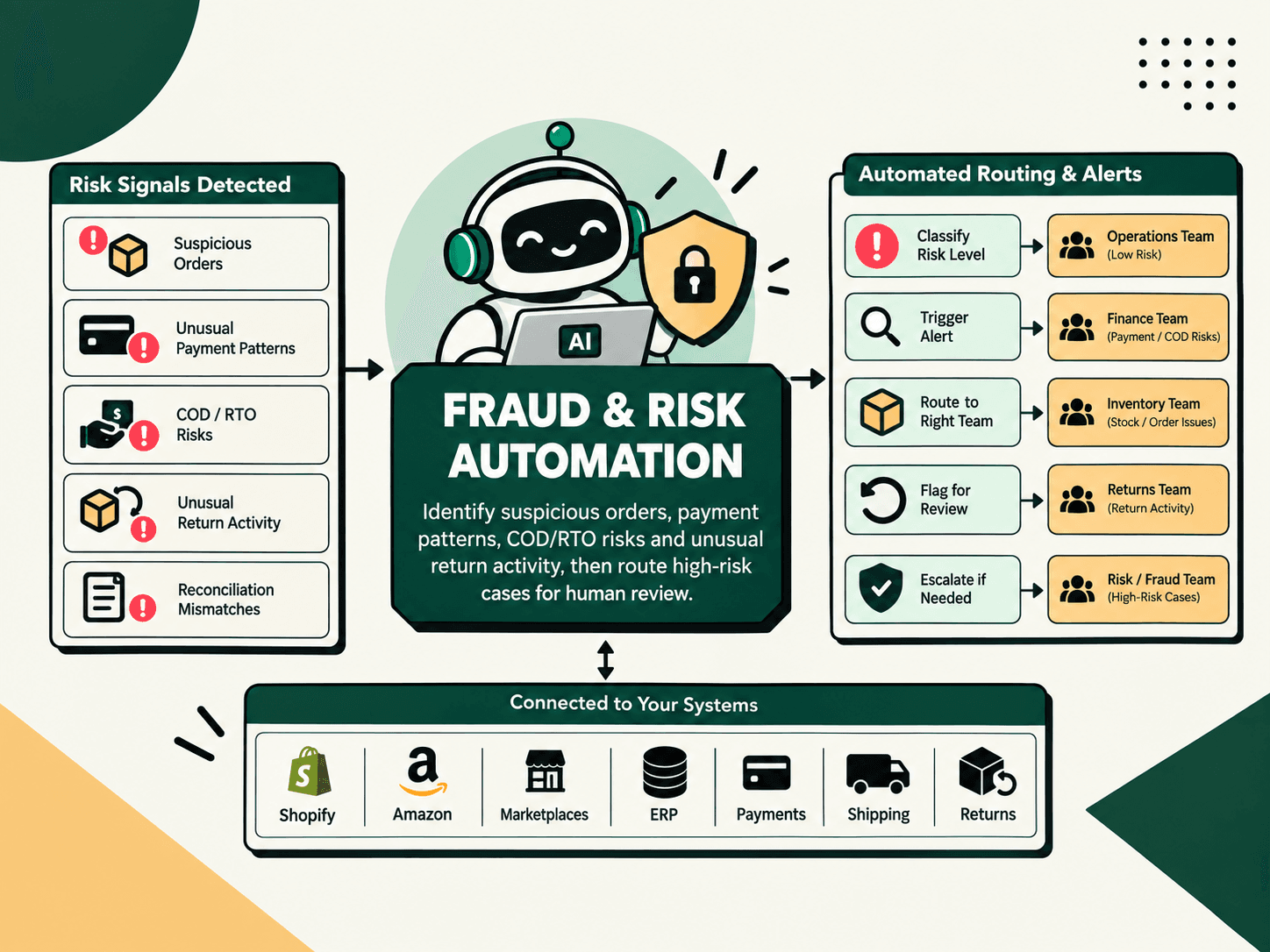
Fraud and risk automation uses rules, data and AI to identify potentially risky ecommerce activity and route it for review. Instead of manually checking every order or transaction, businesses can automatically flag unusual patterns and send high-risk cases to the appropriate team.
Why Automate Fraud & Risk Detection?
Growing ecommerce operations process large volumes of orders and payments, making manual risk checks difficult to scale.
- Suspicious orders.
- Unusual payment patterns.
- High-risk COD orders.
- Potential RTO risks.
- Unusual return activity.
- Repeated customer or address patterns.
Risk automation helps teams focus their attention on transactions that require additional review.
How Fraud & Risk Automation Works
A typical workflow evaluates transaction and customer signals against defined rules or AI-based risk indicators.
Order / Payment Event → Risk Signals → Risk Classification → Alert → Human Review → Approve / Hold / Escalate
Businesses can define thresholds and conditions for automatically flagging potentially risky activity.
Suspicious Order Detection
Automated workflows can flag orders based on unusual combinations of order, customer, address, payment or behavioral signals.
Order Data → Risk Rules / AI → Risk Score or Flag → Review Workflow
Flagged orders can be held or routed for review according to the business's operating rules.
COD & RTO Risk Management
COD operations can involve additional delivery and return-to-origin risks. Automation can identify orders that match defined high-risk patterns before fulfillment.
COD Order → Risk Analysis → Low Risk / High Risk → Fulfill or Review
This allows operations teams to apply additional verification or review where required.
Payment Risk Detection
Payment workflows can monitor unusual transaction patterns and identify cases that require further investigation.
Payment Event → Pattern Detection → Risk Flag → Finance / Risk Team
Automated alerts can provide the relevant transaction context so teams can investigate efficiently.
Unusual Return Activity
Returns can also be monitored for patterns that fall outside a business's expected operating behavior.
Return Activity → Pattern Analysis → Risk Flag → Returns Team → Human Review
Automation can identify unusual activity while leaving final decisions to the appropriate team and business policies.
Where AI Fits Into Fraud & Risk Automation
AI can assist with identifying patterns across large volumes of operational data, classifying risk signals and summarizing why a case was flagged.
Order + Payment + Customer + Return Data → AI Analysis → Risk Signal → Human Review
For high-impact decisions, AI can support review rather than independently making the final decision.
Connect Risk Automation With Your Commerce Systems
Risk workflows can connect with the systems that contain order, payment, customer and fulfillment information.
Shopify + Marketplaces + ERP + Payments + Shipping + Returns → Risk Automation Layer
This creates a connected workflow for identifying and routing potential risks across the commerce operation.
Human Review for High-Risk Cases
Fraud and risk automation should route high-risk cases to trained human teams for review. The workflow can provide the signals, order information and reason for the flag so the reviewer can make the appropriate decision.
Risk Detected → Context Collected → Human Review → Approve / Hold / Escalate
What Five Anchor Can Implement
Five Anchor can build fraud and risk workflows around your existing commerce operations. This can include suspicious-order detection, payment-risk monitoring, COD and RTO risk workflows, unusual-return detection, automated alerts and human-review queues.
Detect potential risk earlier and route high-risk activity to the right team automatically.
How to Measure Fraud & Risk Automation
- Risk cases detected automatically.
- Time to review flagged cases.
- High-risk orders routed correctly.
- Manual order-review workload.
- False-positive rate.
- COD/RTO risk cases identified.
- Unusual return cases flagged.
Final Takeaway
Fraud and risk automation creates a structured layer for detecting suspicious ecommerce activity and routing it for review.
By connecting order, payment, customer, fulfillment and returns data, businesses can automate risk detection while keeping high-impact decisions under human oversight.
Build automated fraud and risk workflows with Five Anchor.
Frequently Asked Questions
What is fraud and risk automation?
It uses rules, data and AI to identify potentially risky ecommerce activity and route cases for review.
Can suspicious orders be detected automatically?
Yes. Orders can be evaluated against defined risk signals and automatically flagged when they meet specified conditions.
Can COD and RTO risks be automated?
Yes. COD orders can be evaluated for defined risk patterns and routed for verification or review before fulfillment.
Can AI detect unusual return activity?
AI can assist with identifying unusual patterns in return data and flagging cases for human review.
Should AI make final fraud decisions?
For high-impact cases, AI can provide signals and context while trained human teams make the final decision according to business policies.