What Is Exception Management & Alerts?
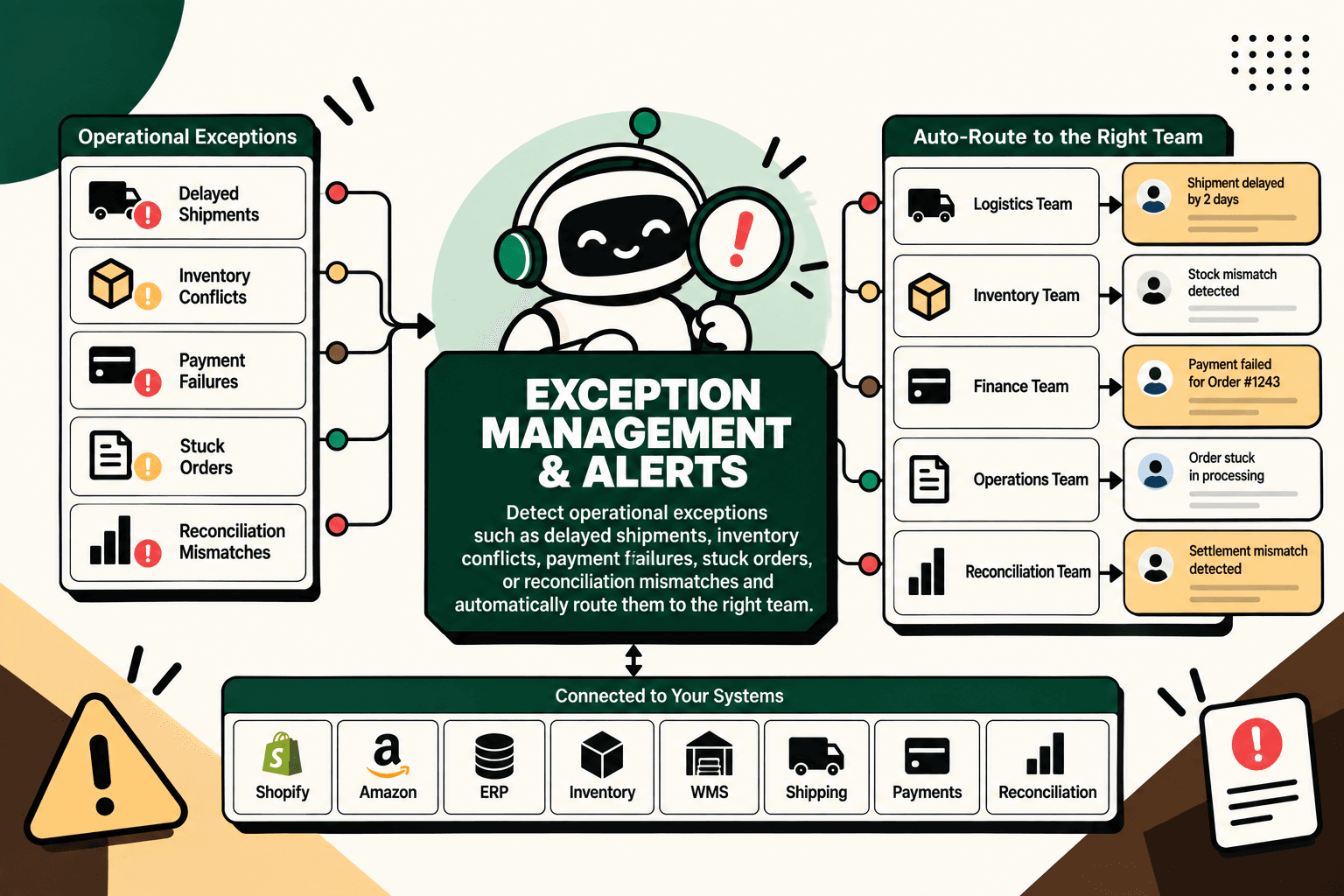
Exception management automatically detects operational issues and routes them to the right team for action. Instead of relying on teams to manually monitor multiple systems, businesses can create workflows that identify exceptions, classify them and trigger the appropriate response.
Why Automate Exception Management?
As ecommerce operations grow, issues can occur across orders, inventory, payments, shipping and reconciliation.
- Delayed shipments.
- Inventory conflicts.
- Payment failures.
- Stuck orders.
- Reconciliation mismatches.
- Fulfillment exceptions.
Automated exception management helps teams identify operational issues earlier and reduces the need for constant manual monitoring.
How Exception Management Works
A typical exception workflow continuously checks operational events and system data against defined conditions.
System Event → Exception Detection → Classification → Alert → Team Routing → Resolution → System Update
Business rules can determine the severity, responsible team, escalation path and required action for each exception.
Common Ecommerce Exceptions
| Exception | Automated Action |
|---|---|
| Delayed Shipment | Alert fulfillment or logistics team |
| Inventory Conflict | Flag stock mismatch and route to inventory team |
| Payment Failure | Notify finance or order operations |
| Stuck Order | Identify blocked workflow and escalate |
| Reconciliation Mismatch | Flag transaction for finance review |
| Fulfillment Exception | Route issue to warehouse or operations team |
Automated Alerts
Once an exception is detected, the workflow can send an alert through the communication channels used by the responsible team.
Exception → Priority → Team → Alert → Action
Alerts can include the relevant order, customer, shipment, inventory or transaction information so teams can investigate without searching across multiple systems.
AI-Powered Exception Detection
AI can assist with classifying exceptions, identifying unusual patterns and summarizing the issue for the team responsible for resolving it.
Operational Data → AI Analysis → Exception Classification → Recommended Workflow → Human Action
AI can support interpretation while deterministic business rules continue to control critical operational workflows.
Connect Exception Management With Your Systems
Exception management becomes more effective when connected across the systems responsible for commerce operations.
Shopify + Marketplaces + ERP + Inventory + WMS + Shipping + Payments → Exception Management Layer
This creates a centralized workflow for detecting and routing issues across otherwise disconnected systems.
Automated Escalation
Not every exception requires the same level of response. Workflows can escalate unresolved or high-priority issues automatically.
Exception Detected → Team Alert → No Resolution → Escalation → Manager / Specialist
This helps prevent important operational issues from remaining unresolved because they were missed in a busy support or operations queue.
What Five Anchor Can Implement
Five Anchor can build exception management workflows around your commerce and operational infrastructure. This can include delayed-shipment alerts, inventory conflict detection, payment failure workflows, stuck-order monitoring, reconciliation exceptions, team routing and AI-powered operational analysis.
Stop discovering operational problems after they become customer problems. Detect, route and resolve exceptions automatically.
How to Measure Exception Management
- Exceptions detected automatically.
- Time to detect.
- Time to resolution.
- Exceptions routed correctly.
- Unresolved exceptions.
- Escalation rate.
- Manual monitoring workload.
Final Takeaway
Exception management turns operational problems into structured workflows instead of relying on manual monitoring.
By connecting commerce, ERP, inventory, warehouse, shipping, payment and reconciliation systems, businesses can detect issues, alert the right teams and automate escalation.
Build automated exception management with Five Anchor and stay ahead of operational issues.
Frequently Asked Questions
What is exception management?
Exception management identifies operational issues that fall outside expected workflows and routes them for resolution.
What ecommerce exceptions can be detected?
Common examples include delayed shipments, inventory conflicts, payment failures, stuck orders and reconciliation mismatches.
Can alerts be routed to different teams?
Yes. Business rules can route exceptions to operations, inventory, finance, warehouse, logistics or support teams.
Can AI detect operational exceptions?
AI can assist with anomaly detection, classification and summarization, while defined business rules can control critical workflows.
Can exception management connect with ERP and Shopify?
Yes. Exception workflows can connect commerce, ERP, inventory, WMS, shipping, payment and other operational systems.