What Is Enterpristore Ecommerce AI Technology?
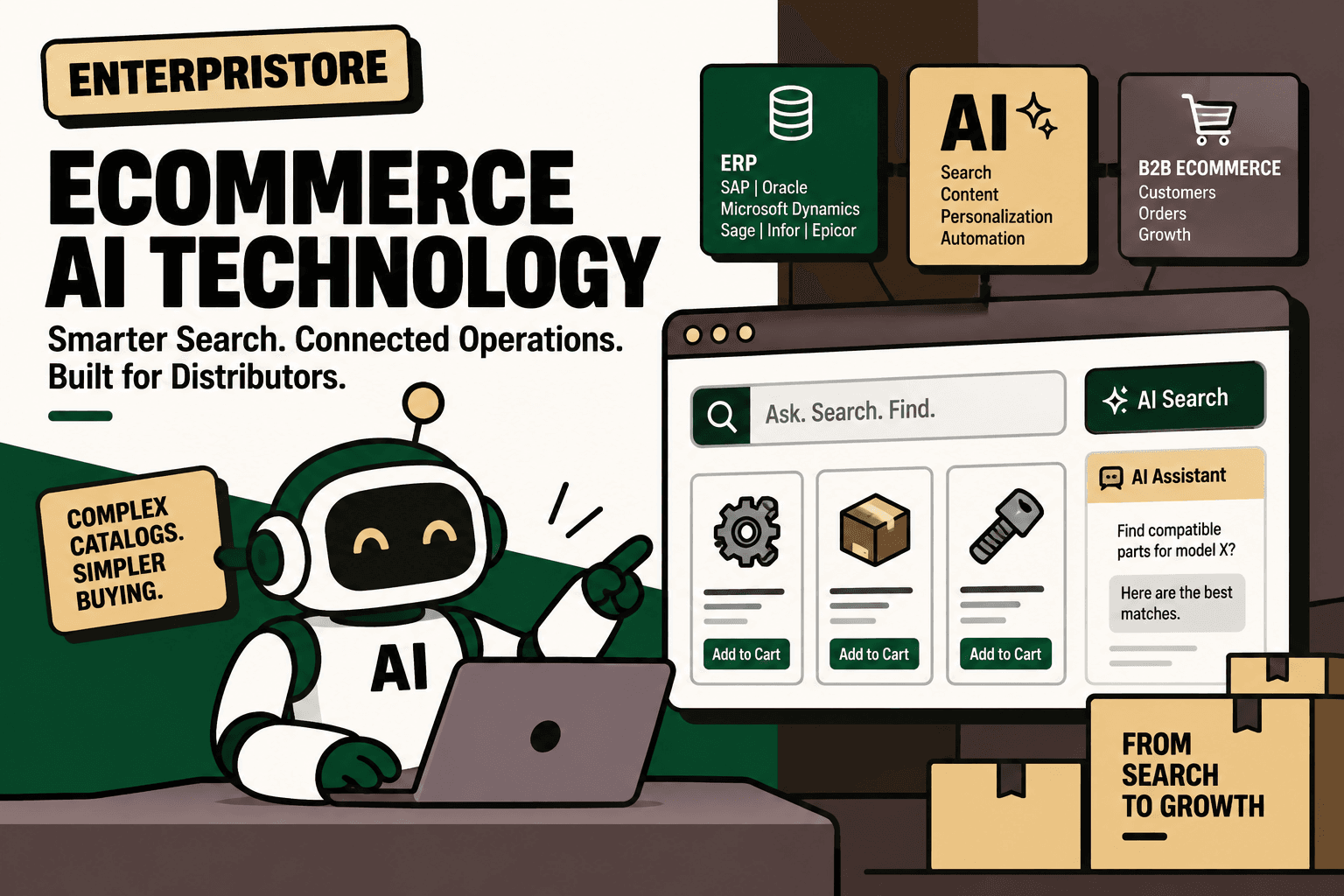
Answer: Enterpristore is a B2B and enterprise ecommerce platform that combines ecommerce, ERP integration, product information management, customer portals, search, content management and AI-powered capabilities. Its AI technology is focused particularly on complex product discovery, content generation, conversational assistance and ERP-connected B2B commerce.
That distinction matters. Enterpristore is not simply an AI chatbot added to an online store. Its published architecture places ecommerce between business systems such as ERP, CRM and product data systems and the buyer-facing experience. Its platform describes integrations with systems including SAP, Epicor, Microsoft Dynamics, Oracle, Sage, Infor, QuickBooks and Syspro. Enterpristore's official platform overview
The AI layer is then applied to areas such as search, product content, category content and customer assistance. Enterpristore's published materials describe AI search, AI chat, bulk content generation, natural-language query understanding, conversational search, visual search and voice search. Enterpristore's AI and ecommerce features
The practical question for a distributor or B2B ecommerce operator is therefore not simply whether Enterpristore uses AI. The more useful question is where AI sits in the commerce architecture, what data it can use, which buyer problems it solves, and which operational systems remain authoritative.
Why AI Is Particularly Relevant to B2B Ecommerce
B2B ecommerce has a different search and buying problem from a simple consumer storefront. Product catalogs can contain technical specifications, manufacturer references, model numbers, product families, substitutes, compatible products, units of measure, customer-specific pricing and documents.
Enterpristore's B2B ecommerce positioning is built around distributors and wholesalers that need ecommerce to work with complex product catalogs and enterprise back-office systems. Its platform describes capabilities for product information, customer-specific pricing, multiple warehouses, order processing and ERP-connected inventory and pricing. Enterpristore's B2B ecommerce platform for distributors
In this environment, a buyer may not know the exact SKU. They may describe the application, specification, compatibility requirement or desired outcome instead.
Illustrative scenario: A procurement user might search for a product by saying that they need a particular component compatible with an existing system, within a certain size and price range. A conventional keyword search may depend heavily on whether the catalog contains the same terminology. A natural-language search layer can attempt to interpret the intent and map it to structured product attributes.
This is where AI can change the search problem from matching words to interpreting product intent against structured catalog data.
Enterpristore's Main AI Capabilities
Based on Enterpristore's published product and technology material, its AI ecommerce capabilities can be grouped into several areas.
| Capability | Primary purpose | Where it matters |
|---|---|---|
| AI search | Understand natural-language product queries | Product discovery |
| Conversational search | Answer questions using indexed business data | Complex product research |
| AI chat assistant | Answer product and customer questions | Buyer assistance |
| AI product content | Generate product descriptions | Catalog enrichment |
| AI category content | Generate category and SEO content | Merchandising and organic search |
| Visual search | Find products using images or similarity | Visual product discovery |
| Voice search | Convert spoken requests into search | Alternative product discovery |
| Personalization | Adapt results to customer or session context | Relevant discovery |
| RAG | Generate contextual responses from indexed data | Product and business information |
These capabilities are described in Enterpristore's official search and feature documentation. Enterpristore search capabilities
AI Search: The Core Ecommerce Use Case
Answer: AI search attempts to understand what a buyer means rather than relying only on exact keyword matching.
Enterpristore says its search infrastructure uses Typesense as its primary search engine and combines it with AI-powered large language model capabilities. Its documented search functionality includes autocomplete, typo tolerance, synonyms, faceted navigation, ranking controls, semantic or hybrid search, natural-language query understanding and conversational search. Enterpristore's search capabilities documentation
This creates a layered search architecture rather than replacing traditional search entirely.
Traditional layer: keywords → indexes → filters → ranked products
AI-enhanced layer: natural language → intent and query understanding → structured filters and search → ranked products or contextual response
The distinction is important because deterministic search remains valuable. Product IDs, exact model numbers, manufacturer references and technical specifications often require precise retrieval rather than generative interpretation.
Why Hybrid Search Matters
A B2B ecommerce search system can need both semantic understanding and exact matching. A buyer searching for a specific model number should not receive an approximate product simply because an AI model considers it semantically similar.
Conversely, a buyer asking a natural-language question may need the system to understand concepts that do not appear verbatim in the product title.
Enterpristore's published search documentation describes semantic or hybrid search alongside keyword search, faceting, filtering, synonyms and tunable ranking. Enterpristore's search technology documentation
Five Anchor POV: The practical architecture for complex ecommerce search is usually not “AI instead of search.” It is a layered system where deterministic retrieval handles exact product facts and AI improves interpretation, discovery and contextual assistance.
Conversational Search and RAG
Answer: Retrieval-augmented generation, or RAG, allows a generative AI system to retrieve relevant information from a controlled knowledge base before producing an answer.
Enterpristore's search documentation describes built-in conversational search using RAG over indexed data. It also describes natural-language query understanding that can translate free-form queries into structured search filters, sorting and queries. Enterpristore's documented RAG and natural-language search capabilities
This is particularly relevant when buyers need answers rather than just product tiles.
For example, a buyer might need to know which products satisfy a set of technical constraints, which manufacturer options exist, or which product documents contain a relevant specification.
The underlying data still matters. If the catalog contains incomplete attributes, outdated documents or inconsistent product relationships, a RAG system cannot reliably manufacture the missing business truth.
AI Chat for B2B Ecommerce
Enterpristore describes an AI chat assistant for B2B ecommerce that can provide product information, recommendations and customer assistance using company-specific information. Its AI ecommerce material positions conversational assistance as part of the buying journey rather than only as a generic customer-service tool. Enterpristore's AI-powered ecommerce platform for distributors
The distinction between a generic chatbot and a commerce-aware assistant is significant.
| Generic chatbot | Commerce-aware AI assistant | Operational requirement |
|---|---|---|
| Answers general questions | Uses product and business context | Reliable product data |
| Provides generic explanations | Supports product discovery | Structured catalog |
| May not know availability | Can be connected to commerce data | ERP or inventory integration |
| Primarily conversational | Can support buying workflows | Controlled actions and permissions |
For higher-risk actions such as changing an order, issuing a refund, changing customer pricing or modifying account information, conversational AI should not automatically receive unrestricted write access. Those actions require explicit business rules, permissions, logging and appropriate human escalation.
AI Product Content Generation
Another major Enterpristore AI capability is product content generation. Enterpristore says its platform can generate product descriptions, category content and SEO articles, and its feature documentation describes bulk API processing for large catalogs. Enterpristore content generation features
This can address a common B2B catalog problem: a distributor may have thousands of products with incomplete, inconsistent or poorly structured descriptions.
AI can help create first drafts from structured attributes such as product ID, language and configured product information. Enterpristore specifically describes using product information as input for AI-generated product content. Enterpristore AI product content information
However, generated content should not be treated as automatically authoritative.
Technical specifications, safety information, compatibility statements, certifications, dimensions and regulatory claims should come from validated source data. AI can format or explain those facts, but it should not invent them.
A Safer AI Content Workflow
- Retrieve authoritative product attributes.
- Validate required fields.
- Generate a draft description.
- Check for unsupported specifications or claims.
- Apply brand and SEO rules.
- Route high-risk products for human review.
- Publish through controlled workflows.
- Monitor content quality and search performance.
Visual Search and Voice Search
Enterpristore's search documentation describes image-based search using the CLIP model and voice search using Whisper-based transcription. Enterpristore search technology documentation
Visual search can be useful when buyers know what a product looks like but do not know its name or catalog terminology. Voice search can reduce the friction of entering complex product queries, particularly on mobile or in environments where typing is inconvenient.
These capabilities are not necessarily equally valuable for every distributor. Their business value depends on catalog structure, buyer behavior, product complexity and the quality of the underlying visual and textual data.
What Technology Sits Behind Enterpristore AI?
Enterpristore's published search documentation identifies Typesense as its primary search engine and describes integrations with semantic search, vector search, natural-language query understanding, RAG, CLIP-based image search and Whisper-based voice search. Enterpristore search architecture
Its feature documentation also says its AI content-generation capabilities use OpenAI, Google Gemini and Anthropic. Enterpristore AI technology features
This is a useful architectural signal: Enterpristore's AI approach is not described as a single proprietary foundation model. Instead, it combines ecommerce application logic, search infrastructure, LLM capabilities and business data.
The broader pattern can be represented as:
ERP and business systems → product and customer data → ecommerce platform → search and AI orchestration → buyer experience → order workflow → ERP
ERP Integration Is a Major Part of the Architecture
Answer: For B2B ecommerce, AI is only as useful as the business data it can access safely. ERP integration therefore becomes a core part of the ecommerce architecture rather than a secondary integration.
Enterpristore's APIConnect documentation describes connections between ecommerce and ERP, CRM, CMS, PIM and EDI systems, with real-time or batch processing. Its published ERP integration material lists systems including SAP, Epicor, Sage, QuickBooks, Microsoft Dynamics, Oracle and Infor. Enterpristore ERP integrations
Its Infor integration documentation describes bidirectional data flows involving customer information, product catalog data, inventory, pricing, orders, quotes and invoice history. Enterpristore Infor API integration
This matters because a buyer-facing AI assistant should not be operating on an isolated copy of the catalog if the authoritative price, inventory or customer-specific commercial information lives in the ERP.
AI Ecommerce Architecture: What Should Be Deterministic?
A useful way to evaluate Enterpristore or any AI ecommerce platform is to separate AI reasoning from transactional truth.
| Function | Preferred approach | Reason |
|---|---|---|
| Exact SKU retrieval | Search and structured data | Precision matters |
| Product attribute lookup | Structured data | Source of truth matters |
| Natural-language query interpretation | AI plus search | Intent requires interpretation |
| Product recommendation | Rules plus AI | Context and constraints matter |
| Product description drafting | AI plus validation | Generation needs source-data controls |
| Inventory availability | ERP or inventory system | Transactional accuracy matters |
| Order creation | Deterministic transaction workflow | Financial and operational consequences |
| Complex customer question | RAG plus human escalation | Requires context and confidence controls |
This distinction is one of the most important implementation lessons. AI should interpret, summarize, recommend and assist where appropriate. Transactional systems should remain authoritative for facts and controlled actions.
Where Enterpristore Is Most Relevant
Based on its published positioning, Enterpristore is particularly relevant to businesses with complex B2B or distribution requirements.
- Wholesale distributors
- Manufacturers with distributor or dealer networks
- Businesses with complex product catalogs
- Companies requiring ERP-connected ecommerce
- Organizations with customer-specific pricing
- Businesses managing multiple warehouses
- Distributors needing advanced product search
- Companies with substantial catalog content requirements
Enterpristore's own B2B materials emphasize ERP connectivity, real-time inventory, pricing, product data and complex wholesale requirements. Enterpristore B2B distribution platform
Enterpristore vs a Custom AI Ecommerce Layer
The more important buying decision is not necessarily “Which AI ecommerce platform has the most AI?” It is whether a business needs a packaged platform, an existing commerce stack with AI extensions, or a custom orchestration layer.
| Consideration | Enterpristore-style platform | Custom AI infrastructure |
|---|---|---|
| Core commerce | Integrated platform approach | Existing commerce can remain |
| ERP integration | Built into platform architecture | Designed around existing systems |
| AI search | Platform capability | Custom search and AI layer |
| AI content | Built-in generation features | Custom generation workflows |
| Legacy systems | Depends on available connectors | Can be tailored to unusual systems |
| Control | Platform-defined capabilities | Greater workflow customization |
| Implementation | Platform implementation and configuration | Integration and engineering project |
Neither model is automatically better. The correct choice depends on whether the organization needs to replace or consolidate its commerce layer, or whether the existing commerce and ERP systems are worth retaining and extending.
What an AI-Ready B2B Ecommerce Stack Requires
AI search and conversational commerce require more than an LLM. A practical AI-ready ecommerce stack needs clean and structured business data.
1. Product data
SKUs, attributes, specifications, manufacturer information, documents, compatibility relationships and product hierarchies need consistent structure.
2. Customer data
Customer segments, account relationships, purchasing history and commercial permissions may be required for personalized B2B experiences.
3. Commercial data
Pricing, price breaks, customer-specific pricing, promotions and availability need clear ownership and synchronization rules.
4. Inventory data
AI search can recommend products, but availability should come from the authoritative inventory system rather than a stale generated answer.
5. Order data
Order history and status can improve customer assistance, but transactional actions need controlled access to the underlying order system.
6. Governance
Every AI workflow needs rules for data access, permissions, logging, escalation, validation and failure handling.
Implementation Playbook for AI Ecommerce Technology
Businesses evaluating an AI ecommerce platform should begin with the workflow, not the model.
- Map the buyer journey. Identify where customers search, compare, ask questions, request quotes, place orders and seek support.
- Map the data architecture. Identify where product, pricing, customer, inventory, order and document data actually lives.
- Establish system ownership. Define which platform is authoritative for each critical data object.
- Baseline current performance. Measure search exits, zero-result queries, assisted-sales workload, content production time, catalog completeness and relevant conversion metrics.
- Prioritize use cases. Use volume × frequency × manual effort × error cost × revenue impact ÷ implementation complexity as a practical prioritization model. This is a practical framework, not an industry-standard formula.
- Classify the workflow. Decide which steps should use deterministic rules, AI assistance, human approval or remain human-only.
- Connect systems. Integrate ecommerce, ERP, PIM, WMS, CRM, helpdesk, analytics and other required systems using APIs, webhooks or supported connectors.
- Build guardrails. Define validation, permissions, confidence thresholds, escalation rules, logging, monitoring and fallback behavior.
- Pilot one workflow. Start with a high-volume, relatively low-risk use case such as product search assistance or catalog content drafting.
- Measure outcomes. Compare operational and commercial metrics before expanding the AI layer.
- Scale selectively. Extend successful workflows into customer support, recommendations, content, merchandising and operational automation.
What Should You Measure?
AI adoption itself is not a useful business KPI. The relevant metric depends on the workflow.
| AI use case | Potential KPI | Important control |
|---|---|---|
| AI search | Search success and zero-result rate | Exact-match accuracy |
| Conversational search | Question resolution and assisted discovery | Grounded responses |
| AI product content | Content production time and approval rate | Source-data validation |
| Recommendations | Engagement and assisted conversion | Commercial relevance |
| AI support | Resolution time and escalation rate | Human escalation |
| ERP-connected automation | Processing time and exception volume | Transaction integrity |
The correct baseline should be established before implementation. Otherwise, an organization may know that an AI feature is being used without knowing whether it improved the underlying business process.
Risks and Limitations of AI Ecommerce Technology
Data quality
AI cannot reliably compensate for missing or contradictory product data. Poor catalog structure can lead to poor retrieval and poor generated answers.
Hallucinations
Generative AI can produce plausible language that is not supported by source data. RAG and structured retrieval can reduce this risk but do not eliminate the need for validation.
Transactional authority
Inventory, pricing, order status, customer credit and financial information should remain tied to authoritative systems.
Integration complexity
Enterprise ecommerce often involves ERP, CRM, PIM, WMS, shipping, payment, tax and customer-support systems. The AI layer does not remove the need for integration engineering.
Maintenance
Catalog structures, product attributes, APIs, prompts, search ranking, business rules and AI models can change. Production AI workflows require monitoring and maintenance.
Security and permissions
An AI assistant connected to customer or ERP data needs access controls that limit what it can retrieve and what actions it can execute.
Where Five Anchor Fits
Five Anchor is positioned as AI Infrastructure for D2C & E-Commerce. The relevance to an Enterpristore-style architecture is the underlying problem: connecting commerce, ERP, inventory, customer operations and intelligence so AI can operate on reliable business context.
For a business that already has an ecommerce platform and ERP but wants more AI capability, the first step does not necessarily need to be replacing the existing stack. Five Anchor can map the current workflow, identify system ownership, connect commerce and operational systems, and build targeted AI workflows around search, customer operations, inventory intelligence, order processing or reporting.
For example, a custom architecture could connect commerce → ERP → inventory → customer data → AI orchestration → customer-facing assistant, while preserving deterministic control over pricing, inventory, order creation and other transactional operations.
Five Anchor POV: The strongest enterprise ecommerce AI architecture is usually an integration problem before it is a model-selection problem. The AI layer becomes more useful when it can retrieve trustworthy product, inventory, customer and order context and then operate inside clearly defined business permissions.
How to Evaluate an Ecommerce AI Platform
If you are comparing Enterpristore with other ecommerce AI technologies, evaluate the platform against the actual operating model rather than counting AI features.
- Catalog complexity: Can the platform represent the product attributes and relationships your buyers actually use?
- Search quality: Can it handle exact identifiers, synonyms, natural-language queries and structured filters?
- ERP connectivity: Can authoritative pricing, inventory, customer and order data flow reliably?
- AI grounding: Can AI answers be tied to controlled product and business data?
- Transactional controls: Which actions can AI execute and which require approval?
- Content workflow: Can generated content be reviewed, validated and published at scale?
- Integration flexibility: Can the platform connect to the systems that cannot be replaced?
- Observability: Can the business monitor search quality, AI errors, integration failures and workflow exceptions?
- Commercial fit: Does the architecture support the pricing, account, quote and ordering model of the business?
Enterpristore Ecommerce AI Technology: The Bottom Line
Enterpristore's ecommerce AI technology is best understood as an AI-enhanced B2B ecommerce architecture rather than a standalone chatbot. Its published capabilities span AI search, natural-language query understanding, conversational RAG, visual and voice search, product and category content generation, AI chat and personalization. Enterpristore's feature documentation
Its other important differentiator is the connection between the ecommerce layer and enterprise business systems. Enterpristore publishes integrations and APIConnect capabilities for ERP, CRM, PIM, EDI and other systems, including major enterprise ERP platforms. Enterpristore ERP integration documentation
The strategic lesson extends beyond one platform. AI ecommerce works best when it sits on top of reliable product, customer, inventory, pricing and order data. Search and generative AI can improve discovery and assistance, but transactional systems should remain authoritative and high-impact actions should be governed by rules and human approval where appropriate.
For organizations building or extending an AI-enabled ecommerce operation, the practical sequence is map the workflow → establish data ownership → connect the systems → add AI to high-value decisions → add guardrails → measure outcomes → scale what works.
Key Takeaways
- •Enterpristore is positioned as an enterprise and B2B ecommerce platform with ERP connectivity and AI-powered commerce capabilities.
- •Its published AI capabilities include natural-language search, conversational search, RAG, AI chat, product content generation, visual search, voice search and personalization.
- •Enterpristore describes Typesense as its primary search engine and documents semantic, hybrid, vector, conversational, image and voice search capabilities.
- •Enterpristore says its AI content-generation capabilities use OpenAI, Google Gemini and Anthropic.
- •ERP integration is central to the architecture because product, pricing, inventory, customer and order data often remain authoritative in enterprise systems.
- •AI should interpret, recommend and assist while deterministic systems remain authoritative for transactional data and controlled actions.
- •The strongest AI ecommerce implementations begin with workflow mapping, data ownership, integrations, guardrails and measurable business KPIs.
Enterpristore-Style Ecommerce Platform vs Custom AI Ecommerce Infrastructure
| Enterpristore-Style Platform | Custom AI Infrastructure | Best Fit |
|---|---|---|
| Inventory Sync Frequency | 15–30 min batch polling (high oversell risk) | Sub-second atomic locking (<450ms) |
| Concurrent Drop Resilience | Fails under concurrency; causes negative stock balance | Redis atomic reservation queue guarantees exact counts |
| Error Handling & Retries | Silent failure; manual CSV audit needed | Dead-letter queues with automated exponential retry |
| Fulfillment Routing Speed | 2–4 hours delayed batch export to 3PL warehouse |