What Is Delivery & RTO Management?
Delivery and RTO management connects shipping events, customer communication and operational workflows to manage delivery issues automatically. Instead of manually tracking failed deliveries or following up with customers, businesses can automate routine delivery workflows and intervene when an order is at risk of becoming an RTO.
Why Automate Delivery & RTO Operations?
Delivery issues can create repetitive work across customer support, logistics and operations teams.
- Customers asking for delivery updates.
- Failed delivery attempts.
- Incorrect or incomplete addresses.
- COD verification.
- Orders at risk of RTO.
- Manual delivery follow-ups.
Automating these workflows helps teams respond to delivery events faster and focus their attention on orders that require intervention.
How Delivery & RTO Automation Works
A connected workflow can monitor delivery events and trigger the appropriate customer or operational action.
Shipping Event → Risk / Issue Detection → Customer Communication → Intervention → Delivery / RTO Resolution
Business rules can determine which orders require communication, verification, reattempts or human escalation.
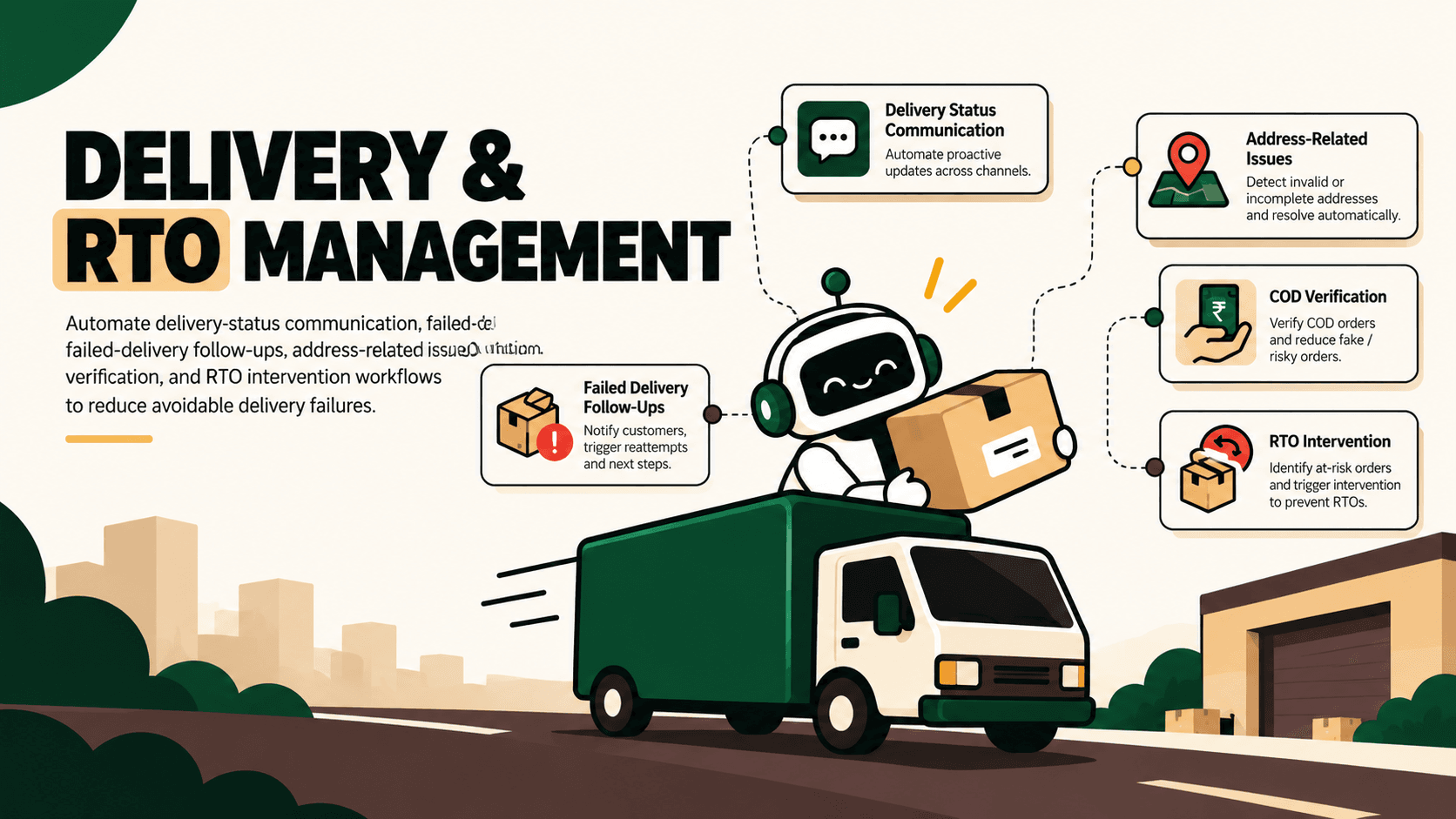
Automated Delivery Status Communication
Customers frequently contact support to ask about their order status. Automated communication can proactively share relevant updates based on shipping events.
Order Shipped → Out for Delivery → Delivery Attempt → Delivered
Updates can be sent through the communication channels used by the business, reducing the need for customers to contact support for routine status information.
Failed Delivery Follow-Ups
When a delivery attempt fails, automation can trigger a follow-up workflow instead of leaving the order in a manual queue.
Failed Delivery → Customer Notification → Reattempt / Action → Status Update
The workflow can communicate the next steps to the customer and route unresolved issues to the appropriate operations team.
Address-Related Issues
Incomplete or incorrect address information can contribute to delivery failures. Automated workflows can identify address-related issues and trigger the appropriate resolution process.
Address Issue → Customer Request → Address Verification → Update / Escalation
This gives operations teams a structured process for handling address problems before they create additional delivery attempts.
COD Verification
COD orders can be routed through automated verification workflows before or during fulfillment.
COD Order → Verification Workflow → Confirmed / Flagged → Fulfillment or Review
High-risk or unverified orders can be routed to the appropriate team according to defined business rules.
RTO Intervention
RTO intervention workflows can identify orders showing defined risk signals and trigger the appropriate action.
At-Risk Order → Risk Detection → Customer / Operations Intervention → Reattempt / Resolution
This allows teams to intervene before an order progresses further through the return-to-origin process.
AI for Delivery & RTO Management
AI can assist with customer conversations, delivery-issue classification and identifying the next approved workflow.
Customer Message / Shipping Event → AI Classification → Order & Shipping Data → Action or Escalation
AI can handle routine conversations while human teams remain involved in exceptions and cases requiring operational judgment.
Connect Delivery Operations With Your Existing Systems
Delivery automation becomes more useful when shipping information is connected with the systems managing orders and customers.
Shopify + Marketplaces + ERP + Inventory + Shipping + Payments → Delivery & RTO Automation
This creates a connected workflow from order placement through delivery, intervention and potential RTO.
What Five Anchor Can Implement
Five Anchor can build automated delivery and RTO workflows around your existing commerce infrastructure. This can include delivery-status communication, failed-delivery follow-ups, address verification, COD workflows, RTO intervention, shipping integrations, AI customer support and exception routing.
Turn delivery issues into automated workflows before they become repetitive support problems.
How to Measure Delivery & RTO Automation
- Delivery updates automated.
- Failed deliveries followed up automatically.
- COD orders verified.
- At-risk orders identified.
- RTO interventions triggered.
- Delivery-related support interactions.
- Average issue-resolution time.
Final Takeaway
Delivery and RTO management connects shipping events with customer communication and operational intervention.
By automating delivery updates, failed-delivery follow-ups, address issues, COD verification and RTO workflows, businesses can reduce repetitive operational work and create a more connected post-purchase process.
Automate your delivery and RTO operations with Five Anchor.
Frequently Asked Questions
What is delivery and RTO management?
It is the automation of delivery-status communication, failed-delivery handling, COD verification and RTO intervention workflows.
Can failed deliveries be handled automatically?
Yes. Failed delivery events can trigger customer notifications, reattempt workflows and operational escalations.
Can COD orders be verified automatically?
Yes. COD orders can be routed through automated verification workflows based on defined business rules.
Can automation help with RTO management?
Yes. At-risk orders can be identified and routed through predefined intervention workflows before the order progresses further toward RTO.
Can delivery automation connect with Shopify and ERP?
Yes. Delivery workflows can connect commerce platforms, ERP, inventory, shipping and payment systems to coordinate post-purchase operations.