What Is Customer Self-Service?
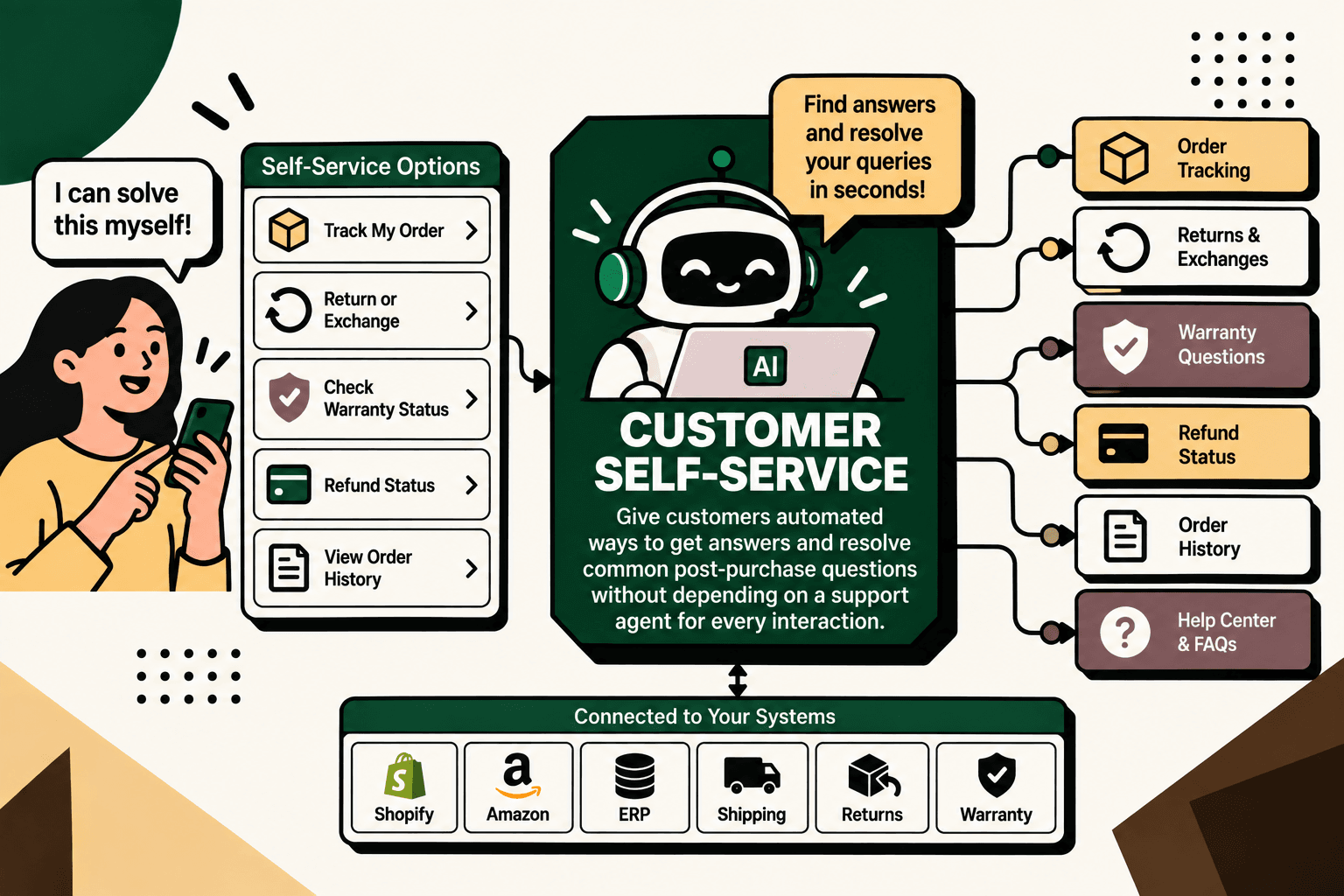
Customer self-service gives customers automated ways to find answers and complete common post-purchase tasks without contacting a support agent. It can connect order tracking, returns, warranties, refunds and order history into one accessible experience.
Instead of waiting for an agent to answer routine questions, customers can find relevant information and resolve common requests themselves.
Why Does Customer Self-Service Matter?
Post-purchase support teams often receive repetitive questions that do not always require human intervention.
- Where is my order?
- How can I return my product?
- What is my warranty status?
- When will my refund arrive?
- Can I view my order history?
- What is the status of my replacement?
Self-service can reduce repetitive support interactions while giving customers faster access to information.
How Customer Self-Service Works
A self-service experience can connect customers directly with the systems containing their order and post-purchase information.
Customer → Self-Service Portal / AI Agent → Order & Operational Data → Answer or Action
Customers can select a common request, provide the required information and receive an answer or initiate the appropriate workflow.
What Can Customers Handle Through Self-Service?
| Request | Self-Service Action |
|---|---|
| Order Tracking | View current order and shipment status |
| Returns | Start or check a return request |
| Exchanges | Request an eligible exchange |
| Warranty | Check warranty information or start a claim |
| Refunds | Check refund status |
| Order History | View previous purchases and order details |
AI-Powered Customer Self-Service
AI can make self-service more conversational by allowing customers to ask questions instead of navigating through multiple menus.
Customer Question → AI Agent → Verified Order Data → Answer / Action → Escalation When Required
AI can identify customer intent, retrieve relevant information and guide customers through approved workflows.
Connect Self-Service With Your Commerce Systems
Customer self-service becomes more useful when connected to the systems that contain real-time operational information.
Shopify + Amazon + ERP + Shipping + Returns + Warranty → Customer Self-Service
This allows customers to access relevant information without requiring support teams to manually look it up for every interaction.
When Should a Human Agent Step In?
Self-service does not need to handle every situation. Complex cases can be routed to a human agent with the customer's information and conversation context.
Self-Service Handles Routine Requests → Detects Exception → Escalates With Context → Human Agent
This keeps human support available for cases that require investigation, approval or judgment.
What Five Anchor Can Implement
Five Anchor can build customer self-service workflows around your existing commerce and operational systems. This can include order tracking, returns, exchanges, warranty status, refunds, order history, AI chat and integrations with Shopify, marketplaces, ERP and shipping systems.
Give customers answers and actions without making them wait for a support agent.
How to Measure Customer Self-Service
- Self-service resolution rate.
- Support tickets avoided.
- Customer response time.
- Human escalation rate.
- Self-service completion rate.
- Average support interactions per order.
- Cost per support interaction.
Final Takeaway
Customer self-service turns common post-purchase questions into automated customer experiences.
By connecting self-service with order, shipping, returns, warranty and ERP data, businesses can give customers faster answers while reducing repetitive support work.
Build customer self-service with Five Anchor and automate the post-purchase experience.
Frequently Asked Questions
What is customer self-service?
Customer self-service allows customers to find information and complete common support tasks without depending on a support agent for every interaction.
What can customers do through self-service?
Customers can track orders, initiate returns, check warranty information, view refunds and access order history depending on the workflows available.
Can AI power customer self-service?
Yes. AI can understand customer questions, retrieve relevant information and guide customers through approved workflows.
Can self-service connect with Shopify and ERP?
Yes. Self-service workflows can connect with Shopify, ERP, shipping, returns, warranty and other operational systems.
Can customers still contact a human agent?
Yes. Complex or exceptional requests can be escalated to human support with the relevant customer and conversation context.