Introduction: Why Amazon Seller Return Automation Matters
Amazon returns create work across multiple business functions. A return request may begin in Seller Central, but its operational consequences can extend to shipping, warehouse inspection, inventory availability, customer communication, accounting and settlement reconciliation.
When these activities are handled through disconnected systems and manual spreadsheets, teams can lose visibility into the return lifecycle. A returned item may remain unavailable in inventory after inspection. A refund record may not match the corresponding transaction. Customer support may respond without knowing the latest return status. Finance may have to investigate discrepancies across marketplace reports and ERP records.
Amazon seller return automation connects eligible return information with the operational systems responsible for tracking, inspecting, recording and reconciling returned orders. The objective is to reduce repetitive work, improve status visibility and route exceptions to the right person without bypassing Amazon's policies or the seller's financial controls.
Amazon's Selling Partner API (SP-API) provides programmatic access to supported selling operations. The available data and actions depend on the relevant API, permissions, marketplace, account configuration and fulfillment model. Start with the official Amazon Selling Partner API documentation before designing an integration.
1. What Is Amazon Seller Return Automation?
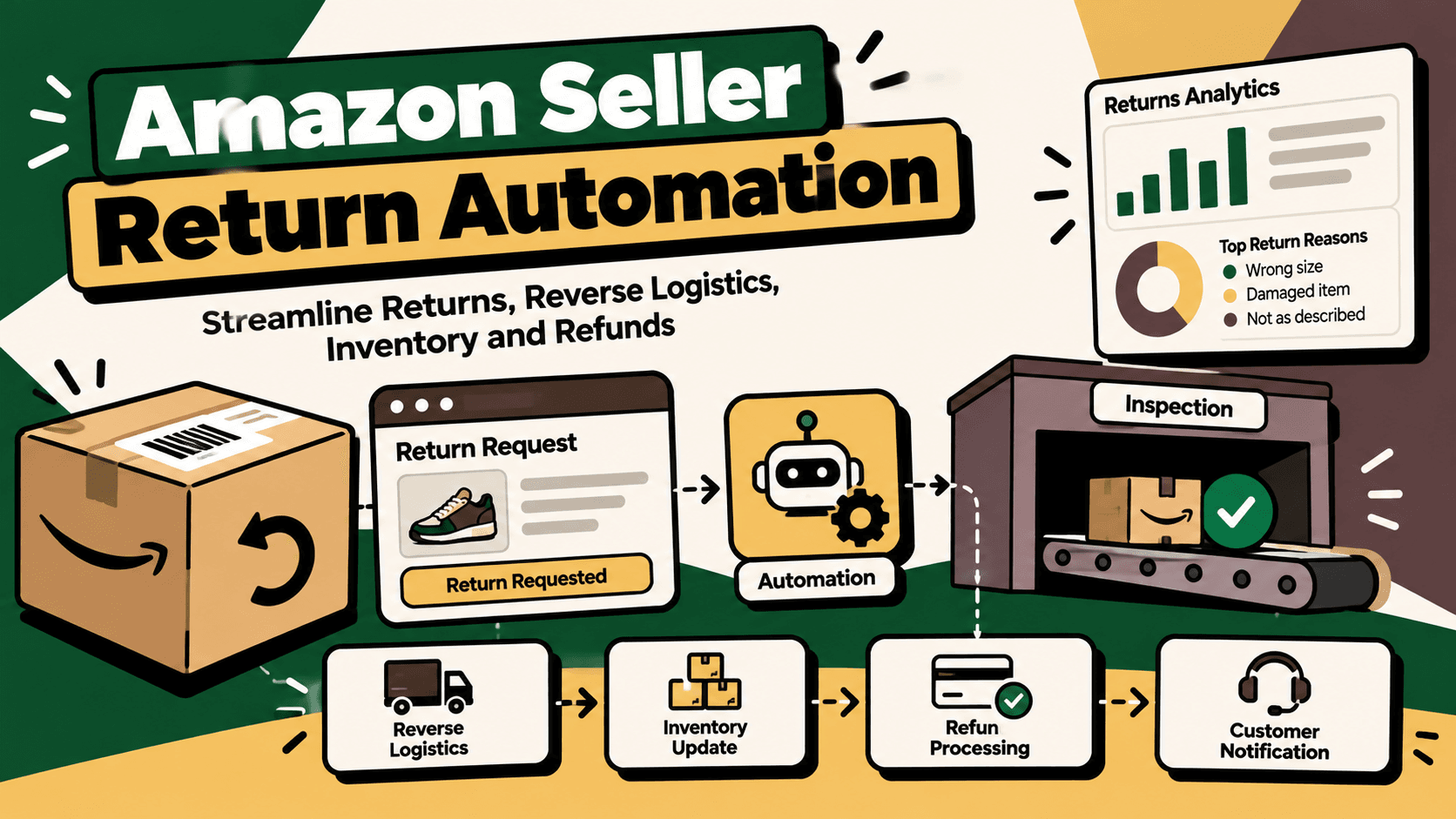
Amazon seller return automation uses integrations, business rules and, where useful, AI-assisted workflows to reduce manual handling across the return lifecycle. It can capture eligible return data, associate returns with orders and SKUs, monitor supported status updates, coordinate warehouse processes, synchronize approved inventory changes and reconcile refund-related records.
Automation does not mean that every return decision, refund or inventory adjustment should happen without review. Amazon controls the applicable marketplace processes and policies. Sellers must also apply their own financial, inventory and customer-service controls where appropriate.
Four connected stages
- Return capture: collect available return and order information and associate it with the correct customer order, SKU and marketplace reference.
- Return tracking: monitor available status information and coordinate reverse-logistics activities according to the fulfillment arrangement.
- Inspection and inventory: record the physical item's condition and apply approved rules before changing sellable stock.
- Reconciliation and reporting: match return records with refund and financial information, identify discrepancies and make unresolved cases visible.
The central principle is that a return request, a physical returned item, a refund and an inventory adjustment are related but distinct records. Treating them as one event can create accounting and stock errors.
2. What Can Be Automated in Amazon Returns?
| Workflow | Automation opportunity | Control required |
|---|---|---|
| Return request processing | Capture available return details and categorize reasons | Validate order, SKU and return identifiers |
| Return status tracking | Synchronize supported status changes and flag delays | Confirm event freshness and source |
| Reverse logistics | Coordinate pickup, shipment tracking and warehouse notifications | Respect the applicable FBA or FBM workflow |
| Inventory updates | Route returned items into inspection and restocking workflows | Require condition verification before sellable-stock updates |
| Customer support | Prepare status responses and create or update support tickets | Escalate disputed, sensitive or unresolved cases |
| Refund reconciliation | Match available refund and settlement records to return references | Do not infer that a return automatically means a refund is complete |
| Returns analytics | Identify high-return SKUs and recurring return reasons | Use consistent definitions and reliable source data |
The appropriate starting point is the workflow creating the greatest measurable operational burden. A seller with frequent inventory discrepancies may benefit more from return-to-stock controls than from an AI chatbot. A seller spending substantial time matching refund records may need reconciliation automation first.
3. FBA vs. FBM: Design Automation Around the Fulfillment Model
Fulfillment by Amazon (FBA) and Fulfilled by Merchant (FBM) involve different operational responsibilities. A return automation workflow must identify which party handles the physical return, which status information is available and which actions remain under Amazon's control.
| Operational area | FBA considerations | FBM considerations |
|---|---|---|
| Physical return handling | Amazon generally manages fulfillment and the associated return process under applicable FBA rules | The seller's configured shipping and warehouse process may require direct coordination |
| Inventory visibility | Reconcile available Amazon inventory and relevant return or reimbursement records | Connect return inspection and disposition to the seller's inventory or ERP system |
| Return status | Use the supported Amazon data and reports relevant to the account | Combine available marketplace information with the seller's reverse-logistics records |
| Automation focus | Visibility, exception detection, inventory reconciliation and financial review | Return coordination, shipping, inspection, inventory updates and financial review |
This comparison is a planning guide rather than a complete statement of Amazon policy. Exact responsibilities, eligible actions and reporting options depend on the marketplace, program and current account configuration. Review the SP-API onboarding documentation and relevant Seller Central guidance before implementation.
4. Recommended Amazon Returns Integration Architecture
A dependable architecture separates marketplace data collection, business rules, physical return handling, financial reconciliation and reporting. This makes it easier to determine where a return is in its lifecycle and which system owns each decision.
Architecture layers
- Amazon Seller Central and supported APIs: provide eligible order, return, shipment or financial information according to the APIs and reports available.
- Integration layer: authenticates requests, maps identifiers, validates records, handles retries and records processing outcomes.
- Returns workflow engine: applies deterministic rules to status transitions, eligibility checks, notifications, exception routing and approvals.
- ERP and inventory: maintain the operational records assigned to them, including approved stock movements and accounting references.
- Warehouse and shipping systems: support applicable reverse-logistics tracking, physical inspection and item disposition.
- Customer support: receives relevant return context and provides approved status communications or human escalation.
- Analytics and reconciliation: compare return, inventory and financial records and surface unresolved discrepancies.
A simplified workflow is Amazon return information → integration layer → return record and business rules → logistics, ERP and support actions → verification and reconciliation. Not every business requires every layer, and not every Seller Central action is exposed through the same API.
Build a canonical return record
Use a consistent internal representation for a return so that connected systems can refer to the same business event. Depending on the workflow, useful fields may include marketplace, seller order reference, order item, SKU, quantity, return identifier, return reason, status, shipment reference, refund reference, item condition, inventory disposition and last update time.
Keep the source identifiers and timestamps alongside normalized fields. This helps operators trace a discrepancy back to its origin rather than relying on a transformed status alone. Avoid storing unnecessary personal information in logs or analytical datasets.
5. How to Automate the Return Lifecycle
Step 1: Capture and identify the return
Collect return information through supported APIs, reports or existing operational integrations. Match it to the correct marketplace order and order item using stable identifiers. Do not depend only on customer names or product titles because those values may not uniquely identify a transaction.
Validate the return reference, SKU, quantity and order relationship before creating downstream tasks. If the record cannot be matched confidently, place it in an exception queue rather than creating a duplicate or updating the wrong order.
Step 2: Apply business rules
Use deterministic rules for predictable actions such as routing a known status to a warehouse queue, identifying a missing identifier or notifying a team that a record requires review. The rules should reflect the actual marketplace and seller workflow.
Do not assume that an internal automation can override Amazon's return eligibility, authorization or refund decisions. The integration should observe supported states and execute only actions that are permitted and properly authorized.
Step 3: Track the reverse-logistics process
For returns where the seller manages shipping or warehouse coordination, associate available shipment references with the original order and return record. Monitor the relevant events and flag missing scans, delayed movement or conflicting status information according to defined thresholds.
For FBA workflows, focus on the status and reports available to the seller, including relevant inventory or financial exceptions. Do not design an FBA workflow around physical handling actions that belong to Amazon.
Step 4: Inspect and classify returned stock
A return request does not prove that an item has arrived, and arrival does not prove that it is suitable for resale. The physical inspection process should record the item condition and apply approved disposition rules.
Possible dispositions include sellable, damaged, incomplete, under investigation or requiring repair. These are illustrative internal categories; the actual values should match the warehouse and ERP data model. Only update sellable inventory when the required inspection and approval conditions have been met.
Step 5: Reconcile refunds and financial records
Match available refund and settlement information to the relevant order and return references. Distinguish a requested refund, a processed refund and a financial settlement entry wherever the source systems expose those states.
Flag missing references, amount mismatches, unexpected timing and duplicate records. Route unresolved discrepancies to finance rather than automatically creating compensating entries or assuming a transaction has completed.
Step 6: Notify customers and internal teams
Where the marketplace workflow and communication permissions allow, automation can prepare approved status messages or update internal support tickets. Messages should use verified return status and avoid promising a refund date or outcome that the system cannot confirm.
Escalate disputes, unusual return reasons, suspected abuse, damaged high-value items and cases where source systems disagree. Human review should be part of the designed workflow, not a fallback invented after an automation fails.
6. Where Amazon SP-API Fits
Amazon's Selling Partner API is a technical foundation for integrations with supported selling operations. The exact endpoint, notification mechanism, permissions and data availability must be confirmed against the current documentation and marketplace requirements.
Start with the SP-API reference and the guide to connecting to SP-API. Review the relevant API models and authorization requirements rather than assuming all return fields are available through one endpoint.
API integration controls
- Authentication: use the supported authorization flow and protect credentials.
- Permissions: request only the access required for the selected workflow.
- Rate limits: implement bounded retries and backoff for temporary throttling or service errors.
- Data validation: validate identifiers, quantities, dates and expected states before writing to downstream systems.
- Idempotency: ensure that repeated notifications or retried requests do not create duplicate return tasks or inventory movements.
- Observability: log processing outcomes and maintain a traceable relationship between source events and downstream actions.
- Version management: review API changes and test integrations before deploying updates.
Where notifications are supported for the required event, they can reduce dependence on repeated polling. If the required return event is not available through a notification, use the supported API or reporting method appropriate to that workflow. Design around documented capabilities rather than assuming that every event can be delivered instantly.
7. Where AI Helps—and Where Rules Are Safer
AI is most useful when return operations involve unstructured information, inconsistent descriptions or a large volume of cases requiring classification. Deterministic rules remain preferable for exact identifier matching, permission checks, inventory posting and financial reconciliation.
| Task | Recommended approach | Human involvement |
|---|---|---|
| Match return to order | Deterministic identifiers and validation | Review ambiguous matches |
| Classify free-text return reasons | AI classification with defined categories | Review low-confidence or high-impact cases |
| Summarize customer conversations | AI-assisted summarization from approved data | Agent handles disputes and sensitive cases |
| Update sellable stock | Rules plus verified warehouse inspection | Approval for damaged or ambiguous items |
| Reconcile refund records | Deterministic matching and variance rules | Finance resolves exceptions |
| Identify return patterns | Analytics with optional AI-assisted explanation | Operations validates root-cause conclusions |
For example, AI may classify free-text reasons into categories such as wrong size, damaged item or product mismatch. The system can then aggregate these categories by SKU. However, it should not conclude that a product defect is confirmed merely because a customer describes one, and it should not automatically change inventory or financial records based solely on a generated interpretation.
8. Implementation Plan: From Manual Returns to Reliable Automation
Phase 1: Map the current workflow
Document how return requests are received, how teams track shipments, how warehouse inspection is recorded, how inventory is updated and how refunds are reconciled. Identify duplicate data entry, manual handoffs and the systems involved in each step.
Phase 2: Establish baseline metrics
Measure return-processing effort, unresolved return cases, inventory discrepancies, refund reconciliation exceptions, time to resolve exceptions and return-related support contacts. Use consistent definitions and a representative measurement period.
Phase 3: Define system ownership and data mappings
Specify which system owns each field and state. Map Amazon order and return references to ERP records, inventory records, shipment references and refund entries. Define what happens when identifiers are missing or records conflict.
Phase 4: Select the smallest viable workflow
Choose one bounded problem, such as synchronizing supported return records into an internal exception queue or matching refund records to order references. Avoid launching a broad, bidirectional automation before the underlying data model and exception handling are stable.
Phase 5: Implement guardrails and recovery
Configure access controls, validation, retry policies, duplicate prevention, audit trails and human approval for high-impact actions. Make failures visible and provide a safe manual recovery path.
Phase 6: Test realistic edge cases
- Duplicate notifications or repeated API responses.
- Missing or changed order and SKU references.
- Partial returns involving multiple order items.
- Delayed or conflicting return status information.
- Items received in damaged or incomplete condition.
- Refund and settlement amounts that do not match expectations.
- API throttling, expired credentials and temporary outages.
- Differences between FBA and FBM responsibilities.
Phase 7: Pilot, measure and expand
Run the workflow against a limited set of representative records. Compare the results with the baseline, review exception quality and confirm that downstream inventory and financial records are correct. Expand to additional workflows only when the pilot is reliable and operational owners understand how to recover failures.
9. Prioritize Return Automation by Business Impact
Not every return workflow deserves the same investment. A practical prioritization model is:
Priority score = volume × frequency × manual effort × error cost × revenue impact ÷ implementation complexity.
This is a practical decision framework, not an industry-standard formula. Use consistent scoring scales to compare candidate workflows and validate the ranking with operational owners.
| Candidate workflow | Why it may be valuable | Primary KPI |
|---|---|---|
| Return record synchronization | Reduces repeated data entry and improves case visibility | Manual handling time and synchronization failure rate |
| Warehouse inspection routing | Makes returned items and unresolved inspections easier to track | Time from receipt to disposition |
| Inventory reconciliation | Helps detect discrepancies between return outcomes and stock records | Inventory discrepancy rate |
| Refund reconciliation | Surfaces missing or mismatched financial records | Unresolved refund exceptions and time to resolution |
| AI return-reason classification | Structures free-text reasons for analysis | Classification accuracy and manual review rate |
| Support ticket automation | Reduces repetitive status lookups and case routing | Handling time and repeat-contact rate |
Calculate financial impact using measured labor, error costs, recoveries and operational outcomes. Include integration development, API maintenance, monitoring, exception handling and ongoing support costs. Do not present an estimated efficiency improvement as a guaranteed return on investment.
10. Common Failure Modes and How to Prevent Them
Confusing return status with inventory availability
A return can be requested, shipped, received or inspected without being eligible for resale. Model these states separately and require the correct evidence before updating sellable stock.
Assuming every action is available through SP-API
API coverage and permissions vary by workflow. Verify the required endpoint, data fields and authorization before committing to an architecture. Where an operation is not supported, use an approved alternative process rather than building an unsupported dependency.
Creating duplicate records during retries
Temporary failures can make it unclear whether an operation succeeded. Use stable identifiers, idempotent processing and reconciliation to prevent repeated requests from creating duplicate return cases or inventory transactions.
Automating refunds without financial verification
A return record is not sufficient proof that a refund has been processed or settled. Reconcile the relevant source records and route mismatches to finance before creating corrective transactions.
Using AI for deterministic decisions
AI-generated classifications can be useful but may be wrong. Keep exact matching, authorization, stock posting and financial controls in deterministic workflows. Use AI where interpretation adds value and apply confidence thresholds and human review.
Ignoring security and maintenance
Return workflows can include customer information, order details and financial references. Apply least-privilege access, secure credentials, limit sensitive logging and establish monitoring, access reviews and regression testing for integration changes.
11. How Five Anchor Fits into Amazon Seller Return Automation
Amazon returns are not only a marketplace task. They connect to the wider commerce infrastructure that manages orders, inventory, warehouse operations, shipping, customer support and financial reporting.
Five Anchor's positioning is AI Infrastructure for D2C and E-Commerce. Its Commerce Infrastructure and AI-Powered Customer Operations services are relevant when a business needs to connect supported marketplace data with ERP, inventory, logistics and customer-service workflows.
What an implementation could include
- Workflow mapping: document the return lifecycle and identify where manual handoffs or reconciliation delays occur.
- Marketplace integration: connect supported Amazon APIs or reports with the internal return data model.
- ERP and inventory integration: map order, SKU, return and disposition records to the systems that own them.
- Automation rules and AI: classify return reasons, route cases, trigger approved notifications and identify exceptions without bypassing business controls.
- Human escalation: send ambiguous returns, damaged-item cases and financial mismatches to the appropriate team.
- Monitoring and measurement: track synchronization failures, unresolved exceptions, inventory accuracy and reconciliation effort.
The objective is a traceable workflow that reduces repetitive handling while keeping consequential decisions under the right controls. Five Anchor is relevant when Amazon return processes need to connect with broader ecommerce operations rather than remain isolated in marketplace dashboards.
12. KPIs for Measuring Return Automation
Measure whether automation improves the actual return workflow, not merely how many events the integration processes.
- Return processing time: elapsed time from receipt of a return record to the next verified operational state.
- Manual handling time: staff effort spent entering, checking and reconciling return information.
- Synchronization success rate: share of eligible records processed successfully, using a consistent definition.
- Exception resolution time: time required to close a return, inventory or refund discrepancy.
- Inventory discrepancy rate: frequency of differences between verified return disposition and recorded stock.
- Refund reconciliation rate: share of eligible refund records matched to the expected order and financial references.
- AI classification quality: accuracy of return-reason categories and the proportion requiring human correction.
- Customer support handling time: time spent on return-related inquiries, interpreted alongside resolution quality and repeat contacts.
Record baseline values before deployment and compare them with pilot results using the same definitions. Review failure categories as well as averages; a faster workflow can still be unsafe if it increases incorrect stock updates or unresolved financial discrepancies.
Conclusion
Amazon seller return automation connects return requests, reverse logistics, inventory, customer support and refund reconciliation into a more traceable operating process. The most reliable implementations distinguish marketplace return status from physical item condition, inventory disposition and financial settlement.
Start by mapping the current workflow, confirming Amazon's supported API capabilities and defining ownership for each record. Automate one high-impact process, add validation and exception handling, and measure the result before expanding.
For ecommerce businesses managing returns across marketplace, ERP, warehouse and customer-service systems, the goal is not to automate every decision. It is to make routine processing dependable, discrepancies visible and high-impact decisions accountable.
Key Takeaways
- •Amazon seller return automation should connect return information with inventory, logistics, customer support and financial workflows.
- •FBA and FBM require different operational designs because physical handling responsibilities and available data differ.
- •A return request, a returned item, an inventory adjustment and a refund are separate states that must be reconciled.
- •Amazon SP-API capabilities depend on the relevant API, permissions, marketplace and account configuration.
- •Use deterministic rules for identifiers, permissions, stock posting and financial reconciliation; use AI for suitable classification and summarization tasks.
- •Start with one high-impact workflow, add retries and exception handling, and measure outcomes against a documented baseline.
- •Five Anchor's commerce infrastructure and customer operations services are relevant when return workflows need to connect with ERP, inventory, logistics and support systems.
Amazon Return Automation: Manual Processing vs. Integrated Workflows
| Area | Manual or Disconnected Process | Integrated Automation |
|---|---|---|
| Inventory Sync Frequency | 15–30 min batch polling (high oversell risk) | Sub-second atomic locking (<450ms) |
| Concurrent Drop Resilience | Fails under concurrency; causes negative stock balance | Redis atomic reservation queue guarantees exact counts |
| Error Handling & Retries | Silent failure; manual CSV audit needed | Dead-letter queues with automated exponential retry |
| Fulfillment Routing Speed | 2–4 hours delayed batch export to 3PL warehouse |