What Are AI Voice Agents for E-Commerce?
AI voice agents for e-commerce are software agents that can understand spoken customer requests, retrieve information from commerce systems, apply business rules, take approved actions and escalate conversations to human teams when necessary. The important distinction is that an AI voice agent is not simply a phone bot with a natural-sounding voice. Its business value comes from connecting the conversation to live ecommerce data and operational workflows.
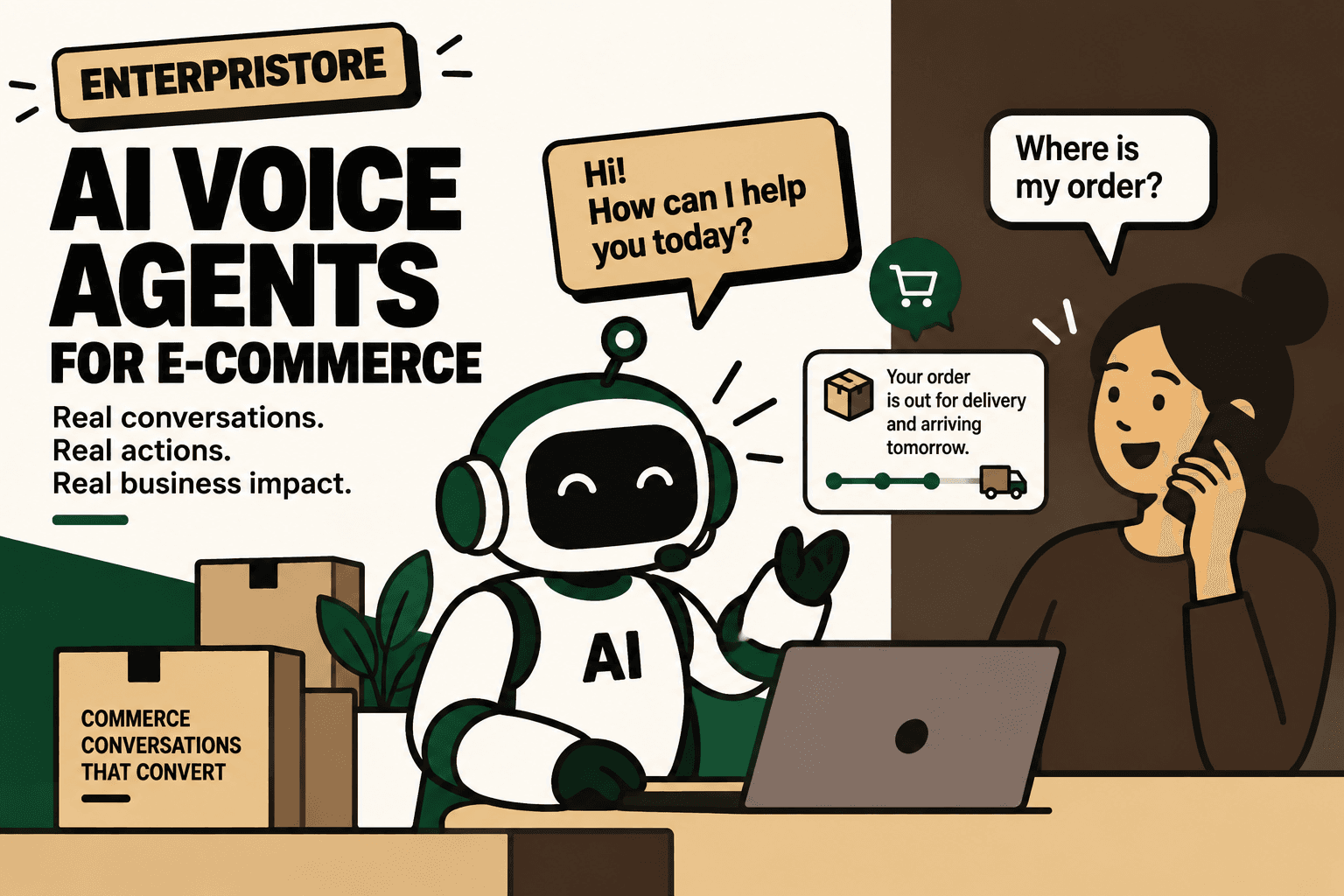
A customer asking “Where is my order?” does not really need a voice response. They need the system to identify the customer, locate the relevant order, retrieve shipment information, explain the status and, where appropriate, send a tracking link or escalate a delivery problem.
That creates a more useful architecture: voice → intent → customer and commerce data → business rules → action → confirmation → human escalation when required.
The current ecommerce voice-agent market includes solutions connected to Shopify and other commerce workflows, with use cases ranging from customer support and order tracking to abandoned-cart recovery, COD confirmation and sales conversations. Voiceflow's Shopify integration documents agents that can retrieve order information and perform supported commerce actions.
This distinction matters for D2C operators because the largest opportunity is usually not replacing every customer-service conversation. It is removing repetitive work from high-volume workflows while keeping people responsible for exceptions, sensitive decisions and complex customer situations.
:contentReference[oaicite:0]{index=0}
Why E-Commerce Is a Strong Use Case for Voice AI
E-commerce generates a large number of conversations around relatively structured events: orders, payments, delivery, returns, cancellations, product questions and account information. Many of these conversations follow recognizable workflows even when customers express their requests in different ways.
For example, these requests are linguistically different but operationally similar:
- “Can you tell me where my package is?”
- “Has my order shipped yet?”
- “I ordered this two days ago. What's happening?”
- “Can you check the delivery status?”
The customer is essentially asking the system to retrieve an order and shipment status. An AI voice agent can interpret the natural-language variation while deterministic systems remain responsible for the underlying order and logistics data.
This creates an important division of labor. AI handles interpretation and conversation; business systems remain authoritative for transactional facts.
That model is particularly relevant to D2C businesses where customer-service volume increases with order volume. A scalable support architecture should therefore aim to resolve routine questions automatically, route exceptions intelligently and give human agents the context they need when intervention is necessary.
What Can AI Voice Agents Automate in E-Commerce?
| Use case | What the agent can do | Primary business metric |
|---|---|---|
| Order tracking | Identify the order, retrieve shipment status and communicate the latest available information | Ticket and call volume |
| COD confirmation | Call customers after a COD order and record the confirmation outcome | COD confirmation rate and RTO rate |
| NDR recovery | Contact customers after failed delivery and coordinate an approved next step | Successful reattempts |
| Returns and exchanges | Verify the order, explain policy and initiate supported workflows | Resolution time |
| Abandoned-cart recovery | Call selected high-intent shoppers and address objections | Recovered revenue |
| Product recommendations | Understand requirements and recommend relevant products | Conversion rate and assisted revenue |
| Lead callback | Call new leads quickly and capture qualification information | Lead response time and qualified leads |
| Win-back | Contact selected dormant customers using approved campaign logic | Reactivation rate |
| Human escalation | Transfer complex conversations with relevant context | First-contact resolution and handling time |
Inbound vs. Outbound AI Voice Agents
One of the most useful ways to evaluate ecommerce voice AI is to separate inbound and outbound workflows. They use similar technology but solve different operational problems.
Inbound AI Voice Agents
Inbound agents respond when a customer calls the business.
Customer call → speech recognition → intent detection → customer identification → commerce lookup → approved action → response or escalation
Common inbound requests include order status, delivery questions, cancellation requests, return eligibility, refund status, product information and general support.
The main opportunity is reducing repetitive support work without creating another frustrating IVR. The agent should allow customers to describe their problem naturally instead of forcing them through a long menu of numbered options.
Outbound AI Voice Agents
Outbound agents begin with an ecommerce event or business rule.
Commerce event → eligibility rule → outbound call → conversation → action or outcome → record updated in commerce system
Typical triggers include a new COD order, abandoned cart, failed delivery, high-value lead, dormant customer or campaign segment.
Shopify's app ecosystem includes voice-agent products positioned around abandoned-cart recovery, upselling, win-back campaigns and inbound support. Shopify App Store listing for Loop AI Voice Agents
The Highest-Value E-Commerce Voice AI Use Cases
1. COD Confirmation and RTO Prevention
For businesses with significant cash-on-delivery volume, a voice agent can call a customer after an order is placed, confirm that the order was intentionally placed and capture the customer's response.
The workflow can be simple:
- COD order is created.
- The order enters a confirmation queue.
- The agent calls the customer.
- The agent verifies the relevant order information.
- The customer confirms, requests a change or indicates that the order should not proceed.
- The result is written back to the order or escalated according to business rules.
India-focused voice platforms are already positioning voice agents around COD confirmation and NDR or RTO recovery. Soniqaa, for example, describes AI voice agents for COD and NDR recovery.
What stays deterministic: order eligibility, cancellation permissions, customer identity checks and the final status update should be controlled by explicit business rules and system permissions.
2. Order Tracking and WISMO Support
“Where is my order?” is one of the clearest voice-AI opportunities because the question is repetitive while the answer is usually data-driven.
A production workflow should not ask an LLM to invent a delivery estimate. It should retrieve the current order and shipment data from the appropriate system and allow the language model to explain that information naturally.
Example: A customer says, “My parcel hasn't arrived. Can you check what happened?” The agent identifies the customer, retrieves the relevant order, checks the latest shipping event and explains the status. If the shipment is delayed beyond a configured threshold, the workflow can create a ticket or transfer the call rather than pretending the problem has been resolved.
The operational metric is not simply “number of calls answered.” Better measures include automated resolution rate, transfer rate, repeat contacts, average handling time and the percentage of calls requiring manual lookup.
3. NDR Recovery
Non-delivery reports create a different kind of opportunity because the business has already acquired the order but still needs to recover the delivery.
An outbound agent can contact the customer, determine whether the customer still wants the package and capture an approved delivery preference. The workflow can then pass that information to the shipping or order-management system.
Open-source ecommerce voice implementations also demonstrate workflows around NDR retry, delivery updates, COD confirmation and abandoned-cart recovery. TelenowAI's Shopify voice AI project
The important design principle is that the agent should not independently invent logistics decisions. It should operate inside a defined set of permitted actions.
4. Abandoned-Cart Recovery
Abandoned-cart calls are commercially different from support calls. The objective is not to resolve an existing operational problem but to recover a potential sale.
A useful workflow can combine cart value, customer history, product information and campaign rules to determine whether a customer should receive an outbound call.
The conversation can then focus on the reason for abandonment. The customer may have a product question, shipping concern, payment issue or uncertainty about the product.
The important measurement is recovered revenue attributable to the workflow, not call volume. Brands should also track contact rate, conversation-to-order rate, revenue per attempted call and opt-out or complaint rates.
5. Product Discovery and Sales Assistance
Voice becomes more interesting when the customer does not know exactly what product they want.
Instead of matching a spoken request to a single FAQ, an AI sales agent can ask clarifying questions, retrieve relevant catalog information and narrow the product set.
For example, a customer might say, “I need a laptop bag for a 16-inch laptop that I can use for business travel.” The agent needs product attributes, compatibility information, availability and potentially pricing before recommending anything.
This is where ecommerce AI becomes more dependent on data quality. If product attributes are incomplete or inventory data is stale, a fluent voice conversation can still produce a poor customer experience.
AI Voice Agent vs. Traditional IVR
| Feature | Traditional IVR | AI voice agent |
|---|---|---|
| Interaction | Menu-driven | Natural conversation |
| Intent handling | Predefined paths | Natural-language interpretation |
| Context | Usually limited | Can use customer and order context |
| Knowledge | Script and menu dependent | Can retrieve approved business information |
| Actions | Often routes the caller | Can perform approved system actions |
| Personalization | Limited | Can use customer-specific context |
| Exceptions | Usually transferred | Can classify selected exceptions and escalate with context |
The distinction is therefore not simply “old technology versus new technology.” A traditional IVR is primarily a routing interface. An AI voice agent can become an operational interface when it is connected to the systems that contain the customer's actual data.
What the Architecture of an E-Commerce Voice Agent Looks Like
A production-grade system normally contains several distinct layers.
- Telephony layer: receives or initiates calls.
- Speech recognition: converts customer speech into usable input.
- Agent reasoning: determines intent, context and the next conversational step.
- Knowledge and retrieval: supplies approved product, policy and business information.
- Commerce tools: retrieve orders, customers, products, inventory and delivery information.
- Action layer: performs only explicitly permitted changes.
- Guardrails: validate identity, permissions, policy and action thresholds.
- Human escalation: transfers conversations that require judgment or intervention.
- Observability: records outcomes, errors, transfers and operational metrics.
The architecture can connect Shopify or another commerce platform with an OMS, CRM, warehouse, shipping aggregator, returns system, helpdesk and analytics layer. The voice model itself is only one component.
Five Anchor POV: For D2C businesses, the highest-leverage work is often the integration layer. A voice agent that can speak naturally but cannot access the right order, inventory, shipping or returns data is still dependent on a human operator. The infrastructure should therefore be designed around the workflow first and the voice interface second.
Where AI Should Make Decisions and Where It Should Not
A reliable ecommerce voice system should not treat every decision as an AI decision.
| Decision type | Recommended approach | Why |
|---|---|---|
| Understand what the customer means | AI | Natural language varies widely |
| Retrieve order status | Deterministic API | The commerce system should remain authoritative |
| Explain return policy | AI with approved knowledge | Natural explanation is useful but policy must be controlled |
| Issue an unrestricted refund | Rule or human approval | Financial impact requires explicit controls |
| Recommend products | AI plus catalog data and rules | Reasoning can help, but recommendations need accurate product information |
| Handle abuse or unusual disputes | Human escalation | Context and judgment may exceed the automation boundary |
| Update an order | Tool call with permissions | Actions need validation and auditability |
This approach reduces a common implementation mistake: giving a language model broad authority over transactional systems simply because it can converse fluently.
AI Voice Agents for Indian D2C E-Commerce
India creates a particularly relevant environment for voice commerce because customer operations can involve COD, delivery exceptions, multilingual conversations and high interaction volumes.
Meesho has been publicly described as using voice agents for multilingual customer support. ElevenLabs' published case material describes the use of voice technology for Hindi and English customer interactions involving ecommerce support. ElevenLabs' Meesho case study
That does not mean every Indian D2C brand should immediately deploy a multilingual voice agent. The correct starting point is the workflow with enough volume, repeatability and measurable business impact to justify the integration effort.
For many businesses, the first candidate could be COD confirmation, NDR recovery or order-status support rather than open-ended product selling.
What Results Are Being Reported?
Public vendor case studies indicate that voice automation can operate at substantial scale, but the reported results should be treated as company-reported outcomes rather than universal benchmarks.
Case study evidence: Gnani AI describes an ecommerce logistics deployment in which its customer reportedly automated more than 2.5 million queries, with the vendor reporting 65% first-call resolution and a 72% reduction in agent dependency. Gnani AI customer story
Case study evidence: ElidePro's ecommerce case study reports a change from a 65% to 100% call-answer rate, a 60% reduction in human workload and approximately ₹12 lakh per month in previously missed revenue. These are reported figures from the provider's case study and should not be treated as an independently audited benchmark for every ecommerce business. ElidePro ecommerce case study
The practical lesson is not that a particular percentage of calls can always be automated. It is that voice AI economics depend on the workflow, call volume, integration quality, customer behavior, escalation rate and cost of the existing process.
How to Calculate the Business Case
A useful business case should connect automation to measurable operational or commercial outcomes rather than simply counting AI conversations.
Support economics
Measure current call volume, average handling time, support cost, repeat contacts, escalation rate and resolution rate. Then estimate the portion of calls that can be resolved without human intervention.
Illustrative scenario: If a brand receives 10,000 repetitive support calls per month and 30% are suitable for an automated workflow, the addressable volume is 3,000 calls. The financial value depends on the actual cost of handling those calls, the automation's resolution rate and the ongoing cost of the voice infrastructure. This is a planning example, not an industry benchmark.
Revenue recovery economics
For abandoned carts, lead callbacks or win-back campaigns, the model should instead focus on incremental orders and attributable contribution margin.
A simple framework is:
- Eligible contacts
- Successful connections
- Qualified conversations
- Conversions
- Average order value
- Contribution margin
- Voice and integration cost
Do not measure ROI from revenue alone. A voice campaign that generates orders but requires excessive discounts, high contact costs or creates customer complaints may not be economically attractive.
How to Prioritize E-Commerce Voice Automations
A practical prioritization model is:
Priority = volume × frequency × manual effort × error cost × revenue impact ÷ implementation complexity
This is a practical decision framework, not an industry-standard formula.
The model encourages teams to look beyond novelty. A low-volume product-sales agent may sound more impressive than an order-status workflow, but the order-status workflow may create more measurable operational value if it handles a much larger volume with lower implementation risk.
| Workflow | Typical priority | Reason |
|---|---|---|
| Order tracking | High | Frequent, structured and data-driven |
| COD confirmation | High | Clear trigger and measurable outcome |
| NDR recovery | High | Direct connection to delivery recovery |
| Abandoned cart | Medium to high | Commercial value is measurable but depends on customer segment and contact economics |
| Returns | Medium | Potentially high volume but policy and exception complexity can be significant |
| Open-ended sales | Medium | Higher reasoning and product-data requirements |
| Complex complaints | Low for full automation | Human judgment is often more appropriate |
Implementation Playbook for AI Voice Agents
1. Map the Existing Workflow
Document the trigger, customer input, systems consulted, decisions made, actions taken, exceptions, human handoffs and final output.
Do not start by selecting a voice model. Start by documenting what actually happens when a customer calls.
2. Establish a Baseline
Measure call volume, frequency, average handling time, response time, current resolution rate, transfer rate, operational cost, error rate and revenue impact where relevant.
3. Identify the Bottleneck
Separate the conversational problem from the operational problem. If agents spend most of their time opening an order-management system and copying shipment information into a conversation, the real bottleneck may be system access rather than customer communication.
4. Classify Each Step
Decide whether each step should be deterministic automation, AI-assisted reasoning, human approval or human-only handling.
5. Connect the Systems
Depending on the workflow, this may include Shopify, another commerce platform, ERP, OMS, CRM, WMS, shipping provider, returns platform, helpdesk, WhatsApp, email and analytics.
APIs and webhooks should provide controlled access to current data. The agent should not depend on manually copied spreadsheets or stale exports for transactional decisions.
6. Add Guardrails
Define identity verification, permissions, allowed actions, refund or cancellation thresholds, escalation rules, fallback behavior, retry logic, logging and monitoring.
7. Build the Smallest Viable Workflow
Start with one high-volume, relatively low-risk workflow. For example, an order-status agent can be a better first pilot than an autonomous agent that modifies refunds, addresses and payment details.
8. Test Edge Cases
Test ambiguous customer identities, multiple orders, unavailable tracking data, delayed shipments, conflicting information, unsupported requests, abusive conversations, language switching and customers asking for actions outside the agent's permissions.
9. Keep Human Approval Where It Matters
High-impact financial decisions, unusual disputes, fraud indicators and policy exceptions should have explicit human controls rather than being delegated to the model by default.
10. Measure the Pilot
Track automated resolution, escalation rate, repeat contacts, average handling time, customer satisfaction, successful actions, failed actions and business outcomes specific to the workflow.
11. Scale Only After Reliability
Once the first workflow is stable, reuse the infrastructure for additional use cases rather than launching several independent voice agents with separate data connections and inconsistent policies.
Where Five Anchor Fits
Five Anchor positions its work as AI Infrastructure for D2C & E-Commerce, which makes AI voice operations one part of a broader commerce-operations architecture rather than an isolated chatbot project.
For an ecommerce voice deployment, the implementation can begin with workflow mapping and baseline measurement, followed by connections between the commerce platform, customer records, order systems, logistics and support tools. AI agents can then be introduced with defined permissions, guardrails and human escalation.
The relevant Five Anchor service area is AI-Powered Customer Operations, which includes AI voice operations, AI chat operations, returns and exchange automation, warranty operations, customer self-service, automated customer communication and ticket automation. The same architecture can connect into Five Anchor's broader commerce infrastructure work when the voice workflow needs marketplace, ERP, inventory, warehouse or shipping integrations. Five Anchor
Five Anchor POV: The strongest deployment is usually not “an AI caller.” It is a controlled operational workflow in which the voice interface is connected to the same underlying systems that employees use. That allows the automation to retrieve live context, perform defined actions, document the outcome and hand exceptions to people with the relevant information already attached.
Common Failure Modes
Poor Data Quality
If product attributes, customer records, inventory or shipment information is inaccurate, the voice agent can communicate incorrect information confidently.
Too Much AI, Not Enough Rules
Language models are useful for interpreting intent, but deterministic systems are generally better suited to permissions, eligibility, calculations and transactional updates.
Weak Integration Design
A voice agent that cannot access current commerce data becomes another information layer that employees must support manually.
No Escalation Strategy
Every automated workflow needs a clear definition of when the agent should stop. Escalation should also transfer useful context so the customer does not have to repeat the entire conversation.
Optimizing for Call Volume Instead of Outcomes
A high number of automated conversations does not necessarily mean the workflow is working. Measure resolution, revenue recovery, successful delivery, reduced repeat contacts or another business metric that reflects the purpose of the automation.
Ignoring Privacy and Security
Voice workflows can process customer identity, order details, addresses, payment-related information and other sensitive data. Access should therefore follow least-privilege principles, with appropriate logging, retention and permissions for the systems involved.
What Should Stay Human?
The goal of ecommerce voice AI should not be to eliminate human involvement. It should be to concentrate human effort where judgment creates more value.
- Complex complaints and disputes
- Fraud or abuse investigations
- High-value exceptions
- Policy overrides
- Unusual refunds or financial decisions
- Customers who explicitly request a human
- Situations where system data is incomplete or contradictory
- Cases involving significant reputational or legal risk
A good system therefore has a simple operating principle: automate the predictable, augment the complex and escalate the consequential.
AI Voice Agents Are Becoming an Operational Interface
The strongest way to think about AI voice agents for e-commerce is not as a replacement for IVR or as a more natural call-center script. They are becoming an interface between customers and the underlying commerce operation.
The progression is:
- Customer speaks naturally.
- AI identifies the intent.
- The system retrieves trusted customer and commerce data.
- Business rules determine what can happen.
- The agent performs an approved action.
- The customer receives a clear response.
- The outcome is recorded.
- A human takes over when the workflow reaches an exception.
That architecture is more valuable than voice alone because it connects the customer conversation to the actual business process.
Final Takeaway
AI voice agents for e-commerce are most valuable when they combine natural conversation with live commerce data and controlled actions. The strongest early use cases are generally repetitive, measurable workflows such as order tracking, COD confirmation, NDR recovery, abandoned-cart recovery and structured customer support.
The technology should be evaluated as an operational system, not simply as a voice-generation product. Before deployment, map the workflow, establish a baseline, identify the bottleneck, connect the required systems, define AI and human responsibilities, add guardrails, pilot one workflow and measure the business outcome.
For D2C businesses, the long-term opportunity is a connected customer-operations layer where voice, chat, commerce, logistics and support systems work from the same operational data. The objective is not to make every conversation automated. It is to make routine conversations faster, transactional workflows safer and human intervention more focused.
Key Takeaways
- •AI voice agents are more valuable when they can retrieve live ecommerce data and perform controlled actions rather than simply answer questions.
- •High-volume workflows such as order tracking, COD confirmation and NDR recovery are strong candidates for early automation.
- •AI should interpret conversations while deterministic systems remain authoritative for transactional data, permissions and business rules.
- •Inbound and outbound voice agents solve different problems and should be measured against different KPIs.
- •Human escalation remains important for complex complaints, financial exceptions, fraud concerns and other high-impact decisions.
- •A reliable deployment requires workflow mapping, baseline metrics, system integrations, guardrails, testing, monitoring and staged scaling.
Traditional IVR vs. AI Voice Agent
| Feature | Traditional IVR | AI Voice Agent |
|---|---|---|
| Inventory Sync Frequency | 15–30 min batch polling (high oversell risk) | Sub-second atomic locking (<450ms) |
| Concurrent Drop Resilience | Fails under concurrency; causes negative stock balance | Redis atomic reservation queue guarantees exact counts |
| Error Handling & Retries | Silent failure; manual CSV audit needed | Dead-letter queues with automated exponential retry |
| Fulfillment Routing Speed | 2–4 hours delayed batch export to 3PL warehouse | Instantaneous automated webhook dispatch (<90 sec) |