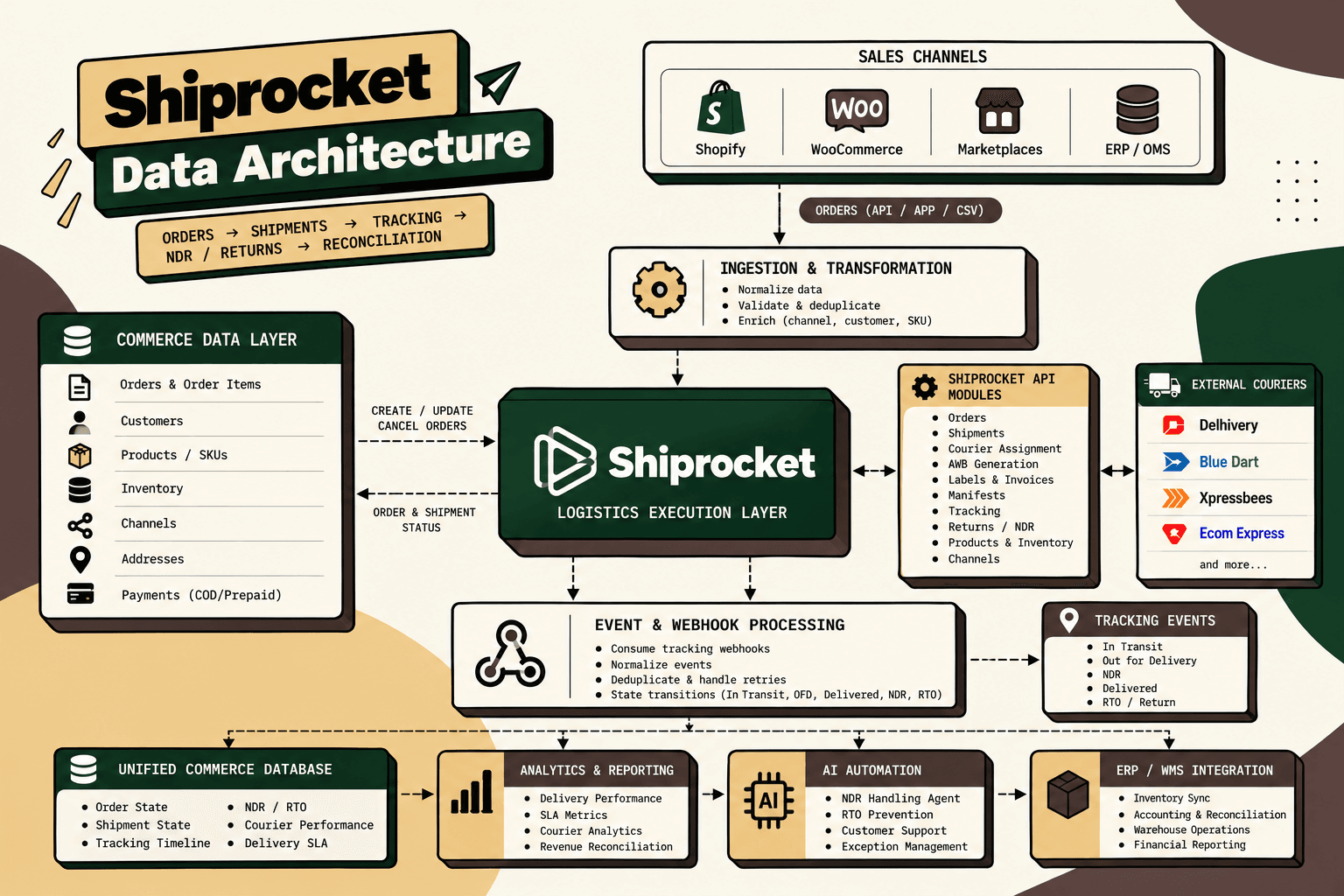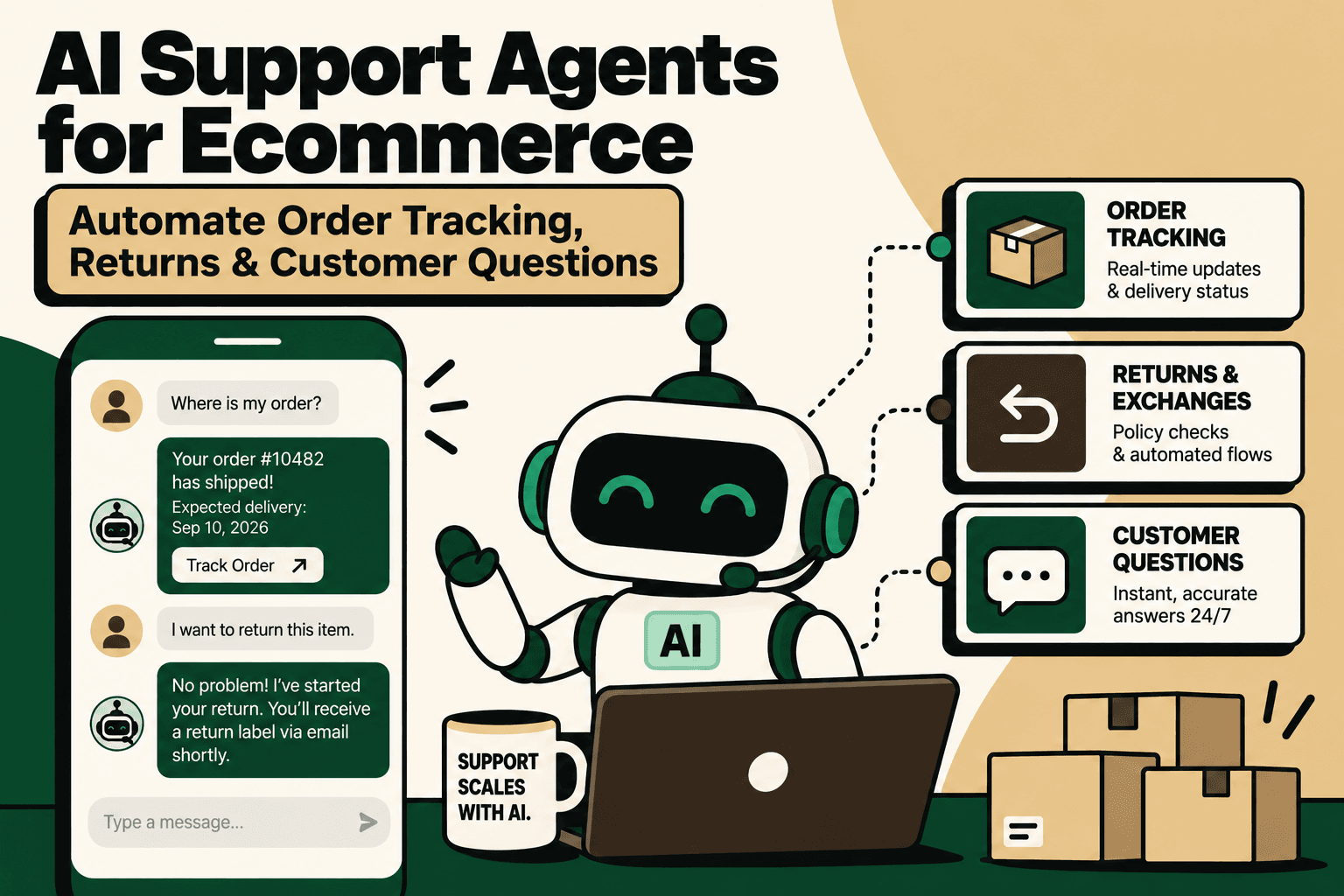
Ecommerce support becomes expensive and difficult to scale when every customer question requires a person to search across the store, order system, shipping portal, returns platform, and internal policies before replying. The problem is not simply ticket volume. It is the amount of operational context hidden behind each ticket.
AI support agents solve a different problem from traditional chatbots. Instead of only generating an answer from a knowledge base, an ecommerce AI agent can identify customer intent, retrieve live order or product information, apply business rules, perform approved actions in connected systems, and hand the conversation to a human when the request falls outside its authority. Gorgias describes this model as using store data, help-center content, guidance, and connected actions to work through customer requests rather than simply matching questions to static answers. Gorgias: How AI Agent works
The practical opportunity for D2C brands is therefore not to replace the support team with a chatbot. It is to build an AI support operations layer that connects customer conversations with ecommerce operations.
What Is an AI Support Agent for Ecommerce?
An AI support agent is an AI-powered customer-service system that can understand a customer's request, retrieve relevant information from connected systems, follow predefined business guidance, take permitted actions, and escalate cases that require human judgment.
That distinction matters because ecommerce support is rarely just a question-and-answer problem.
A customer asking, “Where is my order?” does not need a generic explanation of your shipping policy. They need their specific order identified, the latest fulfillment status retrieved, the tracking information checked, and a useful answer returned.
A customer asking, “Can I return this?” may require an eligibility check based on the order date, delivery date, product, return policy, and potentially the return system.
A customer asking, “Can I change my address?” may require the agent to determine whether the order has already been fulfilled before deciding whether the request can be completed automatically or needs human intervention.
The core pattern is: customer message → intent detection → data retrieval → policy evaluation → approved action → confirmation → escalation when required.
Why Ecommerce Customer Support Gets Operationally Complex
Support teams often appear to be answering simple questions, but many questions hide multiple system lookups and decisions.
A typical post-purchase request might involve the following systems:
- Ecommerce platform for order and customer data
- Order management system for fulfillment status
- Warehouse or 3PL system for operational status
- Shipping carrier or aggregator for tracking events
- Returns platform for eligibility and return status
- CRM or helpdesk for conversation history
- Knowledge base for product and policy information
- ERP or finance system for refunds, invoices, or payment status
When these systems are disconnected, a support representative becomes the integration layer. The agent reads the customer's message, opens several systems, reconciles the information mentally, and writes the response.
That workflow is manageable at low volume. It becomes fragile when order volume, channels, SKUs, warehouses, marketplaces, or support conversations increase.
Research evidence: Shopify describes AI customer-service tools as capable of handling repetitive customer-service tasks, triggering workflows, and escalating important requests to human agents. Its current ecommerce guidance also distinguishes AI chatbots that can pull live order data from simpler rule-based bots that return predetermined responses. Shopify: AI Chatbot Customer Service Guide
How AI Support Agents Automate Order Tracking
Order tracking is one of the clearest starting points for ecommerce customer-service automation because the request is frequent, the underlying data is structured, and the desired response is usually well defined.
Answer: An AI support agent can identify the customer's order, retrieve fulfillment and tracking information, interpret the current delivery state, and return the relevant update without requiring a support representative to perform the lookup manually.
The Traditional Order-Tracking Workflow
- Customer asks where the order is.
- Support agent asks for an order number if it is not already available.
- Agent searches the ecommerce platform.
- Agent checks fulfillment information.
- Agent opens the shipping or logistics system.
- Agent finds the latest tracking event.
- Agent interprets the status.
- Agent writes a response.
None of these steps is individually difficult. The cost comes from repeating them hundreds or thousands of times.
The AI-Assisted Workflow
- Customer sends a message through chat, WhatsApp, email, or another supported channel.
- AI identifies the request as an order-tracking intent.
- The system authenticates or identifies the customer.
- The agent retrieves the relevant order.
- The workflow retrieves fulfillment and tracking data.
- The agent interprets the latest delivery state.
- The agent responds with the appropriate status and next step.
- If the shipment is delayed, missing, damaged, or otherwise exceptional, the workflow can escalate according to predefined rules.
Shopify's current guidance gives a similar example: an AI chatbot can pull live order data and respond with a specific order status instead of returning a generic tracking-page link. Shopify: AI Chatbot Customer Service Guide
Gorgias also documents an Order Management workflow that provides customers with order status, tracking number, shipping information, and order-issue options. Its documentation states that the functionality can automate up to 30% of live-chat ticket volume for supported Shopify workflows. Gorgias: Order Management 101
Where Order Tracking Needs More Than a Status Lookup
The more valuable automation starts when the agent can distinguish normal delivery from an exception.
| Customer situation | AI support response |
|---|---|
| Shipment is moving normally | Provide current status, tracking link, and available delivery information |
| Shipment is delayed | Explain the latest available status and follow the delay policy |
| Tracking has not updated | Check defined exception rules and escalate when thresholds are met |
| Order shows delivered but customer cannot find it | Collect required details and route to the appropriate delivery exception workflow |
| Wrong or incomplete shipment | Verify order and fulfillment data before creating or escalating an issue |
This is where AI becomes useful as an interpretation layer. The underlying shipment data can remain deterministic; AI helps understand what the customer is asking and choose the correct approved workflow.
How AI Support Agents Automate Returns and Exchanges
Returns are more complicated than order tracking because the agent must combine customer intent, order information, product information, and business policy.
Answer: An ecommerce AI support agent can identify the order, check eligibility conditions, explain the applicable return or exchange process, initiate an approved workflow, and escalate requests that fall outside policy.
A basic return flow can look like:
- Customer requests a return or exchange.
- AI identifies the order and relevant item.
- The workflow checks return eligibility.
- The system retrieves the applicable policy.
- AI explains the available options.
- The customer receives the appropriate return instructions or portal link.
- The permitted action is initiated.
- Exceptions are routed to a human team.
Gorgias documents a Shopify-connected return flow in which order information is pulled directly from Shopify and eligibility can be configured using an order-created or order-delivered window. The workflow can also direct eligible customers to a Loop Returns portal when that integration is configured. Gorgias: Set Up a Return Flow
Why Policy-Aware Returns Matter
A generic chatbot might answer, “Our return policy allows returns within 30 days.” That answer is incomplete if the customer's specific order is outside the window, contains an excluded item, or has another eligibility condition.
A policy-aware support agent instead asks: What does the policy mean for this particular order?
That requires structured rules around questions such as:
- When was the order placed?
- When was it delivered?
- Is the item eligible?
- Is the item excluded from returns?
- Is the requested action a return, exchange, replacement, or refund?
- Has the order already entered fulfillment?
- Is the request within the permitted time window?
- Does the request require an approval?
Important limitation: not every return action should be fully autonomous. For example, Gorgias's documented Order Management flow allows customers to submit return requests, while agent approval and processing can still be required depending on configuration. Gorgias: Order Management 101
This illustrates an important implementation principle: automate the workflow boundary, not necessarily every decision inside it.
How AI Support Agents Answer Ecommerce Customer Questions
Not every support request is transactional. Ecommerce brands also receive large volumes of pre-purchase and post-purchase questions about products, shipping, availability, sizing, policies, exchanges, warranties, and usage.
Common questions include:
- Is this product available in my size?
- When will this order arrive?
- Do you ship to my location?
- What is your return policy?
- Can I exchange this item?
- Can I change my shipping address?
- Where is my refund?
- How do I use this product?
- Is this product suitable for a particular use case?
- Do you have this variant in stock?
AI support agents can answer these questions using a combination of product data, store policies, knowledge-base content, customer information, and live operational data.
Gorgias's AI FAQ functionality, for example, can surface questions on product pages about topics such as sizing, materials, shipping, and returns and provide AI-generated answers using product information. Gorgias: AI FAQs
Shopify likewise describes AI customer-service tooling that can use store policies and product data to answer customer questions and distinguish AI-assisted responses from simple predefined responses. Shopify: AI Chatbot Customer Service Guide
Pre-Purchase Questions Are Operationally Important
Support automation should not be treated only as a post-purchase cost-reduction exercise.
A question such as “Is this available in Medium?” can influence a purchase decision. A question such as “Will this arrive before Friday?” can determine whether a customer completes an order. A question such as “Can I return it if the size is wrong?” can reduce purchase uncertainty.
That means an AI support layer can sit across both customer service and ecommerce conversion workflows, provided the information it uses is accurate and the commercial actions it takes are appropriately controlled.
AI Support Agents vs Traditional Chatbots
The most useful distinction is not “old chatbot versus new AI.” It is the difference between a system that primarily returns information and a system that can coordinate an approved workflow.
| Capability | Traditional automation | AI support agent |
|---|---|---|
| Intent handling | Predefined paths | Natural-language intent and context |
| Data access | Usually limited to configured responses | Can retrieve approved live business data |
| Workflow logic | Fixed rules | Rules plus contextual reasoning |
| Actions | Usually limited to predetermined triggers | Can invoke approved actions in connected systems |
| Exceptions | Often routed immediately to humans | Can classify selected exceptions before escalation |
| Human role | Handles many unresolved requests | Focuses on high-risk, ambiguous, sensitive, or high-value cases |
AI should not replace deterministic automation where deterministic automation is safer. If a return window is exactly 30 days, the eligibility calculation should remain a rule. AI can interpret the customer's language and retrieve the relevant rule, but the underlying policy condition should be deterministic.
The Architecture Behind an Ecommerce AI Support Agent
The most important architectural decision is to connect the agent to the systems that contain the truth it needs to answer questions or perform actions.
Customer channels → website chat, WhatsApp, email, messaging
AI support layer → intent detection, customer identification, retrieval, reasoning, policy evaluation, tool selection, response generation
Commerce systems → Shopify or another ecommerce platform, marketplaces, OMS, CRM
Operational systems → WMS, 3PL, shipping carriers, returns platform
Business systems → ERP, finance, customer records, analytics
Human escalation → support agents, operations teams, finance, fraud, or specialist teams
The AI layer should not become another isolated system containing a second version of business truth. It should retrieve the current information from authoritative systems wherever practical.
What Data Does the Agent Need?
- Customer identity and authentication state
- Order ID and order history
- Order and payment status
- Fulfillment status
- Tracking events
- Product and variant data
- Inventory availability where relevant
- Return and exchange rules
- Refund status
- Shipping policies
- Product documentation
- Customer conversation history
- Escalation and approval rules
The quality of the support agent is therefore constrained by the quality and accessibility of this information.
What Should Be Rules, What Should Be AI, and What Should Stay Human?
A common implementation mistake is to give the AI agent too much authority simply because the technology can technically call an API.
A better model is to divide decisions into four categories.
| Decision type | Recommended treatment | Examples |
|---|---|---|
| Deterministic | Rules and automation | Return-window calculation, order-status lookup, eligibility checks |
| Interpretive | AI | Intent detection, summarization, classification, natural-language understanding |
| Controlled action | AI plus rules and permissions | Starting an approved return, updating permitted information, creating a support case |
| High-risk or ambiguous | Human approval | Fraud concerns, sensitive complaints, unusual refunds, policy exceptions, high-value disputes |
Five Anchor POV: The strongest ecommerce AI support architecture is not the one with the highest percentage of automated conversations. It is the one that places automation at the correct decision boundaries. A routine tracking request should require almost no human intervention; a high-value refund exception should not be treated the same way.
Human Escalation Is Part of the Automation
Human handoff should not be treated as an AI failure. It is a designed component of the workflow.
Good escalation rules answer three questions:
- When should AI stop? For example, when information is missing, confidence is low, policy interpretation is ambiguous, or the request is excluded.
- Who should receive the case? A general support agent, logistics team, finance team, fraud specialist, or another function.
- What context should be transferred? The customer message, order information, actions already taken, relevant policy, system status, and reason for escalation.
Gorgias documents controls for excluded topics, handover topics, connected tools, knowledge sources, and response-quality checks. Its documentation also states that when the system cannot safely satisfy the requirements for a response, it can hand the conversation to the human team. Gorgias: AI Agent controls and safety
Shopify's current guidance similarly recommends human handoff rules for ecommerce chatbot deployments rather than treating automated support as a complete replacement for human service. Shopify: AI Chatbot Customer Service Guide
Illustrative Scenario: Turning a Return Request Into a Workflow
Illustrative scenario: A customer writes, “I bought these shoes two weeks ago and the size is wrong. Can I exchange them for one size larger?”
A weak chatbot might answer with a generic link to the return policy.
A connected AI support workflow could instead:
- Identify the customer.
- Find the relevant order.
- Identify the purchased SKU and size.
- Check whether the order is within the exchange window.
- Check whether the item is eligible.
- Check whether the requested size is available.
- Explain the exchange process.
- Start the approved workflow or send the customer to the exchange portal.
- Escalate if the order or policy does not meet the configured conditions.
The important point is that AI is not independently deciding what the brand's policy should be. The business defines the policy and permitted actions. AI interprets the customer's request and coordinates the workflow within those boundaries.
How to Prioritize Ecommerce Support Automation
Not every support workflow deserves an AI agent. A practical prioritization model is:
Automation priority = volume × frequency × manual effort × error cost × revenue impact ÷ implementation complexity
This is a practical decision framework, not an industry-standard formula.
Use it to compare workflows rather than to produce a supposedly precise ROI score.
| Workflow | Typical priority | Why |
|---|---|---|
| Order tracking | High | High volume, structured data, repeatable responses |
| Basic return eligibility | High | Clear policy rules and frequent requests |
| Product FAQs | High | Large repetitive question volume and low action risk |
| Address changes | Medium | Useful but requires fulfillment-state checks and permissions |
| Refund exceptions | Low to medium | Financial impact and policy complexity increase risk |
| Fraud disputes | Low | High risk and strong need for human judgment |
The best first automation is usually a high-volume, low-risk workflow with clear business rules and accessible data.
Implementation Roadmap for AI Ecommerce Support
Deploying an AI support agent should be treated as an operational infrastructure project, not simply a chatbot installation.
1. Map the Existing Workflow
Document the triggers, customer inputs, systems consulted, decisions made, actions taken, exceptions, human handoffs, and final outputs.
For order tracking, this might reveal that a five-minute support interaction actually contains several system lookups. For returns, it may expose manual policy checks that should become deterministic rules.
2. Establish a Baseline
Measure the current state before automation.
- Ticket volume by intent
- Average handling time
- First-response time
- Resolution time
- Escalation rate
- Manual touches per ticket
- Error or rework rate
- Return-processing time
- Customer satisfaction where available
3. Identify the System of Record
For every important piece of information, determine which system is authoritative. Order status should not come from a stale spreadsheet simply because that spreadsheet is convenient for the support team.
4. Separate Rules From AI
Encode deterministic business conditions as rules. Use AI for interpretation, classification, summarization, retrieval decisions, and natural-language interaction.
5. Connect the Required Systems
Depending on the workflow, integrations may include Shopify, Amazon, Walmart, eBay, Etsy, ERP, WMS, 3PL, shipping systems, returns platforms, CRM, helpdesk, WhatsApp, email, and analytics.
6. Add Guardrails
Define permissions, validation rules, approval thresholds, retry behavior, fallbacks, audit logs, monitoring, and escalation conditions before giving the agent action-taking authority.
7. Start With One Workflow
A sensible pilot might be order tracking because the intent is common and the workflow is relatively bounded. Once reliability is established, expand to return eligibility, product questions, order modifications, and other workflows.
8. Measure the Result
Do not measure success only by the number of conversations answered by AI. Track operational outcomes.
- Automated resolution rate
- Human escalation rate
- Average handling time
- First-response time
- Resolution time
- Manual touches removed
- Incorrect-response rate
- Return-processing time
- Customer satisfaction
- Revenue leakage from unresolved issues
9. Scale Carefully
Expand only after the workflow is reliable. New channels, new markets, new policies, new fulfillment partners, and new product categories can introduce edge cases that were absent during the initial pilot.
What Can Go Wrong With Ecommerce AI Support?
AI support automation has real failure modes. The most important ones are operational rather than purely technical.
Stale or Incomplete Data
If the agent receives outdated inventory, shipping, or order information, it can produce a confident but incorrect answer. The solution is not simply a better language model. It is better data access, synchronization, validation, and source-of-truth design.
Over-Automation
A brand may allow an agent to initiate refunds, cancellations, or account changes without sufficient controls. The fact that an API exists does not mean the action should be automatically authorized.
Policy Ambiguity
If internal policies are inconsistent, AI will not magically resolve the contradiction. The business needs clear rules for returns, exchanges, cancellations, refunds, shipping exceptions, warranties, and escalation.
Integration Failures
APIs fail. Webhooks can be delayed. Third-party systems can change. Carrier data can be incomplete. Production workflows therefore need retries, fallbacks, logging, monitoring, and a human path when a dependency is unavailable.
Security and Privacy
Customer-service agents can access personally identifiable information and may be given permission to take actions. Authentication, authorization, data minimization, auditability, and vendor security therefore need to be part of the architecture.
Gorgias explicitly highlights the security implications of AI agents that interact with customers and take actions, including the need for controls around knowledge, permissions, exclusions, handovers, and response quality. Gorgias: AI Agent safety and security
Case Study: Gorgias Order Management for Shopify
Case study:
Company: Gorgias
Context: Gorgias provides customer-service infrastructure for ecommerce brands and documents AI and order-management workflows connected to Shopify.
Problem: Customers frequently need order-status, shipping, return, cancellation, and order-issue information that would otherwise require support-team involvement.
Intervention: Gorgias's Order Management functionality connects customer-facing workflows with Shopify order information and supports tracking, return requests, cancellation requests, and order-issue reporting. Gorgias: Order Management 101
Workflow change: Customers can access order information and submit supported requests through customer-facing flows instead of requiring a live support conversation for every basic request. Return workflows can also connect to Loop Returns when configured. Gorgias: Return Flow Documentation
Reported result: Gorgias states that Order Management can automate up to 30% of live-chat ticket volume for supported Shopify workflows. This is a vendor-reported capability statement, not an independent benchmark across ecommerce brands. Gorgias: Order Management 101
Lesson: The useful unit of automation is not the chat message. It is the operational workflow behind the message.
Where Five Anchor Fits
Five Anchor POV: For a D2C business, the next step beyond deploying an AI chatbot is connecting customer conversations to the operational systems that determine what can actually happen.
That means the architecture may need to connect the ecommerce platform to order data, fulfillment systems, shipping providers, returns workflows, CRM or helpdesk records, and business rules. The AI layer then interprets the customer's request and coordinates the permitted workflow.
Five Anchor's AI-Powered Customer Operations focus maps directly to this problem: AI chat operations, customer self-service, returns and exchange automation, automated customer communication, and ticket automation can be designed as part of a connected workflow rather than as an isolated chat interface.
Implementation can follow a practical sequence: map the support workflow, identify the system of record, baseline ticket and handling metrics, classify each decision as deterministic, AI-assisted, or human-only, connect the required systems, add guardrails and escalation, pilot one workflow, and measure the operational outcome.
The broader Five Anchor architecture also connects customer operations with Commerce Infrastructure and E-Commerce Intelligence. That matters when a support question cannot be resolved from the helpdesk alone—for example, when answering a customer requires live order, inventory, fulfillment, refund, or marketplace information.
The Business Outcome to Measure
The objective of AI support automation should not be “more AI.” It should be a measurable improvement in the customer-operation workflow.
For a mature ecommerce operation, the scorecard can combine:
- Customer experience: first-response time, resolution time, satisfaction, and availability.
- Operational efficiency: manual touches, handling time, escalation rate, and automated resolution rate.
- Accuracy: incorrect responses, policy errors, failed actions, and rework.
- Commercial impact: prevented revenue leakage, completed purchases influenced by support, and successful retention or recovery workflows where measurement is available.
- System reliability: integration failures, stale-data incidents, action failures, and fallback frequency.
An AI agent that answers 80% of conversations but creates costly errors may be worse than one that safely resolves 40% and escalates the rest. The correct target depends on the risk, economics, and complexity of each workflow.
A Practical Maturity Model for Ecommerce Support Automation
- Level 1 — Knowledge automation: Static FAQs, macros, help-center content, and predefined responses.
- Level 2 — Contextual support: AI understands intent and retrieves customer or order context.
- Level 3 — Workflow automation: AI can initiate approved actions in connected systems.
- Level 4 — Exception orchestration: AI identifies operational exceptions and routes them to the correct team with context.
- Level 5 — Connected customer operations: Customer conversations, commerce systems, fulfillment, returns, finance, and analytics operate as a coordinated service layer.
Most brands should not jump directly to Level 5. The practical path is to make one workflow reliable, prove the operating model, then expand.
The Core Principle: Resolve Problems, Not Just Questions
The defining difference between a basic ecommerce chatbot and a properly designed AI support agent is what happens after the customer asks a question.
A basic system may produce an answer.
A connected AI support system can determine what the customer is trying to accomplish, retrieve the information required to make the decision, apply the brand's rules, execute an approved action, communicate the result, and escalate when the request is outside its authority.
That is why order tracking, returns, exchanges, product questions, shipping issues, and refund requests are useful starting points. They expose the operational systems behind customer conversations.
The strongest ecommerce support architecture is therefore: customer conversation → intent → live data → business rules → approved action → confirmation → human escalation when necessary.
For D2C brands, that shift turns customer support from a collection of repetitive tickets into a connected operational workflow—one that can be measured, governed, improved, and eventually extended across the rest of the commerce stack.
Key Takeaways
- •Ecommerce AI support agents are more useful when they can access live operational data and approved actions rather than only generate answers.
- •Order tracking is a strong first automation because the workflow is frequent, structured, and relatively low risk.
- •Returns and exchanges require policy-aware automation that combines customer intent with order and eligibility data.
- •Deterministic rules should govern predictable business conditions while AI handles interpretation and workflow coordination.
- •Human escalation should be designed into the system for ambiguous, sensitive, high-value, or high-risk cases.
- •The right KPI is operational improvement, not simply the percentage of conversations handled by AI.
- •Connected AI support infrastructure can link customer operations with ecommerce, fulfillment, returns, and business systems.
Traditional Ecommerce Automation vs AI Support Agents
| Traditional Automation | AI Support Agent | Human Oversight |
|---|---|---|
| Inventory Sync Frequency | 15–30 min batch polling (high oversell risk) | Sub-second atomic locking (<450ms) |
| Concurrent Drop Resilience | Fails under concurrency; causes negative stock balance | Redis atomic reservation queue guarantees exact counts |
| Error Handling & Retries | Silent failure; manual CSV audit needed | Dead-letter queues with automated exponential retry |
| Fulfillment Routing Speed | 2–4 hours delayed batch export to 3PL warehouse |