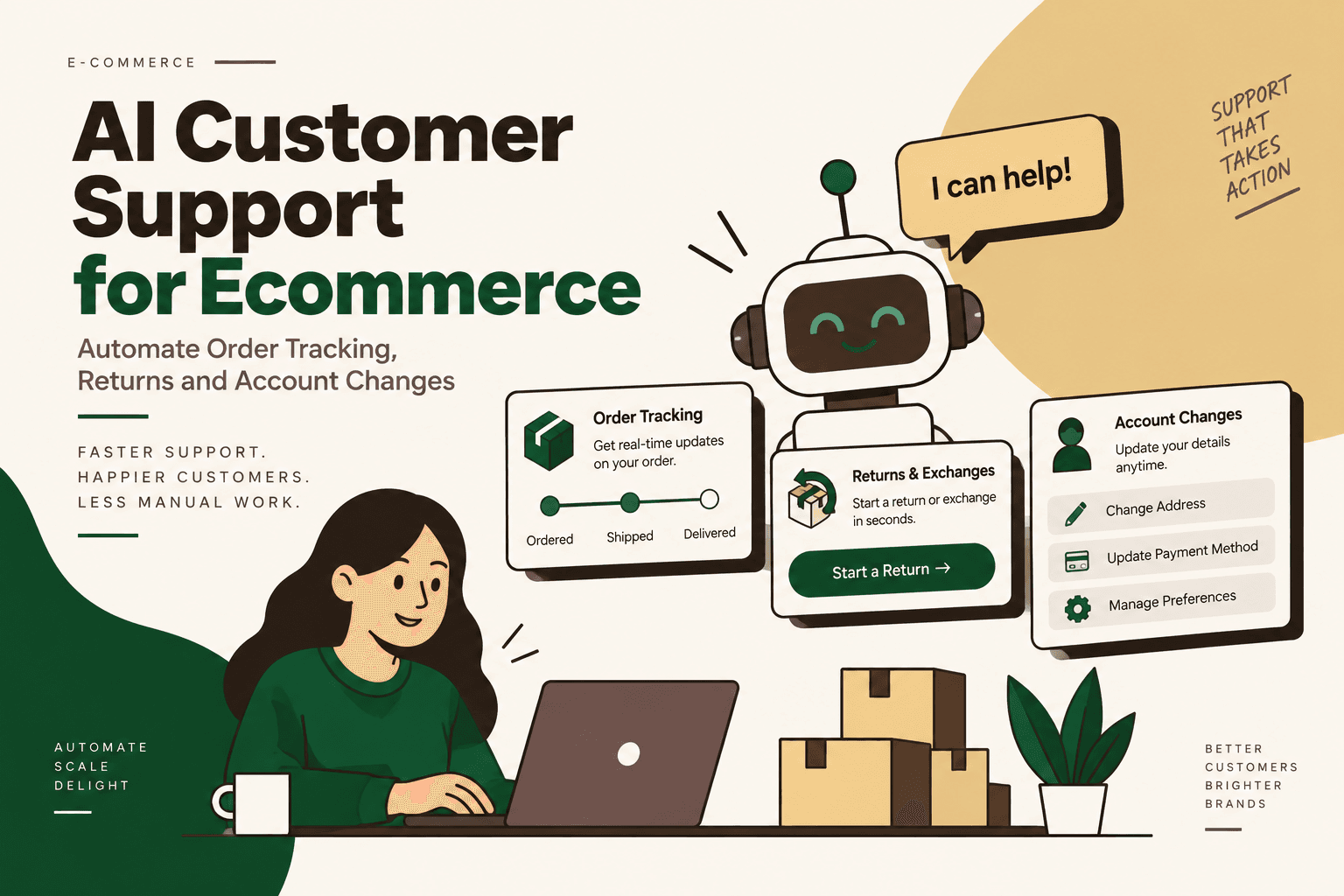
For a growing ecommerce brand, customer support usually becomes expensive for a simple reason: the number of customer questions grows with the number of orders.
More orders create more “Where is my order?” questions, return requests, refund follow-ups, delivery issues and product questions. If every request enters a human queue, support cost and response time can rise together.
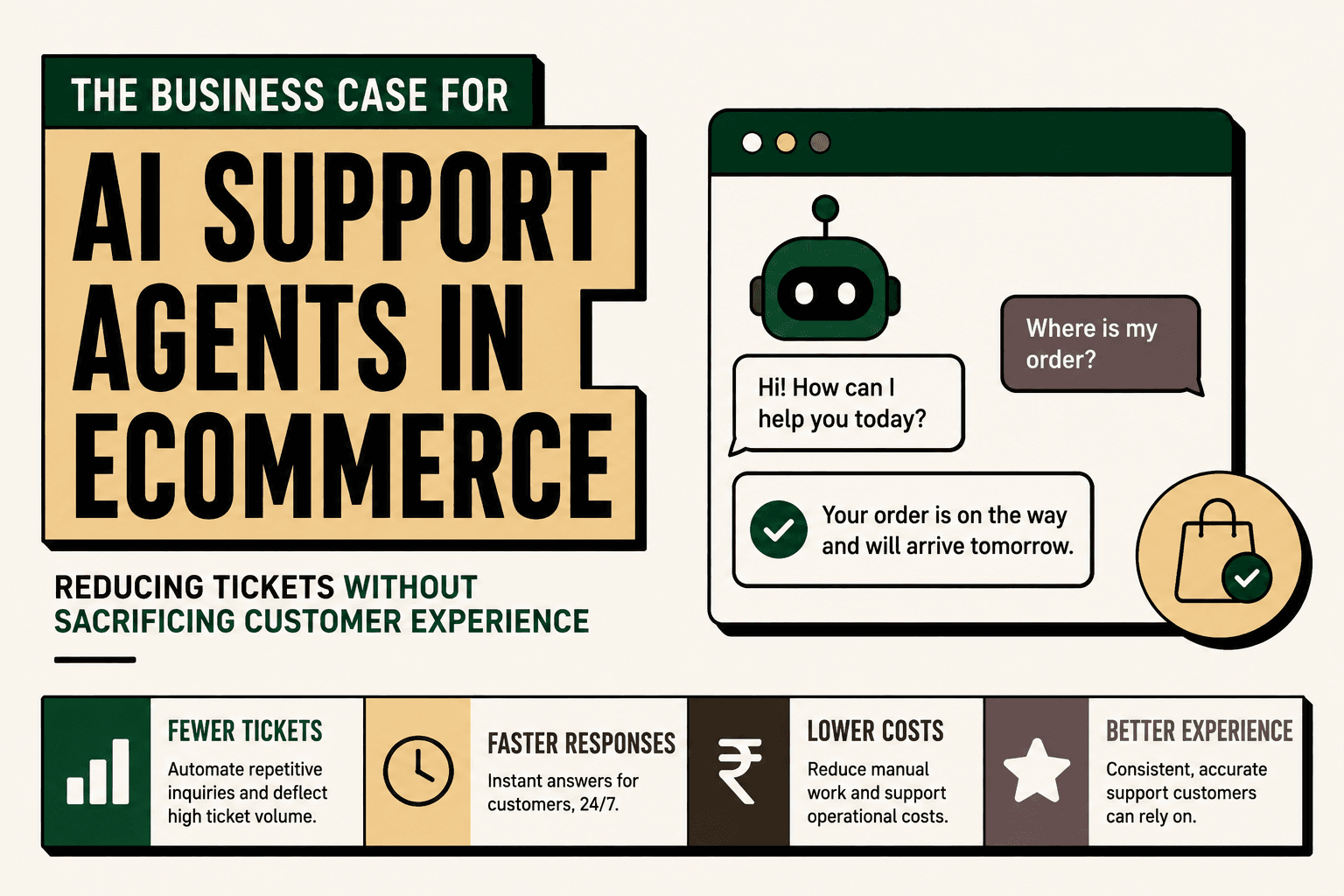
The business case for AI support agents is not primarily about replacing support agents. It is about removing repetitive work from the human queue while keeping people responsible for the conversations that require judgment, empathy or commercial decision-making.
That distinction changes how an ecommerce business should evaluate AI. The relevant question is not how many conversations an AI agent touches. It is how many customer problems it can resolve accurately, end to end, while preserving a good customer experience.
What Is an AI Support Agent for Ecommerce?
Answer: An AI support agent is a customer-service system that can understand a customer's request, retrieve relevant information from connected ecommerce systems, perform approved actions and escalate conversations when human judgment is required.
A traditional chatbot usually follows predefined paths. An AI support agent can interpret a wider range of natural-language requests and use operational context to determine what should happen next.
For ecommerce, that context can include order information, shipment status, product data, inventory, customer history, return policies and support knowledge.
Shopify describes retail AI systems that can answer product questions, check order status, handle return information and escalate complex conversations to humans. Shopify's retail chatbot guide
| Capability | Traditional chatbot | AI support agent |
|---|---|---|
| Understanding | Predefined intents | Natural-language intent |
| Context | FAQ or script | Customer and order context |
| Actions | Usually limited | Can execute approved actions |
| Exceptions | Usually sends to support | Can classify and route exceptions |
| Human handoff | Often starts over | Can pass conversation context |
The difference matters economically because a support agent that can only answer questions may still leave the underlying workflow with a human. An agent that can safely retrieve information, perform approved actions and close the loop can remove more work from the operation.
The Core Business Case: Reduce the Cost of Each Customer Interaction
Answer: AI creates an economic opportunity when it lowers the amount of human effort required to resolve a customer problem without creating additional errors, escalations or customer dissatisfaction.
There are several potential economic levers:
- Fewer tickets reaching human agents.
- Lower average handling time for tickets that do reach humans.
- Faster first responses.
- More support coverage outside staffed hours.
- Fewer repetitive internal lookups.
- More consistent responses to routine questions.
- Higher support capacity without matching growth in manual workload.
The strongest metric is therefore not “AI conversations.” It is resolved customer problems per unit of human effort.
Five Anchor POV: For D2C brands, ticket reduction should be treated as an operational metric rather than an AI vanity metric. If an AI agent handles thousands of conversations but customers still need to contact a human to finish the same problems, the apparent automation rate may overstate the actual business value.
Ticket Deflection Is the First ROI Lever
Answer: Ticket deflection measures support demand that is resolved without creating a human-handled ticket. It is one of the clearest ways to connect AI support automation with support capacity.
Illustrative scenario: Imagine a brand receives 10,000 support requests per month. If an AI workflow genuinely resolves 40% of eligible requests without human intervention, 4,000 conversations would no longer require human handling. The actual financial value would depend on the team's handling cost, the complexity of those conversations and the cost of running the AI workflow.
The calculation is intentionally simple:
Resolved conversations × avoided human handling cost = potential gross support capacity value
That is not the same as saying the business can immediately remove an equivalent amount of payroll. Released capacity can instead be used to absorb growth, improve response times, work through complex cases or support revenue-generating activities.
Industry benchmarks vary considerably by product, integration quality, support complexity and definition of “resolution.” G2's 2026 customer-support research is one example of the broader shift toward measuring AI performance through actual support outcomes rather than simply AI adoption. G2's AI in Customer Support Report
Why Ecommerce Support Is Particularly Suitable for AI
Ecommerce support contains a large number of recurring workflows with structured data behind them.
Customers may phrase the request differently, but the underlying task is often predictable.
- “Where is my package?” → retrieve shipment status.
- “When will my order arrive?” → retrieve delivery estimate.
- “I want to return this.” → check return policy and order eligibility.
- “Can I exchange my size?” → check exchange rules and inventory.
- “Where is my refund?” → retrieve refund status.
- “Can I cancel my order?” → check fulfillment state and cancellation rules.
- “Is this available?” → retrieve product or inventory information.
- “What is the warranty?” → retrieve warranty policy.
The language is unstructured, but the operational data is often structured. That makes ecommerce a useful environment for combining AI interpretation with deterministic business logic.
The Workflow Change That Creates the Value
Consider a traditional support workflow.
Customer → support queue → agent reads request → agent identifies order → agent checks system → agent interprets policy → agent responds → customer follows up if unresolved
An AI-enabled workflow can become:
Customer → AI understands intent → retrieves approved context → applies workflow rules → performs approved action → confirms resolution → escalates exception
The important change is not the conversational interface. It is the number of operational steps that can happen without a human manually coordinating them.
Shopify's current AI guidance similarly recommends starting customer-service agents with defined repetitive questions such as order status, shipping, return policies and basic product information, while routing complaints, unusual refund requests and other sensitive cases to staff. Shopify's AI transformation guide
Which Ecommerce Support Workflows Should You Automate?
1. Order Tracking
Order tracking is often one of the highest-volume support categories.
The agent can identify the order, retrieve the latest carrier event and explain the current status. If a shipment is delayed, the workflow can provide the available information and escalate according to predefined rules.
What to automate: order lookup, shipment status, estimated delivery information and approved delivery notifications.
What should remain human: unusual lost-package disputes, compensation decisions and cases where carrier and store data conflict.
2. Returns and Exchanges
Returns are another strong candidate because policies can be expressed as rules while customers describe their requests in natural language.
An AI agent can collect the order information, identify the customer's intent, explain eligibility and initiate an approved return or exchange workflow.
What to automate: eligibility checks, policy explanation, return initiation, label generation where supported and status updates.
What should remain human: policy exceptions, high-value refunds, disputed condition claims and unusual fraud indicators.
3. Product Questions
Customers often ask questions about product specifications, sizing, compatibility, materials, availability and usage.
An AI agent can retrieve answers from an approved product knowledge base rather than forcing a customer to search the website.
The main requirement is knowledge quality. If the product catalog is incomplete or outdated, AI can produce a polished but incorrect answer.
4. Refund Status
Refund questions are operationally repetitive but financially sensitive.
The agent can retrieve the refund state and communicate what the system actually shows. It should not invent a refund date or override financial controls.
Rule: explain verified status automatically; escalate discrepancies.
5. Order Cancellation
Cancellation requests depend on fulfillment state and business policy.
An AI agent can identify the intent and retrieve the order. A rules engine should determine whether cancellation is permitted. If the order has already entered a restricted fulfillment state, the workflow should route the request appropriately.
6. Warranty and Post-Purchase Questions
Warranty eligibility, installation questions, care instructions and replacement requests can often be structured into guided workflows.
The agent should gather the required information before escalating a case, so the human agent receives a useful case rather than an incomplete conversation.
Ticket Deflection Is Not the Same as Resolution
This distinction is critical.
An AI system can make a conversation disappear from the visible queue without actually solving the customer's problem. It may answer incorrectly, push the customer toward another channel or close the interaction prematurely.
Deflection without resolution is not a successful support outcome.
A stronger measurement model separates:
- AI conversations started.
- AI conversations completed.
- Issues resolved without human intervention.
- Issues transferred to humans.
- Repeat contacts for the same issue.
- Customer satisfaction after AI resolution.
- Escalation rate.
- Incorrect-answer rate.
The business case becomes much clearer when the denominator is actual customer problems rather than AI sessions.
How AI Support Agents Affect Response Time
Answer: AI can reduce response time because routine requests do not have to wait for a human agent to become available.
For example, an order-status request can be answered as soon as the system retrieves the relevant shipment information. A return-policy question does not need to wait behind a complicated complaint.
That creates two distinct benefits.
Benefit 1: Faster routine resolution. Customers receive answers without entering a queue.
Benefit 2: A cleaner human queue. Human agents spend more of their available time on cases that require investigation or judgment.
Salesforce's 2025 State of Service research reports that AI is expected to resolve half of service cases by 2027. This is a forecast from Salesforce's research, not a guarantee for individual ecommerce businesses. Salesforce 2025 State of Service Report
The Customer Experience Constraint
The business case fails if ticket reduction comes at the expense of customer trust.
Customers generally do not care whether a human or AI answered the question. They care whether the answer is accurate, relevant and easy to act on.
That means the AI experience should optimize for resolution quality, not simply containment.
Several principles help:
- Tell customers what the agent can do.
- Use current, approved business information.
- Retrieve live order and shipment data where appropriate.
- Do not guess when information is missing.
- Make human escalation easy to access.
- Pass conversation context to the human agent.
- Review failed and escalated conversations.
Shopify recommends clear escalation rules and human support options for retail chatbot deployments, including routing sensitive or complex cases to staff. Shopify's retail chatbot guidance
What Should Always Go to a Human?
Answer: Human escalation should be based on risk and judgment, not simply on whether a question is difficult for the model.
| Situation | Recommended handling | Reason |
|---|---|---|
| Order status | AI resolution | Structured information |
| Return policy question | AI resolution | Policy-based |
| Simple product question | AI resolution | Knowledge-based |
| Refund status | AI plus rules | Financial context |
| High-value refund exception | Human approval | Financial risk |
| Angry or distressed customer | Human escalation | Empathy and judgment |
| Conflicting order data | Human escalation | Source-of-truth issue |
| Potential fraud | Controlled review | Risk and compliance |
Five Anchor POV: A well-designed support agent should have an explicit “stop” condition. Knowing when not to act is part of the automation architecture.
The Hidden Cost of Poor AI Support
AI support does not automatically reduce cost.
If the system gives inaccurate answers, creates repeat contacts, requires heavy monitoring or causes more escalations, the total cost of support can increase.
Common hidden costs include:
- Integration development.
- Knowledge-base maintenance.
- AI usage and infrastructure costs.
- Monitoring and quality assurance.
- Human review.
- Exception handling.
- Security controls.
- Data cleanup.
- Workflow maintenance as policies change.
Recent reporting also highlights the governance risks of customer-service AI. IT Pro reported on research from Sinch in which many organizations reconsidered AI-agent deployments because of concerns including data exposure, hallucinations and auditability. IT Pro's report on AI agents in customer service
The implication is straightforward: governance is part of ROI. An automation project that saves handling time but introduces costly errors is not a successful cost-reduction project.
Data Quality Determines AI Support Quality
An AI support agent can only be as reliable as the operational information it can access.
Before deployment, audit:
- Order status consistency.
- Customer identifiers.
- Product catalog accuracy.
- Inventory availability.
- Shipping events.
- Return policies.
- Refund status.
- Warranty rules.
- Customer conversation history.
If the AI receives stale or conflicting information, the problem is not necessarily the model. It may be the underlying infrastructure.
This is why ecommerce AI support should connect to the systems that contain operational truth rather than rely exclusively on static FAQs.
The Architecture Behind an Ecommerce AI Support Agent
A practical architecture can look like this:
Customer channels → website chat, WhatsApp, email or voice
↓
AI support agent → intent detection, context retrieval and response generation
↓
Commerce systems → Shopify, marketplaces, order management and customer records
↓
Operational systems → ERP, warehouse, logistics, inventory and returns
↓
Action layer → approved updates, return initiation, notifications or escalation
↓
Human support → exceptions, sensitive cases and judgment-heavy decisions
The AI layer should not become the source of truth. It should retrieve information from authoritative systems and operate within defined permissions.
Rules vs AI vs Human Decisions
A strong support architecture deliberately divides responsibility.
Use rules when: the decision is predictable and must be consistent.
Use AI when: the system needs to interpret natural language, classify intent, summarize context or reason across approved information.
Use human approval when: the action has meaningful financial, reputational, legal or customer-trust consequences.
Use human-only handling when: the situation is highly sensitive, ambiguous or outside the designed workflow.
This hybrid approach is more practical than trying to make one AI model responsible for every support decision.
How to Calculate the Business Case
Start with the current operation rather than an assumed AI benchmark.
Measure:
- Monthly support volume.
- Average handling time.
- Support cost per interaction.
- Percentage of repetitive requests.
- First-response time.
- Resolution time.
- Repeat-contact rate.
- Escalation rate.
- Customer satisfaction.
- Current support-team capacity.
Then estimate the potential impact of a specific workflow.
Illustrative scenario: A brand handles 12,000 support conversations each month. Suppose 7,000 relate to repetitive requests and each currently takes an average of five minutes of human handling. That represents approximately 583 hours of human handling per month.
If a new workflow safely resolves a portion of those repetitive requests without human intervention, the business can calculate the resulting capacity release from actual post-launch data.
The important point is that capacity release is not automatically equivalent to cash savings. A growing brand may use that capacity to support more orders without adding support staff, improve response times or move experienced agents into higher-value work.
A Better Support ROI Formula
A useful internal model is:
Net support value = avoided human handling cost + capacity value + measurable customer or revenue benefit − AI operating cost − implementation cost − maintenance cost
This should be calculated using the brand's own numbers.
Do not assume a vendor's advertised automation rate is your expected result.
Also avoid counting every deflected ticket as a direct cash saving. If support staff are salaried, removing one interaction may release capacity rather than immediately reduce the payroll bill.
How to Implement an AI Support Agent Without Creating a New Problem
- Map the workflow. Document customer triggers, systems, decisions, actions, exceptions and human handoffs.
- Establish a baseline. Measure ticket volume, handling time, response time, resolution rate, escalation rate and customer satisfaction.
- Prioritize. Select workflows with high volume, high repetition, meaningful manual effort and manageable implementation complexity.
- Classify decisions. Separate deterministic rules, AI-assisted decisions, human approvals and human-only cases.
- Connect systems. Integrate the ecommerce platform, order data, logistics, product information, returns and support platform as required.
- Add guardrails. Define permissions, validation, escalation thresholds, fallbacks, retry behavior and logging.
- Pilot one workflow. Order tracking or basic support questions are often more appropriate starting points than unrestricted refunds.
- Measure actual resolution. Track resolved conversations, repeat contacts, escalations, response time and customer satisfaction.
- Review failures. Identify incorrect answers, missing knowledge and integration problems.
- Scale gradually. Add returns, refunds, cancellations or other actions only after the foundation is reliable.
This sequence follows a practical automation model: map, baseline, prioritize, classify, connect, guardrail, pilot, measure and scale.
What a Strong Pilot Looks Like
A useful pilot should be narrow enough to control and important enough to measure.
Example: Order-status support.
- Trigger: customer asks about an order.
- AI task: identify the order and intent.
- Data: order and shipment status.
- Rule: only use current approved status information.
- Action: explain the latest status and next expected event.
- Escalation: carrier conflict, missing data or compensation request.
- KPI: resolution rate, repeat contact, response time and customer satisfaction.
This pilot is easier to evaluate than an agent that attempts to handle every customer-support scenario from day one.
Case Study: Snow Teeth Whitening
Case study: Shopify reports that Snow Teeth Whitening used a Rep AI assistant in its Shopify store to handle customer support queries. Shopify states that the assistant resolved 98% of support queries without an agent. Shopify also reports that during the first 60 days, the bot converted 33.85% of abandoned-cart chats, representing more than $220,000 in added revenue, increased product-page conversion by 22% and reduced ticket volume by almost 50%.
These are company-related results reported by Shopify, not independent verification. They demonstrate why an ecommerce support agent can have value beyond pure ticket reduction when support, shopping assistance and commerce data are connected. Shopify's retail chatbot examples
Lesson: The strongest support automation can sit close to the transaction itself. It can answer service questions while also helping customers complete the next useful step, provided commercial actions remain appropriately controlled.
Why Human Agents Still Matter
Removing repetitive work does not make human support less important. It can make human support more valuable.
Human agents are better positioned to handle:
- Complex complaints.
- Emotionally sensitive conversations.
- High-value customers.
- Refund exceptions.
- Policy disputes.
- Fraud investigations.
- Operational failures.
- Cases where customer and system information conflict.
Instead of spending their day answering the same order-status question hundreds of times, experienced agents can investigate the cases where something genuinely went wrong.
This is one reason the business case should be framed around support capacity, not simply headcount reduction.
How to Protect Customer Experience While Reducing Tickets
Use five controls.
- Accuracy: Ground responses in approved and current information.
- Context: Give the agent access only to the customer and operational data it needs.
- Action boundaries: Restrict what the AI is allowed to change.
- Escalation: Provide a clear route to a human.
- Measurement: Monitor resolution quality, repeat contact and customer satisfaction alongside ticket deflection.
Shopify's current guidance similarly recommends narrow routing protocols, approved information sources, human escalation for sensitive topics and ongoing review of AI conversations. Shopify's customer-service AI guidance
Where Five Anchor Fits
Problem: D2C brands often have customer conversations spread across website chat, WhatsApp, email and voice while the information needed to resolve those conversations lives in Shopify, ERP, logistics, inventory, returns and other systems.
Solution: Five Anchor positions its work as AI Infrastructure for D2C & E-Commerce, including AI chat operations, AI voice operations, customer self-service, returns and exchange automation, automated customer communication and ticket automation.
Implementation: A practical deployment can begin by mapping support workflows, identifying high-volume intents, connecting the required commerce and operational systems, defining what the AI can read and change, adding human escalation and establishing measurable KPIs.
Business outcome: The goal is a support operation where routine questions are resolved quickly, human agents receive better-contextualized exceptions and support capacity can scale with ecommerce demand more efficiently.
That makes the relevant Five Anchor service not simply “an AI chatbot,” but a connected customer-operations layer that can work across chat, voice, WhatsApp, order data, returns and other ecommerce workflows.
The Metrics That Should Decide Whether the Project Continues
After the pilot, review the same metrics used to establish the baseline.
| Metric | Why it matters | Desired signal |
|---|---|---|
| Ticket deflection | Measures human-queue reduction | Higher, without quality decline |
| Resolution rate | Measures actual problem solving | Higher |
| Repeat contact | Detects failed resolutions | Lower |
| First response time | Measures speed | Lower |
| Average handling time | Measures human workload | Lower |
| Escalation rate | Shows human dependency | Appropriate for risk level |
| CSAT | Protects customer experience | Stable or higher |
| Cost per resolved issue | Connects workflow to economics | Lower |
A successful deployment does not necessarily maximize every metric simultaneously. A slightly higher escalation rate may be acceptable if it prevents costly errors. A lower ticket volume may be undesirable if customers are simply abandoning unresolved conversations.
The Real Business Case for AI Support Agents
The strongest case for ecommerce AI support is not that machines can talk to customers.
They already can.
The business case comes from changing the operating model behind the conversation.
Customer request → intent → context → decision → action → resolution
If AI can reliably handle more of that chain, human support capacity becomes less constrained by repetitive work.
If the AI cannot access accurate data, cannot take approved actions or cannot recognize when it should stop, the apparent automation may create another layer of work.
That is why the right objective is not “automate as many tickets as possible.” It is:
Resolve more customer problems with less unnecessary human effort while preserving trust, accuracy and access to human help.
For D2C brands, that is the practical business case. Ticket reduction is the mechanism. Faster response and greater support capacity are operational benefits. Lower cost per resolved problem is the economic outcome. Customer experience remains the constraint that determines whether the automation is actually successful.
Key Takeaways
- •The business case for AI support agents is primarily about reducing human effort per resolved customer problem, not replacing support teams.
- •Ticket deflection is useful only when the customer's underlying problem is actually resolved.
- •Order tracking, returns, product questions, refund status and other structured ecommerce workflows are strong starting points for AI support.
- •AI should interpret customer language while deterministic rules control predictable business decisions and high-risk actions receive human approval.
- •Live access to accurate order, shipment, product, inventory and policy data is critical to reliable ecommerce support automation.
- •Customer experience should be measured alongside ticket reduction through repeat contact, resolution quality, escalation and CSAT.
- •Start with one high-volume, low-risk workflow, establish a baseline, add guardrails and scale only after the pilot is reliable.
Traditional Ecommerce Support vs AI Support Agent
| Feature | Traditional support | AI support agent |
|---|---|---|
| Inventory Sync Frequency | 15–30 min batch polling (high oversell risk) | Sub-second atomic locking (<450ms) |
| Concurrent Drop Resilience | Fails under concurrency; causes negative stock balance | Redis atomic reservation queue guarantees exact counts |
| Error Handling & Retries | Silent failure; manual CSV audit needed | Dead-letter queues with automated exponential retry |
| Fulfillment Routing Speed | 2–4 hours delayed batch export to 3PL warehouse | Instantaneous automated webhook dispatch (<90 sec) |