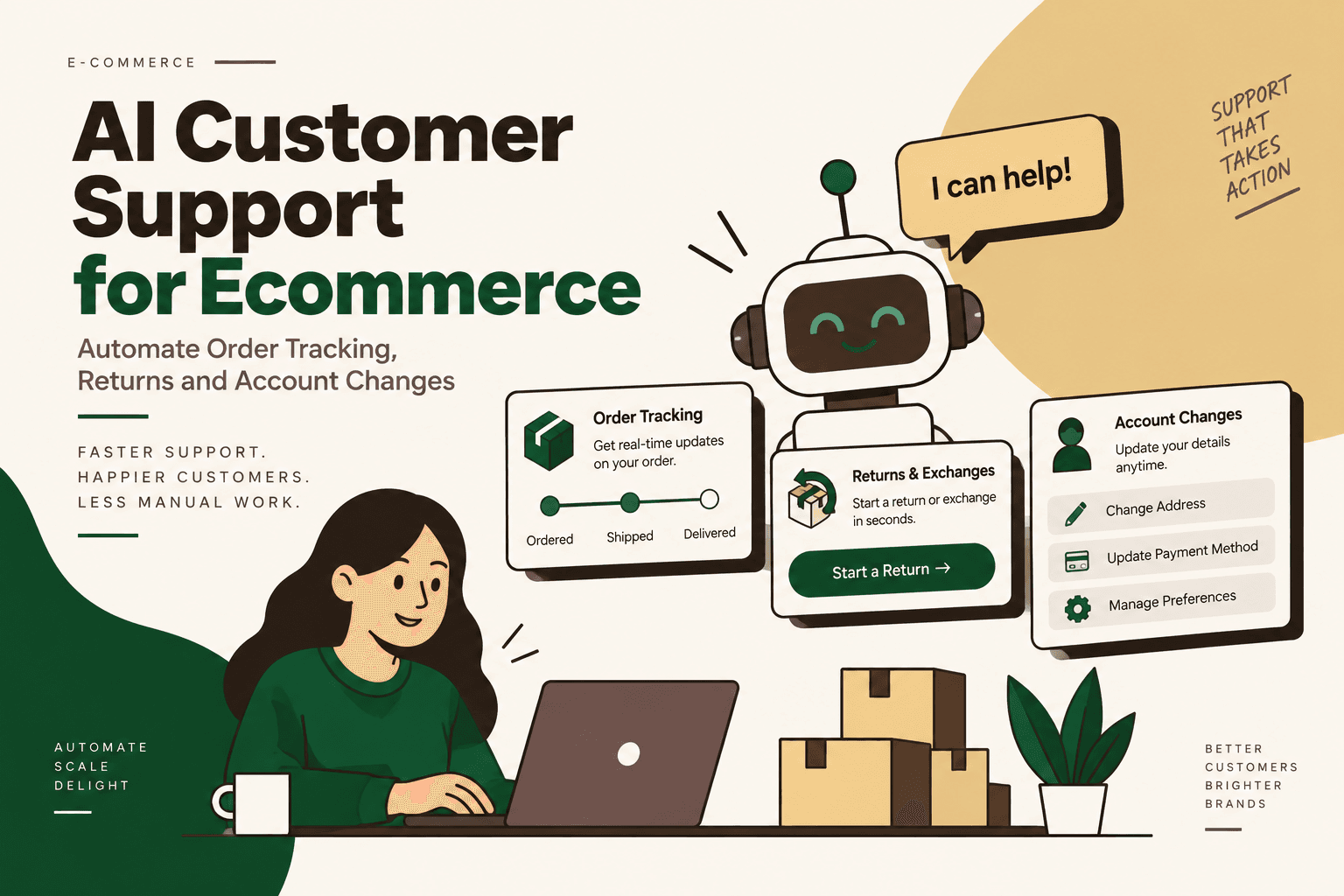
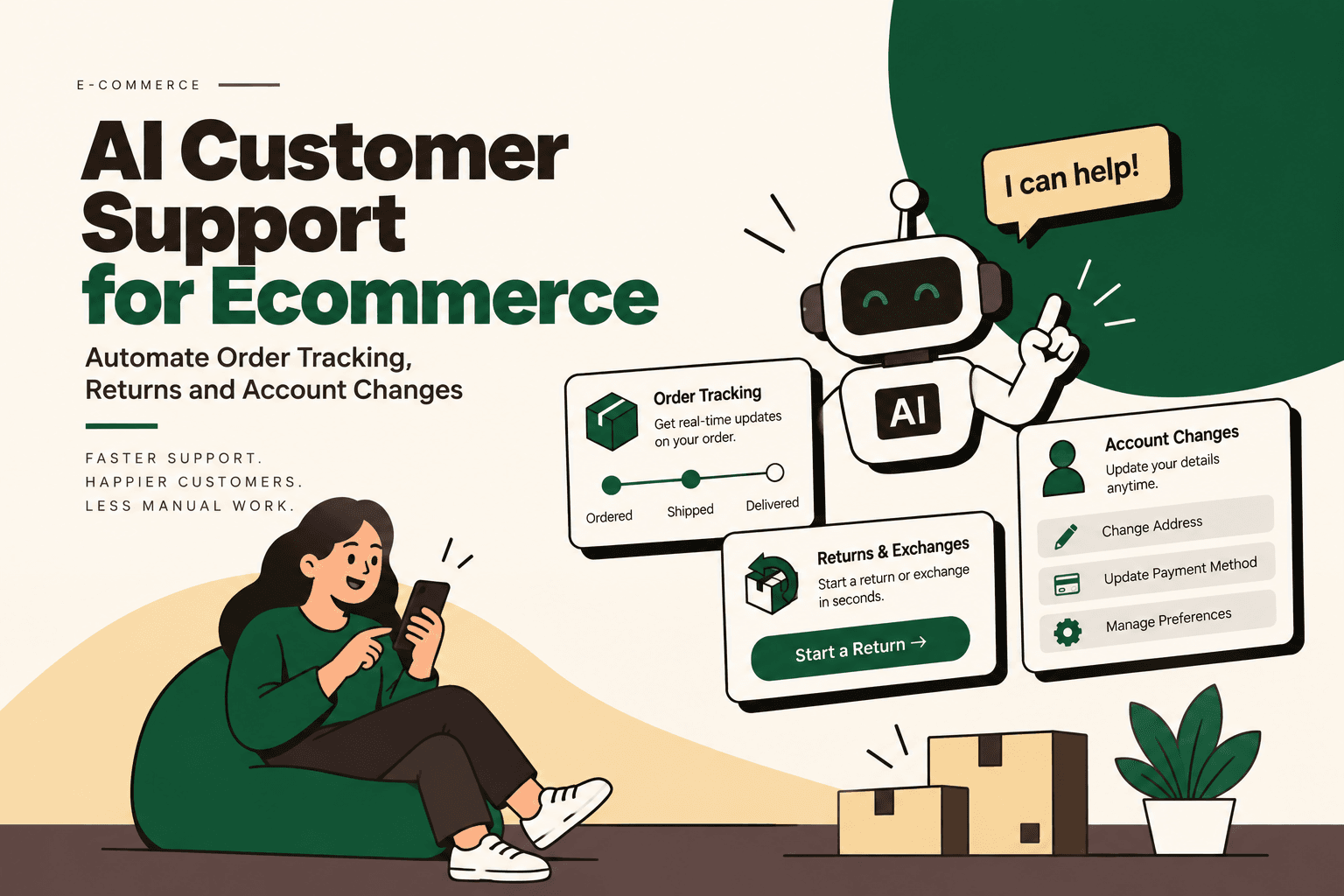
Customers do not always ask support teams questions that can be answered from a help center.
They ask questions about their account: Where is my order? What is the status of my return? Which warranty applies to my purchase? Can I change my delivery address? What payment method is attached to my account?
Those questions require two different kinds of information. The first is company knowledge: policies, FAQs, product information, warranty terms and approved support content. The second is customer-specific data: orders, returns, payments, account records and other information retrieved from authorized business systems.
An AI support agent can combine these sources so customers receive answers grounded in approved company information and, where permitted, their actual account data. The supplied search research describes this category as an AI customer support agent or an AI support agent with RAG and CRM/ERP integration. :contentReference[oaicite:0]{index=0}
What Is an AI Support Agent Using Approved Company Data?
Answer: An AI support agent using approved company data is a customer-support system that retrieves information from authorized company sources before generating an answer. In ecommerce, those sources can include knowledge bases, policy documents, CRM records, commerce platforms, ERP systems and customer-order data.
The key difference from a generic AI chatbot is grounding. Instead of relying primarily on the language model's general knowledge, the support agent retrieves relevant information from sources the business has selected and controls.
For customer-specific questions, the system can also retrieve the authenticated customer's records. That means the agent can distinguish between a general question such as “What is your return policy?” and an account question such as “Is my order eligible for a return?”
The supplied research specifically distinguishes company knowledge from customer-specific account data and identifies RAG combined with CRM or ERP access as the relevant architecture. :contentReference[oaicite:1]{index=1}
Why Approved Company Data Matters in Customer Support
Customer support answers are operationally important. A wrong product specification, outdated return policy or incorrect account status can create another support interaction instead of resolving the first one.
Grounding an AI support agent in approved sources creates a clearer information boundary. The business determines which policies, documents, systems and records the agent can use.
This does not eliminate every AI risk. Retrieval can fail, business data can be stale, permissions can be misconfigured and the customer question can be ambiguous. But it gives the support workflow a defined source of truth that can be monitored and maintained.
For ecommerce teams, the practical question is therefore not simply whether an AI model can answer a question. It is whether the model can retrieve the right information from the right system and stay within the permissions defined by the business.
What Account Questions Can an AI Support Agent Answer?
The search research identifies several examples of account and post-purchase questions that can be handled when the appropriate information sources are connected. :contentReference[oaicite:2]{index=2}
Order Status
A customer may ask, “Where is my order?”
The answer requires customer identification, order retrieval and potentially live shipping information. A grounded support agent can retrieve the relevant order record and, where the integration supports it, combine that information with carrier or fulfillment data.
The workflow is different from a chatbot simply responding with a generic tracking-policy article.
Return Status
A customer may ask, “What is the status of my return?”
The agent needs access to the customer's return record rather than only the company's general returns policy. If the return system is connected, the response can be based on the actual status available in that system.
Return Eligibility
A customer may ask, “Which of my orders are eligible for a return?”
This requires combining customer-specific order data with the company's approved return rules. The system may need to check purchase date, product eligibility, order status and other business-defined conditions.
Delivery Address
A customer may ask, “Can I change the delivery address?”
This is both an account question and an operational question. The agent may need to retrieve the order, determine its fulfillment state and check whether the business permits an address change at that point in the workflow.
Warranty Information
A customer may ask, “What warranty do I have on this product?”
The answer may require both product-level warranty information and purchase-specific information. The agent should retrieve the applicable approved warranty documentation and, where necessary, verify the customer's purchase record.
Account Details
Customers may also ask to update account information or understand information associated with their account.
These requests require stronger controls when the requested action changes customer data. Reading approved account information and changing account information should be treated as different permission levels.
Company Knowledge vs Customer Account Data
One of the most important design decisions is separating information that applies to everyone from information that belongs to an individual customer.
| Information Type | Typical Source | Example Question |
|---|---|---|
| Company policy | Approved knowledge base or policy system | What is your return policy? |
| Product information | Product catalog or approved product data | What materials are used in this product? |
| Warranty policy | Approved warranty documentation | How long is the warranty? |
| Order information | Commerce platform, OMS or ERP | Where is my order? |
| Return information | Returns platform or order system | What is my return status? |
| Customer account data | CRM or customer account system | What address is on my account? |
The AI layer should not blur these sources together. It should know which source answers which type of question and what permissions apply to each source.
How RAG Fits Into an AI Support Agent
Answer: Retrieval-Augmented Generation, or RAG, allows an AI system to retrieve relevant information from an approved source and use that retrieved context to formulate its response.
In customer support, a simplified workflow is:
- Customer submits a question.
- The AI identifies the intent and required information.
- The system retrieves relevant approved company content or customer-specific records.
- The retrieved information is passed into the response workflow.
- The AI generates an answer based on the available context.
- The system applies confidence, permission and escalation rules.
- The answer is delivered or the conversation is transferred to a human.
RAG is therefore not simply a technical feature. It is part of the information-control architecture of the support operation.
Why RAG Alone Is Not Enough for Account Questions
A knowledge-base RAG system can answer questions about company policies, but account questions often require live transactional data.
For example, a document can explain that returns are accepted under certain conditions. It cannot tell the customer whether their specific order currently qualifies unless the system can retrieve the relevant order data and apply the appropriate rules.
This is why the supplied research describes AI support agents as combining approved knowledge with CRM, commerce or ERP connections. ConnectLoop, for example, is described in the research as using approved company information while connecting to CRM, commerce and support systems. Zenvox is described as combining approved business information with live customer, order and inventory data from connected systems. :contentReference[oaicite:3]{index=3}
The Architecture Behind Grounded Ecommerce Support
A practical architecture for a D2C brand can be represented as:
Customer → AI Support Agent → Knowledge Retrieval + Customer Data → Business Rules → Response or Action → Human Escalation
The components have different responsibilities.
1. Customer Interface
The customer may interact through website chat, WhatsApp, email, messaging or another support channel.
2. AI Support Agent
The agent interprets the request, determines what information is needed and coordinates the appropriate retrieval or action.
3. Approved Knowledge Layer
This contains the information the business has approved for customer-facing answers, such as FAQs, policies, product information and warranty documentation.
4. Customer and Commerce Data
This includes information such as orders, returns, customer profiles and other account records. Access should be authenticated and permission-controlled.
5. Business Rules
Deterministic rules should handle decisions that can be expressed clearly. Examples include return windows, eligibility conditions and permission thresholds.
6. Action Layer
If the agent is authorized to perform an action, it can interact with the appropriate system through an integration or API.
7. Human Escalation
Ambiguous, sensitive, high-risk or unsupported cases should move to a human with the relevant context preserved.
The broader ecommerce research supplied with this topic describes a similar architecture connecting customer interactions to commerce platforms, ERP or OMS systems, shipping systems, returns platforms and support tools. :contentReference[oaicite:4]{index=4}
Example: Answering “Where Is My Order?”
Example: A customer asks, “Where is my order?”
- The support agent identifies the authenticated customer.
- The system retrieves the customer's relevant order.
- The order status is retrieved from the commerce, OMS or ERP system.
- Shipment information is retrieved where available.
- The agent interprets the status and explains it to the customer.
- If the data indicates an exception, the conversation can be routed to the relevant support workflow.
The important point is that the AI does not need to guess what “your order” means. The system retrieves the customer's actual order information from an authorized source.
Example: Answering “Can I Return This Order?”
Example: A customer asks whether a particular order is eligible for return.
- Identify the customer.
- Retrieve the relevant order.
- Retrieve the approved return policy.
- Apply deterministic eligibility rules.
- Explain the result using the retrieved information.
- If the customer is eligible and the workflow permits automation, initiate the approved return process.
- If the request falls outside the defined rules, escalate it to a human.
This illustrates why account-aware AI support is more than a question-answering interface. The response depends on both company knowledge and customer context.
AI Support Agent vs Traditional Chatbot
| Feature | Traditional Chatbot | Grounded AI Support Agent |
|---|---|---|
| General FAQ answers | Can provide predefined or generated answers | Can retrieve approved company information |
| Customer-specific answers | Often requires human handoff or separate integration | Can retrieve authorized customer data |
| Order status | Usually needs an integration | Can retrieve live order information when connected |
| Policy application | Usually explains policy | Can combine policy with customer context |
| Account changes | Often routes to a human | Can execute permitted changes through connected systems |
| Source control | Depends on implementation | Can be constrained to approved sources |
| Human escalation | Transfers the conversation | Can transfer with retrieved context |
The distinction is not that one system uses AI and the other does not. The important difference is the relationship between the AI, approved information, customer context and operational systems.
What the Search Research Says About Existing Solutions
The supplied research identifies several solutions that illustrate different approaches to grounded AI support.
ConnectLoop LIA
The research describes ConnectLoop LIA as answering customer questions from approved company information while connecting to CRM, commerce and support systems. :contentReference[oaicite:5]{index=5}
Zenvox
The supplied research describes Zenvox as using approved business information while also retrieving live customer, order and inventory data through connected ERP and CRM systems. :contentReference[oaicite:6]{index=6}
Infomaze AI Support Agent
The research describes an Infomaze AI support implementation that combines an approved knowledge base with authenticated CRM lookups so the agent can answer questions about an individual customer's account using account data. The available source is a company-published case-study article, so any reported performance result should be treated as company-reported rather than independent validation. :contentReference[oaicite:7]{index=7}
Infomaze AI customer support agent case study
Knowledge and Policy Systems
The supplied search results also include systems focused specifically on approved company data and policy control. Siesta's documentation describes asking an agent questions about approved company data and verifying the answer against retrieved sources. :contentReference[oaicite:8]{index=8}
These examples show that “AI support agent” is a category rather than a single product pattern. The architecture, integrations, permissions and action capabilities need to be evaluated against the actual support workflow.
How to Decide What Data the AI Can Use
Grounding is only useful if the data boundary is explicit.
Start by classifying sources into four groups:
- Approved public knowledge: information safe to provide to customers generally.
- Authenticated customer data: records belonging to the current customer.
- Restricted operational data: information that may be available to employees but should not be exposed directly to customers.
- Action systems: systems where the agent can create or modify records.
Each category should have different access rules.
For example, a customer-support agent may be allowed to retrieve an order status but not expose internal warehouse notes. It may be allowed to explain a return policy but not change the policy. It may be allowed to initiate a standard return but require human approval for an exception.
What Should AI Do, What Should Rules Do, and What Should Humans Do?
A reliable support architecture separates these responsibilities rather than giving the AI unrestricted control.
| Decision Area | Recommended Role | Reason |
|---|---|---|
| Understand customer intent | AI | Natural-language requests vary significantly |
| Retrieve approved information | AI plus retrieval system | Relevant context needs to be found |
| Return-window calculation | Deterministic rule | Predictable business logic should remain explicit |
| Customer identity verification | System authentication | Access should not depend on model judgment alone |
| Standard low-risk action | AI plus controlled action layer | Can be automated when permissions are explicit |
| Policy exception | Human approval | Ambiguous cases require business judgment |
| High-risk financial or account action | Human approval or strict authorization | Error consequences can be significant |
Implementation Framework for Ecommerce Brands
1. Map the Questions
Start with actual support conversations. Group them into intents such as order status, return status, warranty, delivery changes, account details and policy questions.
For every intent, record the information required to answer it and the system that currently contains that information.
2. Establish a Baseline
Measure ticket volume, frequency, manual handling time, response time, escalation rate, repeat contacts and error patterns for the target support categories.
Without a baseline, automation performance is difficult to evaluate.
3. Identify the Source of Truth
For each answer, determine which system is authoritative.
A return policy might come from a policy knowledge base. Order status might come from the OMS or commerce platform. Shipment status might come from a carrier or 3PL integration.
4. Separate Retrieval From Action
Reading data and changing data should not automatically receive the same permissions.
An agent may be permitted to retrieve order information while requiring additional authorization before changing an address or initiating a refund.
5. Add Guardrails
Define authentication requirements, source restrictions, permissions, approval thresholds, fallback behavior, logging and escalation rules.
Guardrails should also cover missing data, conflicting sources, duplicate actions and integration failures.
6. Start With One Low-Risk Workflow
A practical first workflow might be order-status questions because the intent is common and the required data can often be structured.
Once retrieval, authentication and escalation work reliably, additional workflows can be added.
7. Pilot and Measure
Measure response time, resolution rate, escalation rate, error rate, repeat contacts and customer experience metrics where available.
The goal is not to maximize the number of conversations handled by AI. The goal is to improve the underlying support workflow without increasing error or customer risk.
8. Scale by Workflow
After the first workflow is reliable, expand into returns, warranty questions, account changes and other use cases based on volume, manual effort, error cost, revenue impact and implementation complexity.
A practical prioritization model is volume × frequency × manual effort × error cost × revenue impact ÷ implementation complexity. This is a practical framework, not an industry-standard formula.
Common Failure Modes
Using General Model Knowledge for Company-Specific Answers
An AI model may know what a typical return policy looks like. That does not mean it knows a particular retailer's current return policy.
Company-specific answers should come from approved company sources.
Mixing Customer Data With General Knowledge
An agent should not infer account information from a generic conversation. It should retrieve the authenticated customer's actual record.
Giving the AI Write Access Too Early
Read access and write access should be treated separately. An agent can often be piloted as a retrieval-and-answer system before it receives authority to modify orders or accounts.
Ignoring Source Freshness
An approved source is not automatically a current source. Policies, product information and operational data change.
Knowledge management should therefore include ownership, update processes and monitoring.
Failing to Escalate
Not every account question has a clean answer. The system needs an explicit path for ambiguous, sensitive, unavailable or high-risk cases.
Where Five Anchor Fits
Problem: Ecommerce support questions often cross multiple systems. A customer may start in a chat window, but the answer can depend on the storefront, ERP, OMS, CRM, shipping platform, returns system or internal policy documentation.
Architecture: Five Anchor's AI Infrastructure for D2C & E-Commerce positioning is relevant when the support agent needs more than a knowledge base. The underlying workflow can connect customer interactions with commerce and operational systems while keeping approved data, permissions and human escalation separate.
Implementation: Five Anchor's AI-Powered Customer Operations service area includes AI chat operations, customer self-service, returns and exchange automation, warranty operations, automated customer communication and ticket automation. The implementation can begin with workflow mapping and system discovery, then connect the required commerce, ERP, CRM, returns or shipping systems and add the appropriate AI and guardrails.
Business outcome: The intended outcome is a support workflow that can answer more customer-specific questions from trusted sources while reducing unnecessary manual lookup and preserving human control over exceptions.
Five Anchor POV: The practical opportunity is not to put an AI chatbot in front of disconnected systems. It is to build a controlled information and action layer between the customer and the commerce infrastructure. That distinction matters because accurate account support depends as much on data access, authentication and workflow design as it does on language generation.
How to Measure the Business Impact
AI support should be evaluated against the workflow it changes.
Useful metrics include:
- Support volume by intent
- Average handling time
- First-response time
- Resolution time
- Escalation rate
- Repeat-contact rate
- Incorrect-answer rate
- Successful retrieval rate
- Percentage of requests requiring human intervention
- Customer satisfaction where measured
Illustrative scenario: If a support team spends substantial time manually looking up order and return information, an AI retrieval workflow may reduce the amount of repetitive lookup work. The actual capacity released should be calculated from the company's measured ticket volume, handling time, accuracy and implementation costs rather than assumed in advance.
Security and Governance Are Part of the Support Product
An AI support agent that can access account information is handling customer data. An agent that can modify orders or accounts has an even broader operational responsibility.
Implementation should therefore define:
- Customer authentication
- Data-access permissions
- Approved knowledge sources
- Customer-data boundaries
- Action permissions
- Human-approval thresholds
- Audit logging
- Monitoring and alerting
- Data retention requirements
- Fallback behavior when a source is unavailable
The principle is simple: the AI should only know and do what the workflow explicitly permits.
What the Best Grounded AI Support Architecture Looks Like
For an ecommerce brand, a mature support architecture can be thought of as five connected layers.
- Conversation layer: understands what the customer is asking.
- Knowledge layer: retrieves approved company information.
- Customer-data layer: retrieves authenticated account and order information.
- Decision and action layer: applies deterministic rules and executes only permitted actions.
- Human layer: handles exceptions, ambiguity and higher-risk decisions.
This model creates a clearer division of responsibility. AI interprets language and coordinates context. Business systems remain the source of operational truth. Rules control predictable decisions. Humans retain authority over exceptions.
Frequently Asked Questions
Can an AI support agent answer questions about my specific order?
Yes, when the support system is authenticated and connected to the relevant commerce, OMS or ERP data. The agent can retrieve the customer's order information rather than relying on generic model knowledge.
What does “approved company data” mean?
It means information sources that the business has intentionally selected for use by the AI system, such as approved policies, product documentation, FAQs, CRM records and authorized operational data.
Is RAG enough for ecommerce customer support?
RAG can ground answers in approved knowledge, but account-specific support often requires additional integrations with commerce, CRM, ERP, OMS, returns and shipping systems. RAG alone cannot provide live transactional information that it cannot retrieve.
Can an AI support agent change account information?
It can be designed to perform permitted account changes when the appropriate system integration, authentication and permissions exist. Higher-risk changes can require human approval.
How is an AI support agent different from an AI chatbot?
An AI chatbot can answer questions conversationally. A grounded AI support agent can combine approved company knowledge with customer-specific data and, when authorized, coordinate actions across connected business systems.
What should an ecommerce brand automate first?
Start with a high-volume, relatively low-risk workflow where the source of truth is clear and the expected outcome is measurable. Order-status retrieval is one possible starting point, followed by other workflows once the data and escalation architecture are reliable.
Conclusion
An AI support agent that answers account questions using approved company data is not simply a more sophisticated chatbot.
It is a controlled interface between customers and the information systems that operate the business.
The architecture combines approved company knowledge with authenticated customer data, retrieval, deterministic business rules, controlled actions and human escalation. That combination makes it possible to answer questions about orders, returns, warranties and accounts using information that is relevant to the customer and governed by the business.
For D2C brands, the implementation priority should be straightforward: identify the questions that consume the most manual support effort, map their source systems, establish the source of truth, separate AI from deterministic rules, define permissions and build a small pilot before expanding the agent's authority.
The goal is not to make every support interaction autonomous. The goal is to make the right support workflows more accurate, contextual and operationally efficient while keeping humans in control of the decisions that require judgment.
Key Takeaways
- •An AI support agent should retrieve answers from approved company sources rather than rely on general model knowledge for company-specific questions.
- •Account-aware support requires both company knowledge and authenticated customer-specific data such as orders, returns and account records.
- •RAG is useful for approved policies and knowledge, but live account questions often require CRM, ERP, commerce, OMS or other operational integrations.
- •AI should interpret customer intent and coordinate retrieval while deterministic business rules handle predictable decisions.
- •Read access and write access should be separated, with stronger controls for account changes, refunds and other higher-risk actions.
- •Five Anchor can map support workflows, connect commerce and operational systems, implement AI customer operations and add guardrails and human escalation.
Traditional Chatbot vs Grounded AI Support Agent
| Feature | Traditional Chatbot | Grounded AI Support Agent |
|---|---|---|
| Inventory Sync Frequency | 15–30 min batch polling (high oversell risk) | Sub-second atomic locking (<450ms) |
| Concurrent Drop Resilience | Fails under concurrency; causes negative stock balance | Redis atomic reservation queue guarantees exact counts |
| Error Handling & Retries | Silent failure; manual CSV audit needed | Dead-letter queues with automated exponential retry |
| Fulfillment Routing Speed | 2–4 hours delayed batch export to 3PL warehouse | Instantaneous automated webhook dispatch (<90 sec) |