AI Solutions for FBM: What Can Actually Be Automated?
Answer: The most effective AI solutions for FBM, or Fulfillment by Merchant, do not usually replace the entire fulfillment stack with one AI tool. They combine commerce platforms, order management systems, warehouse and shipping software, APIs, rules-based automation and AI decision-making to automate the flow from order capture through delivery, returns and exception handling.
For an FBM operation, the practical automation chain is:
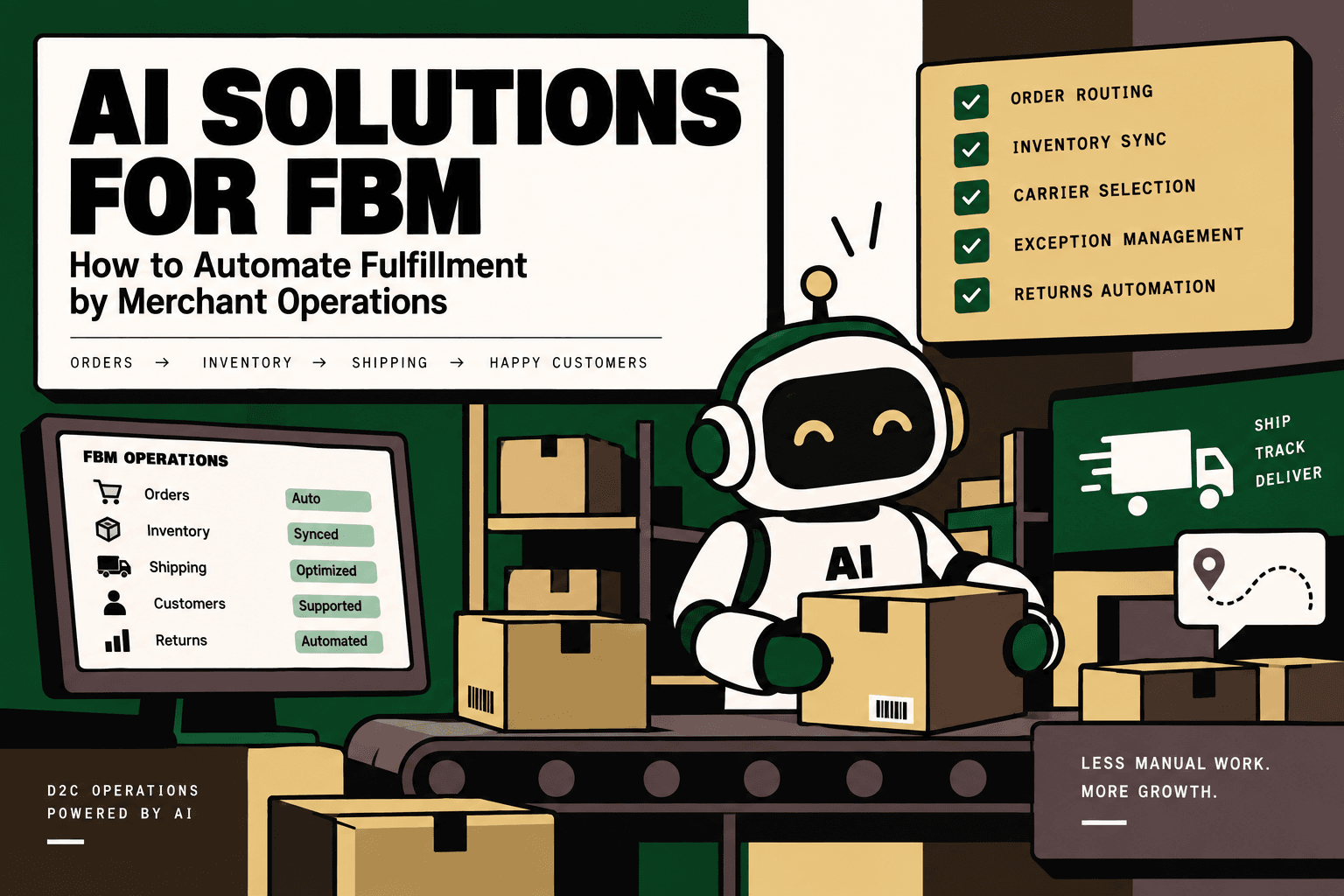
Order received → validate → allocate inventory → choose fulfillment location → select carrier → pick and pack → ship → track → detect exceptions → communicate with customer → manage returns → restock.
The research behind this article points to a market that is best understood as an ecosystem of solutions rather than a single category called an “AI FBM tool.” Commerce platforms such as Shopify already provide order management, fulfillment and routing capabilities, Amazon provides FBM infrastructure and related seller tools, and newer fulfillment platforms such as ShipBob are adding AI-driven decision and action layers. Amazon Fulfilled by Merchant Shopify Help Center: Order Routing ShipBob AI
The bigger opportunity for a growing D2C brand is therefore not simply adding an AI chatbot. It is connecting orders, inventory, warehouses, logistics, customer communication and operational decisions so that routine work is executed automatically and exceptions reach the right human.
What Is FBM Automation?
Fulfillment by Merchant means that the merchant remains responsible for fulfilling customer orders rather than relying entirely on a marketplace's fulfillment network. That responsibility can include inventory availability, order processing, packing, shipping, tracking and delivery management.
Amazon's FBM resources describe merchant-managed fulfillment and provide tools and integrations intended to help sellers automate parts of inventory and shipping operations. Amazon's FBM overview
For a small operation, much of this work can be handled manually. As order volume increases, however, the operation develops more handoffs:
- Marketplace orders have to reach the operational system.
- Inventory has to remain synchronized across channels.
- Orders have to be assigned to the correct location.
- Shipping services have to be selected.
- Warehouse teams need accurate pick and pack instructions.
- Tracking events need to return to the commerce platform.
- Delayed and failed deliveries need intervention.
- Customers need accurate order updates.
- Returns need to be authorized, received, inspected and reconciled.
Automation removes repetitive coordination. AI becomes useful when the system must interpret multiple variables, identify anomalies, predict risk or decide what action should happen next.
The 10 AI Solution Categories for FBM
A useful way to evaluate the market is to divide FBM automation into ten solution categories. Not every category requires generative AI. In many cases, deterministic automation is safer and simpler. AI should be introduced where the workflow requires interpretation, prediction, prioritization or contextual decision-making.
| FBM operation | What can be automated | Best technology approach |
|---|---|---|
| Order management | Order capture, validation and status synchronization | OMS, APIs and workflow automation |
| Inventory | Stock synchronization, forecasting and replenishment | Inventory platform plus AI forecasting |
| Order routing | Warehouse or fulfillment-location selection | Rules plus optimization |
| Carrier selection | Carrier and service-level selection | Rules, optimization and predictive models |
| Warehouse operations | Picking, batching and packing workflows | WMS plus warehouse automation |
| Delivery monitoring | Tracking and delay detection | Carrier integrations plus anomaly detection |
| Exception management | Classification, prioritization and approved actions | AI agents plus guardrails |
| Customer operations | Tracking, delivery and order questions | AI customer-support agents |
| Returns | Eligibility, routing, communication and status updates | Returns automation plus AI |
| Operations intelligence | Root-cause analysis and recommendations | AI analytics and operational agents |
1. AI Order Management and Order Processing
Answer: AI-enabled order management can centralize orders from marketplaces and D2C channels, validate them, identify exceptions and trigger the next fulfillment step.
The first problem is fragmentation. A brand may receive orders from Amazon, Shopify and other marketplaces while fulfillment information lives in an OMS, ERP, warehouse system and shipping platform. Moving that information manually creates unnecessary operational work and increases the risk of stale or inconsistent data.
Shopify describes automated order management as a process that can cover order capture, validation, routing and fulfillment across channels and inventory locations. Shopify: Automated Order Management
A basic workflow can therefore be:
- Receive an order.
- Validate payment, address and order status.
- Check inventory availability.
- Create or update the fulfillment order.
- Assign the order to the appropriate location.
- Send the fulfillment instruction to the warehouse or logistics partner.
- Return shipment and tracking information to the commerce platform.
Most of those steps do not require an LLM. They are better handled through APIs, webhooks and deterministic rules. AI becomes more useful when the system has to investigate why an order cannot follow the normal path or decide how multiple variables should be balanced.
Where AI adds value
- Classifying unusual orders.
- Detecting anomalies in order data.
- Prioritizing orders approaching a fulfillment cutoff.
- Explaining why an order is stuck.
- Recommending an alternative fulfillment action.
2. AI Inventory Synchronization, Forecasting and Replenishment
Answer: AI inventory automation combines real-time stock synchronization with forecasting and decision support so that merchants can maintain the right inventory in the right locations.
FBM becomes difficult when inventory exists in multiple warehouses, stores, 3PL locations or fulfillment partners. A seller may know the total inventory available but still make a poor fulfillment decision if the inventory is located too far from the customer or reserved for another channel.
Shopify provides inventory management and multi-location fulfillment capabilities, while fulfillment platforms such as ShipBob also position inventory automation as part of ecommerce fulfillment operations. Shopify fulfillment features ShipBob inventory automation
AI can add a predictive layer by analyzing historical sales, seasonality, channel demand, promotions and location-level patterns.
Example: Instead of simply asking whether SKU A is in stock, an inventory system can identify that SKU A has sufficient total inventory but is becoming constrained in one region and recommend moving stock before the shortage affects fulfillment.
Implication: Inventory AI is not only about preventing stockouts. It can improve the decisions made later in the fulfillment workflow because routing and shipping are only as good as the inventory data they receive.
3. AI Order Routing
Answer: AI order routing determines where an order should be fulfilled by considering inventory, location, service requirements, capacity and operational constraints.
This is one of the clearest areas where the difference between basic automation and intelligent automation becomes visible.
A basic rule might say:
If the order is for North India, send it to Warehouse A.
A more sophisticated system can consider:
- Available inventory.
- Customer destination.
- Warehouse capacity.
- Expected delivery time.
- Carrier serviceability.
- Shipping cost.
- Split-shipment risk.
- Order priority.
- Warehouse cutoff times.
Shopify's order-routing system applies a series of rules and prioritizes locations based on the results. Shopify: Understanding Order Routing
For many businesses, this rules-based approach is sufficient. AI or optimization becomes more useful when the number of locations, constraints and objectives becomes difficult to manage through static rules.
Illustrative scenario
Illustrative scenario: A customer in Delhi places an order for two SKUs. Warehouse A has both products but is near capacity. Warehouse B is farther away but has more available capacity and a lower probability of missing the carrier cutoff. An intelligent routing layer can evaluate those variables and recommend the fulfillment location rather than applying a single geographic rule.
The objective should not be “use AI because AI is available.” The objective should be to improve a measurable operational metric such as fulfillment time, split shipments, shipping cost or SLA compliance.
4. AI Carrier Selection and Shipping Optimization
Answer: AI-powered carrier selection evaluates shipping options against factors such as destination, serviceability, cost, delivery promise and historical performance.
In a multi-carrier FBM operation, the question is rarely just “which carrier is cheapest?” The cheapest service may have a longer transit time, higher exception frequency or weaker service in a particular destination.
A carrier decision engine can evaluate:
- Destination and pincode serviceability.
- Package weight and dimensions.
- Shipping price.
- Promised delivery date.
- Carrier cutoff times.
- Historical delivery performance.
- COD or prepaid status.
- RTO risk.
Amazon's FBM infrastructure includes Buy Shipping for purchasing shipping labels and helping merchants confirm and track shipments. Amazon FBM
The key design principle is to keep hard constraints deterministic. If a carrier does not service a destination, AI should not be allowed to select it. AI can optimize among the options that satisfy the rules.
5. AI Warehouse and Pick-Pack Automation
Answer: AI can improve warehouse fulfillment by prioritizing orders, grouping compatible orders, recommending picking sequences and identifying operational exceptions.
Warehouse automation does not necessarily mean robotics. A software layer can already reduce manual coordination by generating structured work for warehouse teams.
A typical workflow is:
Order → picklist → picking → scan validation → packing → label → manifest → dispatch.
AI and optimization can become useful when the warehouse has many simultaneous orders and constraints such as carrier cutoffs, priority shipments, SKU locations and worker availability.
Example: Instead of treating every order equally, the system can prioritize orders that must leave before a carrier cutoff and batch compatible orders so that the warehouse team spends less time moving between locations.
For larger operations, this software layer can sit alongside WMS technology and physical warehouse automation. The objective is not to make every warehouse decision autonomous. It is to reduce unnecessary decision-making for warehouse staff while preserving human control over physical exceptions.
6. AI Delivery Monitoring and Exception Management
Answer: AI delivery monitoring identifies shipments that are behaving differently from the expected fulfillment path and prioritizes the exceptions that need intervention.
Traditional automation is often reactive:
If shipment status equals delayed → send an alert.
AI can make the workflow more contextual:
Shipment has not received a scan within the expected interval → compare the event against normal transit behavior → classify the risk → identify the affected customer and order value → recommend the next approved action.
Possible exception categories include:
- Shipment has not moved.
- Carrier pickup was missed.
- Address exception occurred.
- Delivery promise is at risk.
- Shipment was marked delivered but the customer disputes delivery.
- Return-to-origin risk increased.
- Tracking information is inconsistent.
ShipBob's current AI offering illustrates the direction of this category. The company describes AI capabilities across inventory placement, order routing, carrier selection, packaging and logistics, including an AI agent that can work with fulfillment data and take certain operational actions. ShipBob AI
Five Anchor POV: Exception management is one of the strongest candidates for AI agents because the work begins with investigation rather than a single fixed rule. The agent can gather information from multiple systems, classify the problem and recommend an action, while permissions determine which actions it can actually execute.
7. AI Customer Support Connected to FBM
Answer: AI customer-support agents can automate post-purchase questions when they are connected to live order, inventory, fulfillment and logistics data.
This is an important distinction. A generic chatbot can explain a return policy. A connected AI support agent can potentially retrieve an order, check its current status, interpret a tracking event and provide a relevant response.
Common FBM-related customer questions include:
- Where is my order?
- When will my order arrive?
- Why has my tracking not updated?
- Can I change my delivery address?
- Can I cancel my order?
- My order says delivered but I cannot find it.
- How do I return the product?
- Can I exchange the product?
The underlying architecture should be:
Customer message → AI interpretation → live commerce data → business rules → approved action → customer response → human escalation when required.
This makes AI customer operations part of the fulfillment architecture rather than a separate support tool. Five Anchor's AI-Powered Customer Operations service area is designed around this kind of connection between customer conversations, self-service, returns, automated communication and ticket workflows. :contentReference[oaicite:0]{index=0}
8. AI RTO and Failed-Delivery Prevention
Answer: AI can help identify orders with elevated failed-delivery or return-to-origin risk and trigger approved interventions before fulfillment costs are incurred.
This is especially relevant to merchants operating in markets where COD, address quality, customer history and delivery reliability can materially affect fulfillment outcomes.
A risk model can consider signals such as:
- Payment type.
- Customer order history.
- Previous failed deliveries.
- Destination characteristics.
- Address completeness.
- Order value.
- Product category.
- Carrier and destination performance.
The resulting workflow might be:
Order received → risk score → apply policy → verify selected high-risk orders → release, hold or escalate.
The critical point is governance. An AI score should not automatically become a customer rejection decision without a documented policy. High-risk actions should have thresholds, fallbacks and human review.
9. AI Returns, Exchanges and Refund Workflows
Answer: AI can automate the decision and communication layers around returns while deterministic systems execute the transactional steps.
A connected returns workflow can evaluate:
- Whether the order exists.
- Whether the product is eligible.
- Whether the return window is open.
- What reason the customer provided.
- Whether an exchange or refund is appropriate under policy.
- Which return method should be offered.
- Where the returned inventory should go.
- What downstream inventory or refund action is required.
ShipBob's fulfillment software also describes automated returns workflows including return-label generation, tracking and routing returned products according to the merchant's process. ShipBob fulfillment software
AI is particularly useful for understanding natural-language return requests and classifying reasons. It should not invent return eligibility. Eligibility should come from the merchant's policy and transactional data.
10. AI Fulfillment Agents and Operational Intelligence
Answer: An AI fulfillment agent sits above the existing commerce, ERP, OMS, WMS, logistics and analytics stack and helps investigate problems, make recommendations and execute approved actions.
This is different from adding another dashboard.
A dashboard tells an operations manager:
“312 orders are delayed.”
An operational agent can be designed to investigate:
“Why are those orders delayed, which systems are responsible, which orders are most urgent, and what approved action should happen next?”
For example, an agent could inspect order status, warehouse events and carrier tracking data, group exceptions into categories and present an action queue.
Illustrative scenario: A fulfillment agent identifies that a group of orders is delayed because a warehouse cutoff was missed. It separates orders that can still arrive within the promised window from orders that require intervention. The system then recommends actions according to predefined rules, while high-impact actions require human approval.
This is the direction represented by current AI fulfillment offerings such as ShipBob's AI platform, which describes AI as an operational layer that can interact with fulfillment data and perform selected actions. ShipBob AI
AI Tools vs AI Infrastructure: What Is the Difference?
One of the most important decisions for an FBM business is whether it needs another application or an orchestration layer connecting the applications it already has.
| Approach | What it does | Best fit |
|---|---|---|
| Commerce-native automation | Automates workflows inside the commerce platform | Smaller and less complex operations |
| OMS/WMS | Centralizes orders, inventory and fulfillment operations | Growing multichannel brands |
| Shipping platform | Manages labels, carriers and tracking | Multi-carrier operations |
| AI layer | Interprets data, predicts risk and recommends actions | Complex operational decisions |
| AI agent layer | Investigates problems and executes approved actions | High-volume, multi-system operations |
Shopify's ecosystem illustrates why a merchant does not necessarily need to replace the commerce platform to improve fulfillment. Shopify provides order-management and routing infrastructure, while its developer ecosystem also supports applications for order management, order routing and fulfillment services. Shopify developer documentation for orders and fulfillment
Which FBM Solutions Are Available Today?
The current market includes several types of solutions. The right choice depends on whether the merchant primarily needs commerce automation, multichannel order management, outsourced fulfillment, logistics optimization or a custom AI layer.
Shopify and Shopify Flow
Shopify provides native order, inventory and fulfillment capabilities, including order routing and workflow automation. Shopify Flow is designed around trigger-condition-action workflows, which makes it suitable for many deterministic operational tasks. Shopify Flow Shopify fulfillment features
Best suited to: Shopify-centric brands that want to automate operational workflows before introducing a more complex AI layer.
Amazon FBM and Veeqo
Amazon provides FBM infrastructure and highlights tools such as Veeqo for inventory and shipping workflows across Amazon and other ecommerce channels. Amazon FBM
Best suited to: Amazon-heavy sellers that need to streamline order, inventory and shipping operations.
Amazon Supply Chain and Multichannel Fulfillment Integrations
Amazon Supply Chain Services provides integrations for ecommerce fulfillment and lists connections with order-management, shipping and fulfillment applications. Amazon Supply Chain integrations
Best suited to: Merchants looking to connect commerce channels with fulfillment infrastructure rather than build every integration themselves.
ShipBob AI and Fulfillment Software
ShipBob positions its fulfillment technology around ecommerce order fulfillment and currently describes an AI layer covering areas such as inventory placement, order routing, carrier selection, packaging and logistics operations. ShipBob AI
Best suited to: Brands considering outsourced fulfillment or a fulfillment platform with increasingly sophisticated automation and AI capabilities.
Unicommerce
Unicommerce offers multichannel order management and warehouse-management capabilities for ecommerce businesses. Its product documentation describes OMS functionality for multichannel retail and WMS capabilities covering warehouse operations through delivery to logistics partners. Unicommerce OMS Unicommerce WMS
Best suited to: Indian and multichannel ecommerce businesses looking for a broader OMS/WMS operating layer.
What Should Be Automated With Rules, AI or Humans?
A common implementation mistake is assuming every workflow should be powered by AI. That usually increases complexity without increasing value.
| Decision type | Recommended approach | Example |
|---|---|---|
| Predictable transaction | Deterministic automation | Sync tracking number to marketplace |
| Policy-based decision | Rules | Reject an ineligible return |
| Pattern recognition | AI | Identify unusual delivery behavior |
| Complex recommendation | AI plus rules | Recommend carrier based on several variables |
| High-impact exception | AI recommendation plus human approval | Approve expensive replacement |
| Ambiguous or sensitive case | Human-only | Complex fraud or customer dispute |
The implementation playbook for D2C AI automation recommends mapping triggers, inputs, decisions, actions, exceptions and human handoffs before deciding which steps should be deterministic automation, AI, human approval or human-only. :contentReference[oaicite:1]{index=1}
How to Prioritize FBM Automation Opportunities
Do not begin with the most technically impressive workflow. Begin with the workflow where automation can create measurable operational value.
A practical prioritization model is:
Volume × frequency × manual effort × error cost × revenue impact ÷ implementation complexity
This is a practical decision framework, not an industry-standard formula.
Use it to compare opportunities such as order routing, tracking support, carrier selection, inventory alerts, NDR management and returns.
| Opportunity | Volume | Complexity | AI potential | Typical first step |
|---|---|---|---|---|
| Order status updates | High | Low | Medium | Automated self-service |
| Order routing | High | Medium | High | Rules and routing baseline |
| Carrier selection | High | Medium | High | Centralize carrier data |
| Inventory forecasting | Medium-High | High | High | Clean SKU/location history |
| Exception management | Medium | High | High | Classify exceptions |
| Returns | Medium-High | Medium | Medium-High | Digitize return policy |
How to Implement AI Automation for FBM
A reliable implementation starts with the workflow rather than the AI model.
1. Map the current workflow
Document every trigger, input, system, decision, action, exception, human handoff and output.
For example:
Amazon order → OMS → inventory check → warehouse allocation → carrier selection → WMS → shipment → tracking → customer communication.
If the workflow cannot be described clearly, automating it will usually make the existing confusion faster rather than better.
2. Establish the baseline
Measure the current operation before introducing AI.
- Orders processed per day.
- Manual processing time.
- Order-processing errors.
- Average fulfillment time.
- Shipping cost per order.
- Late shipment rate.
- Exception volume.
- RTO or failed-delivery rate where relevant.
- Customer contacts related to fulfillment.
- Return processing time.
3. Identify bottlenecks
Look for repetitive work and decisions that consume disproportionate operational attention.
A useful question is:
“What does an operations employee repeatedly look up, compare, decide and then execute?”
Those activities are often stronger AI-agent candidates than simple data-entry tasks.
4. Separate rules from AI
Write down which decisions are fixed by business policy and which require contextual judgment.
For example, a carrier that does not service a pincode should be eliminated by a deterministic rule. Choosing between several valid carriers based on cost, SLA and performance can then become an optimization problem.
5. Connect the systems
Potential systems include:
- Shopify.
- Amazon and other marketplaces.
- ERP.
- OMS.
- WMS.
- 3PL systems.
- Carrier and shipping APIs.
- CRM and helpdesk.
- WhatsApp and email.
- Analytics platforms.
The goal is to create reliable data movement using APIs, webhooks and orchestration rather than spreadsheets or manual copying.
6. Add guardrails
AI agents that can take operational actions need permissions and boundaries.
- Define which actions are read-only.
- Define which actions can be executed automatically.
- Set approval thresholds for high-value actions.
- Validate data before writing changes.
- Define retry and fallback behavior.
- Log agent actions.
- Monitor failures and unusual behavior.
- Provide a clear human escalation path.
7. Start with the smallest viable workflow
Do not automate the entire FBM operation in one deployment.
A stronger pilot might be:
Order tracking exception → identify delayed shipments → classify cause → create action queue → automatically communicate routine updates → escalate unresolved cases.
Once the workflow is reliable, expand into routing, carrier optimization, returns or replenishment.
8. Measure the result
Track the metric that the automation was designed to improve.
- Manual hours saved.
- Order-processing time.
- Error rate.
- Shipping cost.
- Late shipment rate.
- Exception resolution time.
- Customer-support contacts.
- Return-processing time.
- Inventory accuracy.
- Revenue leakage.
Do not use “AI adoption” as the primary KPI. The operational result is what matters.
What an AI-Powered FBM Architecture Can Look Like
A scalable architecture does not require replacing every system. The AI layer can sit above the existing operational infrastructure.
Commerce channels
Shopify + Amazon + marketplaces
↓
Commerce and order layer
OMS + ERP + order database
↓
AI orchestration layer
Routing + exception detection + recommendations + AI agents
↓
Execution systems
WMS + warehouse + shipping + 3PL + carrier APIs
↓
Post-purchase layer
Tracking + customer support + returns + exchanges
↓
Intelligence layer
Operational dashboards + anomaly detection + recommendations
This architecture separates the system of record from the decision layer. The ERP, OMS or commerce platform remains responsible for transactional truth. AI interprets that information and helps determine what should happen next.
Where Five Anchor Fits Into FBM Automation
Problem: FBM operations become difficult when the merchant's marketplace, commerce platform, ERP, inventory, warehouse, logistics and customer-support systems operate as disconnected islands.
Solution: The stronger approach is to connect those systems and introduce automation or AI only where it improves a specific operational decision or repetitive workflow.
Implementation: Five Anchor's positioning as AI Infrastructure for D2C & E-Commerce maps directly to this architecture. Its Commerce Infrastructure service area covers marketplace and ERP integrations, order processing automation, inventory synchronization and warehouse and shipping integrations. Its AI-Powered Customer Operations area extends the same infrastructure into customer self-service, returns, automated communication and ticket workflows. :contentReference[oaicite:2]{index=2}
Business outcome: The objective is not to add another isolated AI interface. It is to reduce manual coordination, make fulfillment decisions more consistent, surface exceptions earlier and give operations teams a clearer view of what requires attention.
Five Anchor POV: For a complex FBM operation, the highest-value AI implementation is often an orchestration layer that connects the systems already running the business. That layer can map workflows, integrate commerce and operational systems, deploy AI agents where contextual reasoning is useful, add human approval and measure the operational outcome.
What Not to Automate With AI
More automation is not automatically better. Some FBM decisions should remain deterministic or human-controlled.
Do not use AI for simple transactional rules
If the requirement is “when shipment is created, send the tracking number to the marketplace,” an API workflow is usually preferable to an AI agent.
Do not let an LLM invent business policy
Return eligibility, refund thresholds, cancellation rules and customer compensation policies should come from documented business rules.
Do not give unrestricted write access
An agent that can change inventory, issue refunds, cancel orders or create expensive replacement shipments needs explicit permissions and approval controls.
Do not ignore data quality
An AI system cannot reliably compensate for inaccurate inventory, incomplete order data, inconsistent SKU identifiers or unreliable tracking events. Data quality is an infrastructure problem, not a prompting problem.
Do not measure success by the number of automated actions
The objective is improved fulfillment performance, lower operational effort, fewer errors, better customer communication or reduced revenue leakage. An automation that performs more actions but creates more exceptions is not an improvement.
The Business Case for AI-Powered FBM Automation
The business case should be built from the economics of the specific workflow rather than generic AI savings claims.
A simple calculation is:
Automation value = manual work avoided + errors avoided + revenue leakage reduced + capacity created − technology and implementation cost.
For example, an order-routing project should be evaluated against routing time, split shipments, shipping costs, late deliveries and operational effort. An AI customer-support project should be evaluated against support contacts, resolution time, escalation rate and customer experience.
Illustrative scenario: If an operations employee spends five minutes manually reviewing each of 1,000 orders per day, the process represents about 83.3 hours of manual handling per day. Automating only the repetitive review portion does not automatically mean that 83.3 hours of labor cost disappears. The business may instead gain capacity for exception management, merchandising, customer operations or growth. The distinction between direct cost reduction and capacity creation should therefore be made explicit.
Common FBM Automation Mistakes
- Buying software before mapping the workflow. A tool cannot fix a process that has not been understood.
- Calling rules-based automation AI. If the workflow is a fixed trigger-condition-action sequence, AI may not be necessary.
- Ignoring integration complexity. The hardest part may be synchronizing systems rather than selecting an AI model.
- Automating exceptions before normal orders. Stabilize the standard workflow first.
- Allowing AI to make high-impact decisions without approvals. Use thresholds and human escalation.
- Ignoring maintenance. Carrier rules, marketplace policies, SKUs, warehouse locations and business policies change.
- Creating another dashboard instead of an action system. Operations teams need prioritized actions, not just more data.
- Trying to replace the OMS or ERP unnecessarily. In many cases, the better architecture is an AI layer connected to existing systems.
How to Choose the Right FBM Automation Solution
Use the following decision framework before selecting a platform.
| If your main problem is... | Start by evaluating... | Then consider... |
|---|---|---|
| Too many manual orders | OMS and order automation | AI exception management |
| Multiple warehouses | Inventory and order routing | Optimization or AI routing |
| High shipping complexity | Multi-carrier platform | Predictive carrier selection |
| Warehouse bottlenecks | WMS and fulfillment workflows | AI prioritization and optimization |
| Too many delivery exceptions | Tracking and exception platform | AI investigation and action agents |
| High post-purchase support volume | Connected customer-support automation | AI customer operations |
| Returns consuming operations time | Returns workflow automation | AI classification and self-service |
| Disconnected systems | Integration and orchestration | AI operational layer |
The Future of FBM Automation Is Intelligent Orchestration
The most useful way to think about AI for FBM is not as a replacement for Shopify, Amazon, ERP, OMS, WMS, 3PLs or shipping platforms. It is as an intelligence and orchestration layer that helps those systems work together.
Commerce data informs inventory decisions. Inventory data informs fulfillment routing. Fulfillment data informs delivery predictions. Delivery data informs customer communication. Returns data feeds inventory and operational decisions. The value compounds when those systems share reliable information instead of forcing employees to move data between them manually.
The market already contains individual pieces of this architecture. Shopify provides commerce-native order and fulfillment automation. Amazon provides FBM infrastructure and related seller tools. Fulfillment platforms such as ShipBob are adding AI-driven decision and action capabilities. Multichannel platforms such as Unicommerce address OMS and WMS requirements. The remaining question for a merchant is how much of the operational layer should be purchased, configured or custom-built. Shopify order management Amazon FBM ShipBob AI Unicommerce OMS
For a growing D2C brand, the practical goal is straightforward: automate the predictable work, use AI where interpretation and decision-making add value, keep high-impact exceptions under human control and measure the operational result.
That is the difference between simply adding AI to an FBM operation and building an AI-enabled fulfillment infrastructure.
Key Takeaways
- •AI for FBM is an ecosystem of automation, integrations and decision intelligence rather than one universal AI fulfillment tool.
- •The main automation opportunities span order management, inventory, order routing, carrier selection, warehouse operations, delivery exceptions, customer support, RTO prevention, returns and AI fulfillment agents.
- •Deterministic rules should handle predictable transactional workflows; AI is more useful for contextual decisions, predictions, anomaly detection and exception management.
- •Shopify provides native fulfillment, inventory, order-routing and workflow automation capabilities, while Amazon provides FBM infrastructure and related seller tools.
- •ShipBob currently positions AI across inventory placement, order routing, carrier selection, packaging and logistics operations.
- •Unicommerce provides multichannel OMS and WMS capabilities that can form part of a broader FBM automation stack.
- •An effective AI fulfillment architecture connects commerce channels, OMS or ERP, inventory, WMS, logistics, customer support and analytics.
FBM Automation Approaches Compared
| Traditional Automation | AI-Enabled Automation | Human-Controlled Operations |
|---|---|---|
| Inventory Sync Frequency | 15–30 min batch polling (high oversell risk) | Sub-second atomic locking (<450ms) |
| Concurrent Drop Resilience | Fails under concurrency; causes negative stock balance | Redis atomic reservation queue guarantees exact counts |
| Error Handling & Retries | Silent failure; manual CSV audit needed | Dead-letter queues with automated exponential retry |
| Fulfillment Routing Speed | 2–4 hours delayed batch export to 3PL warehouse |