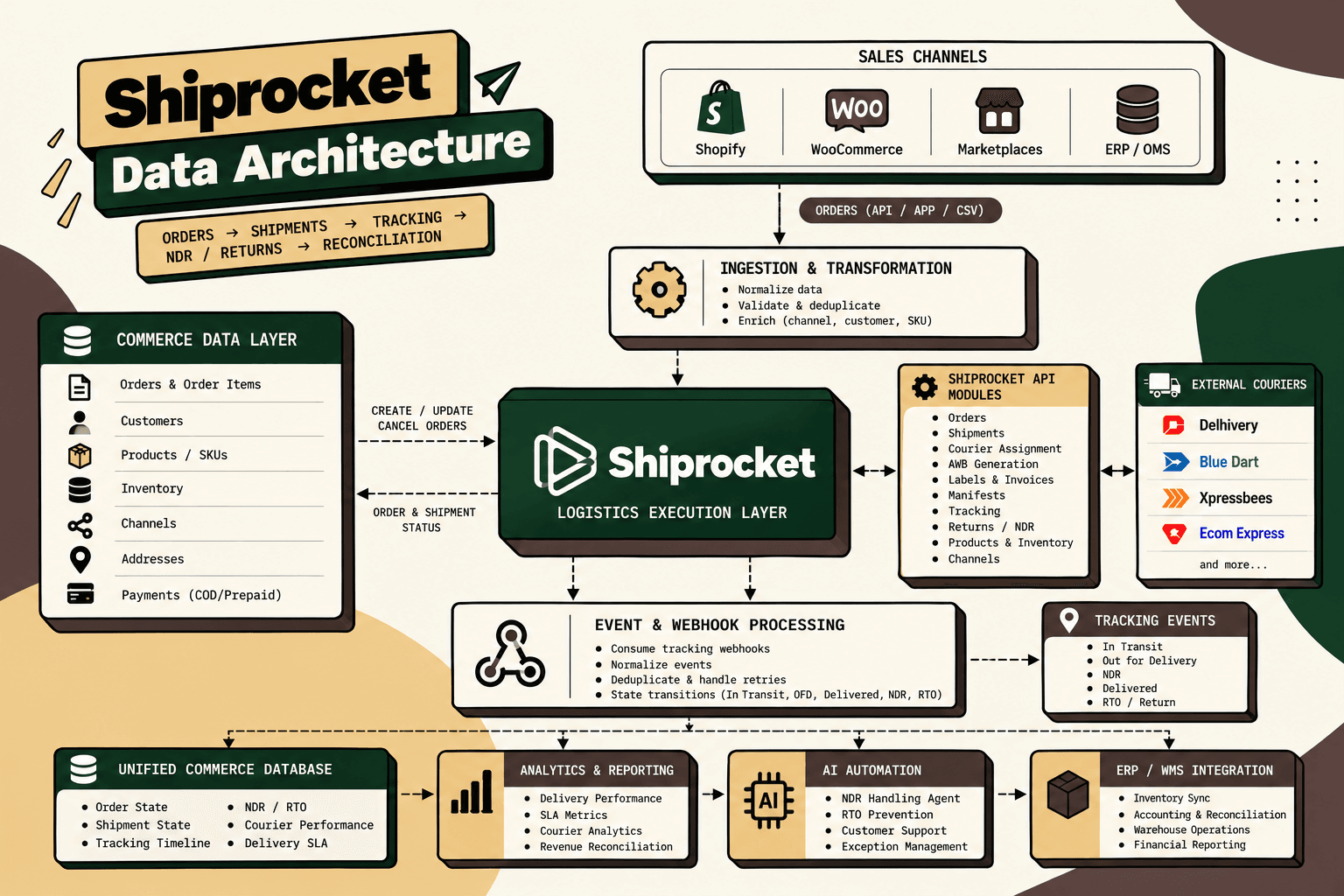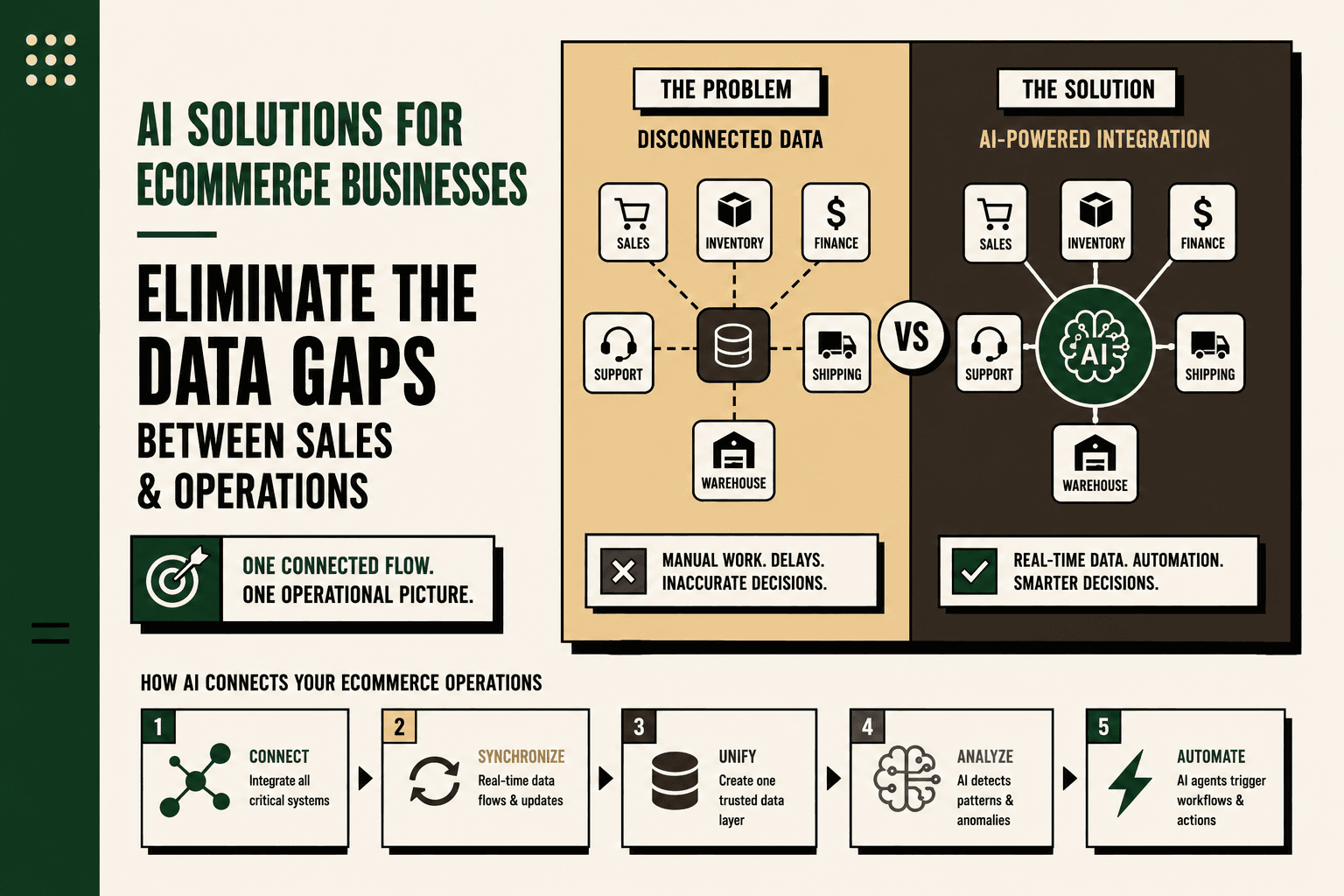
For a growing ecommerce business, the problem is rarely a lack of data. The bigger problem is that sales and operations often work from different versions of the truth.
Shopify knows what customers ordered. Your ERP may own inventory and financial records. A warehouse or 3PL knows what has actually been picked and shipped. Your shipping platform knows the latest delivery status. Customer support sees the problems that customers experience.
When those systems do not exchange information reliably, the business creates a hidden integration layer: people.
Employees reconcile spreadsheets, check multiple dashboards, copy order information, chase inventory updates and investigate mismatched records.
The practical role of AI solutions for ecommerce is not to put an AI model on top of disconnected systems. It is to connect operational data first, then use AI to interpret that connected data and coordinate decisions and workflows.
Shopify describes ecommerce ERP integration as a way to move data such as orders, inventory, products, customers, transactions, fulfillments and returns between systems. Shopify's ecommerce ERP integration guide
What Is an Ecommerce Data Gap?
An ecommerce data gap occurs when an important business event happens in one system but the information is delayed, incomplete, duplicated or unavailable in another system that depends on it.
Answer: A data gap exists when the right information does not reach the right system or decision-maker at the right time.
Example: Shopify records a sale, but the inventory system still shows the old available quantity.
Implication: Sales can promise inventory that operations cannot actually fulfill.
Action: Identify which business events must move between systems, which system owns each data type and how quickly each update needs to propagate.
| Sales may see | Operations may see | The gap creates |
|---|---|---|
| Orders | Available inventory | Overselling risk |
| Revenue | Fulfillment status | Reporting delays |
| Product demand | Warehouse capacity | Planning problems |
| Customer orders | Returns and stock adjustments | Inventory discrepancies |
| Promotions | Margin and financial records | Reconciliation work |
How the Data Gap Appears in a Real Ecommerce Workflow
Illustrative scenario: A customer places an order through Shopify.
- Shopify records the order.
- The ERP needs the order for operational and financial processing.
- The inventory system needs to reserve or reduce available stock.
- The warehouse needs fulfillment instructions.
- The shipping system needs the fulfillment information.
- The customer needs tracking and delivery updates.
- Finance eventually needs the transaction and settlement information.
If these events are transferred manually or through unreliable integrations, every handoff becomes a potential failure point.
The result may not look like an obvious technical error. Instead, it appears as an operational problem: an order is delayed, inventory looks wrong, a customer contacts support, finance finds a reconciliation discrepancy or a buyer makes a purchasing decision using stale information.
Shopify's current ERP guidance similarly describes the need to synchronize products, pricing, inventory, orders, fulfillments, returns, customers and payouts, with lower-latency synchronization being particularly important for inventory and order events. Shopify's cloud ERP integration guide
Why Adding AI Alone Does Not Fix the Problem
AI is only as useful as the information and workflows available to it.
If an AI system receives stale inventory information, it may produce a fluent but operationally incorrect recommendation. If order data is fragmented across systems, it may not have enough context to understand what happened. If returns are governed by undocumented exceptions, the model cannot safely determine what action should occur.
That is why the architecture should be:
Commerce systems → Integration layer → Operational systems → Trusted data layer → AI decision and automation layer
The AI layer comes after the data foundation, not instead of it.
Shopify supports direct integrations, iPaaS approaches and APIs for connecting external systems such as ERP and CRM platforms. Shopify's external systems integration documentation
The Ecommerce Data Architecture That Closes the Gap
A practical architecture separates data movement from intelligence.
1. Commerce layer
This is where customer-facing activity begins.
- Shopify
- Marketplaces
- POS
- Customer checkout
- Promotions
2. Integration layer
This layer moves events and records between systems. Depending on the architecture, it may use APIs, middleware, iPaaS tools, queues or webhooks.
Shopify's developer documentation describes webhooks as a way to receive notifications when important store events occur, allowing connected applications to automate workflows without continuously polling for updates. Shopify webhook documentation
3. Operational systems
- ERP
- OMS
- WMS
- Inventory systems
- 3PL platforms
- Shipping systems
- Returns platforms
4. Customer and financial systems
- CRM
- Customer support
- Accounting
- Payment and payout systems
5. Intelligence layer
This is where AI can add interpretation, anomaly detection, forecasting, prioritization, natural-language analysis and workflow orchestration.
The important architectural principle is that AI should consume reliable operational information and operate within defined permissions and rules.
What Data Should Be Synchronized?
Not every field needs to move between every system. The goal is to identify the data domains that actually drive downstream decisions.
| Data domain | Typical owner | Why synchronization matters |
|---|---|---|
| Orders | Commerce or OMS | Triggers fulfillment and downstream processing |
| Inventory | ERP, WMS or inventory system | Controls availability and replenishment |
| Products | ERP or product master | Keeps catalog information consistent |
| Pricing | Commerce or pricing system | Prevents conflicting prices |
| Fulfillment | WMS, OMS or 3PL | Provides shipment status |
| Returns | Returns platform or OMS | Updates order, inventory and financial records |
| Customers | CRM or commerce platform | Maintains customer context |
| Payouts | Commerce and finance systems | Supports reconciliation and reporting |
Shopify's ERP guidance identifies orders, inventory, product details, customer records, transactions, payouts, fulfillments, returns, tax and invoice information as common integration domains. Shopify's ecommerce ERP integration guide
One System Must Own Each Important Data Type
Synchronization does not mean every system should be allowed to overwrite every field.
That approach creates another problem: conflicting records and sync loops.
A connected architecture needs data ownership rules.
For example, a business might decide that the commerce platform owns customer-facing order creation, the ERP owns financial records, and the warehouse system owns physical stock movements.
The exact ownership model depends on the business. The important point is that it is explicit.
Shopify's ERP guidance recommends establishing which system owns each type of data before implementation to prevent conflicting records and synchronization loops. Shopify's data ownership guidance
Where AI Actually Adds Value
Once the underlying data is connected, AI can move beyond simple reporting and begin helping teams interpret cross-functional operational signals.
Inventory risk detection
AI can combine sales velocity, inventory availability, order trends and other approved signals to surface products that may require attention.
Illustrative example: Sales for a SKU are accelerating while available inventory is falling and inbound purchase orders are delayed. Instead of waiting for a stockout report, an AI workflow can flag the combination for an operations team.
Order-risk detection
An AI workflow can identify orders where multiple signals indicate a potential fulfillment problem, such as unusual processing delays or inventory discrepancies.
Returns intelligence
Returns data can be analyzed alongside product, order and support information to identify patterns that may require investigation.
Customer-support intelligence
Support conversations can reveal operational problems before they appear clearly in a conventional dashboard.
For example, an increase in “where is my order?” contacts combined with delayed fulfillment events can indicate a workflow problem rather than simply a customer-service problem.
Replenishment support
AI can help interpret demand and operational signals to prioritize which SKUs deserve attention, while deterministic inventory and purchasing rules remain responsible for the final transaction.
AI Should Interpret; Rules Should Control
A common mistake is allowing the AI model to make every decision.
For ecommerce infrastructure, a better division of responsibility is:
| Task | Best mechanism | Example |
|---|---|---|
| Understand customer language | AI | Classify an order-related request |
| Retrieve current data | Integration/API | Get current inventory |
| Apply fixed eligibility rules | Business logic | Determine return eligibility |
| Detect patterns | AI and analytics | Identify unusual return concentration |
| Execute an approved action | Workflow automation | Update a permitted record |
| Handle exceptions | Human | Approve a policy exception |
This separation makes the system easier to test and safer to operate. AI handles ambiguity and interpretation where it is useful; deterministic logic controls predictable business rules.
From Data Synchronization to Intelligent Orchestration
There is a meaningful difference between synchronization and orchestration.
Synchronization makes sure systems receive the information they need.
Orchestration uses that information to coordinate what should happen next.
Consider an order lifecycle:
Order placed → inventory reserved → ERP updated → warehouse notified → shipment created → tracking returned → customer notified
Each arrow represents a workflow dependency.
Shopify documents webhook-driven event mechanisms for orders, fulfillment and inventory-related events, which can be used to trigger connected workflows. Shopify webhook documentation
AI becomes useful when the workflow contains information that needs interpretation, prioritization or contextual reasoning rather than simple field-to-field movement.
What Happens When Data Gaps Are Not Fixed?
Data problems rarely stay inside the technology stack. They become business problems.
- Sales may promise inventory that operations cannot fulfill.
- Operations may purchase stock using incomplete demand information.
- Support may provide customers with outdated order information.
- Finance may spend time reconciling records across systems.
- Management may make decisions using inconsistent dashboards.
- Warehouse teams may process exceptions manually.
- Customers may experience delays, cancellations or repeated communication.
Shopify notes that disconnected ecommerce and ERP systems can create manual rekeying and inconsistent information as order and inventory complexity grows. Shopify's ERP integration guide
A Practical Framework for Closing Ecommerce Data Gaps
Step 1: Map the workflow
Do not begin with software. Begin with the business event.
Map what happens from order creation through fulfillment, delivery, return and financial reconciliation.
Step 2: Identify every system touched
For each step, record the system involved, the data required, the data created and the downstream system that depends on it.
Step 3: Assign data ownership
Define the authoritative source for orders, inventory, products, customers, fulfillment, returns and finance.
Step 4: Classify synchronization requirements
Determine which workflows require near-real-time events and which can operate through scheduled batches.
Shopify's guidance distinguishes lower-latency flows such as inventory and orders from workflows such as reporting and some reconciliation processes that may be appropriate for batch synchronization. Shopify's cloud ERP integration guide
Step 5: Define failure handling
Every integration should answer a basic question: what happens when the update fails?
- Retry automatically?
- Queue the event?
- Alert operations?
- Prevent downstream action?
- Escalate to a human?
Step 6: Establish a trusted operational view
Before adding advanced AI, make sure the important data can be reconciled and explained.
Step 7: Add AI to high-value decisions
Use AI where interpretation, anomaly detection, prioritization or natural-language interaction provides a genuine advantage over deterministic automation.
Step 8: Measure the workflow
Track synchronization failures, manual reconciliation effort, order exceptions, inventory discrepancies, support contacts, fulfillment delays and other metrics tied to the original problem.
Where Five Anchor Fits
Problem: A D2C brand may have Shopify, an ERP, inventory software, warehouse or shipping systems and customer-support tools, but the workflows between them still depend on manual coordination.
Architecture: The solution is a connected commerce infrastructure in which important events move reliably between systems and a shared operational picture becomes available to the teams and automation workflows that need it.
Implementation: Five Anchor focuses on ecommerce infrastructure across marketplace and ERP integrations, order processing automation, inventory synchronization, warehouse and shipping integrations, financial workflows and custom AI workflows. Its ecommerce intelligence capabilities can then use connected operational data for inventory intelligence, SKU health, reorder health, omnichannel reporting and operational dashboards.
Business outcome: The goal is not simply to create another dashboard or add another AI tool. It is to reduce the manual coordination required to keep sales, inventory, fulfillment, customer operations and finance aligned.
Five Anchor POV: For a D2C business, the highest-value AI architecture often starts below the AI layer. If the underlying commerce and operational events are unreliable, the business is asking AI to reason over an unreliable operating picture. Connect the systems, establish ownership, make the critical events observable, and then automate the decisions that benefit from intelligence.
A Simple Ecommerce Data Gap Audit
Use these questions to identify where your sales and operations are disconnected.
- When an order is placed, which systems receive the event?
- How quickly does available inventory change across sales channels?
- Which system is authoritative for inventory?
- How does the warehouse communicate fulfillment status?
- How does tracking information return to the customer-facing system?
- How are returns reflected in inventory and financial records?
- How are failed synchronization events detected?
- How often does a person manually reconcile data?
- Which reports contain numbers that different teams calculate differently?
- Which operational decisions currently require employees to check several systems?
If several answers are unclear, the problem may not be an AI gap. It may be an integration and data-ownership gap.
What Not to Automate First
Do not begin by connecting every system to an AI agent.
Start with workflows that are high-volume, repetitive, well-defined and measurable.
Good early candidates may include:
- Order-status synchronization
- Inventory updates
- Fulfillment notifications
- Basic reconciliation workflows
- Operational alerts
- Low-risk customer communications
Be more cautious with workflows involving high-value refunds, ambiguous inventory adjustments, financial exceptions or decisions that cannot easily be reversed.
Case Study: When Integration Changes the Operating Model
Case study: Fashion and accessories brand CISE reached the limits of manual fulfillment as demand increased. Shopify reports that the company moved to Shopify Fulfillment Network and cleared more than 1,000 preorders in about 1.5 days during onboarding. Shopify also reports a 71% decrease in average fulfillment time and a 600% increase in orders. Shopify's fulfillment software case study
Lesson: The example illustrates an important point for AI infrastructure: operational improvement can depend on changing the workflow and system architecture, not simply adding an AI interface. AI is most useful when it sits on top of reliable operational processes and connected data.
The Business Case for Closing Data Gaps
The economic value of data integration should be evaluated through the work and errors it removes, not through the presence of a particular technology.
Useful measurements include:
- Manual reconciliation hours
- Inventory discrepancy frequency
- Order exception rate
- Fulfillment delay rate
- Support contacts caused by operational issues
- Refund and cancellation volume
- Time required to produce operational reports
- Purchasing decisions affected by stale inventory information
Illustrative scenario: If a business spends 20 hours each week reconciling order, inventory and fulfillment data, that represents more than 1,000 hours of annual manual coordination before considering the cost of mistakes or delayed decisions. The actual business case depends on the company's volume, labor cost, error rate and implementation cost.
A useful prioritization model is:
Volume × Frequency × Manual Effort × Error Cost × Revenue Impact ÷ Implementation Complexity
This is a practical prioritization framework, not an industry-standard formula. Its purpose is to compare candidate workflows consistently rather than assuming that every automation opportunity has equal value.
The Bigger Opportunity: One Operational Picture
The objective should not be “add AI to ecommerce.”
The more useful objective is to create an operating environment where important business decisions have access to the right information at the right time.
Once sales, inventory, fulfillment, shipping, returns, support and financial data are connected, AI can help teams ask higher-value questions:
- Which products are approaching a stockout risk?
- Which orders are likely to experience a fulfillment problem?
- Which SKUs need operational attention?
- Why are returns increasing for a particular product?
- Which products generate unusually high support volume?
- Where are fulfillment problems creating customer-service demand?
- Which operational issues are affecting revenue?
The answers become more useful because the AI is no longer reasoning over one isolated system. It can operate across a connected operational context, subject to the permissions and data quality of the underlying architecture.
Risks and Limitations
Data quality
AI cannot reliably compensate for incorrect, duplicated or stale source data. Data cleansing, normalization and validation remain part of the implementation.
Integration failures
APIs, webhooks and middleware can fail. Production workflows need retries, monitoring, deduplication and escalation.
Conflicting systems
If two systems can overwrite the same record without clear ownership, automation can create rather than remove inconsistencies.
Over-automation
Not every decision should be delegated to AI. High-impact exceptions may still require human approval.
Maintenance
Catalogs, policies, APIs, warehouse processes and business rules change. Connected ecommerce automation requires ongoing monitoring and maintenance.
Conclusion
Sales and operations do not usually suffer because the business lacks information. They suffer because information is fragmented across systems that do not reliably share the same operational state.
AI solutions for ecommerce can help close that gap, but the sequence matters.
Connect the systems. Define data ownership. Synchronize critical events. Establish reliable operational data. Then apply AI to interpretation, prioritization and workflow automation.
That architecture changes AI from another isolated tool into an intelligence layer that can work across the ecommerce operation.
Do not automate disconnected systems. Connect them first, then make them intelligent.
Key Takeaways
- •The core ecommerce data problem is usually fragmentation rather than a lack of data.
- •Shopify, ERP, inventory, warehouse, shipping, support and finance systems need clearly defined data flows and ownership.
- •AI should sit on top of connected operational data rather than compensate for unreliable integrations.
- •Use APIs, middleware and event-driven workflows to move important operational events between systems.
- •Use deterministic business rules for predictable decisions and AI for interpretation, pattern detection and prioritization.
- •Start automation with high-volume, repetitive, well-defined and measurable workflows.
- •Measure synchronization failures, manual reconciliation, inventory discrepancies, order exceptions and operational delays.
- •The practical objective is one reliable operational picture across sales and operations.
Disconnected Ecommerce Stack vs Connected AI Infrastructure
| Area | Disconnected Stack | Connected AI Infrastructure |
|---|---|---|
| Inventory Sync Frequency | 15–30 min batch polling (high oversell risk) | Sub-second atomic locking (<450ms) |
| Concurrent Drop Resilience | Fails under concurrency; causes negative stock balance | Redis atomic reservation queue guarantees exact counts |
| Error Handling & Retries | Silent failure; manual CSV audit needed | Dead-letter queues with automated exponential retry |
| Fulfillment Routing Speed | 2–4 hours delayed batch export to 3PL warehouse |