For a growing D2C brand, revenue can scale quickly. Operational work often scales just as fast.
More orders create more order processing, inventory updates, customer questions, returns, refunds, reconciliation and coordination between Shopify, marketplaces, ERP systems, warehouses and logistics providers.
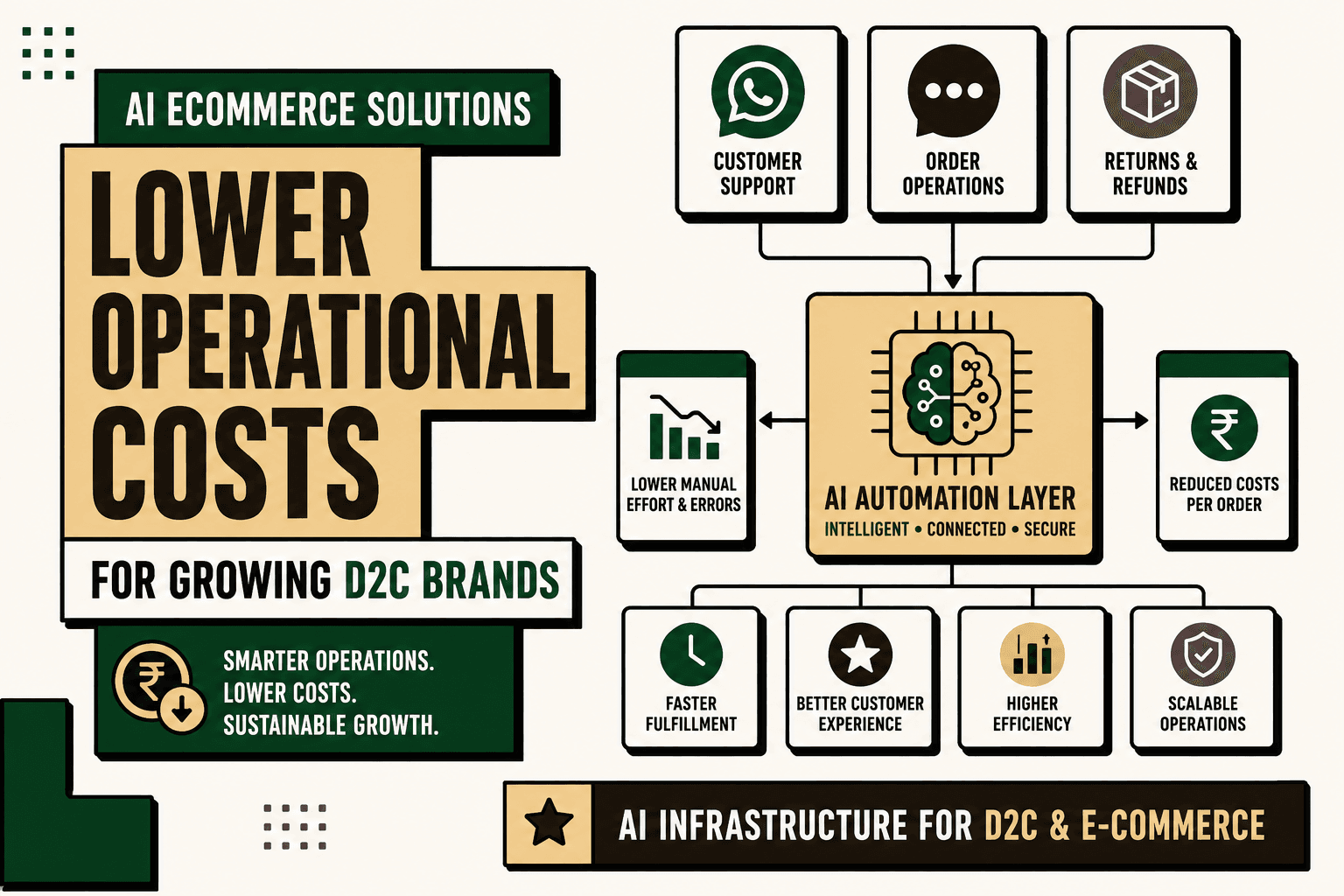
The practical role of AI ecommerce solutions is not simply to add a chatbot. It is to reduce the manual work, errors and coordination required to process each order while keeping humans in control of exceptions.
Research from EY India estimates that GenAI could improve productivity in India's retail, consumer and ecommerce sector by 35% to 37% by 2030. EY also reports that 56% of surveyed organizations said AI had contributed to cost reduction. These are research findings across organizations, not a guaranteed saving for an individual D2C brand. EY India, AIdea of India 2025
The more useful question for a D2C operator is therefore: where does AI actually change the cost structure of ecommerce operations?
Where AI Ecommerce Solutions Can Reduce Costs
Answer: The strongest opportunities usually sit inside repetitive, high-volume workflows: order processing, customer support, returns, reconciliation, inventory coordination and fulfillment routing.
The common pattern is simple:
Routine work → automation
Contextual interpretation → AI
High-risk decisions → human approval
This distinction matters because not every operational task needs AI. Some tasks are better handled by deterministic rules, APIs and conventional automation.
| Workflow | Typical bottleneck | AI or automation opportunity |
|---|---|---|
| Order processing | Manual checks and system updates | Validation, routing and exception handling |
| Customer support | Repetitive questions | AI self-service and ticket automation |
| Returns | Manual eligibility and routing | AI triage plus rules |
| Reconciliation | Transaction matching | Automated matching and exception detection |
| Inventory | Fragmented stock information | Synchronization and anomaly detection |
| Fulfillment | Choosing the right location or carrier | Intelligent routing with controlled rules |
Why Operational Costs Rise as Indian D2C Brands Scale
Scaling ecommerce introduces more than additional orders. It introduces more operational states.
An order can move through payment, inventory allocation, ERP synchronization, warehouse processing, shipping, delivery, customer communication, return handling and financial reconciliation. Every handoff creates an opportunity for delay, duplication or manual intervention.
India's ecommerce market is also becoming increasingly omnichannel. Deloitte and FICCI reported that online retail in India was expected to grow from US$75 billion in 2024 to US$260 billion by 2030. The same report highlights rapid growth in quick commerce and broader expansion beyond traditional metro markets. Deloitte India and FICCI
Five Anchor POV: More channels mean more operational interfaces. A D2C brand may not have a people problem at first; it may have a coordination problem. The opportunity is to connect those systems before adding more manual layers around them.
1. Automate Repetitive Order Processing
Answer: Order processing is one of the clearest places to reduce manual effort because the same sequence occurs repeatedly.
A simplified workflow looks like:
Order received → payment verification → inventory check → ERP sync → fulfillment → shipping → customer notification → reconciliation
If employees manually inspect or update every stage, operating effort grows with order volume.
AI-enabled infrastructure can instead validate incoming information, identify exceptions, synchronize systems, route orders and trigger routine notifications.
- Validate order information.
- Check inventory availability.
- Synchronize orders with ERP or warehouse systems.
- Route orders according to defined fulfillment logic.
- Update fulfillment status.
- Trigger customer communication.
- Escalate orders that fall outside defined rules.
Shopify's current guidance on intelligent automation describes fulfillment routing that combines decision rules with AI logic and recommends measuring outcomes such as fulfillment time, split shipments and shipping cost per order. Shopify, Intelligent Automation Technology
Illustrative scenario: If a team spends five minutes manually processing each of 500 orders per day, that represents approximately 41.7 hours of handling each day. If automation removes part of that manual work, the potential capacity released can be measured against the actual workflow baseline.
The important point is that the 41.7-hour figure is a calculation, not an industry benchmark or promised saving.
2. Reduce Customer Support Workload
Customer support is another area where volume can grow faster than the team can comfortably absorb.
Many ecommerce conversations are repetitive:
- Where is my order?
- Can I cancel it?
- How do I return it?
- When will my refund arrive?
- Is this product available?
- What is your shipping policy?
An AI customer support layer can connect conversations across website chat, WhatsApp and voice to customer and order information.
The important architectural change is from:
Customer → Human → Multiple systems
to:
Customer → AI support layer → Approved data and actions → Human for exceptions
This can reduce the number of routine interactions that require a human to search across systems, copy information and compose a response.
EY's India research identifies customer experience, supply chain and other retail functions as areas where GenAI is expected to create productivity opportunities. EY India, Retail, Consumer and E-Commerce
What should remain human? High-value complaints, unusual refunds, disputed transactions, sensitive customer situations and cases where the available data conflicts should have a defined human escalation path.
3. Automate Returns and Refund Workflows
Returns are expensive because a single request can involve support, logistics, warehouse operations, inventory, payments and finance.
A typical workflow can look like:
Customer request → eligibility check → return approval → pickup → warehouse receipt → quality check → inventory update → refund → reconciliation
AI can help classify the request and collect the required information, while deterministic rules can determine eligibility.
A practical decision model is:
- Eligible + low risk: automate the next approved step.
- Eligible + unusual: route for review.
- Ineligible: explain the policy and provide the appropriate next step.
- Conflicting data: escalate.
This approach is safer than allowing an AI model to make unrestricted refund decisions.
Five Anchor POV: The objective is not to eliminate the returns team. It is to remove routine cases from the team's queue so people spend more time on exceptions that actually require judgment.
4. Reduce Reconciliation Effort
Financial reconciliation becomes increasingly difficult when transactions are distributed across multiple systems.
A D2C finance workflow may need to reconcile:
Storefront ↔ Payment gateway ↔ ERP ↔ COD ↔ Logistics ↔ Refunds ↔ Bank
Manual reconciliation forces finance teams to compare records, identify mismatches and investigate exceptions.
Automation can handle straightforward transaction matching. AI can be useful where descriptions, references or transaction relationships require contextual interpretation.
The preferred operating model is:
Automated matching → discrepancy detection → human investigation
This is particularly useful because the workload is transaction-driven. As order volume increases, the number of records requiring reconciliation can also increase.
However, reconciliation should not be treated as an AI-only problem. Deterministic matching rules, reliable identifiers and accounting controls should form the foundation.
5. Improve Inventory Coordination
Inventory problems often begin with fragmented information rather than a lack of stock.
A brand may have inventory information distributed across Shopify, marketplaces, an ERP, warehouse software and fulfillment partners.
AI ecommerce infrastructure can help by connecting these systems and identifying situations such as:
- Stock mismatches between systems.
- Unexpected inventory movement.
- Potential overselling.
- Slow-moving SKUs.
- Reorder risks.
- Unusual demand patterns.
The first requirement is reliable synchronization. AI cannot compensate for systematically stale or incorrect source data.
Answer: Use automation to synchronize inventory and AI to interpret patterns or exceptions that benefit from contextual reasoning.
Example: If inventory falls below a defined threshold, a deterministic workflow can trigger an alert. AI becomes more useful when several signals need to be interpreted together, such as recent sales velocity, channel demand and unusual changes in order patterns.
6. Reduce Fulfillment and Shipping Costs Through Better Routing
For brands operating multiple warehouses or fulfillment locations, the cheapest fulfillment decision is not always the nearest warehouse.
A routing system can evaluate factors such as:
- SKU availability.
- Warehouse location.
- Customer delivery zone.
- Shipping cost.
- Promised delivery SLA.
- Historical delivery performance.
- Potential split shipments.
Shopify's intelligent automation guidance describes using order data, decision rules and AI logic to route orders to appropriate fulfillment locations while escalating high-risk cases. Shopify, Intelligent Automation Technology
This is a good example of hybrid automation. Rules establish constraints. AI can help evaluate contextual trade-offs. Humans can review unusual situations.
Five Anchor POV: The business metric should not be “how many orders did AI route?” It should be whether fulfillment time, split shipments, shipping cost per order or exception rates improved without compromising customer experience.
7. Automate Customer Communication
Customers often need updates even when no human decision is required.
Examples include:
- Order confirmation.
- Shipping updates.
- Delivery exceptions.
- Return status.
- Refund status.
- Back-in-stock communication.
Event-driven automation can trigger these messages from actual system events rather than relying on staff to send them manually.
This distinction matters. AI does not need to write every message. A deterministic template may be better when the information is structured and the communication is sensitive.
AI becomes useful when the customer asks a follow-up question and the system needs to interpret the request, retrieve context and determine the next approved action.
AI vs Automation: What Should D2C Brands Actually Use?
One of the biggest implementation mistakes is assuming that every automation problem needs an AI model.
| Task type | Best approach | Reason |
|---|---|---|
| Fixed status update | Rule-based automation | Predictable and auditable |
| Order synchronization | API and workflow automation | Structured system event |
| Customer intent classification | AI | Natural language varies |
| Return eligibility | Rules | Policy should be deterministic |
| Return request interpretation | AI plus rules | Language needs interpretation |
| Refund above approval threshold | Human approval | Higher financial risk |
| Reconciliation matching | Rules plus AI for exceptions | Structured data with ambiguous cases |
Five Anchor POV: AI should be added where it improves interpretation, prioritization or decision support. It should not be added simply because the workflow is being modernized.
A Practical AI Automation Prioritization Model
Not every workflow deserves immediate automation.
A practical prioritization model is:
Volume × Frequency × Manual Effort × Error Cost × Revenue Impact ÷ Implementation Complexity
This is a decision framework, not an industry-standard formula.
Use it to compare opportunities rather than to produce a supposedly precise ROI score.
| Factor | Question to ask |
|---|---|
| Volume | How many times does the workflow occur? |
| Frequency | How regularly does it happen? |
| Manual effort | How much human time does each instance require? |
| Error cost | What happens when the workflow is wrong? |
| Revenue impact | Can the workflow affect sales, margin or leakage? |
| Implementation complexity | How difficult is the required integration and governance? |
A high-volume workflow with reliable data and simple rules is usually a better first candidate than a complex, low-volume workflow with ambiguous decisions.
How to Measure Whether AI Is Actually Reducing Costs
AI adoption is not the metric. Operational improvement is.
Establish a baseline before changing the workflow.
- Orders processed.
- Manual minutes per order.
- Support tickets per order.
- Average handling time.
- Return processing time.
- Reconciliation time.
- Inventory discrepancy rate.
- Shipping cost per order.
- Error rate.
- Escalation rate.
- Customer satisfaction.
Then measure the same indicators after deployment.
Illustrative scenario: Suppose a support team handles 2,000 repetitive requests per month at an average of six minutes per request. That represents 200 hours of handling time. If a new workflow safely resolves some of those requests without human handling, the capacity released can be calculated from the actual post-launch automation and escalation rates.
The correct business case must also subtract implementation, integration, model, infrastructure, monitoring and maintenance costs. Automation is not automatically cheaper simply because fewer interactions are handled manually.
Why AI Ecommerce Infrastructure Matters More as Brands Scale
Indian ecommerce growth is creating more opportunities for D2C brands, but it also increases operational complexity. Deloitte and FICCI project India's online retail market to grow substantially through 2030, while quick commerce and expansion into Tier II and III markets are changing fulfillment expectations. Deloitte India and FICCI retail outlook
Unicommerce's 2026 D2C report, based on its own platform data, also highlights the importance of operational decisions around RTO, fulfillment and customer retention. The report states that its dataset covers more than 6,000 D2C brands and 410 million shipments. Unicommerce India D2C Report 2026
These sources do not prove that AI alone reduces costs. They show why operational efficiency matters as ecommerce volumes and channel complexity increase.
The strategic implication is important: AI should sit on top of connected commerce infrastructure rather than operate as an isolated application.
The Architecture Behind AI Ecommerce Cost Reduction
A practical architecture can look like:
Shopify / Marketplaces
↓
Commerce and Order Layer
↓
ERP / OMS / WMS
↓
Inventory + Fulfillment + Logistics
↓
Customer Support + Returns
↓
Payments + Finance + Reconciliation
↓
Analytics and Operational Intelligence
The AI layer can sit across these workflows, interpreting requests, detecting exceptions, prioritizing actions and triggering approved automations.
The architecture should preserve clear system ownership:
- The commerce platform remains authoritative for commerce data it owns.
- The ERP remains authoritative for relevant financial or operational records.
- The warehouse system remains authoritative for warehouse inventory.
- The logistics provider remains authoritative for its delivery events.
- The AI layer orchestrates rather than becoming the source of truth.
How to Implement AI Ecommerce Automation Step by Step
1. Map the Workflow
Document triggers, inputs, systems, decisions, actions, exceptions, human handoffs and outputs.
2. Establish a Baseline
Measure volume, frequency, manual time, error rate, response time, cost and revenue impact.
3. Prioritize
Rank opportunities using business impact and implementation complexity rather than choosing the most impressive AI use case.
4. Classify Each Step
Decide whether each step belongs to deterministic automation, AI, human approval or human-only handling.
5. Connect the Systems
Use APIs, webhooks and orchestration to connect Shopify, marketplaces, ERP, warehouse, shipping, CRM, helpdesk, WhatsApp, email and analytics systems where required.
6. Add Guardrails
Define permissions, validation, approval thresholds, fallbacks, retries, logging, monitoring and exception handling.
7. Start With One Workflow
Choose a high-volume, relatively low-risk workflow such as order-status support, basic return triage or order routing.
8. Measure the Result
Compare the new workflow against the baseline using actual operational metrics.
9. Scale Carefully
Only add more workflows after the initial system is reliable.
This implementation sequence follows a practical automation playbook: map, baseline, prioritize, classify, connect, guardrail, pilot, measure and scale.
What Growing D2C Brands Should Not Automate Blindly
There are several areas where aggressive automation can create more cost than it removes.
- High-value refunds: financial risk may justify human approval.
- Complex complaints: customer trust can be damaged by inappropriate automation.
- Conflicting data: AI should not guess which system is correct.
- Inventory corrections: incorrect automated adjustments can compound data-quality problems.
- Policy exceptions: unusual cases often require business judgment.
- Sensitive customer information: access should be restricted and logged.
The objective is not maximum automation. It is maximum useful automation within acceptable risk.
Data Quality Is a Cost-Control Issue
AI cannot produce reliable operational outcomes from unreliable inputs.
Before deploying an AI workflow, check:
- Are order statuses consistent?
- Are customer identifiers reliable?
- Is inventory synchronized?
- Are shipping events current?
- Are return rules documented?
- Are refund records reconciled?
- Can the AI distinguish current data from historical information?
If the underlying systems disagree, the solution may need data reconciliation before AI deployment.
Five Anchor POV: In ecommerce, integration quality is often a prerequisite for AI quality. A sophisticated model connected to fragmented operational data can simply automate confusion faster.
Where Five Anchor Fits
Problem: Growing D2C brands can accumulate Shopify, marketplace, ERP, warehouse, shipping, support and finance workflows that operate separately.
Solution: Five Anchor's positioning is AI Infrastructure for D2C & E-Commerce, with services spanning commerce infrastructure, AI-powered customer operations and ecommerce intelligence.
Implementation: A relevant engagement can begin with workflow mapping and baseline measurement, followed by system integration, order and inventory automation, AI customer operations, controlled actions, guardrails, human escalation and operational measurement.
Business outcome: The intended result is a more scalable operating model in which routine work is automated, exceptions reach the right people and operational data becomes easier to act on.
For a D2C brand, that can mean connecting order processing, inventory synchronization, customer self-service, returns, shipping workflows, reconciliation and reporting instead of implementing disconnected point solutions.
A Simple Decision Framework for D2C Operators
Before approving an AI automation project, ask five questions:
- Is the workflow frequent? If it happens rarely, automation may not justify its complexity.
- Is the data reliable? If not, fix the data path first.
- Is the decision repeatable? If yes, rules or automation may be sufficient.
- Is the cost of an error acceptable? If not, add stronger controls or human approval.
- Can the result be measured? If not, establish a baseline before implementation.
This prevents AI from becoming an expensive layer without a measurable operational purpose.
Conclusion: Reduce the Work Required to Process Growth
The strongest case for AI ecommerce solutions in India is not that every D2C process should become autonomous.
It is that growing brands can redesign the operational work required to support increasing order volume.
Automate repetitive order processing. Connect inventory systems. Let AI handle routine customer conversations. Triage returns. Automate reconciliation. Improve fulfillment decisions. Keep humans responsible for exceptions and high-risk actions.
EY's research indicates meaningful productivity potential from GenAI in Indian retail and ecommerce, while broader ecommerce research shows that operational complexity is becoming increasingly important as the market expands. EY India Deloitte India and FICCI
The practical objective for a D2C operator is simpler: reduce the operational cost and manual effort required to process each incremental order without compromising accuracy or customer experience.
That is where AI becomes infrastructure rather than another software feature.
Key Takeaways
- •The biggest cost opportunity is usually reducing manual work per order rather than simply adding an AI chatbot.
- •Order processing, customer support, returns, reconciliation, inventory and fulfillment are strong areas for automation.
- •AI should handle natural-language interpretation and contextual tasks while deterministic rules control predictable business decisions.
- •Reliable Shopify, ERP, warehouse, logistics, payment and customer data is a prerequisite for dependable AI workflows.
- •High-risk refunds, conflicting data and unusual customer cases should retain human approval or escalation.
- •Measure operational cost, handling time, errors, resolution time and customer experience before and after deployment.
- •Start with one high-volume, low-risk workflow and scale only after the integration and guardrails are proven.
- •
Traditional D2C Operations vs AI-Enabled Operations
| Workflow | Traditional approach | AI-enabled approach |
|---|---|---|
| Inventory Sync Frequency | 15–30 min batch polling (high oversell risk) | Sub-second atomic locking (<450ms) |
| Concurrent Drop Resilience | Fails under concurrency; causes negative stock balance | Redis atomic reservation queue guarantees exact counts |
| Error Handling & Retries | Silent failure; manual CSV audit needed | Dead-letter queues with automated exponential retry |
| Fulfillment Routing Speed | 2–4 hours delayed batch export to 3PL warehouse | Instantaneous automated webhook dispatch (<90 sec) |