Most ecommerce integrations start with a simple requirement: move orders from Shopify into the ERP. Then the business grows. Inventory needs to move between locations. Warehouses need fulfillment instructions. Shipping providers need shipment data. Tracking needs to return to the store. Returns need to reach the ERP. Customer support needs the latest order state. Finance needs reconciliation.
At that point, the problem is no longer connecting two systems. It is coordinating an operating environment made up of systems that each know part of the truth.
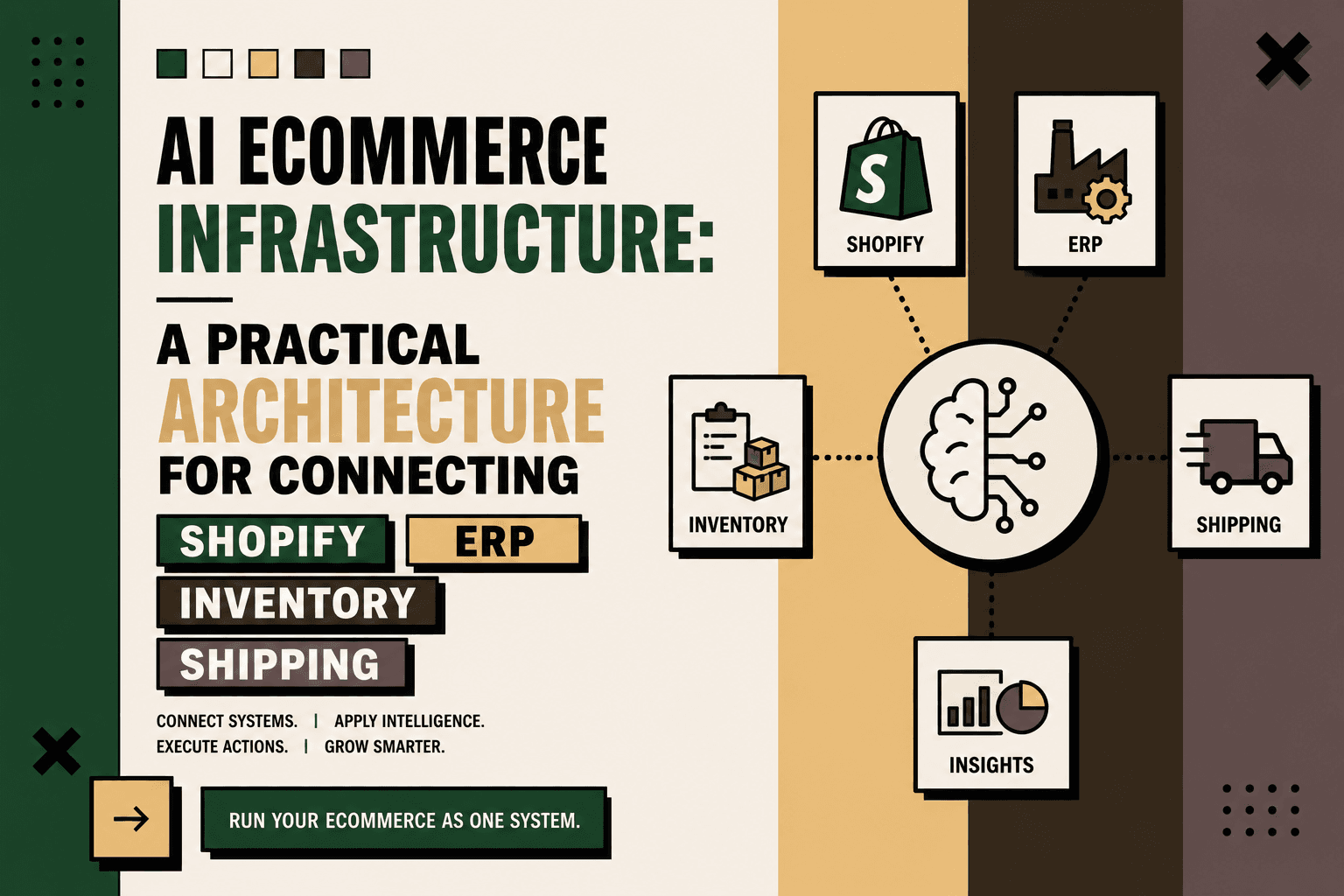
AI ecommerce infrastructure is the orchestration layer that connects those systems, gives operational data a reliable flow, and creates a controlled path from data to decision to execution.
Shopify's current platform provides APIs, webhooks, location-based inventory structures, and fulfillment objects that can support this architecture. Shopify's developer documentation also states that the REST Admin API is legacy and that new integrations should be built with the GraphQL Admin API. Shopify API versioning documentation
What Is AI Ecommerce Infrastructure?
Answer: AI ecommerce infrastructure is the technical and operational layer that connects commerce, ERP, inventory, fulfillment, shipping, customer operations, and data systems so information can move reliably and AI can make or assist with decisions inside real workflows.
It is not simply an AI chatbot added to Shopify. It is also not a collection of disconnected integrations.
A practical architecture looks more like this:
Customer channels → Commerce platform → Integration and orchestration layer → Operational data → AI decision layer → ERP, WMS, 3PL, shipping and customer operations.
The distinction matters because AI can only make useful operational decisions when the underlying data is available, current, structured enough to interpret, and connected to systems capable of executing the resulting action.
The Problem: Too Many Systems, Too Little Coordination
A growing D2C business may use Shopify for commerce, an ERP for financial and business records, a WMS or 3PL for fulfillment, shipping platforms for carrier execution, a returns system for reverse logistics, a helpdesk for customer operations, and analytics tools for reporting.
Each system can perform its individual job well while the overall workflow still fails.
Consider a normal order:
- A customer places an order in Shopify.
- The order is sent to the ERP.
- Inventory is checked and reserved.
- The warehouse receives fulfillment instructions.
- The order is picked and packed.
- A shipping partner receives the shipment.
- Tracking information is generated.
- Tracking is returned to the commerce and customer-facing systems.
- Finance records the transaction.
- Customer support needs access to the current state if something goes wrong.
If every step depends on spreadsheets, manual exports, polling, duplicated databases, or fragile point-to-point integrations, the business accumulates latency and reconciliation work.
Five Anchor POV: The architectural question should not be “How do we connect Shopify to the ERP?” It should be “How should operational events move through the business, which system owns each state, and which decisions should happen automatically?”
Why Point-to-Point Integrations Become Fragile
Point-to-point integrations can work when there are only a few systems and workflows. Complexity increases as more systems are added.
Imagine Shopify connects directly to the ERP, WMS, shipping platform, returns platform, CRM, analytics system, and customer-support platform. The ERP also connects to inventory, finance, procurement, warehouse, and reporting systems.
The number of dependencies grows with the stack.
Every new integration introduces another authentication mechanism, data mapping, retry behavior, monitoring requirement, version dependency, and failure mode.
The alternative is an integration and orchestration layer that gives systems a controlled way to publish events, consume events, transform data, apply rules, and trigger actions.
This does not mean every business needs a sophisticated enterprise event platform from day one. The architecture should match the business's transaction volume, latency requirements, operational complexity, and failure tolerance.
A Five-Layer AI Ecommerce Architecture
A practical architecture can be organized into five layers.
| Layer | Purpose | Typical components |
|---|---|---|
| Customer channels | Customer and commercial interaction | Shopify, marketplaces, support, apps |
| Integration and orchestration | Move, transform, route, and coordinate events | APIs, webhooks, queues, middleware |
| Operational data | Represent current business state | Orders, products, inventory, fulfillment, returns, payments |
| AI decision layer | Predict, classify, recommend, detect, and optimize | Forecasting, anomaly detection, routing, recommendations |
| Execution systems | Perform business actions | ERP, WMS, 3PL, shipping, Shopify, CRM |
The important point is that AI sits on top of an operational foundation. It should not be responsible for compensating for missing integrations, inconsistent identifiers, or unreliable source data.
Layer 1: Commerce and Customer Channels
Shopify is usually the customer-facing commerce layer, but it should not automatically become the source of truth for every domain.
Shopify can hold orders, products, customers, inventory-related information, fulfillment state, and customer-facing order status. Its current GraphQL Admin API exposes inventory items and inventory levels by location, while fulfillment orders represent work intended to be fulfilled. Shopify InventoryItem documentation Shopify InventoryLevel documentation Shopify FulfillmentOrder documentation
The architecture should therefore distinguish between the system that owns the customer experience and the system that owns each operational domain.
Define Ownership Before Building Integrations
Before connecting systems, create a data-ownership map.
| Data domain | Possible system of record | Consumers |
|---|---|---|
| Customer order | Shopify or order management system | ERP, WMS, support, analytics |
| Financial transaction | ERP or finance system | Analytics, reporting, reconciliation |
| Physical stock | WMS or inventory system | Shopify, ERP, marketplaces |
| Fulfillment execution | WMS or 3PL | Shopify, support, ERP |
| Carrier status | Shipping or carrier system | Shopify, support, analytics |
| Customer conversation | CRM or helpdesk | Customer operations, analytics |
The exact ownership model will vary. The important rule is that two systems should not silently compete to overwrite the same business state.
Layer 2: APIs, Webhooks and Orchestration
The integration layer is where the architecture becomes an operating system rather than a collection of scripts.
APIs are useful when one system needs to request or update information in another system.
Webhooks are useful when an application needs to notify another system that an event has occurred.
Queues or event infrastructure are useful when events need buffering, retry behavior, asynchronous processing, or controlled throughput.
Orchestration coordinates multiple steps and determines what should happen when an event enters the workflow.
Shopify provides webhook subscriptions for receiving notifications about shop events, making webhooks a relevant building block for event-driven integrations. Shopify Webhooks documentation
A production architecture should also assume that integrations fail. Events can arrive late, duplicate messages can occur, APIs can become unavailable, mappings can change, and downstream systems can reject requests.
That means every important integration needs idempotency, retry logic, dead-letter or exception handling where appropriate, logging, monitoring, and reconciliation.
Layer 3: The Operational Data Layer
The operational data layer represents what is happening across the business.
At minimum, this usually includes:
- Orders
- Order lines
- Products and SKUs
- Customers
- Inventory by location
- Reservations and commitments
- Purchase orders
- Fulfillment orders
- Shipments
- Tracking events
- Returns
- Refunds
- Payments
- Operational exceptions
Shopify's inventory model explicitly connects inventory items to inventory levels at locations and supports multiple inventory quantity states. Shopify InventoryLevel documentation
This matters because “inventory” is not always one number. Available, committed, incoming, and on-hand quantities can represent different operational states.
An AI system making replenishment or allocation recommendations needs to know which state it is using.
Layer 4: The AI Decision Layer
Once the operational data is reliable, AI can add decision support and automation.
Useful AI workloads include:
- Demand forecasting
- Stockout-risk prediction
- Inventory allocation recommendations
- Order-risk classification
- Shipping exception detection
- Carrier-performance anomaly detection
- Customer-intent classification
- Return classification
- Product and SKU anomaly detection
- Replenishment recommendations
- Operational summarization
But not every decision requires AI.
Deterministic rule: If inventory falls below an approved threshold, create a replenishment task.
AI-assisted decision: Predict which SKUs are likely to stock out by combining sales velocity, seasonality, inventory position, lead time, and other available signals.
Human decision: Approve an unusual inventory transfer when the financial or operational impact is significant.
The correct architecture is therefore not “AI everywhere.” It is rules where rules are sufficient, AI where interpretation or prediction adds value, and human approval where the cost of an incorrect action is high.
Layer 5: Execution Systems
AI creates business value only when its decisions can influence real operations.
A recommendation to transfer inventory is useful only if the workflow can create the appropriate transfer task or route it for approval.
A prediction that an order is at risk is useful only if the business can change fulfillment priority, notify the customer, investigate the warehouse, or otherwise act on the signal.
This creates an important distinction between analytics and operational intelligence.
Analytics tells the business what happened. Operational intelligence helps determine what should happen next and can connect that decision to execution.
How Shopify, ERP, Inventory and Shipping Should Work Together
Consider an order moving through the complete architecture.
- Shopify receives the customer order.
- An order event enters the integration layer.
- The integration layer validates identifiers and required fields.
- The ERP receives the commercial transaction.
- Inventory is checked across relevant locations.
- The fulfillment workflow determines where the order should be processed.
- The WMS or 3PL receives the fulfillment instruction.
- The warehouse confirms progress.
- The shipping system receives shipment information.
- The carrier generates tracking information.
- The tracking event flows back through the integration layer.
- Customer-facing systems receive the relevant status.
- Analytics records the operational events.
- AI can evaluate exceptions, forecast risk, or recommend the next action.
Shopify's FulfillmentOrder model represents the work intended to be fulfilled and supports fulfillment and tracking workflows, including situations where an order has multiple fulfillment orders. Shopify FulfillmentOrder documentation
The architecture should preserve this sequence rather than treating each system as an isolated application.
Inventory Synchronization Needs More Than a Stock Update
Inventory synchronization is often described as “send stock from ERP to Shopify.” That is incomplete.
The architecture needs to answer:
- Which system owns physical stock?
- Which locations are sellable?
- How are reservations represented?
- How is incoming inventory represented?
- What happens when a warehouse count changes?
- What happens when two orders arrive simultaneously?
- How are bundles and kits represented?
- How are SKU changes mapped?
- What happens when an update fails?
- How is reconciliation performed?
Shopify's inventory model is location-aware, with inventory levels connecting items and locations and exposing multiple quantity states. Shopify inventory documentation
Five Anchor POV: Inventory synchronization should be designed as a state-management problem, not a field-copying problem. The objective is to make the right inventory state available to the right channel at the right time, with a clear owner and a recovery path when synchronization fails.
Shipping Integration Should Be Event-Driven
Shipping creates a continuous stream of operational events rather than a single “shipped” status.
A useful workflow can distinguish:
- Shipment created
- Label generated
- Carrier received
- In transit
- Delayed
- Exception
- Out for delivery
- Delivered
- Returned to sender
The customer-support system does not necessarily need every raw carrier event. The integration layer can normalize carrier-specific events into a smaller set of business states.
For example, three different carriers may use different terminology for delivery exceptions. The orchestration layer can map those events into a common internal status and then trigger the appropriate workflow.
This is one of the most valuable roles of middleware: normalize operational complexity before it reaches every downstream system.
Where AI Adds Value to Shipping and Fulfillment
AI can operate above deterministic shipping integrations.
For example, a rule can detect that an order has missed its expected fulfillment window. AI can then evaluate the available context to classify the likely cause and recommend the next action.
Possible signals include:
- Warehouse backlog
- Inventory availability
- Carrier performance
- Destination
- Order priority
- Historical delay patterns
- Product characteristics
- Customer commitments
The system could recommend rerouting an order, changing fulfillment priority, notifying support, or escalating the case.
However, the recommendation should not automatically become an irreversible action simply because a model is confident. Guardrails should determine which actions are permitted.
Build Guardrails Before Giving AI Execution Authority
A production AI ecommerce architecture needs explicit boundaries.
| Control | Question to answer |
|---|---|
| Data access | Which customer, order, inventory, and financial data can the system read? |
| Action permissions | Which systems can the automation update? |
| Approval thresholds | Which actions require human approval? |
| Confidence handling | What happens when the model is uncertain? |
| Fallbacks | What happens when an API or model is unavailable? |
| Retries | How are transient failures handled without creating duplicate actions? |
| Auditability | Can the business reconstruct why an action occurred? |
| Monitoring | How are failures, latency, anomalies, and drift detected? |
The most important principle is simple: automation should make the workflow more controlled, not less controlled.
APIs Are Not the Architecture
It is easy to describe an integration project as an API project. APIs are only one component.
A reliable architecture also requires:
- Data ownership
- Canonical identifiers
- Event definitions
- Mapping rules
- State transitions
- Retry behavior
- Idempotency
- Observability
- Reconciliation
- Security
- Version management
- Human escalation
Shopify currently recommends version-aware API development, and its documentation states that the GraphQL Admin API is the recommended direction for new integrations while the REST Admin API is legacy. Shopify API versioning guidance Shopify REST Admin API reference
That means an integration architecture should include API-version management as part of ongoing maintenance rather than treating the initial connection as a one-time project.
Use Reconciliation as a Safety Net
Event-driven systems reduce latency, but events can still fail.
A strong architecture therefore uses two complementary mechanisms:
Events for speed. When something changes, notify downstream systems quickly.
Reconciliation for correctness. Periodically compare important states and identify mismatches.
For example, if the integration layer believes 100 units were synchronized to Shopify but the source system reports 96, the reconciliation process should identify the discrepancy instead of assuming the event stream was perfect.
Reconciliation should cover the domains where mismatches have material business impact, such as orders, inventory, fulfillment, refunds, and financial transactions.
Operational Intelligence Comes After Connectivity
Once Shopify, ERP, inventory, warehouse, shipping, returns, and customer operations are connected, the business can ask better operational questions.
- Which SKUs are approaching stockout risk?
- Which locations are carrying excess inventory?
- Which orders are at risk of missing fulfillment targets?
- Which carriers are generating abnormal exception rates?
- Which products create unusual return patterns?
- Where are inventory discrepancies recurring?
- Which workflows generate the most manual intervention?
- Which customers are likely to require proactive communication?
This is where AI moves from automation toward prediction and optimization.
Five Anchor POV: The value of connecting Shopify, ERP, inventory, and shipping is not simply that the systems synchronize faster. The larger value is that the business can create a common operational view and then use AI to identify what deserves attention before the problem becomes expensive.
Make the Architecture a Closed Loop
The strongest design creates a continuous loop:
Data → Understand → Predict → Decide → Execute → Measure → Learn.
Illustrative scenario: An AI workflow predicts that a high-velocity SKU is likely to stock out at one location. The system recommends an inventory transfer. A human approves the transfer because the financial threshold requires approval. The ERP or WMS executes the transfer. Inventory availability is updated. Shopify receives the revised sellable quantity. The system then measures whether the transfer prevented the expected stockout.
The example is illustrative. The architecture should be adapted to the actual systems, permissions, inventory policies, and operational risk of the business.
How to Implement AI Ecommerce Infrastructure
The implementation should begin with workflow mapping rather than an AI model.
1. Map the Current Workflow
Document triggers, inputs, systems, decisions, actions, exceptions, human handoffs, and outputs.
Start with one high-value workflow such as order processing, inventory synchronization, fulfillment, or shipping exceptions.
2. Establish the Baseline
Measure transaction volume, manual effort, error rate, processing time, latency, exception volume, operational cost, and revenue impact where measurable.
3. Define Data Ownership
For every important domain, identify the system that owns the state and the systems that consume it.
4. Define the Canonical Data Model
Normalize identifiers for products, SKUs, locations, orders, customers, shipments, and other entities. Decide how variations between systems are mapped.
5. Classify Each Decision
Determine whether each step should be deterministic automation, AI-assisted, human-approved, or human-only.
6. Connect the Systems
Use APIs, webhooks, queues, middleware, or other orchestration mechanisms based on latency, reliability, volume, and complexity requirements.
7. Add Guardrails
Define permissions, validation, approval thresholds, fallbacks, retry behavior, logging, monitoring, exception handling, and security controls.
8. Pilot One Workflow
Choose a high-volume, low-risk workflow where the data is reliable and the outcome is measurable.
9. Measure the Outcome
Track processing time, error reduction, manual hours, exception rates, ticket deflection, revenue leakage, operational cost, and customer impact where relevant.
10. Scale Carefully
Only extend the architecture to additional workflows after the first workflow is reliable, observable, and maintainable.
How to Prioritize What to Automate
A practical prioritization model is:
Volume × frequency × manual effort × error cost × revenue impact ÷ implementation complexity.
This is a practical framework, not an industry-standard formula.
The model helps prevent teams from choosing AI projects simply because they sound sophisticated.
| Workflow | Automation priority |
|---|---|
| High-volume order synchronization | Often high if data is structured and failure cost is manageable |
| Routine inventory updates | Often high when ownership and mappings are clear |
| Shipping exception classification | Potentially high when exception volume is material |
| Complex refund disputes | Lower initially because human judgment may be required |
| Strategic inventory decisions | AI-assisted recommendations may be preferable to autonomous execution |
What Should Not Be Automated First
Do not automate unclear business rules. If teams disagree about how an order, inventory state, refund, or fulfillment exception should be handled, software will not solve the policy problem.
Do not put AI between systems simply because AI is available. A deterministic data transfer should remain deterministic.
Do not automate around unreliable data. An AI workflow built on inconsistent SKU or inventory data can make incorrect decisions faster.
Do not ignore maintenance. APIs change, policies change, warehouses change, carriers change, and business workflows evolve.
Do not remove humans from high-impact decisions without measuring the downside. The cost of an incorrect automated action can exceed the cost of manual review.
Security, Privacy and Operational Reliability
An AI ecommerce architecture can touch customer, order, payment, inventory, financial, and operational information. Security should therefore be treated as an architectural requirement.
Access should follow least-privilege principles. Sensitive data should only be exposed to systems and workflows that need it. Credentials and tokens should be managed securely. Logs should avoid unnecessary sensitive information. Human approval should remain available for actions with significant financial, customer, or operational consequences.
Reliability also needs explicit ownership. Someone should be responsible for monitoring failed events, unresolved reconciliation issues, API changes, automation errors, model behavior, and workflow performance.
What a Practical Technology Stack Can Look Like
| Layer | Example responsibility |
|---|---|
| Commerce | Shopify and marketplace channels |
| ERP | Financial, procurement and business records |
| Inventory and WMS | Stock and warehouse execution |
| Integration | APIs, webhooks and orchestration |
| Event infrastructure | Queues and asynchronous processing where required |
| Operational data | Normalized business state and event history |
| AI | Forecasting, classification, anomaly detection and recommendations |
| Execution | ERP, WMS, 3PL and shipping actions |
| Observability | Logs, alerts, reconciliation and monitoring |
| Customer operations | AI agents, self-service and human escalation |
The specific vendors are less important than the architecture principles. A smaller brand may need only a lightweight integration service and operational database. A larger organization may require event streaming, dedicated orchestration, data infrastructure, and more sophisticated observability.
Where Five Anchor Fits
Problem: D2C businesses often have commerce, ERP, inventory, warehouse, shipping, customer operations, and analytics systems that each perform a specific function but do not share a reliable operational state.
Architecture: The solution is to design an integration and orchestration layer that defines ownership, normalizes data, moves events, coordinates workflows, and exposes reliable operational context to automation and AI.
Implementation: Five Anchor's Commerce Infrastructure work covers ERP integrations, marketplace integrations, order processing automation, inventory synchronization, warehouse and shipping integrations, financial automation, and custom AI workflows. Its E-Commerce Intelligence capability can then turn connected operational data into dashboards, inventory intelligence, order visibility, and performance reporting.
Business outcome: The objective is a more reliable operational flow, fewer manual handoffs, faster exception detection, better inventory visibility, and a foundation on which AI can make decisions that are connected to real execution.
For a D2C business, Five Anchor can approach the project as an infrastructure build: map the workflows, identify system ownership, connect the relevant systems, establish guardrails, deploy automation and AI where appropriate, and measure the operational result.
The Architecture Is More Important Than the AI Model
The most important design decision in an AI ecommerce system is rarely which model to use.
It is deciding how information moves through the business.
Shopify should know what the customer needs to see. The ERP should maintain the business records it owns. Inventory systems should represent operational stock. WMS and 3PL systems should execute physical fulfillment. Shipping systems should provide delivery events. Customer operations should receive enough context to resolve exceptions. AI should interpret, predict, recommend, and automate within defined boundaries.
When those responsibilities are clear, AI has something useful to work with.
When they are not, adding AI can simply create another layer on top of the same fragmentation.
Conclusion: Build the Operating Layer Before Chasing Autonomous Commerce
AI ecommerce infrastructure is not about replacing Shopify, the ERP, the WMS, or the shipping platform.
It is about connecting them so that the business can operate as one system even when the underlying applications remain separate.
The practical architecture is straightforward in principle:
Connect the systems. Define ownership. Normalize operational data. Move events reliably. Apply rules where rules are enough. Use AI where prediction or interpretation adds value. Keep humans involved where the consequences require judgment. Then measure the workflow.
That creates a foundation for a closed-loop ecommerce operation in which data can move from transaction to understanding, prediction, decision, execution, and measurement.
Shopify sells. ERP records. Inventory tracks. WMS fulfills. Shipping delivers. AI helps orchestrate.
The goal is not to add more technology to the stack. The goal is to make the stack behave like a coordinated operating system.
Key Takeaways
- •AI ecommerce infrastructure is an orchestration and decision layer, not simply an AI chatbot or another point-to-point integration.
- •Define which system owns each data domain before connecting Shopify, ERP, inventory, warehouse, shipping, and customer operations.
- •Use APIs, webhooks, queues, and orchestration according to the workflow's latency, reliability, volume, and complexity requirements.
- •AI should sit on top of reliable operational data and should complement rather than replace deterministic automation.
- •Inventory architecture needs to account for locations, reservations, available stock, incoming stock, identifiers, and reconciliation.
- •Production AI workflows require permissions, validation, retries, fallbacks, monitoring, auditability, and human escalation.
- •A strong architecture creates a closed loop from data to understanding, prediction, decision, execution, measurement, and learning.
Traditional Integrations vs. AI Ecommerce Infrastructure
| Point-to-Point Integration | Orchestrated AI Infrastructure | Operational Principle |
|---|---|---|
| Inventory Sync Frequency | 15–30 min batch polling (high oversell risk) | Sub-second atomic locking (<450ms) |
| Concurrent Drop Resilience | Fails under concurrency; causes negative stock balance | Redis atomic reservation queue guarantees exact counts |
| Error Handling & Retries | Silent failure; manual CSV audit needed | Dead-letter queues with automated exponential retry |
| Fulfillment Routing Speed | 2–4 hours delayed batch export to 3PL warehouse |