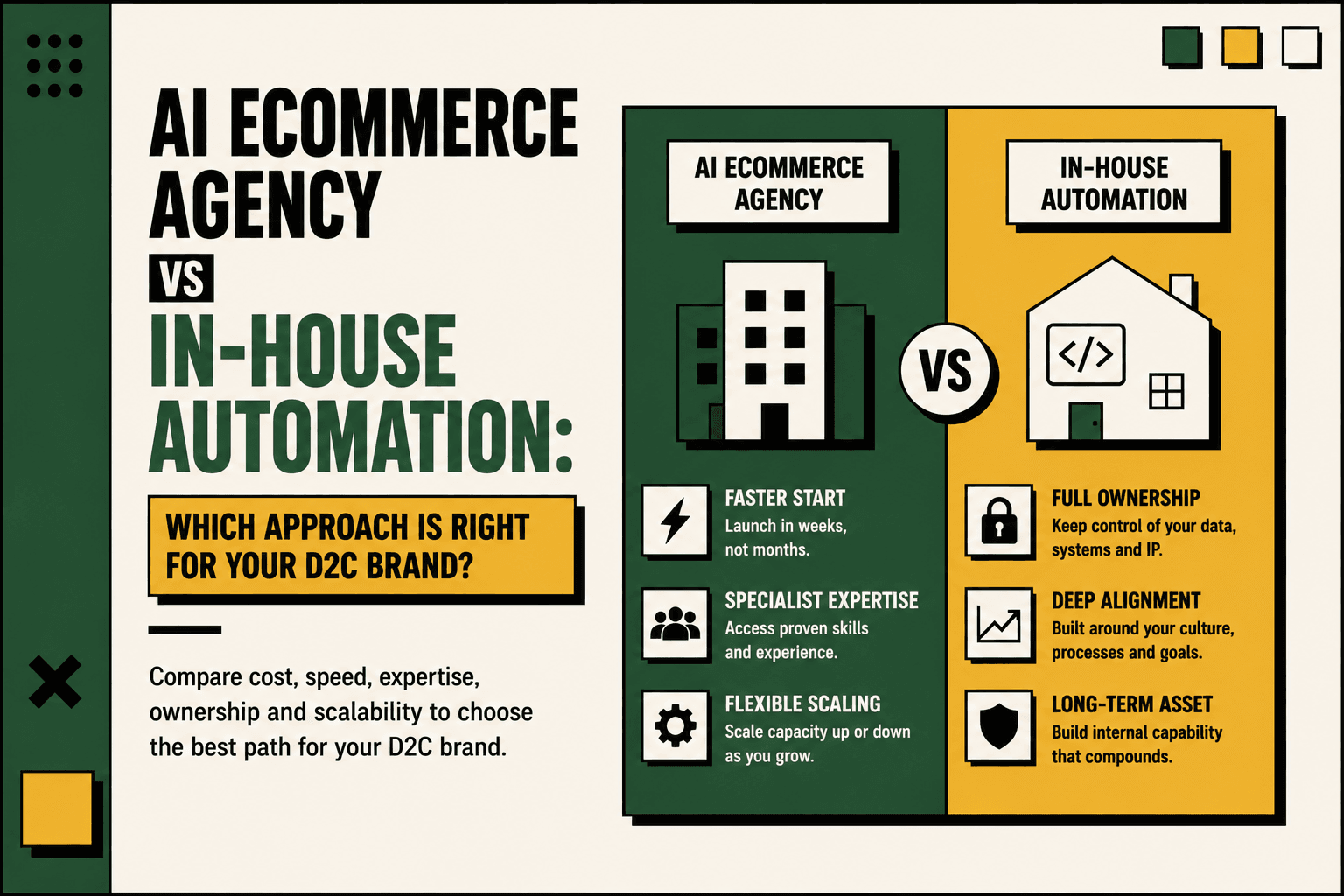
For a growing D2C brand, the automation question eventually changes from “What should we automate?” to “Who should build and operate it?”
You can build an internal automation capability. You can work with an AI ecommerce agency. Or you can combine both.
The right choice depends on more than the agency fee or the salary of one developer. You need to consider implementation speed, ecommerce integration complexity, internal technical capability, ownership, maintenance, security, opportunity cost and how strategically important the automation becomes to your operation.
Shopify's build-versus-buy guidance makes a similar point: custom development can provide greater control and flexibility, while buying or using existing platforms can provide faster deployment and lower resource requirements. It also recommends evaluating total cost of ownership, technical resources, timeline, maintenance and scalability. Shopify's build-versus-buy software guide
The short answer: an agency is often more practical when speed, specialist expertise and integration complexity are the main constraints. In-house automation becomes more attractive when the capability is strategically important, the brand already has strong technical leadership and it can support the ongoing cost of building and maintaining the function. For many growing D2C brands, a hybrid model is the more balanced option.
AI Ecommerce Agency vs In-House: What Are You Actually Choosing?
This decision is often framed as a simple build-versus-buy question. That framing is incomplete.
You are actually choosing an operating model for automation.
An in-house team owns the capability internally. An agency provides external specialists to design and implement the capability. A hybrid model keeps business ownership inside the company while using external specialists for architecture, integrations, AI workflows or deployment.
| Factor | AI ecommerce agency | In-house automation |
|---|---|---|
| Time to access specialist expertise | Usually faster | Requires hiring or developing talent |
| Initial team-building effort | Lower | Higher |
| Internal ownership | Depends on contract and architecture | High |
| Domain knowledge | Must be transferred and documented | Develops internally |
| Shopify and ERP integration capability | Can be immediately available | Depends on existing team |
| Customization | High when the agency builds custom workflows | Very high |
| Maintenance responsibility | Can be outsourced or shared | Internal responsibility |
| Scaling specialist capacity | Can often add external specialists | Usually requires additional hiring |
| Vendor dependency | Potentially higher | Lower |
| Long-term technical knowledge | Must be deliberately retained internally | Built into the organization |
The table is not a universal ranking. It shows the trade-offs that should be evaluated against the brand's actual operating model.
Why the Decision Gets Harder in Ecommerce
A basic automation can be relatively simple. Ecommerce infrastructure rarely stays simple for long.
A D2C workflow may cross:
- Shopify
- Marketplaces
- ERP
- Inventory systems
- Order management
- Warehouse or 3PL systems
- Shipping and carrier platforms
- CRM
- Customer support systems
- Returns and warranty platforms
- Analytics and reporting systems
The automation layer then has to deal with APIs, webhooks, authentication, data mapping, business rules, retries, exceptions and monitoring.
This is why hiring one person who knows AI does not necessarily create an AI automation function.
That person may still need to understand commerce operations, system integration, data architecture, production monitoring, security and the brand's actual workflows.
Five Anchor POV: The more an automation project crosses the boundaries between customer, order, inventory, ERP, shipping, support and returns, the less useful it is to evaluate the decision purely as an AI hiring decision. It becomes an infrastructure decision.
When an AI Ecommerce Agency Makes More Sense
An agency becomes attractive when the main constraint is not ownership but time, breadth of expertise or implementation capacity.
You need several specialist skills at once
A serious ecommerce automation project can require integration engineering, workflow design, AI implementation, data handling, testing, deployment and monitoring.
Hiring all of those capabilities internally can take considerably longer than bringing an existing specialist team into the project.
You have a narrow implementation window
If the objective is to launch an automation before a major sales period, operational deadline or system migration, the cost of waiting can matter as much as the implementation budget.
Shopify's own build-versus-buy analysis identifies implementation timeline, available technical resources and ongoing maintenance as important factors in the decision. Shopify's build-versus-buy guidance
Your internal team is already overloaded
Your developers may be fully occupied with storefront work, product development, security, analytics or existing integrations.
Adding an automation program to the same team can create a hidden opportunity cost: existing priorities move more slowly while the new system is being built.
You need ecommerce-specific integration experience
Connecting Shopify to an ERP is different from building a generic AI prototype. The system has to understand the actual operational consequences of changing an order, synchronizing inventory or communicating a fulfillment status.
An external team that already works across commerce infrastructure can reduce the amount of foundational knowledge that has to be built from scratch.
When In-House Automation Makes More Sense
In-house is not automatically slower or more expensive. It becomes compelling when automation is becoming part of the company's permanent technical capability.
Automation is strategically core
If your competitive advantage depends on proprietary workflows, internal operational intelligence or deeply customized systems, retaining the capability internally can make sense.
You already have senior technical leadership
If you already have engineers, architects or technical product leaders who understand the company's systems, adding AI automation may be an extension of an existing capability rather than a completely new function.
You expect continuous internal iteration
Some automation programs are not projects with a defined finish line. They become a continuous operating capability.
New channels appear. Policies change. Products change. ERP processes change. Customer-support workflows evolve. AI models and tooling change.
If the business expects constant internal iteration, building durable technical ownership may eventually become worthwhile.
Data and process knowledge are unusually sensitive
Internal teams can have an advantage when automation depends heavily on proprietary business logic, sensitive operational data or complex institutional knowledge.
That advantage only exists if the company also invests in documentation and knowledge transfer. An internal system that only one employee understands is not strong technical ownership.
The Cost Is Not Agency Fee vs Developer Salary
This is one of the most common mistakes in the comparison.
A realistic in-house cost model includes:
- Salary and benefits
- Recruitment
- Management time
- AI and development tools
- Infrastructure
- Training
- Documentation
- Testing
- Monitoring
- Maintenance
- Security
- Opportunity cost
An agency model can include:
- Discovery and architecture
- Implementation
- System integrations
- AI or automation tooling
- Deployment
- Monitoring
- Maintenance or retainer
- Software and API costs
The relevant comparison is therefore total cost of ownership over the period in which the automation is expected to operate, not the first invoice versus one employee's annual salary.
Shopify similarly recommends evaluating total cost of ownership, internal resources, implementation timeline and long-term maintenance when assessing build-versus-buy decisions. Shopify's build-versus-buy framework
The Hidden Cost of Hiring One Automation Engineer
One technically strong hire can be valuable. But one person may still be expected to perform several different functions.
Illustrative scenario: Imagine hiring one AI engineer and expecting that person to architect the automation, build AI agents, integrate Shopify, connect the ERP, manage APIs, monitor production, handle failures and understand ecommerce operations.
The issue is not whether that person is capable. The issue is that the company has effectively assigned an entire cross-functional capability to one individual.
This creates concentration risk. If the employee leaves, gets pulled into another priority or lacks experience in one part of the stack, the automation program can slow down significantly.
An agency can reduce that concentration risk by providing multiple specialist roles, but it creates a different risk: vendor dependency.
The Biggest Agency Risk: Vendor Dependency
Choosing an agency does not remove the need for technical governance.
A poorly structured engagement can leave the brand dependent on the external partner for every change.
Watch for these warning signs:
- The brand does not own its data.
- Architecture documentation is incomplete.
- Integrations are undocumented.
- The system depends on proprietary components without a migration path.
- Internal employees cannot understand or operate the workflow.
- Every small change requires external intervention.
- There is no defined exit or handover process.
- Monitoring and failure handling are unclear.
The right question is not only “Who builds it?” It is “Who owns the system after it is built?”
Deloitte's guidance on scaling agentic AI highlights this same organizational trade-off: companies need to decide what should be built or bought, how internal teams should be developed, where external specialists add value and how technology ownership and governance should work. Deloitte's guidance on building and scaling AI agents
The Third Option: Agency + Internal Owner
For many growing D2C brands, the most practical model is not agency versus in-house. It is agency plus internal ownership.
The external team can own implementation while the brand retains business ownership and strategic control.
| Responsibility | Agency | Internal team |
|---|---|---|
| Architecture | Lead | Review and approve |
| AI agent implementation | Lead | Define business requirements |
| System integrations | Build | Provide access and validation |
| Business rules | Implement | Own and approve |
| Brand knowledge | Configure | Own |
| High-impact approvals | Configure workflow | Approve |
| Data ownership | Operate under agreed access | Own |
| Monitoring | Operate or support | Review performance |
| Strategic roadmap | Advise | Own |
This model can provide implementation capacity without completely outsourcing technical knowledge.
Deloitte's research similarly discusses augmenting internal teams with external specialists while maintaining clear ownership and governance. Deloitte's agentic AI implementation guidance
How to Decide: A Five-Question Framework
1. Do we already have senior technical ownership?
If the answer is no, building an entire automation capability internally may require more hiring than the project initially appears to need.
If the answer is yes, the internal team may be able to own architecture and use external specialists selectively.
2. How complex are the workflows?
A simple notification workflow is very different from an automation that connects Shopify, ERP, inventory, shipping, returns and customer support.
The more systems and exception paths involved, the more important integration and operational expertise become.
3. How quickly does the business need the result?
If speed is critical, compare the cost of waiting for hiring and ramp-up against the cost of external implementation.
4. Is automation a strategic capability or an operational project?
If automation is becoming a core part of how the company operates, internal ownership becomes more valuable.
If the goal is to solve a defined operational bottleneck, an agency may be more efficient.
5. What must remain under internal control?
Define this before signing an agreement or hiring a team.
Typical ownership requirements include:
- Data
- Source code
- API credentials
- Business rules
- Architecture documentation
- Monitoring data
- Knowledge-base content
- AI workflow configuration
- Exit and migration rights
A Practical Automation Prioritization Model
The build-versus-buy decision should happen after deciding what is worth automating.
A useful practical model is:
Automation priority = volume × frequency × manual effort × error cost × revenue impact ÷ implementation complexity
This is a decision-making framework, not an industry-standard formula.
The purpose is to prevent the team from choosing projects simply because they are technically interesting.
For example, a repetitive order-processing task that consumes significant operational time may deserve attention before a sophisticated AI assistant that only handles a small number of edge cases.
What Should Be AI, Automation or Human?
Choosing the implementation model is only half the architecture decision. You also need to decide what technology should perform each step.
| Workflow responsibility | Recommended mechanism | Reason |
|---|---|---|
| Understand natural-language intent | AI | Useful for interpreting variable customer requests |
| Retrieve current order data | System integration | Requires authoritative operational data |
| Check a fixed policy | Deterministic rules | Produces consistent decisions |
| Draft contextual communication | AI | Useful for natural-language responses |
| Approve high-risk exception | Human | Requires judgment and accountability |
| Log completed action | Workflow automation | Supports auditability |
Five Anchor POV: The strongest ecommerce architecture is usually not “AI everywhere.” It is a coordinated system in which AI handles interpretation, integrations provide current information, deterministic rules control predictable actions and humans retain authority over important exceptions.
What an AI Ecommerce Agency Should Actually Deliver
If you choose an agency, do not buy a vague promise to “implement AI.” Define the deliverables around the operating workflow.
- Workflow audit: Document the current process, bottlenecks, systems, exceptions and human handoffs.
- Baseline: Measure volume, frequency, manual effort, error cost, response time and relevant business impact.
- Architecture: Define the systems, APIs, data flows, AI components and deterministic rules.
- Integration: Connect the required commerce and operational systems.
- AI workflow: Implement agents or AI-assisted steps only where they provide a clear advantage.
- Guardrails: Define permissions, validation, escalation, retries and approval thresholds.
- Testing: Test normal cases, missing data, conflicting data, edge cases and failure paths.
- Deployment: Move the workflow into production with appropriate monitoring.
- Documentation: Document architecture, integrations, business rules and operating procedures.
- Measurement: Track the operational KPI the automation was designed to improve.
If an agency cannot clearly explain these steps, the project may be more of a prototype exercise than an operational automation program.
How Five Anchor Fits the Agency Model
Problem: D2C brands often need automation across multiple commerce and operational systems but may not want to build an entire specialized engineering function before proving the business case.
Architecture: Five Anchor approaches this as AI Infrastructure for D2C & E-Commerce, connecting commerce platforms, ERP, inventory, customer operations and intelligence through integrations, automation and AI workflows.
Implementation: The practical sequence is to audit the workflow, map systems and decisions, identify the highest-value automation opportunities, design the architecture, connect the required systems, implement AI agents or deterministic automation, add guardrails and human escalation, deploy and measure the result.
Business outcome: The objective is not to outsource every technical decision. It is to give the brand an implementation capability while keeping business logic, data ownership and strategic control where they belong.
For a D2C brand evaluating agency versus in-house automation, this distinction matters. The external partner should build infrastructure that the internal business can understand, govern and eventually evolve.
How to Structure the Engagement So You Keep Control
If you choose an agency, define ownership before implementation begins.
Own the accounts
Where practical, core cloud, commerce, analytics and operational accounts should remain controlled by the brand rather than being permanently tied to the agency.
Document the architecture
The brand should have a current map of integrations, workflows, data sources, permissions and dependencies.
Define source-code and configuration ownership
Contractually clarify what happens to source code, workflow configurations, prompts, automation logic and deployment assets when the engagement ends.
Define the exit path
A good agency relationship should not require permanent dependency. Establish what a future handover would involve and what documentation must exist.
Measure business outcomes
Do not evaluate the partner only on whether the automation was launched. Evaluate whether the workflow improved.
How to Build In-House Without Creating a Silo
If you decide to build internally, use the same discipline.
- Assign an owner: One person should own the automation roadmap.
- Map the architecture: Document commerce, ERP, inventory, shipping, support and data dependencies.
- Start with one workflow: Prove the operating model before building a large platform.
- Separate AI from rules: Do not use an AI model where deterministic logic is sufficient.
- Add observability: Track failures, latency, data quality and workflow outcomes.
- Create documentation: Avoid single-person knowledge dependency.
- Plan maintenance: APIs, policies, models and workflows will change.
- Review ROI: Continue funding workflows that produce measurable operational value.
McKinsey's research on generative AI illustrates why this discipline matters. Its customer-service research found measurable improvements in issue resolution and handling time in a study involving 5,000 customer-service agents, while also noting that productivity gains were not uniform across skill levels. McKinsey estimates that applying generative AI to customer-care functions could create productivity value equivalent to 30% to 45% of current function costs. These findings are research evidence, not guaranteed outcomes for a particular D2C brand. McKinsey's generative AI research
Agency vs In-House: The Decision in Practice
Choose an AI ecommerce agency when:
- You need specialist capability quickly.
- Your internal technical team is already constrained.
- The project crosses multiple ecommerce systems.
- You need architecture and implementation experience.
- You want to validate an automation program before building a larger internal team.
Choose in-house when:
- Automation is becoming a core strategic capability.
- You already have strong technical leadership.
- You can support ongoing engineering and maintenance.
- The workflows contain proprietary logic that needs continuous internal iteration.
- You want long-term technical capability embedded in the organization.
Choose a hybrid model when:
- You need speed but also want internal ownership.
- You have an internal technical or operations owner but need specialist implementation support.
- You want an external team to accelerate architecture and integration work.
- You want the internal team to gradually absorb the system knowledge.
The Better Question Is Not Agency vs In-House
The most useful question for a D2C brand is:
What level of automation capability should we own internally, and where does external expertise create more value than building the capability ourselves?
That framing avoids the false assumption that every automation decision has to be binary.
A brand can keep business ownership internally while outsourcing implementation. It can build core capabilities internally while using specialists for difficult integrations. It can start with an agency and later bring selected functions in-house.
The important thing is to make the ownership model explicit.
Conclusion
An AI ecommerce agency is not automatically better than an in-house team. An in-house team is not automatically more strategic.
The right choice depends on the relationship between speed, complexity, technical capability, total cost of ownership, strategic importance and ownership requirements.
For many D2C brands, the strongest starting point is to avoid building a large internal function before proving which workflows deserve automation. Start with one high-value process, establish a baseline, design the architecture, implement the smallest reliable workflow and measure the result.
If external specialists are used, retain ownership of the important assets: data, business rules, documentation, credentials, architecture and strategic decisions.
If the automation becomes a permanent source of competitive advantage, the company can progressively bring more capability in-house.
The goal is not to choose the cheapest builder. It is to build an automation capability that the business can operate, measure, govern and scale.
Key Takeaways
- •The agency-versus-in-house decision is an operating-model decision, not simply a hiring decision.
- •Compare total cost of ownership rather than an agency fee against one developer's salary.
- •Multi-system ecommerce automation can require integration, AI, workflow, deployment and monitoring expertise at the same time.
- •In-house automation becomes more attractive when automation is strategically core and strong technical leadership already exists.
- •An agency becomes more attractive when speed, specialist expertise or internal capacity is the primary constraint.
- •Vendor dependency is the main structural risk of outsourcing, so data, documentation, architecture and exit rights should remain under clear ownership.
- •A hybrid model can provide implementation speed while preserving internal business ownership and technical knowledge.
- •
AI Ecommerce Agency vs In-House Automation
| Factor | AI Ecommerce Agency | In-House Automation |
|---|---|---|
| Inventory Sync Frequency | 15–30 min batch polling (high oversell risk) | Sub-second atomic locking (<450ms) |
| Concurrent Drop Resilience | Fails under concurrency; causes negative stock balance | Redis atomic reservation queue guarantees exact counts |
| Error Handling & Retries | Silent failure; manual CSV audit needed | Dead-letter queues with automated exponential retry |
| Fulfillment Routing Speed | 2–4 hours delayed batch export to 3PL warehouse | Instantaneous automated webhook dispatch (<90 sec) |