For a growing D2C brand, post-purchase support can become an operations problem long before it becomes a staffing problem. Customers ask where their order is, whether they can cancel it, how to start a return, when a refund will arrive, whether an address can still be changed, or what to do about a damaged product. Each question may look simple. The work required to answer it often is not.
The real opportunity with AI customer support is therefore not simply generating faster replies. It is removing the repetitive coordination behind those replies.
AI can reduce post-purchase support work by identifying customer intent, retrieving order and operational data, applying predefined policies, executing approved actions, communicating the result and escalating exceptions to humans.
That makes AI customer support for D2C brands less like a chatbot and more like a customer-facing workflow layer connected to the commerce stack.
How AI actually reduces post-purchase support work
The short answer is simple: AI reduces work when it can resolve a customer request rather than merely describe how a customer could resolve it.
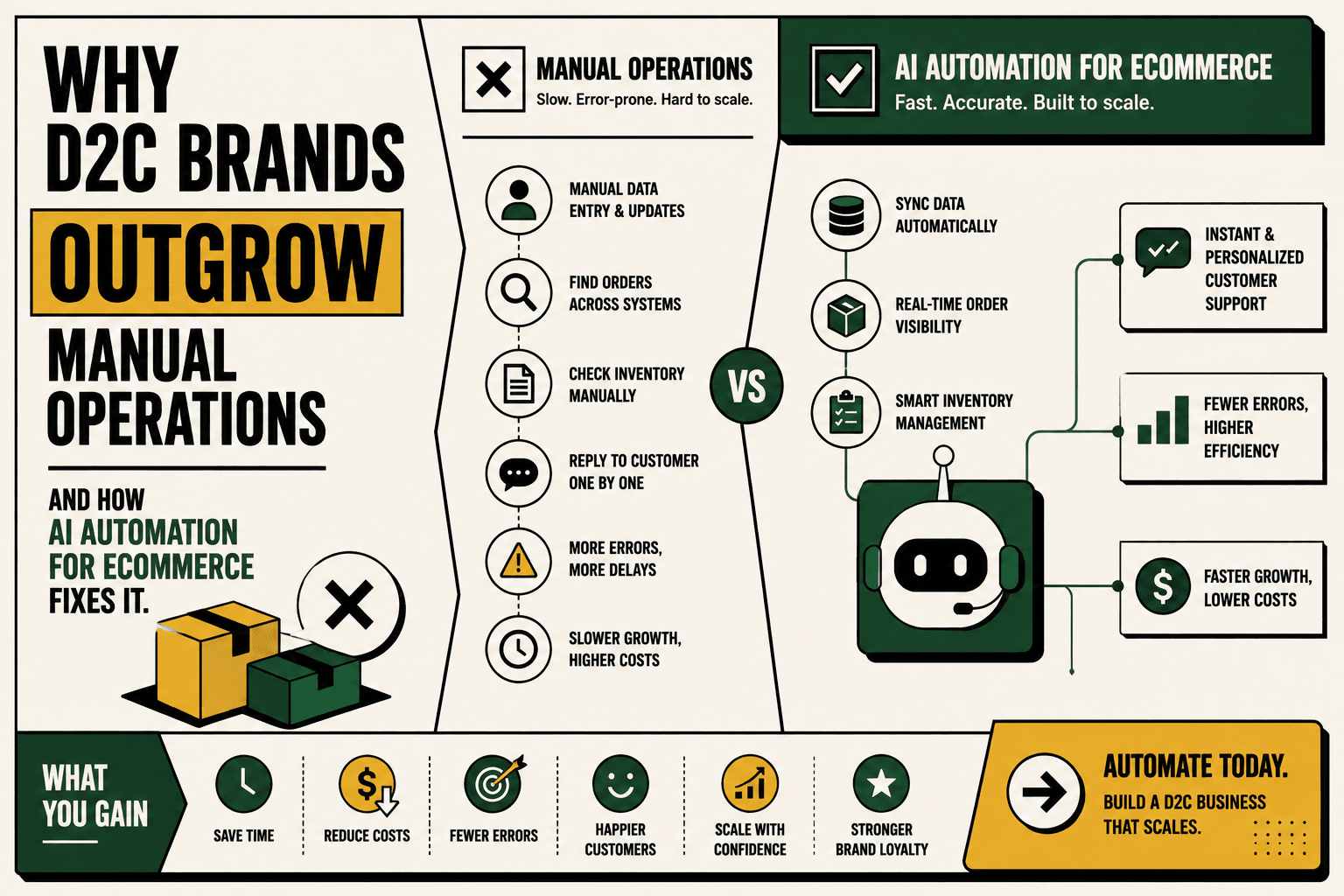
A conventional support workflow might require an agent to open the helpdesk, locate the order, inspect Shopify or an ERP, check a shipping provider, interpret the brand's policy, write a response, perform an action in another system and update the ticket.
An AI-enabled workflow can compress those steps into a single controlled process:
- Identify the customer's intent.
- Retrieve the relevant customer, order and operational data.
- Apply deterministic business rules and policies.
- Execute an approved action when the request is eligible.
- Confirm the outcome to the customer.
- Escalate exceptions that require judgment.
This distinction is important because FAQ automation saves writing time, while workflow automation removes operational work.
Which post-purchase tasks are best suited to AI?
D2C support demand is often concentrated around predictable intents. These are strong candidates for AI because the required inputs, rules and actions can usually be defined.
| Post-purchase problem | Manual workflow | AI-enabled workflow |
|---|---|---|
| Order tracking | Agent searches order and courier systems | AI retrieves current shipment status and explains it |
| Delivery delay | Agent investigates and replies | AI identifies the delay and communicates the available information |
| Cancellation | Agent verifies eligibility and cancels | AI checks rules and executes an approved cancellation |
| Return request | Agent explains policy and creates the request | AI validates eligibility and initiates the return |
| Exchange | Agent checks policy and inventory | AI checks rules and available inventory before initiating |
| Refund status | Agent searches payment and order systems | AI retrieves the refund state and communicates it |
| Wrong or damaged item | Agent gathers information and escalates | AI collects evidence and routes the exception |
| Warranty | Agent verifies purchase and policy | AI retrieves purchase information and applies warranty rules |
| Address change | Agent checks fulfillment status | AI validates whether the order can still be modified |
The exact automation boundary depends on the brand's policies, integrations and risk tolerance. The principle is consistent: automate predictable decisions and reserve human attention for cases where context, judgment or accountability matters.
The biggest change is the support workflow, not the chatbot
A chatbot sitting on top of a storefront can answer questions. It cannot reliably resolve operational problems if it has no access to the systems that contain the answers or perform the required actions.
A useful architecture looks like this:
Customer message → intent detection → data retrieval → policy validation → approved action → outcome verification → customer response → exception escalation
For example, consider a customer asking, “Can I cancel my order?”
A basic chatbot might explain the cancellation policy. An integrated AI support workflow can identify the order, check whether fulfillment has started, determine whether cancellation is permitted, execute the cancellation if approved and communicate the result.
That difference is where meaningful workload reduction occurs.
Five Anchor POV: AI customer support should be treated as part of commerce infrastructure rather than an isolated conversational interface. For a D2C operation, the customer-facing layer becomes significantly more useful when it can connect orders, ERP data, inventory, shipping, returns, payments and warranty workflows.
Why post-purchase support creates so much repetitive work
The apparent simplicity of a support ticket hides a chain of operational dependencies.
A “Where is my order?” request may require order identification, shipment identification, carrier data retrieval, status interpretation and customer communication.
A return request may require checking the purchase date, product eligibility, return window, item condition, payment status and return method.
A cancellation request may require checking whether the order has been allocated, packed, shipped or handed to a carrier.
When those systems are disconnected, the support agent becomes the integration layer. Every ticket forces a person to move information between applications.
That is why reducing support workload is not simply a matter of improving the wording of AI responses. It requires reducing the number of manual handoffs around each customer interaction.
What AI should automate versus what should remain human
The safest D2C customer service automation strategy separates four types of work.
| Work type | Recommended owner | Typical examples |
|---|---|---|
| Deterministic automation | Software rules | Status lookup, notifications, eligibility checks |
| AI-assisted decisions | AI with defined rules | Intent classification, message interpretation, exception categorization |
| Human approval | AI prepares, human approves | High-value refunds, unusual replacements, policy exceptions |
| Human-only | Support or operations team | Fraud investigations, sensitive disputes, complex escalations |
This prevents a common implementation mistake: giving an AI agent broad authority before the business has defined the decisions it is actually allowed to make.
AI should not improvise on suspected fraud, unusual refunds, expensive replacements or policy exceptions simply because a customer asks confidently. The better architecture is AI for interpretation, deterministic rules for control and humans for high-impact judgment.
How much work can AI remove?
The answer should be measured from the brand's own support operation rather than assumed from a generic industry benchmark.
Illustrative scenario: Suppose a D2C brand receives 1,000 post-purchase tickets per week and 60% involve predictable requests such as order tracking, return eligibility, refund status or address changes. If the brand can safely automate half of those predictable workflows, approximately 300 tickets per week could move out of the fully manual workflow. The actual time saved would depend on the number of manual steps removed from each ticket.
The important metric is therefore not only “AI resolution rate.” A brand should measure the work eliminated before and after automation.
- Tickets requiring human handling
- Average manual handling time
- First response time
- Resolution time
- Number of system handoffs per ticket
- Escalation rate
- Automation error rate
- Refund and replacement exceptions
- Customer satisfaction
- Support cost per order
This produces a much more useful view of ecommerce support ticket automation than counting chatbot conversations.
Real-world evidence: Psycho Bunny
Case study: Psycho Bunny implemented Gorgias AI Agent to handle repetitive customer support requests. The company reported that its AI Agent resolved 26% of customer tickets, with resolution times 99.4% faster than the team average. The automated workflows included questions around order status, returns, exchanges and shipping, allowing human agents to focus on more complicated customer conversations.
Gorgias customer story: Psycho Bunny
The lesson is not that every D2C brand will achieve the same result. The more useful lesson is that measurable workload reduction came from targeting repetitive support requests and connecting AI to relevant customer and commerce information.
Real-world evidence: Orthofeet
Case study: Orthofeet faced a fragmented customer experience stack involving multiple support channels and limited integration between its tools and Shopify. After consolidating its customer operations and deploying AI Agent, the company reported reaching 56% ticket automation in less than two months.
The company also reported email first-response times falling from 24 hours to 35 seconds and chat first-response times falling from three minutes to 13 seconds. Its published case study attributes the workflow improvement to integrated customer data, automation of routine inquiries and AI access to Shopify order information.
Gorgias customer story: Orthofeet
Again, the result should be treated as a company-reported case rather than a universal benchmark. The operational lesson is more transferable: AI becomes more useful when customer support has access to the same operational context that agents previously had to gather manually.
Why integrations matter more than adding another AI tool
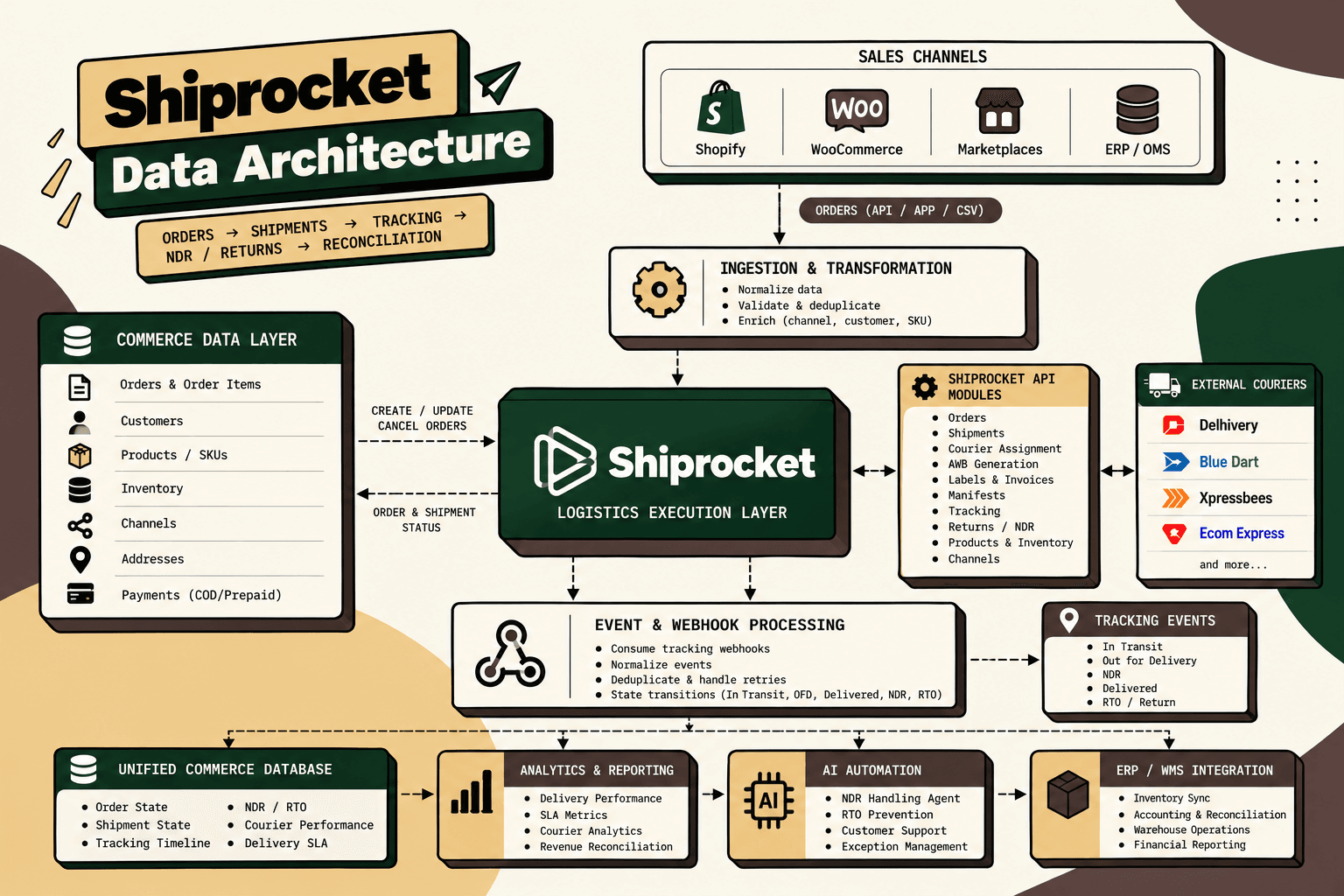
A D2C brand may have Shopify for commerce, an ERP for financial and operational records, a warehouse system for fulfillment, a shipping platform for tracking, a returns platform, a payment system, a CRM and a helpdesk.
If those systems are disconnected, AI can still generate language, but it has limited ability to resolve the underlying issue.
A practical AI customer support architecture may therefore connect:
- Commerce platform and marketplace orders
- ERP and customer records
- Inventory and warehouse systems
- Shipping and carrier data
- Returns and exchange systems
- Payment and refund information
- Warranty records
- Helpdesk and CRM history
- WhatsApp, email, website chat and other customer channels
- Analytics and operational reporting
APIs, webhooks and an orchestration layer can allow the support agent to retrieve information and trigger permitted actions without forcing a human to copy information between systems.
How to implement AI customer support for a D2C brand
The safest approach is to start with one high-volume, low-risk workflow rather than attempting to automate the entire customer service operation at once.
- Map the workflow. Document the trigger, customer input, systems consulted, decisions, actions, exceptions, human handoffs and final output.
- Establish a baseline. Measure ticket volume, frequency, manual handling time, response time, error rate and support cost.
- Prioritize the workflow. A practical prioritization model is volume × frequency × manual effort × error cost × revenue impact ÷ implementation complexity. This is a decision framework, not an industry-standard formula.
- Classify each step. Decide whether it belongs to deterministic automation, AI, human approval or human-only handling.
- Connect the systems. Give the workflow controlled access to the commerce, order, inventory, shipping, returns and customer data it actually needs.
- Add guardrails. Define permissions, validation rules, approval thresholds, fallback behavior, retry logic, logging and escalation paths.
- Pilot one workflow. Order tracking, return initiation or refund-status questions are often easier starting points than complex disputes.
- Measure outcomes. Track hours saved, manual tickets removed, response time, error rate, escalation rate and customer experience.
- Scale gradually. Expand to additional workflows only after the first workflow operates reliably.
What guardrails should an AI support agent have?
Guardrails turn AI from an open-ended conversational system into a controlled operational workflow.
- Data permissions: Define exactly which customer and order data the agent can read.
- Action permissions: Define which actions the agent can execute without approval.
- Financial thresholds: Require human approval for refunds, credits or replacements above defined limits.
- Policy boundaries: Prevent the model from inventing exceptions to return, warranty or cancellation policies.
- Confidence handling: Escalate ambiguous requests rather than forcing a response.
- Verification: Confirm that an action actually succeeded before telling the customer it did.
- Audit logs: Record relevant inputs, decisions, actions and escalations.
- Fallbacks: Provide a human path whenever a connected system is unavailable or the request falls outside the workflow.
Where D2C brands often get AI support wrong
1. Starting with the chatbot instead of the workflow
A visually impressive chatbot cannot compensate for missing order, shipping or returns data. Start by mapping the operational problem and then determine what the AI layer needs to access.
2. Automating replies but not actions
If AI explains the return policy but a human still has to create every return request, much of the operational work remains. Prioritize workflows where approved actions can also be executed.
3. Giving AI too much authority
Unrestricted automation creates unnecessary financial, policy and customer-experience risk. Use thresholds and human approval for high-impact decisions.
4. Measuring deflection instead of work removed
A ticket may be “handled by AI” while still creating downstream work for an agent. Measure the entire workflow, including escalations and corrective actions.
5. Ignoring data quality
Incorrect inventory, stale shipment status or inconsistent order records can produce incorrect customer responses. AI cannot compensate for unreliable operational data.
6. Treating deployment as a one-time project
Policies change, carriers change, products change and edge cases emerge. AI workflows require monitoring, maintenance and periodic review.
What stays human in an AI-enabled support operation?
The goal is not to remove human judgment from customer service. It is to use human judgment where it has the highest value.
After automation, support agents can spend more time on unusual fulfillment failures, complex returns, high-value customers, product troubleshooting, sensitive disputes, fraud and warranty exceptions. They can also investigate recurring support issues that reveal problems in fulfillment, product quality or customer communication.
This creates an important operating model:
AI handles predictable volume. Humans handle uncertainty, exceptions and high-impact decisions.
For a growing D2C business, that can be more valuable than simply reducing the number of tickets in an inbox.
How Five Anchor fits into the architecture
For brands that have outgrown disconnected support tools, the problem is often broader than customer service software. The support workflow depends on commerce infrastructure.
Five Anchor approaches this as an AI infrastructure problem for D2C and ecommerce operations: map the workflow, connect the required commerce and operational systems, implement AI-powered customer operations, add guardrails and human escalation, then measure the operational result.
That can include AI chat operations, automated customer communication, returns and exchange automation, warranty workflows, ticket automation and integrations across commerce platforms, ERP, inventory, warehouse and shipping systems.
The practical sequence is problem → architecture → implementation → measurable outcome. The AI interface is only one part of that system.
How to measure whether AI actually reduced support work
A good measurement framework separates activity metrics from business outcomes.
| Metric | What it tells you |
|---|---|
| Automation rate | How much eligible support volume is resolved without human handling |
| Human touch rate | How often an agent must intervene |
| Manual handling time | How much work remains per ticket |
| First response time | How quickly customers receive an initial response |
| Resolution time | How quickly the underlying issue is resolved |
| Escalation rate | How often AI encounters an exception or uncertainty |
| Error rate | Whether automation introduces incorrect actions or information |
| Support cost per order | Whether operational efficiency improves relative to order volume |
| CSAT | Whether automation maintains or improves customer experience |
The strongest measurement compares the complete workflow before and after implementation. If AI reduces response time but creates more downstream corrections, the automation is not genuinely removing work.
The strategic implication for D2C brands
AI customer support is most valuable when it changes the operating model from ticket processing to exception management.
Instead of paying human attention to every order-status question, return request or refund-status inquiry, the business can automate predictable workflows and concentrate human effort on cases that require judgment.
That does not mean every support ticket should be automated. It means the business should identify where repetitive work is caused by predictable decisions, fragmented data and unnecessary system handoffs, then automate those parts carefully.
The result is a support operation designed around the actual structure of the ecommerce business: orders, customers, inventory, shipping, returns, payments, policies and exceptions.
For D2C brands considering AI customer service automation, the right first question is therefore not “Which AI chatbot should we buy?” It is “Which post-purchase workflow consumes the most repeatable human effort, and what systems would an AI agent need to resolve it safely?”
Key Takeaways
- •AI customer support reduces workload by automating the workflow behind repetitive post-purchase questions, not merely by generating replies.
- •Order tracking, return initiation, exchange eligibility, refund status and other predictable workflows are strong automation candidates.
- •Integration with commerce, ERP, inventory, shipping, returns and payment systems is more important than adding another chatbot interface.
- •High-impact refunds, fraud cases, unusual replacements and policy exceptions should retain human approval.
- •D2C brands should measure manual work removed, response time, resolution time, escalation rate, errors and support cost rather than relying only on chatbot deflection.
- •The best implementation starts with one high-volume, low-risk workflow and scales after reliability is established.
Traditional D2C Support vs AI-Enabled Post-Purchase Support
| Traditional Support | AI-Enabled Support | Key Difference |
|---|---|---|
| Inventory Sync Frequency | 15–30 min batch polling (high oversell risk) | Sub-second atomic locking (<450ms) |
| Concurrent Drop Resilience | Fails under concurrency; causes negative stock balance | Redis atomic reservation queue guarantees exact counts |
| Error Handling & Retries | Silent failure; manual CSV audit needed | Dead-letter queues with automated exponential retry |
| Fulfillment Routing Speed | 2–4 hours delayed batch export to 3PL warehouse |