The biggest mistake D2C brands make when evaluating customer-service AI is treating an AI chatbot and an AI support agent as the same thing.
They are not.
A chatbot primarily helps a customer find information and receive an answer. An AI support agent can go further: understand the request, retrieve customer and order data, apply defined policies, take an approved action, confirm the result and escalate when the situation falls outside its authority.
That distinction matters because ecommerce support is rarely just a question-and-answer problem. A customer asking, “Where is my order?” may need a current shipment status. A customer asking to change an address may require a Shopify update. A return request may require eligibility checks, inventory information and a returns workflow.
The practical rule is simple: use a chatbot when the main problem is information. Consider an AI support agent when the main problem is execution.
AI Chatbot vs AI Support Agent: The Core Difference
The clearest way to understand the difference is to look at the workflow each system is designed to perform.
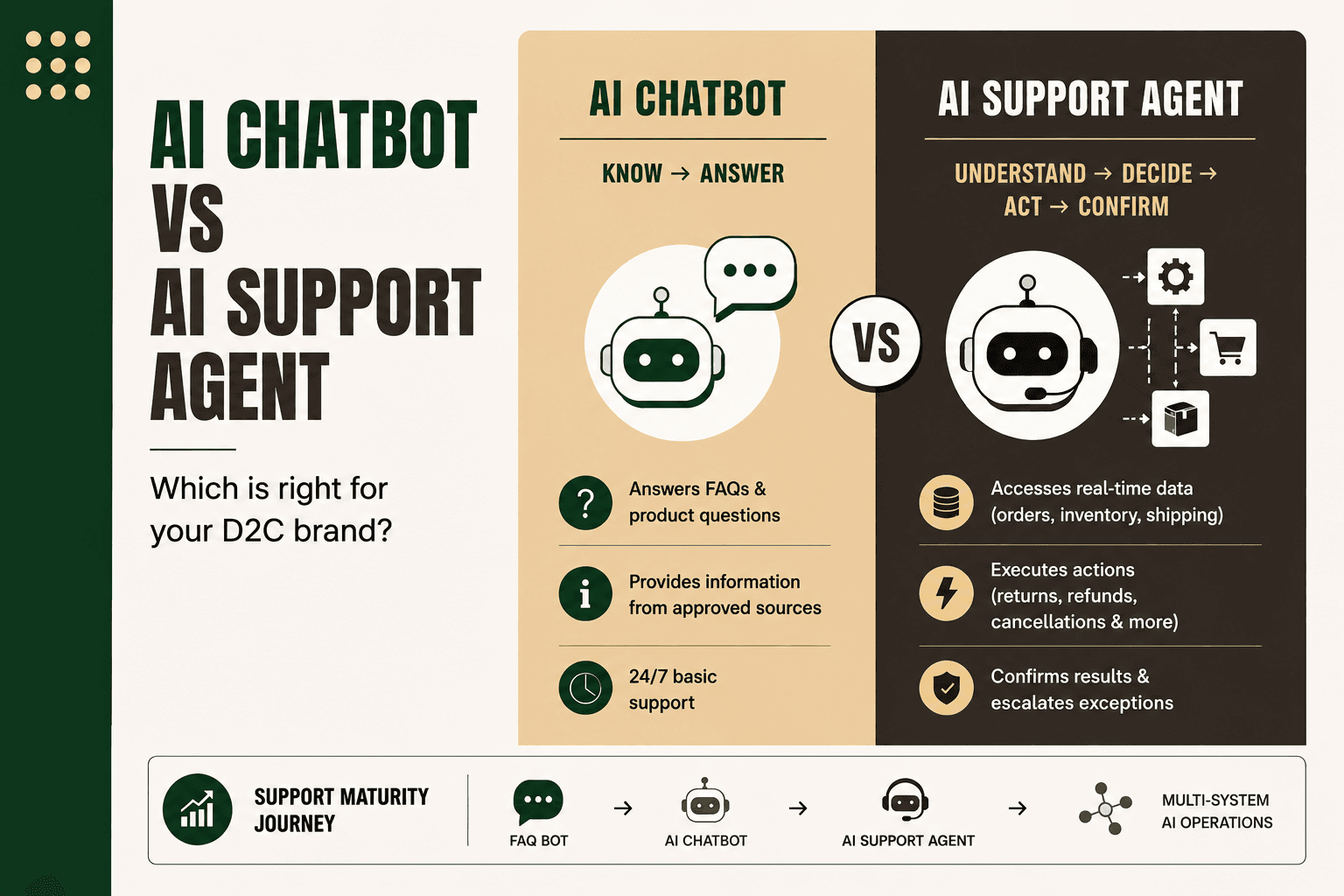
AI chatbot: Know → Answer
AI support agent: Understand → Decide → Act → Confirm
A chatbot can explain a return policy. An agent can potentially determine whether a specific order qualifies, retrieve the required information, initiate the approved workflow and confirm what happened.
Modern ecommerce support platforms illustrate this distinction. Gorgias documents AI Agent workflows that can handle post-purchase conversations such as returns, order tracking, cancellations and missing items, while its Actions can make changes in connected systems such as Shopify. Gorgias AI Agent documentation
Intercom's Fin for Ecommerce similarly supports post-purchase workflows involving order tracking, returns, refunds, exchanges and order updates or cancellations through configured procedures and Shopify integration. Intercom Fin for Ecommerce documentation
| Capability | AI Chatbot | AI Support Agent |
|---|---|---|
| Answer FAQs | Strong fit | Strong fit |
| Product questions | Strong fit | Strong fit |
| Order tracking | Usually informational | Can retrieve and interpret order status |
| Returns | Usually explains or routes | Can execute configured workflows |
| Refunds | Usually explains policy | Can perform approved actions in connected systems |
| Order changes | Limited | Can perform configured changes |
| System access | Often limited | Designed around connected business systems |
| Action execution | Usually limited | Core capability |
| Human escalation | Yes | Yes, when rules or confidence require it |
What an AI Chatbot Actually Does
An ecommerce chatbot is primarily a conversational information layer.
It can use product information, help-center content, policies and other approved knowledge to answer questions without requiring a human agent to respond to every conversation.
Typical chatbot use cases include:
- Shipping-policy questions
- Product specifications
- Sizing guidance
- Frequently asked questions
- Store policies
- Basic delivery information
- Product discovery
- Simple pre-purchase questions
This can still be valuable. Many support conversations do not require a system change. If a customer asks whether a product is machine washable, there may be no reason to connect an AI system to your ERP or order-management platform.
The chatbot can answer from approved information and stop there.
The problem begins when the business expects a chatbot to resolve operational requests that require access to live systems or permission to perform actions.
What an AI Support Agent Adds
An AI support agent introduces an execution layer.
Instead of simply responding with a tracking link, an agent can potentially identify the customer, retrieve the order, inspect shipping information, interpret the situation, communicate the next step and trigger an approved action.
Gorgias, for example, documents Shopify Actions that can allow its AI Agent to cancel an order, update a shipping address, remove or replace an item, reship an order and perform other configured operations. Its documentation also describes customer-confirmation controls and conditions that can restrict when an action runs. Gorgias Shopify Actions documentation
This is a different architecture from a simple chatbot.
Chatbot: “Here is the policy.”
Support agent: “I checked the order against the policy, verified the required information and can complete the approved next step.”
The value is not that the agent sounds more human. The value is that the workflow can potentially remove manual steps.
Why This Difference Matters More in Ecommerce
Ecommerce support sits on top of operational systems.
A customer conversation can depend on information stored in:
- Shopify
- ERP systems
- Order-management systems
- Inventory platforms
- Shipping and carrier systems
- Returns platforms
- Subscription platforms
- CRM systems
- Customer-support systems
This creates a fundamental distinction between answering and resolving.
If a customer asks, “What is your return policy?”, a knowledge-based response may be sufficient.
If the customer asks, “Can I return order 48291 and exchange the blue shirt for a medium?”, the system may need to identify the order, check eligibility, verify inventory and initiate a workflow.
That is no longer simply a conversation problem. It is an operational workflow.
An Illustrative Example: The Wrong-Size Request
Illustrative scenario: A customer says, “I ordered the wrong size. Can I change it?”
A chatbot might respond with the store's exchange policy and provide a link to the returns portal.
An AI support agent connected to the relevant systems could potentially:
- Identify the customer's order.
- Check whether the order is eligible for a change.
- Determine whether the original order has already shipped.
- Check whether the requested replacement is available.
- Ask for confirmation if the action requires customer approval.
- Update the order or initiate the approved exchange process.
- Confirm the result.
The important point is that the agent does not need to make every decision autonomously. A strong workflow can combine AI interpretation, deterministic rules, system integrations and human approval.
Chatbot = Information. Agent = Execution.
This framework is useful when deciding which technology your brand actually needs.
AI chatbot
Know → Answer
The system retrieves or generates an answer from approved information.
AI support agent
Understand → Decide → Act → Confirm
The system interprets the request, evaluates the available options within defined rules, performs an approved action and communicates the outcome.
This does not mean every AI support agent should have permission to execute everything.
In fact, the opposite is usually more sensible.
Actions should have explicit conditions, permissions, confirmation requirements and escalation paths. Gorgias documents configurable conditions and customer confirmation for actions, including automatic confirmation requirements for some irreversible outcomes. Gorgias AI Agent Actions documentation
When an AI Chatbot Is the Better Choice
An AI chatbot is often the better starting point when the operational problem is relatively simple.
1. Most support questions are informational
If customers primarily ask about products, shipping policies, sizing, ingredients, compatibility or store policies, a chatbot may cover a meaningful portion of the workload without requiring deep system integration.
2. Support volume is still low
If the support team receives a manageable number of conversations each day, the complexity of building and maintaining an agent connected to multiple systems may not be justified.
3. Your processes are not standardized
An agent needs clear rules before it can safely execute them. If returns, refunds or cancellations are handled differently by different support employees, the first project may need to be process standardization rather than AI execution.
4. Your operational data is not clean
An AI system cannot compensate for unreliable source data indefinitely. If order, inventory or customer information is inconsistent, connecting an agent to those systems can amplify operational problems instead of solving them.
5. You want a low-complexity entry point
A chatbot can be a useful first stage for learning which customer questions repeat, where knowledge gaps exist and which conversations should eventually become automated workflows.
When an AI Support Agent Makes More Sense
An AI support agent becomes more compelling when repetitive support requests require actual operational work.
1. Support volume is high
As conversation volume grows, repetitive manual actions can consume a large amount of support capacity.
2. The same actions happen repeatedly
Order tracking, address updates, returns, cancellations, refunds and replacement requests are strong candidates when the underlying policies are structured and the required systems are accessible.
3. Your ecommerce systems have usable APIs
An agent becomes much more useful when it can access authoritative operational data rather than relying on stale information copied into a knowledge base.
4. Your policies are explicit
For example, a cancellation workflow might depend on fulfillment status. A return workflow might depend on purchase date, product category or return eligibility.
Those conditions should be represented as deterministic rules rather than left entirely to model judgment.
5. Your goal is resolution, not ticket deflection
Reducing the number of conversations entering a support queue can be useful, but it is not the same as resolving the underlying customer need.
Zendesk's guidance on support metrics distinguishes ticket deflection from automated resolution, reinforcing the importance of measuring what actually happened to the customer's request rather than simply whether a ticket was avoided. Zendesk's ticket deflection and resolution guidance
Do Not Deploy an Agent Just Because You Can
More autonomy is not automatically better.
If a brand has a small support volume, inconsistent processes and fragmented operational data, deploying an agent across Shopify, ERP, shipping, returns and CRM may introduce more complexity than value.
A chatbot may provide a simpler and safer first step.
Likewise, an agent should not receive permission to perform high-impact actions simply because the technology supports them.
The better architecture is to separate responsibilities:
| Decision type | Preferred mechanism | Example |
|---|---|---|
| Static information | Knowledge retrieval | Return-policy explanation |
| Structured eligibility | Deterministic rules | Is this order eligible for cancellation? |
| Natural-language interpretation | AI | Understanding what the customer wants |
| Low-risk approved action | AI plus workflow action | Sending a return-portal link |
| High-impact exception | Human approval | Non-standard refund or policy exception |
| Audit trail | System automation | Recording what action occurred and when |
The Real Architecture Behind an AI Support Agent
An AI support agent should not be treated as a chatbot with more prompts.
A production ecommerce agent typically needs several layers.
- Conversation layer: Captures the customer's request through chat or another supported channel.
- Identity layer: Determines which customer and order the conversation relates to.
- Knowledge layer: Provides policies, product information and approved guidance.
- System integration layer: Retrieves current order, inventory, shipping or customer data.
- Decision layer: Applies business rules and determines whether an action is permitted.
- Action layer: Performs the approved operation through an API or connected system.
- Guardrail layer: Controls permissions, confirmation, limits, retries and escalation.
- Observability layer: Records outcomes, failures, escalations and important events.
This architecture explains why an AI agent can require significantly more implementation work than an FAQ chatbot.
What Should Stay Human?
The goal is not to eliminate human judgment from customer support.
The goal is to reserve it for situations where it provides more value.
Human approval is especially useful when:
- The customer is requesting an exception to policy.
- The financial impact is unusually high.
- The system data conflicts.
- The action is difficult to reverse.
- The customer's identity cannot be established reliably.
- The request involves sensitive information.
- The workflow falls outside the configured rules.
- The AI cannot establish sufficient confidence.
A well-designed agent should therefore have an explicit handoff policy, not merely a generic “talk to a human” button.
How to Choose Between a Chatbot and an AI Support Agent
Use this decision framework before selecting a platform or beginning an implementation.
Question 1: What percentage of support is informational?
If most conversations can be resolved with approved information, prioritize the chatbot layer.
Question 2: What percentage requires an action?
If many conversations require checking or changing data in Shopify, shipping, returns or other systems, an agent may have more potential.
Question 3: Are the actions standardized?
If support agents follow consistent rules, those workflows are easier to automate safely.
Question 4: Is the underlying data reliable?
Before granting an AI system access to operational systems, establish which system is authoritative for each piece of information.
Question 5: What is the cost of a wrong action?
An incorrect product recommendation and an incorrect refund do not have the same risk profile.
Use stricter controls as the consequence of error increases.
Question 6: Can the workflow be measured?
Define the operational outcome before implementation. Depending on the workflow, useful metrics can include first-response time, resolution time, automated resolution rate, escalation rate, repeat-contact rate, refund errors, return-processing time and customer satisfaction.
The D2C AI Support Maturity Curve
For most growing D2C brands, the choice does not have to be permanent.
A more useful model is a maturity curve:
FAQ Bot → AI Chatbot → AI Support Agent → Multi-System AI Operations
Phase 1: FAQ automation
Start with policies, product information and frequently asked questions.
Phase 2: AI chatbot
Allow the system to understand natural-language questions and provide contextual answers.
Phase 3: Connected support agent
Connect the chatbot to order, shipping and customer data so it can retrieve current information.
Phase 4: Controlled execution
Introduce approved actions such as returns, cancellations, address changes or other post-purchase workflows.
Phase 5: Multi-system operations
Connect the support workflow across ecommerce, ERP, inventory, shipping, returns and customer systems where the business case justifies the complexity.
This staged approach prevents a common mistake: trying to build a fully autonomous support operation before the basic processes, data and integrations are ready.
What Five Anchor Would Actually Implement
Problem: A D2C brand may have a chatbot that can answer customer questions but still requires support employees to perform the actual operational work.
Architecture: The next step is to connect customer conversations to the systems that contain authoritative order, inventory, shipping and returns information.
Implementation: Five Anchor's AI-powered customer operations approach can be structured around workflow mapping, system integrations, AI chat operations, returns and exchange automation, customer self-service, automated communication and ticket workflows.
The implementation should start by identifying the highest-volume repetitive requests, mapping the current workflow, defining business rules, connecting the required systems and establishing which actions require customer confirmation or human approval.
Business outcome: The objective is not simply to make the support bot sound better. It is to reduce the amount of manual work required to resolve eligible customer requests while maintaining control over high-risk decisions.
For a brand with Shopify, ERP, shipping and returns systems, this is where customer support becomes an infrastructure problem rather than only a conversational-AI problem.
Implementation Checklist for an AI Support Agent
- Map the support workflow: Identify triggers, systems, decisions, actions, exceptions and human handoffs.
- Establish a baseline: Measure conversation volume, repetitive requests, handling time, escalation rate and resolution outcomes.
- Classify requests: Separate informational questions from requests requiring system access or action.
- Identify authoritative data: Decide which system owns order, inventory, shipping, customer and returns information.
- Standardize policies: Convert important operational rules into explicit, testable conditions.
- Start with low-risk workflows: Begin with actions where the consequences of an error are limited and reversible.
- Add authentication: Ensure the agent has an appropriate method for establishing customer and order context.
- Define permissions: Give the agent access only to the systems and actions it actually needs.
- Add confirmation: Require customer or human approval for sensitive or irreversible actions where appropriate.
- Build escalation: Define exactly when the workflow must stop and route to a human.
- Log actions: Record important decisions, API actions, failures and handoffs.
- Pilot: Deploy one or two workflows before expanding the agent's authority.
- Measure: Track resolution quality, automation rate, escalation, errors and customer outcomes.
- Expand: Add additional workflows only after the initial system operates reliably.
What Not to Automate First
Some workflows look attractive but should usually come later.
- Complex policy exceptions
- High-value refunds without approval
- Ambiguous fraud-related cases
- Requests involving conflicting customer records
- Workflows with unreliable inventory or order data
- Processes that support agents themselves cannot explain consistently
- Actions with significant irreversible consequences
The first automation should ideally be high-volume, repetitive, well-defined and measurable.
How to Measure Whether the Agent Is Actually Working
A support AI project should not be judged by how many conversations the model can generate.
Measure the workflow.
| Metric | What it tells you | Why it matters |
|---|---|---|
| Automated resolution rate | How many eligible requests are resolved without human intervention | Shows actual execution |
| Escalation rate | How often the workflow requires a human | Shows where automation boundaries remain |
| Resolution time | How quickly the customer issue is completed | Measures operational speed |
| Repeat contact | Whether customers need to ask again | Tests resolution quality |
| Action error rate | How often automated actions are incorrect | Protects operational quality |
| Customer satisfaction | How customers perceive the resulting experience | Prevents optimization for automation at the expense of CX |
| Cost per resolved request | Operational resource required for resolution | Connects automation to economics |
One useful principle is to distinguish deflection from resolution. A conversation that disappears from the support queue is not necessarily a successful outcome if the customer still has to complete the work elsewhere.
The Hidden Risks of AI Support Agents
Hallucination
An agent can generate plausible language even when the underlying information is wrong. Critical operational answers should therefore be grounded in authoritative systems or controlled knowledge.
Bad source data
If inventory or order status is incorrect, the agent can make a technically coherent response that is operationally wrong.
Over-permissioning
Giving an agent broad access to systems increases the consequences of an incorrect decision. Permissions should be limited to the workflows it is authorized to perform.
Policy ambiguity
If the return policy is unclear to humans, it will be difficult to encode reliably for an AI workflow.
Integration failure
APIs fail. Webhooks arrive late. Shipping information can be incomplete. Production workflows need retries, fallbacks and escalation paths.
Maintenance
Product catalogs change, policies change, APIs change and business processes change. An AI support agent is an operational system that requires ongoing monitoring and maintenance.
Chatbot or Agent? A Practical Decision Rule
Choose an AI chatbot when:
- Most questions are informational.
- Support volume is relatively low.
- Processes are still evolving.
- Operational data is not yet reliable enough for autonomous actions.
- You want a simple first AI deployment.
Choose an AI support agent when:
- Support volume is high.
- Many requests are repetitive.
- Customers frequently need post-purchase actions.
- Shopify, shipping, returns or other operational systems expose usable integrations.
- Policies and workflows are standardized.
- You want to automate resolution rather than simply answer questions.
Choose a staged approach when:
- You need to prove value before increasing system complexity.
- Your data and processes are improving but not fully mature.
- You want to start with FAQs and gradually introduce system actions.
- You want human approval to remain part of the workflow while the agent's capabilities expand.
Conclusion
The question is not whether an AI chatbot or AI support agent is universally better.
The question is what level of customer-service automation your ecommerce operation is ready to support.
A chatbot is useful when customers primarily need information. An AI support agent becomes more valuable when customers need issues resolved through connected systems and defined workflows.
The strongest implementation is rarely “AI everywhere.” It is a controlled combination of AI for natural-language understanding, deterministic rules for predictable decisions, integrations for authoritative data, workflow actions for execution and humans for exceptions that require judgment.
For a growing D2C brand, the sensible path is usually to start with repetitive, low-risk support requests, establish a baseline, connect reliable data sources and then expand the agent's authority one workflow at a time.
The real upgrade is not from chatbot to agent. It is from answering customers to reliably resolving their requests.
Key Takeaways
- •An AI chatbot is primarily an information and conversation layer; an AI support agent adds decision and execution capabilities.
- •The practical distinction is Know → Answer versus Understand → Decide → Act → Confirm.
- •Chatbots are often sufficient for FAQs, product questions and basic policy information.
- •AI support agents become more useful for order tracking, returns, cancellations, refunds, address changes and other operational workflows.
- •AI should not replace deterministic business rules or human approval for high-risk decisions.
- •Reliable operational data and usable integrations are prerequisites for meaningful agent execution.
- •A staged maturity path from FAQ bot to chatbot to connected agent can reduce implementation risk.
- •Measure automated resolution, escalation, resolution time, repeat contact, action errors and customer outcomes rather than only ticket deflection.
AI Chatbot vs AI Support Agent for Ecommerce
| Capability | AI Chatbot | AI Support Agent |
|---|---|---|
| Inventory Sync Frequency | 15–30 min batch polling (high oversell risk) | Sub-second atomic locking (<450ms) |
| Concurrent Drop Resilience | Fails under concurrency; causes negative stock balance | Redis atomic reservation queue guarantees exact counts |
| Error Handling & Retries | Silent failure; manual CSV audit needed | Dead-letter queues with automated exponential retry |
| Fulfillment Routing Speed | 2–4 hours delayed batch export to 3PL warehouse | Instantaneous automated webhook dispatch (<90 sec) |