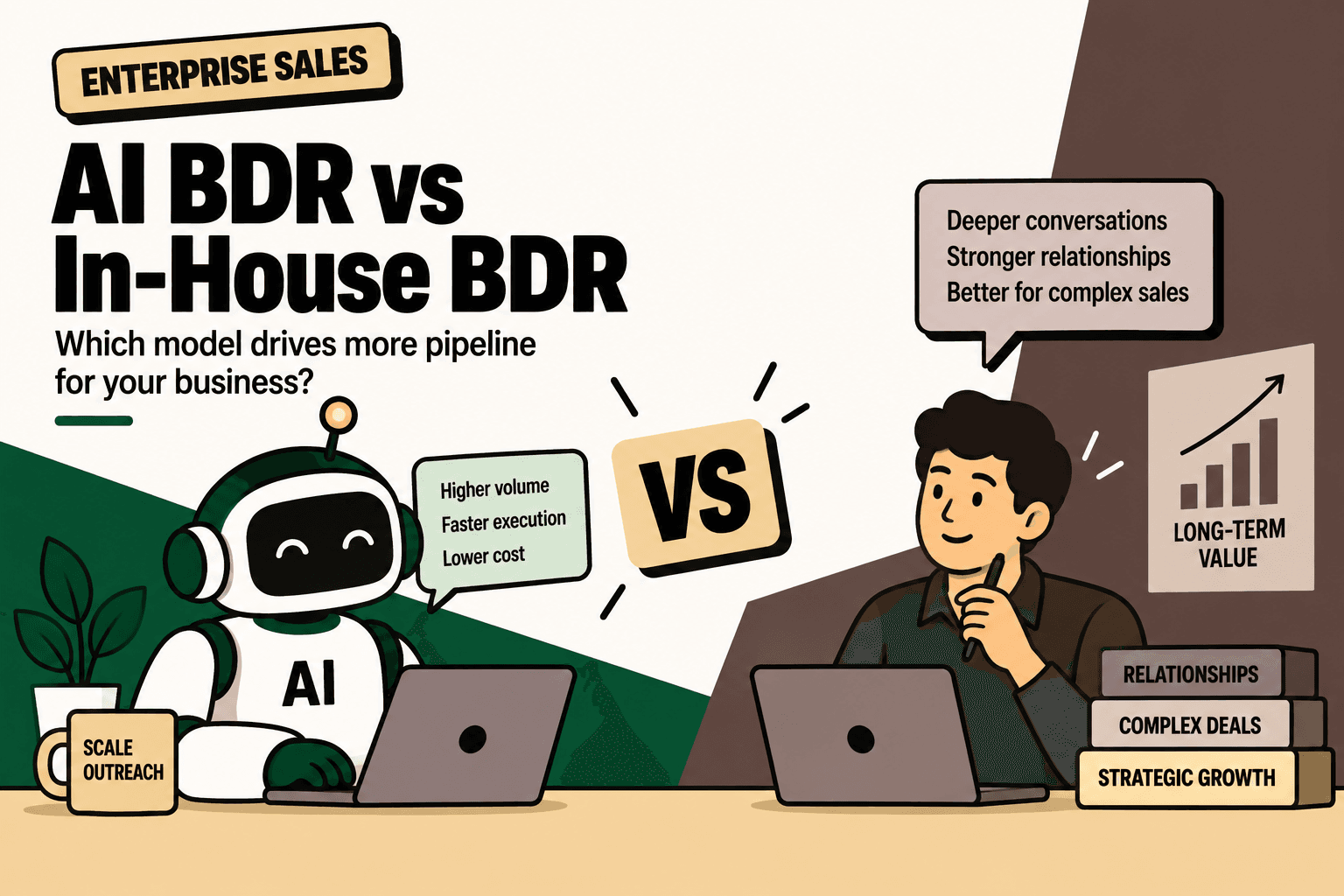
AI BDR vs In-House BDR: What Are You Actually Comparing?
The AI BDR vs in-house BDR decision is not really a choice between software and people. It is a decision about which parts of the business-development workflow should be automated, which require human judgment, and what operating model produces the lowest cost per qualified opportunity.
An AI BDR can automate prospect research, account enrichment, outreach, follow-ups, qualification and meeting scheduling. An in-house BDR can develop account knowledge, handle nuanced conversations, build relationships and adapt to situations that do not fit a predefined workflow.
The strongest question is therefore not “Can AI replace a BDR?” It is “Which BDR activities create more value when performed by software, and which become more valuable when performed by a person?”
Research from Gartner says commercially available AI SDRs are viable for repetitive inbound and outbound selling tasks at scale. Gartner's Innovation Insight: AI SDR Agents for Inbound and Outbound Sales Communication
McKinsey's 2026 research points toward a similar operating-model shift: AI agents can take on more searching, synthesizing, drafting and administrative work while sellers concentrate on relationship building, problem solving and judgment-heavy customer conversations. McKinsey's 2026 B2B sales research
AI BDR vs In-House BDR: Quick Comparison
| Factor | AI BDR | In-House BDR |
|---|---|---|
| Cost structure | Software, data, infrastructure, implementation and oversight | Compensation, benefits, tools, management, recruiting and ramp |
| Ramp time | Can be configured and tested relatively quickly | Usually requires recruiting, onboarding, training and coaching |
| Availability | Can operate continuously | Limited by working hours and team capacity |
| Prospecting volume | Highly scalable | Constrained by rep capacity |
| Research | Can automate repetitive research and enrichment | Can perform deeper contextual research manually |
| Follow-up consistency | Programmatic and persistent | Depends on process and rep execution |
| Personalization | Scalable and data-driven | Potentially deeper and more nuanced |
| Complex objections | Limited by data, reasoning and workflow design | Strongest when judgment and context are required |
| Relationship building | Limited | Strong |
| Scalability | High once infrastructure is reliable | Requires additional hiring and management |
| Management overhead | Lower headcount management but requires monitoring and optimization | Recruiting, coaching, performance management and retention |
The table shows why a simple salary-versus-software comparison is incomplete. The two models have different cost structures, capabilities and failure modes.
What Is an AI BDR?
An AI BDR is an AI-enabled sales development system that performs some of the repetitive activities traditionally handled by business development representatives. Depending on the platform, this can include identifying prospects, researching accounts, enriching contact information, generating personalized outreach, executing sequences, following up, qualifying responses and scheduling meetings.
The basic workflow looks like this:
- Define the ideal customer profile.
- Identify potential accounts.
- Research company and buyer signals.
- Enrich account and contact information.
- Generate an outreach angle.
- Send or initiate the approved outreach.
- Monitor responses.
- Run follow-ups.
- Classify intent and qualification signals.
- Book or route qualified meetings.
This makes AI BDRs particularly relevant when the bottleneck is volume, speed or repetitive execution.
Gartner's research specifically identifies repetitive inbound and outbound selling tasks as a viable application for commercially available AI SDR technology. Gartner
What Is an In-House BDR?
An in-house BDR is a human sales-development representative employed and managed directly by the company. The BDR typically works inside the company's sales process, CRM, messaging framework and management structure.
An in-house BDR can perform the same broad top-of-funnel activities as an AI BDR, but the operating characteristics are different. A person can notice an unusual business situation, ask a clarifying question, change the approach during a conversation and build contextual knowledge over time.
The trade-off is capacity. A human representative has finite working hours and must spend time on research, administration, training, meetings, follow-ups and internal coordination in addition to direct prospecting.
Where AI BDRs Have the Strongest Advantage
1. Prospecting at High Volume
If a sales team needs to evaluate thousands of potential accounts, manual research can become a throughput constraint. An AI workflow can continuously process predefined prospect criteria and prepare accounts for review or outreach.
The value does not come from contacting as many people as possible. It comes from increasing the number of relevant accounts that can be researched and worked without increasing human workload at the same rate.
2. Repetitive Account Research
AI can be useful when research follows a repeatable structure. For example, the workflow may look for company size, industry, technology signals, hiring activity, product launches, geographic presence or other defined buying signals.
The quality of the result depends heavily on the data sources, enrichment process and rules. An AI agent working from poor or outdated data can simply produce incorrect research faster.
3. Consistent Follow-Up
Follow-up is a process problem as much as a people problem. If every prospect is supposed to receive a particular sequence based on response behavior, an automated workflow can execute the cadence consistently.
That does not mean every prospect should receive the same number of messages. Good automation should include suppression rules, response detection, qualification logic, frequency controls and escalation paths.
4. Continuous Operation
Software can operate outside conventional working hours, making it useful for monitoring responses, processing new accounts and maintaining workflows across time zones.
5. Scaling Without Linear Hiring
A human BDR team generally grows by adding people as the addressable workload increases. An AI workflow can often increase throughput without adding a representative for every additional segment, although software, data, infrastructure and oversight costs still increase.
Where In-House BDRs Still Have the Advantage
Complex Objections
When prospects raise objections involving commercial strategy, organizational politics, implementation risk, procurement, technical architecture or competing priorities, the value of human judgment increases.
Relationship Building
Some buying processes depend on trust accumulated across multiple interactions. A human representative can develop interpersonal context that is difficult to encode into an automated sequence.
Enterprise Account Development
Large accounts often involve multiple stakeholders, different priorities and changing internal dynamics. The job may become less about generating another meeting and more about understanding the account's decision structure.
Nuanced Discovery
A strong human BDR can recognize when a prospect's stated problem is not the real buying problem and adapt the conversation accordingly.
Brand-Sensitive Conversations
When the first interaction materially affects brand perception, businesses may prefer human involvement, particularly for strategic accounts or high-value prospects.
McKinsey's 2026 research explicitly emphasizes that AI does not make the human side of B2B sales less important. Instead, AI can shift human effort toward relationship building, problem solving and judgment-rich conversations. McKinsey
The Real Cost of an In-House BDR
One of the most common mistakes in this comparison is using salary as the complete cost of a human BDR.
Human BDR cost = compensation + benefits + sales tools + management + recruiting + onboarding + training + ramp time + attrition cost.
One 2026 vendor analysis estimates that a fully loaded US human SDR or BDR can cost approximately $120,000 to $200,000 per year when compensation and associated costs are included. Because this is vendor-published market analysis rather than an independent compensation study, it should be treated as a reference range rather than a universal benchmark. Artisan's 2026 AI SDR pricing analysis
The same source estimates that human reps commonly take several months to ramp, which means the first-year economics can differ significantly from the economics of a fully productive representative. Artisan
These figures should not be copied into a business case without replacing them with the company's actual compensation, benefits, management structure, technology stack, recruiting costs and productivity data.
The Real Cost of an AI BDR
AI BDR economics are also broader than the monthly software subscription.
AI BDR cost = software + data + infrastructure + implementation + integration + monitoring + human oversight.
Published AI BDR pricing varies substantially by provider and pricing model. Vendor research describes models ranging from monthly subscriptions to usage- or outcome-based pricing. Artisan's AI SDR pricing analysis
An AI BDR may also require additional systems for contact data, enrichment, email infrastructure, CRM synchronization, domain management, deliverability monitoring, analytics and human review.
This means an organization should not compare a software plan with a salary in isolation. The relevant comparison is the cost of producing an equivalent business outcome.
Compare Cost Per Qualified Opportunity, Not Cost Per Seat
The most useful economic metric is usually cost per qualified opportunity or cost per sales-accepted meeting, not the cost of the BDR itself.
For a human team, calculate:
- Total compensation
- Benefits and employment costs
- Sales technology
- Management allocation
- Recruiting and onboarding
- Ramp-period productivity
- Attrition and replacement costs
For an AI workflow, calculate:
- AI platform cost
- Prospect and enrichment data
- Infrastructure
- Implementation
- CRM and sales-tool integrations
- Monitoring and quality assurance
- Human oversight
Then connect those costs to actual output:
Cost per qualified opportunity = total operating cost ÷ qualified opportunities produced.
This prevents a low-cost automation from appearing attractive when it produces poor-quality meetings and prevents an expensive human team from appearing inefficient when it consistently produces high-value opportunities.
Illustrative ROI Scenario
Illustrative scenario: Suppose a company spends $150,000 annually on the fully loaded cost of one BDR and that representative produces 150 sales-qualified opportunities in a year. The direct operating cost would be $1,000 per qualified opportunity before considering differences in opportunity quality or downstream conversion.
Now suppose an AI BDR workflow costs $30,000 annually across software, data, infrastructure and oversight and produces 100 qualified opportunities. Its operating cost would be $300 per qualified opportunity.
That does not prove the AI workflow is better. If the human-generated opportunities convert at a substantially higher rate or produce larger accounts, the higher cost per opportunity may still create more economic value.
The correct next calculation is therefore cost per qualified opportunity → opportunity-to-pipeline conversion → pipeline-to-revenue conversion → contribution margin.
AI BDR vs In-House BDR: Personalization
Personalization is often presented as a simple AI advantage, but there are two different kinds of personalization.
Programmatic personalization uses structured signals to generate individualized messaging at scale. AI can combine account information, industry, role, product interest and other approved signals into an outreach message.
Contextual personalization comes from understanding the prospect's situation deeply enough to change the sales approach. Human BDRs can sometimes recognize subtleties that are difficult to encode into a repeatable workflow.
Therefore, the meaningful question is not whether AI can personalize. It can. The question is how much context is required before personalization creates more value than automation can reliably deliver?
AI BDR vs In-House BDR for Different Sales Motions
| Sales situation | More suitable starting point | Reason |
|---|---|---|
| High-volume outbound prospecting | AI BDR | Repetitive research and follow-up can be systematized |
| SMB or transactional sales | AI-heavy model | Lower complexity can make automation easier to standardize |
| Mid-market qualification | Hybrid | AI can handle volume while humans handle qualified conversations |
| Enterprise accounts | Human-led with AI support | Multiple stakeholders and higher contextual complexity |
| Highly technical products | Hybrid | AI can research and prepare while humans handle deeper discovery |
| Relationship-driven sales | Human-led | Trust and interpersonal context carry greater weight |
| Large-scale account research | AI-assisted | Machines can process large amounts of structured and unstructured information |
The Strongest Model Is Often AI BDR + Human Sales
The research points toward a model in which AI and humans perform different parts of the same revenue workflow.
AI handles volume. Humans handle value.
An AI BDR can:
- Build and refresh ICP account lists.
- Research companies and buying signals.
- Enrich prospect records.
- Identify potential decision-makers.
- Draft personalized outreach.
- Execute approved sequences.
- Monitor replies.
- Classify basic intent signals.
- Schedule qualified meetings.
A human BDR, AE or sales specialist can:
- Handle nuanced discovery.
- Understand complex objections.
- Build relationships.
- Map stakeholders.
- Shape the solution.
- Navigate commercial complexity.
- Manage negotiation.
- Close or advance strategic opportunities.
McKinsey's 2026 B2B sales research describes this broader shift toward human-agent teams, with agents supporting opportunity identification, account planning, outreach and other workflows while sellers concentrate on higher-value customer interactions. McKinsey
AI BDR vs In-House BDR: A Better Decision Framework
Instead of choosing based on enthusiasm for AI or resistance to automation, evaluate the workflow against five dimensions.
1. Volume
How many accounts, contacts, messages or follow-ups must the team process?
2. Frequency
How often does the same activity repeat?
3. Manual Effort
How much human time is spent researching, writing, updating CRM records and following up?
4. Error Cost
What happens when the workflow produces a wrong message, poor qualification or incorrect account decision?
5. Revenue Impact
Does the activity directly influence qualified pipeline, conversion, revenue or margin?
A practical prioritization model is:
Priority = volume × frequency × manual effort × error cost × revenue impact ÷ implementation complexity.
This is a practical decision framework, not an industry-standard formula. Its purpose is to identify workflows where automation has enough economic leverage to justify the implementation effort.
What Should Be Automated First?
The best first workflow is rarely “replace the entire BDR team.” A better starting point is one narrow, repetitive workflow with measurable output.
- Map: Document the trigger, inputs, systems, decisions, actions, exceptions, human handoffs and outputs.
- Baseline: Measure volume, frequency, manual time, response time, current conversion and operating cost.
- Prioritize: Select the workflow with the strongest combination of volume, repeatability and business impact.
- Classify: Decide which steps require deterministic automation, AI reasoning, human approval or human-only handling.
- Connect: Integrate the CRM, data providers, outreach systems and other required tools.
- Guardrail: Define permissions, suppression rules, approval thresholds, escalation conditions and monitoring.
- Pilot: Run the workflow on a controlled segment.
- Measure: Compare quality and economics against the existing process.
- Scale: Expand only after reliability and business value are demonstrated.
What an AI BDR Should Not Do Autonomously
More autonomy is not automatically better. Certain decisions have consequences that justify deterministic rules or human approval.
| Decision | Recommended control | Reason |
|---|---|---|
| Account research | AI with source and quality controls | High volume but data quality matters |
| Outreach drafting | AI with approved messaging rules | Scale is useful but brand risk remains |
| Follow-up timing | Rules plus AI signals | Should respect responses and suppression rules |
| Lead qualification | AI plus explicit criteria | Qualification can be structured but should be auditable |
| Strategic account prioritization | AI recommendation plus human review | High-value accounts require contextual judgment |
| Pricing or commercial commitments | Rules and human approval | Financial and contractual impact |
| Sensitive customer escalation | Human | Reputational and relationship risk |
Implementation Risks
Bad Data Creates Bad Outreach
An AI BDR is only as useful as the data supplied to it. Incorrect titles, outdated company information or weak buying signals can produce highly personalized messages that are personalized to the wrong facts.
Automation Can Increase Volume Without Increasing Quality
More outbound activity is not the same as more pipeline. Teams should monitor positive reply rate, qualified opportunity rate, meeting acceptance, opportunity conversion and downstream revenue rather than measuring activity alone.
Deliverability Becomes an Operating Concern
High-volume automated outreach requires careful controls around sending infrastructure, domain reputation, consent, suppression and messaging frequency. Automation should not be treated as permission to maximize contact volume.
Human Oversight Does Not Disappear
An AI BDR reduces some manual work but introduces new responsibilities: workflow monitoring, prompt and rule maintenance, data quality management, exception handling and performance analysis.
Change Management Matters
McKinsey's 2026 research argues that companies capturing value from agentic AI are redesigning workflows and operating models rather than simply adding AI tools on top of existing processes. McKinsey
How Five Anchor Approaches AI Sales Automation
Five Anchor's positioning is AI Infrastructure for D2C & E-Commerce, so the relevant lesson from the AI BDR debate is broader than sales development itself: automation should be implemented as a connected workflow rather than as an isolated AI tool.
For a business evaluating an AI-led prospecting workflow, the same implementation principles apply: map the process, connect the required systems, define what the agent can and cannot do, add human escalation, monitor outcomes and continuously improve the workflow. Five Anchor's broader custom AI workflow and commerce-infrastructure capabilities can support this type of system orchestration when sales automation intersects with ecommerce, CRM or operational systems.
Five Anchor POV: The practical opportunity is not to remove every human from the top of the funnel. It is to remove low-value coordination so people can spend more time on conversations where context, trust and commercial judgment actually change the outcome.
How to Measure an AI BDR After Deployment
A pilot should use a balanced scorecard rather than one headline metric.
- Accounts researched per period
- Qualified contacts identified
- Positive reply rate
- Meeting-booked rate
- Sales-accepted meeting rate
- Qualified opportunity rate
- Pipeline created
- Pipeline conversion
- Revenue influenced
- Cost per qualified opportunity
- Human hours saved
- Escalation rate
- Data error rate
- Opt-out or complaint rate
The most important measurement depends on the bottleneck. If the business cannot generate enough qualified accounts, measure opportunity creation. If it has enough accounts but poor follow-up, measure response and meeting conversion. If meetings are plentiful but low quality, measure sales acceptance and downstream conversion.
When Should You Choose an AI BDR?
An AI BDR is a strong candidate when:
- The company has a large addressable prospect universe.
- Prospecting follows repeatable criteria.
- Research is time-consuming but structurally similar.
- Follow-up consistency is a bottleneck.
- The company needs greater outbound coverage.
- Lead qualification can be defined with explicit rules.
- The business can provide reliable data and integrations.
- The economic value of additional coverage exceeds the implementation and oversight cost.
When Should You Choose an In-House BDR?
An in-house BDR is usually more appropriate when:
- The sales cycle depends heavily on relationships.
- Accounts are strategically important and relatively few.
- Qualification requires substantial judgment.
- Prospects have complex objections.
- Multiple stakeholders influence the buying decision.
- Product or industry context is difficult to encode.
- Brand-sensitive conversations require human ownership.
- The organization needs people who can learn from customers and feed those insights back into the sales strategy.
When Should You Use a Hybrid Model?
A hybrid model is often the strongest choice when the business needs both scale and judgment.
One practical structure is:
- AI identifies and researches potential accounts.
- AI prepares account context and an outreach recommendation.
- AI handles approved low-risk outreach and follow-up.
- AI detects positive buying signals.
- Qualified responses move to a human BDR or AE.
- The human handles discovery, objection management and relationship building.
- Conversation outcomes are written back into the CRM.
- AI uses approved historical data to improve future prioritization and preparation.
This creates a continuous workflow rather than two disconnected teams.
The Strategic Shift: From BDR Headcount to Revenue Capacity
The most useful way to think about AI BDR adoption is as a change in revenue capacity.
A traditional model asks: How many BDRs should we hire?
An AI-enabled model asks: How much qualified pipeline do we need, what activities create that pipeline, and which parts of those activities should be performed by people, software or both?
That change in framing matters because headcount is only one input into sales productivity. A smaller team with better workflow infrastructure may outperform a larger team burdened by manual research, disconnected systems and inconsistent follow-up. Conversely, an automated system can generate large amounts of low-quality activity if the underlying ICP, data and qualification process are weak.
Final Verdict: AI BDR vs In-House BDR
AI BDRs win on repetitive volume, speed, consistency and scalable execution. In-house BDRs win on nuanced qualification, relationship building, complex objections and contextual judgment.
That makes “AI BDR vs in-house BDR” a misleading binary for many companies. The better model is to identify which parts of the revenue workflow benefit from automation and which parts require human judgment.
Gartner's research supports AI SDRs for repetitive inbound and outbound selling tasks, while McKinsey's current B2B sales research emphasizes redesigned human-agent workflows rather than simple technology substitution. Gartner McKinsey
The decision should therefore be based on cost per qualified opportunity, opportunity quality, pipeline contribution, implementation complexity and the value of human judgment rather than the monthly AI subscription or BDR salary alone.
For companies with high-volume, repeatable prospecting, an AI BDR can become a meaningful layer of revenue infrastructure. For complex sales organizations, the strongest outcome is often a human-led sales team supported by AI that handles research, preparation, outreach coordination and repetitive follow-up.
The objective is not to automate the sales team. It is to design the sales workflow so that every hour of human effort is spent where it has the greatest commercial value.
Key Takeaways
- •AI BDRs are best suited to repetitive, high-volume prospecting, research, outreach and follow-up workflows.
- •In-house BDRs retain an advantage when sales depend on complex objections, relationships, nuanced discovery or strategic accounts.
- •The relevant economic comparison is cost per qualified opportunity and downstream pipeline value, not BDR salary versus AI subscription.
- •AI BDR economics include software, data, infrastructure, implementation and human oversight.
- •A practical prioritization model is volume × frequency × manual effort × error cost × revenue impact ÷ implementation complexity.
- •For many scaling sales organizations, the strongest operating model is AI for volume and humans for judgment.
AI BDR vs In-House BDR
| Feature | AI BDR | In-House BDR |
|---|---|---|
| Inventory Sync Frequency | 15–30 min batch polling (high oversell risk) | Sub-second atomic locking (<450ms) |
| Concurrent Drop Resilience | Fails under concurrency; causes negative stock balance | Redis atomic reservation queue guarantees exact counts |
| Error Handling & Retries | Silent failure; manual CSV audit needed | Dead-letter queues with automated exponential retry |
| Fulfillment Routing Speed | 2–4 hours delayed batch export to 3PL warehouse | Instantaneous automated webhook dispatch (<90 sec) |