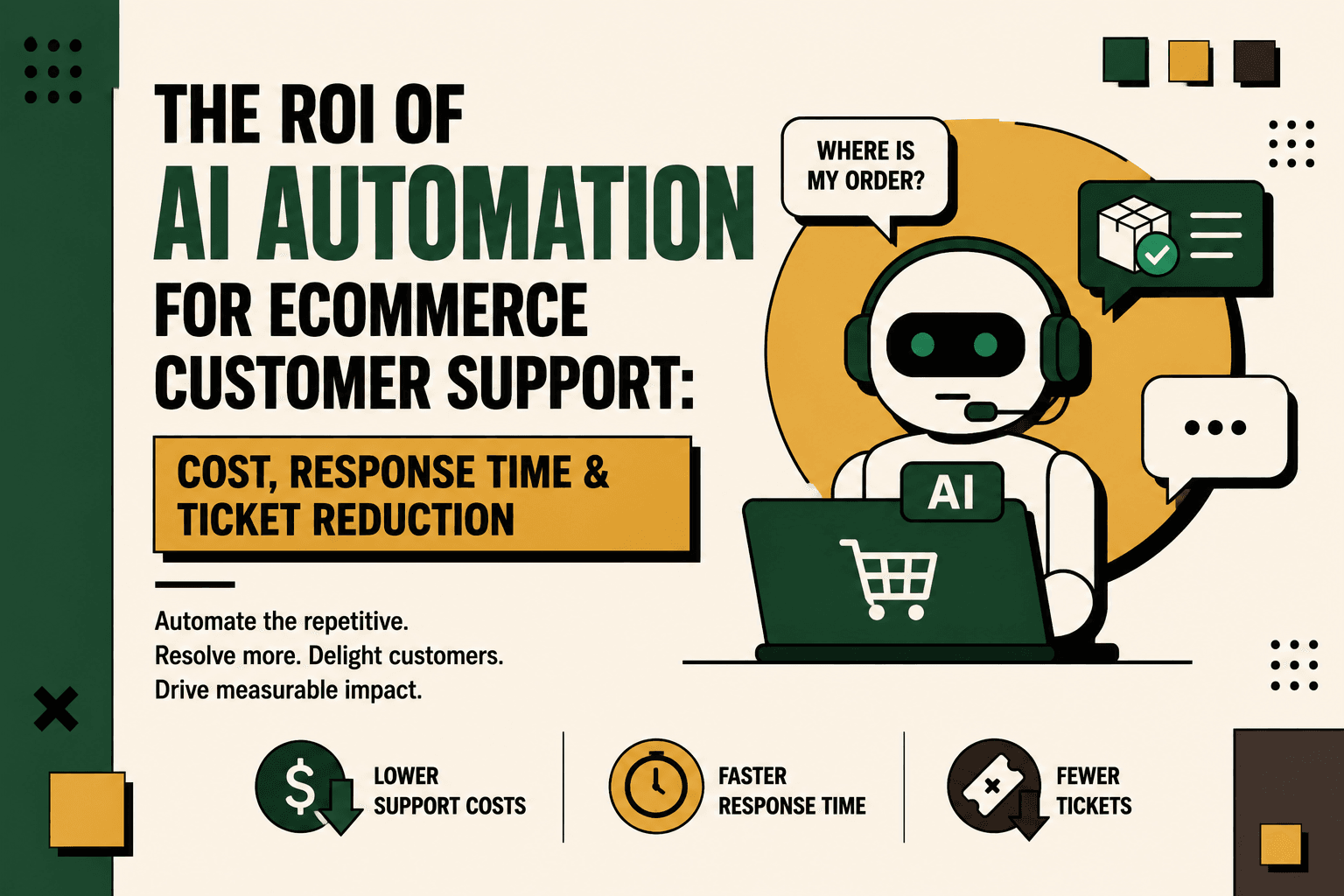
For ecommerce brands, the ROI of AI customer support is not simply about answering customers faster. The stronger business case comes from changing the economics of the support workflow: resolving repetitive issues without an agent, reducing handling effort, shortening response times and allowing human teams to concentrate on exceptions.
That distinction matters because a support chatbot can generate thousands of conversations without creating meaningful savings if customers still need to contact the team again. The useful metric is not how many conversations AI touches. It is how many customer problems it resolves reliably.
The practical question is: how much support cost and operational capacity can an ecommerce brand improve without reducing service quality?
This article provides a framework for answering that question using ticket volume, cost per interaction, response time, resolution rate, automation rate and the full cost of implementation.
What AI Customer Support ROI Actually Means
AI customer support ROI is the measurable economic benefit created when AI changes how customer-service work is performed, minus the cost of building, operating and maintaining the automation.
For ecommerce, the main value usually comes from five areas:
| ROI lever | What changes | Business effect |
|---|---|---|
| Cost per resolution | AI handles repetitive interactions | Lower manual handling cost |
| Response time | AI responds immediately to supported requests | Faster customer resolution |
| Ticket volume | Customers resolve issues through self-service | Smaller human queue |
| Agent productivity | Agents spend less time on repetitive work | More capacity per agent |
| Scalability | Automation absorbs additional demand | Less proportional staffing pressure |
These levers overlap, but they should not be treated as the same metric. A reduction in ticket volume is valuable only when customers actually get their problems solved. A faster first response is valuable only if it contributes to faster resolution or a better customer outcome.
Five Anchor POV: The economic unit to measure is therefore not the AI conversation. It is the resolved customer workflow.
The Three Numbers That Matter Most
For an ecommerce support operation, three metrics provide a useful starting point: cost per resolution, response time and resolution rate.
1. Cost per resolution
Cost per resolution estimates what the business spends to successfully solve a customer issue. It can include agent time, management overhead, support software and other operational costs that are meaningfully attributable to the workflow.
AI can reduce this cost when it resolves appropriate interactions without requiring the same amount of human effort.
2. Response time
AI can respond immediately to supported requests, particularly when the workflow is connected to reliable order, shipping, product and policy information.
McKinsey estimates that generative AI applied to customer-care functions could increase productivity by a value equivalent to 30% to 45% of current function costs. The estimate covers customer-care productivity broadly rather than ecommerce-specific AI agents, so it should be treated as research evidence rather than a D2C benchmark. McKinsey's research on the economic potential of generative AI
3. Resolution rate
Resolution is more important than simple deflection. Zendesk distinguishes ticket deflection from true resolution: sending a customer away from the support queue does not create value if the underlying problem remains unsolved or the customer has to contact support again. Zendesk's analysis of ticket deflection versus resolution
Practical rule: Measure the percentage of eligible conversations that AI resolves successfully without requiring another support interaction.
Where Ecommerce Support Costs Actually Come From
Support cost is rarely just the salary of a customer-service representative.
An ecommerce support operation can also carry costs associated with:
- Hiring and training
- Helpdesk and communication software
- Quality assurance
- Support management
- Order-status requests
- Shipping and delivery questions
- Returns and refunds
- Warranty requests
- Product and policy questions
- Escalations between support and operations
- Peak-season staffing
- After-hours coverage
The most attractive AI opportunities are usually not the most complicated customer conversations. They are the repetitive workflows that occur frequently enough to create meaningful aggregate cost.
Typical examples include:
- “Where is my order?”
- “Has my order shipped?”
- “What is my delivery date?”
- “How do I return this?”
- “Has my refund been processed?”
- “What is your return policy?”
- “Can I exchange this size?”
- “What is the warranty policy?”
These workflows become more valuable to automate when the AI can retrieve live operational information rather than relying only on static knowledge-base content.
Why Ecommerce Support Is Different From Generic Customer Service
Ecommerce support is unusually dependent on operational data.
A customer asking “Where is my order?” does not primarily need a conversational answer. They need current information about a specific order.
A customer asking about a return may need the system to determine eligibility based on order date, product, fulfillment status, return policy and potentially the reason for the return.
That creates an important architecture principle:
AI should interpret the customer's request, while connected commerce systems provide the facts and deterministic rules control permitted actions.
A useful support architecture can therefore look like:
Customer → AI support layer → Shopify / ERP / OMS / shipping / returns data → business rules → action or human escalation
Without those connections, AI may reduce typing effort while leaving the underlying support work unchanged.
The Biggest ROI Opportunity: Repetitive Post-Purchase Support
Post-purchase support is often a strong starting point because customers repeatedly ask about the same operational events.
Consider the workflow for an order-status question:
- The customer asks for an update.
- The support system identifies the order.
- The system retrieves fulfillment and tracking information.
- The workflow interprets the current status.
- The customer receives an explanation and relevant next step.
- Unusual cases are escalated to a human.
A human agent performing this process for every request creates repeated lookup work. An AI workflow can perform the retrieval and explanation automatically when the underlying data is available and reliable.
The ROI comes from removing repeated manual work, not from adding a chatbot interface.
Ticket Reduction: How to Calculate the Opportunity
A simple first-pass model is:
Automated resolutions = Monthly support volume × Eligible repetitive share × Successful AI resolution rate
Then:
Gross support capacity value = Automated resolutions × Human cost per resolution
Finally:
Net monthly benefit = Gross support capacity value − AI operating and maintenance cost
These equations are deliberately simple. A serious business case should also account for implementation, integration, monitoring, human escalation and any measurable effect on revenue or customer retention.
Illustrative Ticket-Reduction Scenario
Illustrative scenario: Assume an ecommerce brand receives 50,000 support conversations per month. Suppose 60% are repetitive or transactional, and an AI workflow successfully resolves 40% of those eligible conversations.
The potential automated resolution volume would be:
50,000 × 60% × 40% = 12,000 automated resolutions per month.
If the average human-handled resolution costs $4, the illustrative gross capacity value would be:
12,000 × $4 = $48,000 per month.
This is a hypothetical calculation, not an ecommerce benchmark or expected result. The actual value depends on the brand's ticket mix, labor cost, eligible workflow share, AI resolution quality and implementation cost.
The calculation is useful because it shows what must be measured before deployment: volume, repetitive share, human cost and realistic automation performance.
Ticket Deflection Is Not the Same as Ticket Resolution
This is one of the most important distinctions in an AI support ROI model.
Suppose an AI assistant tells a customer to visit a help-center article. The support queue may show one fewer ticket, but the customer may still be confused and contact the business again through another channel.
That is not the same economic outcome as successfully resolving the customer's issue.
Zendesk explicitly emphasizes this distinction: deflection reduces queue volume, while resolution means the customer's problem is actually completed during the interaction. Zendesk's ticket deflection and resolution guidance
For ecommerce, this means the KPI hierarchy should look more like:
- Successful resolution
- Repeat-contact rate
- Escalation rate
- Cost per resolution
- Ticket volume
- AI engagement volume
Engagement volume is useful operationally, but it should not be treated as proof of ROI.
Response Time: Where AI Creates Operational Value
AI can reduce the waiting period between a customer asking a question and receiving an initial answer. But the economic value of faster responses depends on what happens next.
For straightforward requests, an immediate answer can complete the interaction without human involvement.
For more complex requests, AI can gather information before a human becomes involved. The human agent then receives a structured context rather than starting the investigation from scratch.
McKinsey identifies reduced response time and improved initial-contact resolution as potential customer-care applications for generative AI. McKinsey's customer-care analysis
Five Anchor POV: Faster responses should therefore be measured as part of a workflow rather than as an isolated speed metric. The objective is not simply to make the first message instant. It is to reduce the total effort and time required to reach a correct resolution.
Agent Productivity Is the Second ROI Layer
Not every valuable AI workflow eliminates a ticket.
AI can also reduce the amount of work required for tickets that still need human involvement.
Examples include:
- Summarizing conversation history
- Retrieving order information
- Finding relevant policies
- Classifying customer intent
- Drafting responses
- Identifying missing information
- Routing cases to the appropriate team
- Preparing an escalation summary
This creates a second ROI model:
Agent capacity created = Assisted interactions × Average manual time saved per interaction
The resulting capacity does not automatically equal payroll savings. A growing D2C brand may instead use that capacity to absorb higher order volume, improve complex support, reduce backlog or expand service coverage.
Automation does not have to reduce headcount to create economic value.
What Current Industry Research Suggests
Research evidence: Salesforce's 2025 State of Service research, based on a survey of 6,500 service professionals, reports that service teams estimated AI was handling 30% of cases in 2025 and expected that figure to reach 50% by 2027. Salesforce also reports that service professionals expect AI agents to reduce service costs and case-resolution times by an average of 20%. These are survey-based expectations, not guaranteed outcomes for ecommerce businesses. Salesforce State of Service research
Five Anchor POV: The important implication for ecommerce is not that every support operation should target a particular automation percentage. It is that support teams are moving toward a model where AI handles a growing share of predictable service work while human agents focus on complex cases.
The quality of the underlying data becomes increasingly important as that model expands. Salesforce reports that organizations that unify customer-service channel data are more likely to report successful AI implementation, reinforcing the operational importance of connected information rather than treating AI as an isolated interface. Salesforce's State of Service findings
Which Support Tickets Should You Automate First?
The best first workflow is usually not the one with the most sophisticated AI requirement. It is the one with the strongest combination of volume, repetition, clear rules and low risk.
| Support workflow | Recommended starting point | Reason |
|---|---|---|
| Order status | Automate first | High repetition and structured data |
| WISMO | Automate first | Frequent and data-driven |
| Policy questions | Automate first | Clear knowledge sources |
| Refund status | Automate with system integration | Requires current transaction data |
| Returns | Automate with rules and escalation | Eligibility can be structured but exceptions occur |
| Order cancellation | Automate with strict controls | Requires fulfillment-state checks |
| Complex complaints | Human-led with AI assistance | High context and reputational risk |
| Fraud-sensitive requests | Human approval | High financial and security risk |
What AI Should Do vs What Rules Should Do
A reliable ecommerce support agent should not be given unrestricted authority over the commerce stack.
A better division of responsibility is:
| Task | Best mechanism | Why |
|---|---|---|
| Understand customer intent | AI | Natural-language interpretation |
| Retrieve order information | System integration | Requires current data |
| Check eligibility | Deterministic rules | Policy must be consistent |
| Explain the result | AI | Contextual communication |
| Approve high-value exception | Human | Higher risk and judgment |
| Log the action | System workflow | Auditability |
The operating principle is simple: AI interprets, systems verify, rules constrain and humans approve exceptions.
The Infrastructure Behind an AI Support Agent
The visible customer experience may be a chat window, WhatsApp conversation, email response or voice interaction. The economic value, however, depends on what sits behind that interface.
A practical ecommerce support architecture may connect:
- Shopify or another commerce platform
- ERP
- Order management system
- Inventory system
- Warehouse or 3PL system
- Shipping and carrier data
- Returns platform
- CRM
- Helpdesk
- Knowledge base
- WhatsApp, chat, email or voice channels
The AI layer can then interpret requests and orchestrate approved workflows across those systems.
This is why a standalone chatbot often produces less ROI than expected. If it cannot access the information required to solve the problem, the customer still needs a human.
Five Anchor's Approach to Customer Support Automation
Problem: Ecommerce support teams often spend significant capacity answering repetitive order, delivery, return, refund and policy questions while more complicated issues compete for the same human attention.
Architecture: Five Anchor approaches this as an AI-powered customer-operations problem rather than simply adding a chatbot. The relevant systems can be connected so that customer conversations have access to appropriate commerce and operational context.
Implementation: The workflow starts with mapping support intents, ticket volume, data sources, manual steps, decision rules and escalation points. High-volume, low-risk workflows can then be prioritized for automation. AI agents can handle interpretation and communication, while deterministic rules and system integrations control transactions and permissions.
Business outcome: The objective is measurable improvement in resolution rate, response time, manual handling effort and support capacity. Five Anchor's AI-Powered Customer Operations service is designed around workflows such as AI voice operations, AI chat operations, returns and exchange automation, customer self-service, automated customer communication and ticket automation.
The important point is that the AI agent should be measured against the support workflow it improves, not the number of conversations it generates.
How to Build the ROI Baseline Before Deployment
Before selecting an AI platform, establish the current economics of the support operation.
- Measure ticket volume. Track monthly conversations by channel and intent.
- Classify ticket types. Separate repetitive transactional requests from complex cases.
- Measure handling time. Determine how much human time each major workflow consumes.
- Calculate support cost. Estimate the cost associated with relevant human-handled resolutions.
- Measure response time. Track first-response and resolution time separately.
- Measure repeat contacts. Identify how often customers contact the business again for the same issue.
- Measure escalation. Track how many AI-eligible conversations require human intervention.
- Measure customer outcomes. Include CSAT or another appropriate quality metric.
- Estimate implementation cost. Include integrations, configuration, testing and deployment.
- Estimate ongoing cost. Include AI usage, monitoring, maintenance and human oversight.
A Practical AI Support ROI Model
A useful model can combine direct savings and capacity creation.
Net AI support benefit = labor capacity created + avoided support cost + measurable revenue recovery − implementation cost − ongoing automation cost
For ticket automation specifically:
Automated resolution value = eligible ticket volume × successful AI resolution rate × human cost per resolution
For agent assistance:
Agent capacity value = assisted ticket volume × minutes saved per ticket × cost per minute of human support time
For response-time improvement, avoid assigning a financial value unless the business has evidence connecting faster resolution to a measurable outcome.
This prevents a common ROI mistake: converting every operational improvement into a dollar figure without proving the connection.
Hidden Costs That Can Change the ROI Calculation
An AI support project can look attractive if the business only counts model or software costs.
The full cost can also include:
- System integration
- Data normalization
- Knowledge-base maintenance
- Workflow configuration
- Testing
- Human escalation
- Monitoring
- Quality assurance
- Prompt or workflow maintenance
- API and infrastructure costs
- Security controls
- Failure handling
- Ongoing policy changes
These costs do not make AI unattractive. They make the business case more realistic.
Common AI Customer Support ROI Mistakes
Counting deflection as resolution
A customer leaving the support queue is not necessarily a successful outcome. Measure whether the issue was actually solved.
Measuring response time without resolution
A faster first response can coexist with a slow or unsuccessful resolution. Track the complete customer journey.
Assuming automation means headcount reduction
A growing ecommerce business may use automation to absorb more demand with the existing team rather than remove employees.
Automating before fixing data quality
If order, inventory or shipping information is incomplete, AI may communicate incorrect information more efficiently.
Giving AI unrestricted transactional authority
High-impact actions such as refunds, cancellations or policy exceptions should have clear rules, permissions and escalation paths.
Ignoring repeat contacts
If customers repeatedly return after an AI interaction, the apparent ticket reduction may be misleading.
The Human Layer Still Matters
The highest-ROI support architecture is not necessarily the one that automates the most conversations.
Human involvement remains valuable for:
- Complex complaints
- High-value customers or orders
- Fraud-sensitive situations
- Ambiguous policy exceptions
- Large refunds
- Reputationally sensitive cases
- Cases involving unusual circumstances
AI can still support these interactions by summarizing context, retrieving information, classifying the issue and preparing a response.
AI should handle the predictable. Humans should own the exceptional.
How to Pilot AI Support Without Overbuilding
- Choose one workflow. Start with a high-volume, low-risk category such as WISMO or order status.
- Map the current process. Document triggers, systems, decisions, actions and exceptions.
- Establish the baseline. Record ticket volume, resolution time, handling time, repeat contacts and cost.
- Connect the required data. Provide the AI with access to the minimum reliable information needed to resolve the workflow.
- Define rules. Specify what AI can answer, what it can initiate and what requires human approval.
- Add escalation. Define clear fallback conditions and route complex cases to humans.
- Run a controlled pilot. Compare AI-assisted and human-only performance.
- Measure resolution, not activity. Track successful resolution, repeat contact and cost per resolution.
- Review failures. Identify incorrect answers, missing data, unnecessary escalations and policy gaps.
- Scale selectively. Expand into returns, refunds, exchanges and other workflows only after the initial use case is reliable.
The Metrics to Put on the Support ROI Dashboard
| Metric | Why it matters | Direction to monitor |
|---|---|---|
| AI resolution rate | Shows whether AI actually solves eligible issues | Increase |
| Repeat-contact rate | Reveals failed or incomplete resolutions | Decrease |
| Cost per resolution | Measures economic efficiency | Decrease |
| First response time | Measures responsiveness | Decrease |
| Total resolution time | Measures end-to-end service speed | Decrease |
| Human escalation rate | Shows how much work remains manual | Optimize, not simply minimize |
| Agent handling time | Shows productivity improvement | Decrease where quality remains stable |
| Support cost per order | Connects service economics to ecommerce scale | Decrease |
| CSAT or quality metric | Prevents cost reduction from degrading service | Maintain or improve |
The most important dashboard principle is to pair efficiency metrics with customer-outcome metrics. A system that cuts cost while increasing repeat contacts is not necessarily producing a better support operation.
What Good AI Support ROI Looks Like
A strong AI support program should eventually demonstrate several measurable changes:
- More eligible issues resolved without human intervention
- Lower cost per resolution
- Faster responses
- Lower manual handling time
- Lower repeat-contact rate
- Better use of agent capacity
- Stable or improved customer satisfaction
- Greater ability to handle peak demand without proportional staffing increases
Not every implementation will improve every metric. The correct target depends on the workflow selected and the constraint the business is trying to remove.
Conclusion: Measure the Resolution, Not the Bot
The ROI of AI automation for ecommerce customer support comes from changing the economics of customer-service work.
The strongest opportunities are usually repetitive, high-volume workflows such as order tracking, WISMO, policy questions, refund status and selected return or exchange requests. These workflows can become economically attractive when AI has access to reliable ecommerce data and operates within clear business rules.
Industry research supports the broader direction. Salesforce reports that service professionals expect AI to handle a growing share of service cases and anticipate reductions in service costs and resolution times, while McKinsey estimates significant productivity potential from generative AI in customer care. These findings provide context, not guarantees for a particular ecommerce operation. Salesforce State of Service research McKinsey customer-care research
The practical path is straightforward: map the workflow, establish the baseline, identify repetitive demand, connect the necessary systems, separate AI from deterministic rules, add human escalation, measure true resolution and calculate the full economics.
The goal is not to maximize automation.
The goal is to resolve more customer problems with less unnecessary operational effort.
Key Takeaways
- •The strongest ecommerce AI support ROI usually comes from high-volume, repetitive and data-driven customer workflows.
- •Successful resolution is a more meaningful KPI than chatbot engagement or simple ticket deflection.
- •Ticket reduction should be measured alongside repeat-contact rate so apparent savings do not hide unresolved customer problems.
- •AI can create value through lower cost per resolution, faster responses, lower manual handling time and greater agent capacity.
- •AI should interpret customer requests while commerce systems provide current data and deterministic rules control high-impact actions.
- •A practical ROI model should include implementation, integration, monitoring, maintenance and human escalation costs.
- •WISMO, order status and straightforward policy questions are strong candidates for an initial automation pilot.
- •
Ecommerce AI Support ROI Prioritization
| Support Workflow | Recommended Approach | Reason |
|---|---|---|
| Inventory Sync Frequency | 15–30 min batch polling (high oversell risk) | Sub-second atomic locking (<450ms) |
| Concurrent Drop Resilience | Fails under concurrency; causes negative stock balance | Redis atomic reservation queue guarantees exact counts |
| Error Handling & Retries | Silent failure; manual CSV audit needed | Dead-letter queues with automated exponential retry |
| Fulfillment Routing Speed | 2–4 hours delayed batch export to 3PL warehouse | Instantaneous automated webhook dispatch (<90 sec) |