AI automation is often presented to D2C brands as a way to “work smarter.” The more useful question is narrower: where does AI automation actually improve the economics of ecommerce operations?
The answer is usually not one chatbot or one isolated AI feature. The strongest opportunities sit in workflows where volume is high, work is repetitive, business rules are reasonably clear, and every additional order creates more manual coordination.
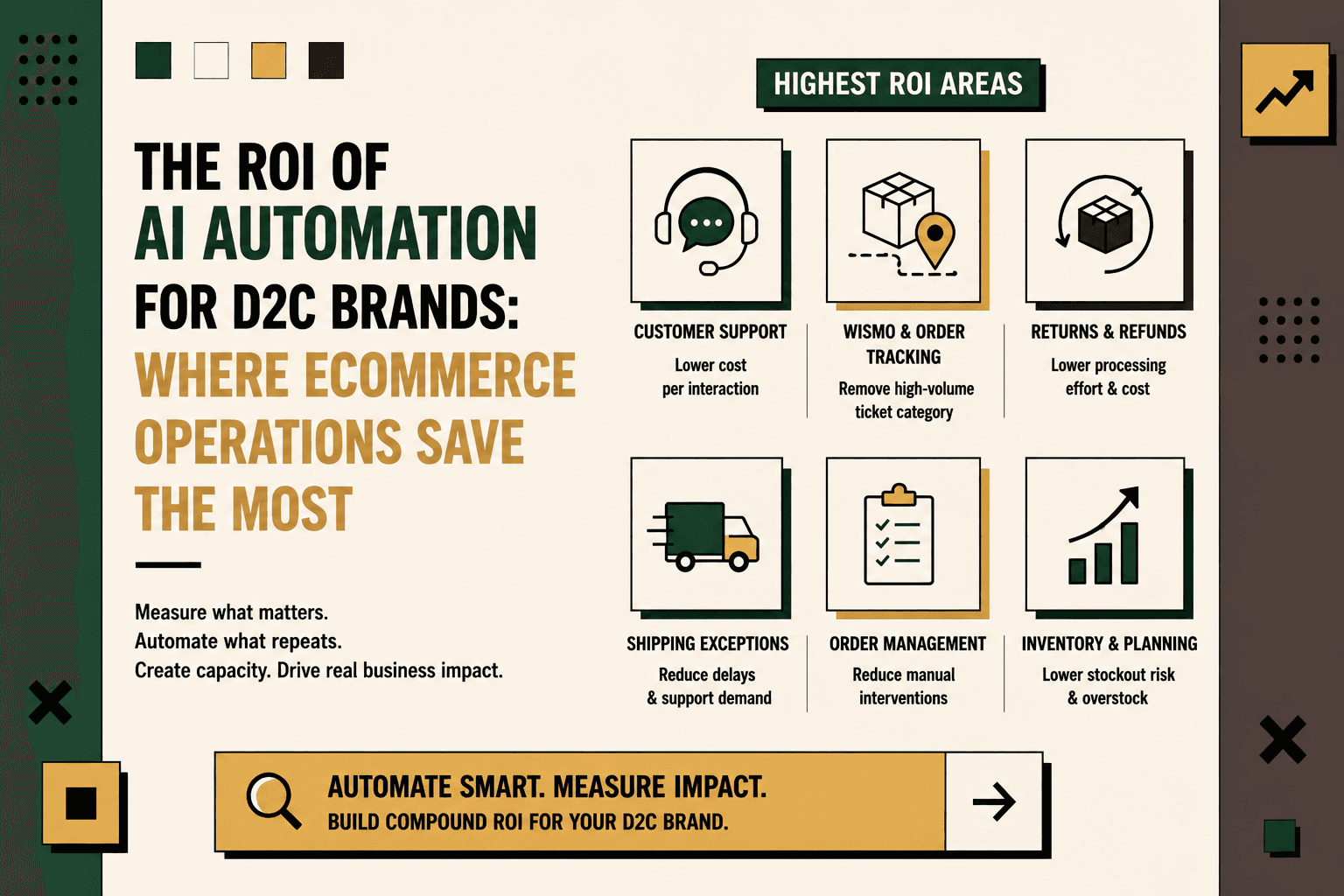
That puts customer support, WISMO, returns, shipping exceptions, order management and post-purchase operations near the top of the list.
The core idea is simple: AI ROI comes from labor saved, errors avoided, revenue recovered and operational capacity created, minus the cost of automation.
Where AI Automation ROI Actually Comes From
A useful D2C automation ROI model is:
AI ROI = Labor Saved + Errors Avoided + Revenue Recovered + Capacity Created − Automation Cost
This matters because labor savings are only one part of the equation.
A workflow that prevents a failed delivery can reduce support contacts and potentially reduce return-to-origin costs. A better return workflow can reduce manual processing. Faster customer responses can release support capacity. Better inventory signals can reduce avoidable stockouts or excess inventory. Proactive post-purchase communication can prevent customers from contacting support in the first place.
Five Anchor POV: For D2C brands, the highest-value AI projects are usually not the ones with the most impressive demos. They are the ones that connect AI to a measurable operational bottleneck and make the workflow cheaper, faster or more scalable.
The Ecommerce Operations With the Clearest ROI Potential
| Ecommerce operation | What AI can automate | Primary economic lever |
|---|---|---|
| Customer support | FAQs, WISMO, order questions, policy queries | Lower cost per interaction and more support capacity |
| Returns and refunds | Eligibility, requests, status, routing and communication | Lower processing effort and fewer avoidable contacts |
| Order management | Status checks, modifications and selected cancellations | Fewer manual interventions |
| Inventory operations | Alerts, replenishment signals and exception monitoring | Lower stockout and overstock risk |
| Shipping | Delay detection, exception communication and failed-delivery workflows | Lower support demand and potentially lower delivery-related losses |
| Post-purchase | Notifications, proactive updates and self-service | Fewer inbound contacts and better operational capacity |
| Retention | Replenishment, win-back and customer communication | Potential revenue recovery and higher customer value |
The common factor is not that these workflows all require generative AI. It is that they contain repeatable work that can be connected to structured ecommerce data.
1. Customer Support Is Often the Fastest ROI Opportunity
Customer support is attractive because the same questions repeat at scale.
- Where is my order?
- When will it arrive?
- Can I change my address?
- How do I return this?
- Can I exchange it?
- Why has my refund not arrived?
- Is this product available?
- What is the warranty policy?
Many of these questions require an agent to retrieve information rather than make a complex judgment.
McKinsey estimates that applying generative AI to customer-care functions could increase productivity by an amount equivalent to 30–45% of current function costs. This is an industry-level estimate, not a guarantee for an individual ecommerce business. McKinsey's research on the economic potential of generative AI
McKinsey's customer-care research also highlights issue resolution and handling-time improvements from AI-assisted support in a large-scale study. McKinsey's customer-care analysis
Five Anchor POV: The practical implication is not “replace the support team.” It is to move repetitive retrieval and communication work into automation while reserving human attention for exceptions, complaints and high-impact decisions.
2. WISMO Automation Can Remove a Predictable Ticket Category
“Where Is My Order?” is a particularly useful automation candidate because the customer generally wants a current operational answer rather than a conversation.
A basic workflow looks like:
Order → Fulfillment → Carrier → Tracking status → ETA → Customer response
If those data sources are connected, an AI support agent can retrieve the relevant information and explain it in natural language.
The workflow is attractive because it is typically:
- High volume
- Repetitive
- Data driven
- Relatively low complexity
- Available outside normal support hours
The economic value is not limited to the wage associated with each ticket. The larger opportunity is support capacity.
If a team no longer spends its time manually checking tracking dashboards, that capacity can be redirected toward complex cases, retention, merchandising, supplier coordination and operational improvement.
3. Returns Are a Major Cost and Workflow Opportunity
Returns deserve special attention because the operational cost extends beyond the initial customer interaction.
The National Retail Federation reports that 19.3% of online sales were returned in 2025 and estimates total retail returns at approximately $849.9 billion for the year. These are U.S. retail industry figures, not D2C-specific benchmarks. National Retail Federation's 2025 Retail Returns Landscape
A return can involve customer communication, eligibility checks, shipping labels, warehouse processing, inventory updates, refund decisions and payment reconciliation.
That means the ROI opportunity is not simply “automate the return request.” It is to connect the workflow end to end.
Customer request → Order lookup → Eligibility → Return creation → Reverse logistics → Warehouse receipt → Refund → Customer communication
Five Anchor POV: Returns are a good example of why isolated AI tools can have limited ROI. If the AI can answer a return question but cannot connect to order, inventory, return and refund systems, the human work has simply moved to the next step.
4. Shipping Exceptions Can Create ROI Beyond Support
Shipping automation becomes valuable when the system moves from reactive support to exception management.
Instead of waiting for customers to ask about delayed deliveries, an operational layer can identify meaningful exceptions and trigger the appropriate workflow.
For example:
- Carrier status indicates a delivery exception.
- The system identifies affected orders.
- The workflow checks the appropriate business rule.
- The customer receives a proactive update where appropriate.
- Cases requiring intervention are routed to the correct team.
This can reduce unnecessary “Where is my order?” contacts while giving operations teams earlier visibility into delivery problems.
The ROI should be measured against actual baseline metrics such as support contacts per order, failed deliveries, RTO, escalation volume and manual handling time rather than assuming every automated notification produces a financial gain.
5. Order Management Can Reduce Manual Coordination
Order management contains many repetitive actions that become harder to coordinate as order volume increases.
- Order-status requests
- Address-change requests
- Cancellation requests
- Order modifications
- Payment or fulfillment exceptions
- Marketplace order coordination
AI can interpret the customer's request, retrieve order context and route the appropriate action. But deterministic backend rules should decide whether a transaction is actually permitted.
For example, an AI agent can understand that a customer wants to cancel an order. A backend workflow should determine whether the order is still cancellable, whether fulfillment has started and whether additional approval is required.
AI should interpret the request. The commerce system should enforce the rule.
6. Inventory Automation Has a Different ROI Profile
Inventory automation can create substantial business value, but its ROI is harder to calculate than support automation because the benefit often appears through avoided outcomes.
Potential workflows include:
- Low-stock alerts
- Replenishment signals
- SKU health monitoring
- Inventory anomaly detection
- Marketplace inventory synchronization
- Stockout-risk monitoring
- Excess-inventory identification
The important distinction is between AI-generated recommendations and automated inventory decisions.
A brand may want AI to identify that a SKU is approaching a stockout threshold. It does not necessarily follow that the AI should automatically create a purchase order.
For higher-impact decisions, a better model is:
Detect → Explain → Recommend → Human approval → Execute → Measure
This reduces the risk of automating a decision before inventory data, lead times, supplier constraints and demand signals are reliable enough.
7. Post-Purchase Automation Can Create Capacity Before a Ticket Exists
One of the most overlooked sources of AI ROI is preventing support demand rather than answering it.
If customers repeatedly contact support because they do not know whether an order has shipped, when it will arrive or what happens next, proactive communication can address the information gap before it becomes a ticket.
Useful post-purchase workflows include:
- Order confirmation
- Shipment notification
- Delivery updates
- Delay communication
- Return instructions
- Refund status updates
- Warranty reminders
- Replenishment communication
This creates a useful distinction:
Reactive automation reduces the cost of handling demand. Proactive automation can reduce the demand itself.
A Better Way to Calculate AI Automation ROI
Start with five numbers.
T = monthly support volume
C = average cost per human-handled interaction
A = expected automation rate
S = monthly automation cost, including software, infrastructure and maintenance
Then:
Monthly gross savings = T × C × A
Monthly net operating benefit = (T × C × A) − S
This is a starting model, not a complete financial valuation.
You should also measure:
- Reduced RTO
- Fewer avoidable refunds
- Reduced return-processing effort
- Reduced overtime
- Faster resolution
- Fewer operational errors
- Revenue recovered
- Additional volume handled by the existing team
Illustrative ROI Scenario
Illustrative scenario: Imagine a D2C brand handling 30,000 support interactions per month.
Assume:
- 60% of interactions are repetitive
- AI successfully resolves 70% of those repetitive interactions
- Average human handling cost is ₹40 per interaction
The potential automated interaction volume would be:
30,000 × 60% × 70% = 12,600 interactions per month
The potential gross support-cost capacity would be:
12,600 × ₹40 = ₹5.04 lakh per month
Annualized, that represents approximately ₹60.48 lakh before automation costs and before considering additional effects such as faster responses, fewer escalations or revenue recovery.
This is deliberately an illustrative calculation. The actual economics depend on ticket mix, labor cost, automation performance, integration complexity, maintenance and the percentage of workflows that can be safely automated.
Do Not Confuse Cost Savings With Capacity Creation
This distinction is important for D2C operators.
Suppose automation saves 1,000 hours per month. The value does not automatically equal the cost of removing 1,000 hours of labor.
The business may instead use that capacity to:
- Handle more orders without proportional hiring
- Improve complex customer cases
- Increase retention activity
- Improve merchandising
- Manage suppliers
- Improve inventory operations
- Reduce operational backlog
- Work on higher-value initiatives
The more useful question is: what additional output can the existing organization produce with the capacity that automation releases?
Which D2C Automations Should You Prioritize?
Not every process deserves AI. A simple prioritization model can prevent expensive experimentation.
| Workflow profile | Recommended approach | Examples |
|---|---|---|
| High volume + low complexity | Automate first | WISMO, FAQs, order status, refund status |
| High volume + medium complexity | Automate with escalation | Delivery exceptions, exchanges, cancellations, damaged orders |
| Low volume + high complexity | Keep humans involved | Complex complaints, unusual refunds, sensitive cases |
| High financial impact + poor data quality | Improve infrastructure first | Inventory commitments, large refunds, automated purchasing |
A practical prioritization formula is:
Volume × frequency × manual effort × error cost × revenue impact ÷ implementation complexity
This is a practical framework for comparing opportunities, not an industry-standard ROI formula.
The Real D2C AI ROI Stack
The highest-value architecture is rarely a collection of disconnected AI tools.
A more useful model is:
Shopify / Storefront → AI orchestration → ERP + Inventory + OMS → Shipping + 3PL → Returns + Refunds → CRM + Marketing
Customer-facing channels can then connect through:
WhatsApp + Voice + Chat + Email + Self-Service
The important economic shift is that the business is not automating one conversation. It is automating the workflow behind the conversation.
For example, a WISMO request may require order data, fulfillment information, carrier status and customer communication. A return request may require order data, policy rules, eligibility, reverse logistics and refund status.
Connecting these systems creates a larger automation surface than adding an AI interface on top of a fragmented workflow.
What Five Anchor Would Actually Implement
Problem: D2C brands often have automation opportunities spread across customer support, order processing, inventory, shipping, returns and reporting. The challenge is determining which workflow should be automated first and connecting the underlying systems reliably.
Architecture: Five Anchor approaches this as AI infrastructure rather than a standalone chatbot. The relevant architecture can connect commerce platforms, ERP, inventory, warehouse and shipping systems with AI-powered customer operations and ecommerce intelligence.
Implementation: A practical engagement would begin with workflow mapping and baseline metrics, then identify the highest-value automation opportunities. From there, the implementation can connect Shopify or marketplace data with ERP, inventory, order, shipping, returns and customer-support workflows. AI agents or deterministic automation can be introduced where they have a clear operational role, with guardrails and human escalation for higher-impact decisions.
Business outcome: The goal is measurable operational improvement: lower manual handling, faster resolution, fewer avoidable support interactions, better workflow visibility and greater capacity without assuming that automation should replace people.
This is where Five Anchor's three service areas fit together: Commerce Infrastructure connects the operational systems, AI-Powered Customer Operations automates repetitive customer workflows, and E-Commerce Intelligence provides the operational visibility needed to measure whether the automation is actually improving the business.
How to Build an ROI Case Before You Automate
- Map the workflow. Document every step, system, decision, handoff and exception.
- Establish the baseline. Measure volume, time per task, error rate, escalation rate and relevant financial impact.
- Identify the bottleneck. Find the step consuming the most manual capacity or creating the most avoidable cost.
- Separate rules from AI. Use deterministic automation for predictable decisions and AI for interpretation, classification and contextual communication.
- Connect the data. Identify Shopify, ERP, OMS, inventory, shipping, returns, CRM and support data required by the workflow.
- Define guardrails. Establish authentication, permissions, approval thresholds and human escalation before enabling actions.
- Build the smallest viable workflow. Start with one measurable use case rather than automating an entire department.
- Measure the result. Compare post-automation performance with the baseline.
- Account for hidden costs. Include integrations, maintenance, monitoring, exception handling and human oversight.
- Scale only after proof. Expand to adjacent workflows when the initial automation is reliable and economically justified.
Common AI ROI Mistakes D2C Brands Make
Measuring conversations instead of outcomes
A high number of automated conversations does not prove financial value. Measure resolution, handling time, escalations, errors and customer outcomes.
Assuming automation equals layoffs
Automation may create more valuable capacity without reducing headcount. Capacity creation can be the more important business outcome for a growing brand.
Ignoring integration cost
An AI model may be inexpensive compared with the engineering required to connect Shopify, ERP, inventory, shipping, returns and support systems reliably.
Automating bad processes
If return rules are unclear or inventory data is inconsistent, adding AI can make the workflow faster without making it better.
Using AI where deterministic rules are better
Not every decision requires generative AI. Predictable eligibility, authentication and authorization rules should usually remain deterministic.
Ignoring maintenance
Business policies change. APIs change. Product catalogs change. Carrier workflows change. Automation needs monitoring and maintenance after deployment.
What Should Stay Human?
AI ROI improves when the system has clear boundaries.
Humans should generally remain involved when a workflow has high financial impact, ambiguous policy interpretation, unusual customer circumstances, fraud indicators, legal or compliance implications or significant reputational risk.
A useful operating model is:
AI handles the predictable. Rules enforce the boundaries. Humans handle the exceptional.
The Business Case for AI Is Bigger Than Labor Cost
The strongest D2C automation business cases combine several effects.
Cost: Less manual processing.
Capacity: More volume handled by the existing organization.
Quality: Fewer repetitive manual errors.
Speed: Faster responses and resolution.
Revenue: Potential recovery from better retention, replenishment or conversion workflows.
Customer experience: More immediate access to order, return and post-purchase information.
Visibility: Better operational data for identifying recurring bottlenecks.
Not every automation will improve every category. The business case should identify which effects are actually measurable for the selected workflow.
Conclusion: Measure AI by the Workflow It Improves
The strongest AI automation ROI for D2C brands usually comes from operations that are high-volume, repetitive, rules- or data-driven and expensive to handle manually.
That puts customer support, WISMO, returns, shipping exceptions, order management and post-purchase operations near the top of the automation priority list.
But the goal should not be to ask how many employees AI can replace.
The better question is:
How much more revenue and operational volume can the existing team handle without operational complexity increasing at the same rate?
That definition leads to better automation decisions because it connects AI investment to actual business constraints.
Start with one workflow. Establish the baseline. Calculate the economics. Connect the systems. Add guardrails. Measure the result. Then scale.
Key Takeaways
- •The strongest D2C AI ROI usually comes from high-volume, repetitive and data-driven workflows.
- •Customer support and WISMO are often strong starting points because the work is repetitive and measurable.
- •Returns can offer a larger operational opportunity because the workflow spans customer support, logistics, inventory and refunds.
- •AI ROI should include labor saved, errors avoided, revenue recovered and capacity created, not just headcount savings.
- •Use deterministic rules for predictable decisions and AI for interpretation, classification and contextual communication.
- •An illustrative ROI model is monthly volume × human handling cost × automation rate, minus software, infrastructure and maintenance costs.
- •Integration, monitoring, maintenance and human oversight must be included in the business case.
- •
D2C AI Automation Prioritization
| Workflow Profile | Recommended Approach | Examples |
|---|---|---|
| Inventory Sync Frequency | 15–30 min batch polling (high oversell risk) | Sub-second atomic locking (<450ms) |
| Concurrent Drop Resilience | Fails under concurrency; causes negative stock balance | Redis atomic reservation queue guarantees exact counts |
| Error Handling & Retries | Silent failure; manual CSV audit needed | Dead-letter queues with automated exponential retry |
| Fulfillment Routing Speed | 2–4 hours delayed batch export to 3PL warehouse | Instantaneous automated webhook dispatch (<90 sec) |