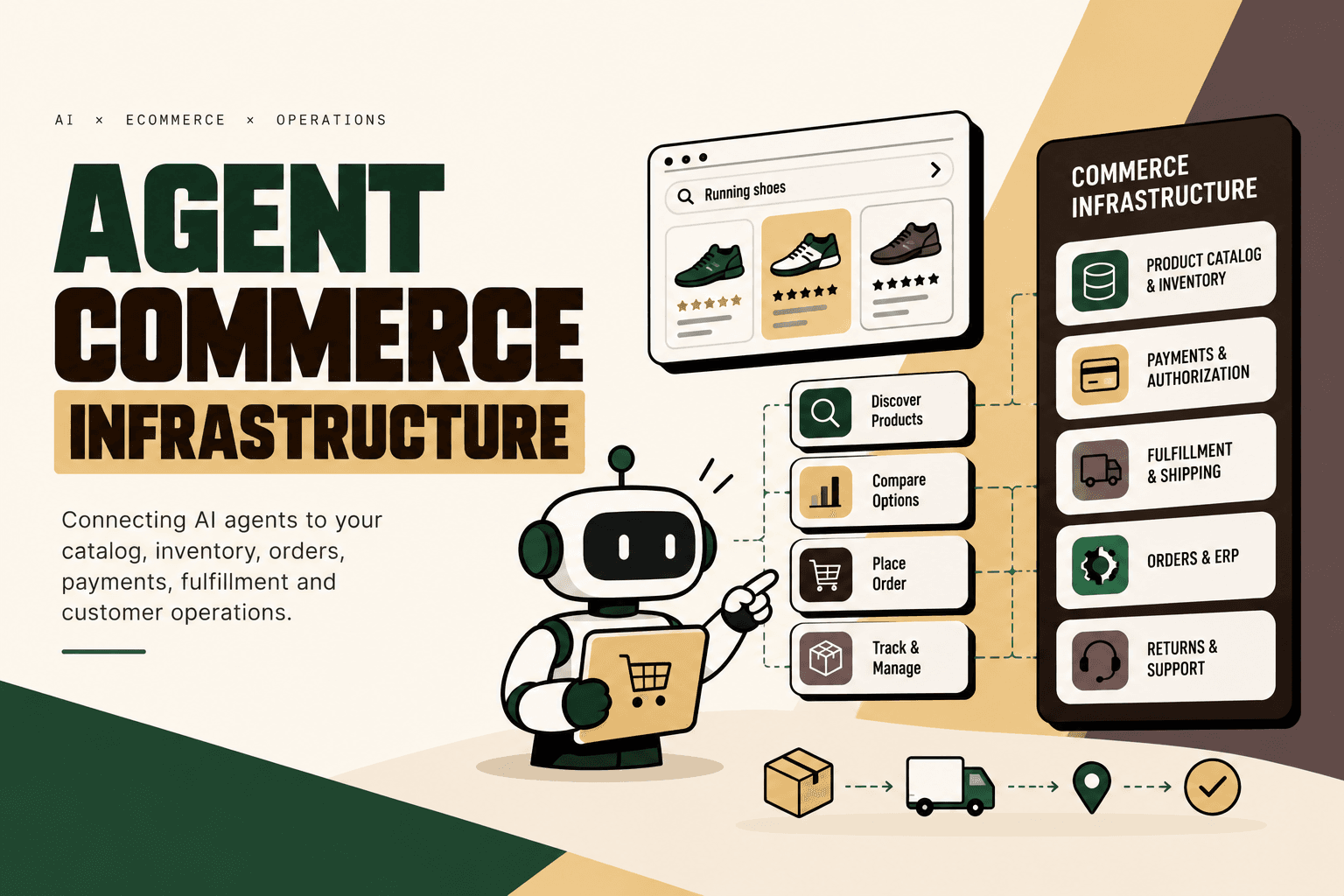
Agent commerce infrastructure is the technology layer that allows AI agents to discover products, understand commerce data, make decisions, execute approved transactions and manage post-purchase workflows.
The fundamental shift is from human → website → cart → checkout toward AI agent → commerce infrastructure → product, payment, order and fulfillment systems. The research for this topic identifies machine-readable product data, APIs and MCP, agent identity and permissions, transaction execution, payment authorization, fraud controls, fulfillment and post-purchase operations as core parts of the emerging stack.
The important distinction is that agent commerce is not simply an AI chatbot placed on top of an ecommerce store. The underlying commerce systems need to become both agent-readable and agent-executable.
What Is Agent Commerce Infrastructure?
Answer: Agent commerce infrastructure is the software, data and integration layer that allows AI agents to interact with ecommerce systems in a controlled way, from product discovery through transaction and post-purchase operations.
Explanation: Traditional ecommerce was designed around people browsing product pages, adding items to carts and completing checkout. An AI agent can potentially perform those activities on behalf of a customer, but only when it has access to reliable information and controlled actions.
Example: A customer asks an AI agent to find a product within a specific budget, confirm availability, select an appropriate delivery option and purchase it. The agent needs structured catalog data, current pricing, inventory information, shipping rules and an authorized transaction path.
Implication: The ecommerce storefront becomes only one interface to the underlying commerce system. AI agents become another potential interface.
Action: Build agent readiness from the commerce systems outward instead of starting with an AI chatbot and trying to connect it to everything afterward.
The Agent Commerce Infrastructure Stack
| Layer | Purpose | Key Requirements |
|---|---|---|
| Agent Discovery | Makes products, services and policies discoverable | Structured catalog and policy data |
| Commerce API / MCP | Provides controlled machine access | APIs, tools, schemas and permissions |
| Orchestration | Coordinates agent requests and system actions | Workflow state, validation and routing |
| Decision Engine | Enforces commerce rules | Pricing, availability and eligibility rules |
| Transaction Layer | Executes approved commerce actions | Cart, checkout and order APIs |
| Payment & Authorization | Controls agent transactions | Identity, limits and approval policies |
| Trust & Security | Protects systems and transactions | Authentication, fraud controls and audit trails |
| Fulfillment | Connects orders to operations | ERP, WMS, inventory and shipping integrations |
| Post-Purchase | Handles customer operations after purchase | Tracking, returns, exchanges, refunds and support |
Why an AI Chatbot Is Not Agent Commerce Infrastructure
An AI chatbot can answer questions without having permission to perform commerce actions. Agent commerce requires a deeper connection to the systems that hold commercial truth.
| Capability | AI Shopping Assistant | Agent Commerce Infrastructure |
|---|---|---|
| Product questions | Answers questions | Queries structured product data |
| Recommendations | Suggests products | Compares products against defined constraints |
| Inventory | May use indexed information | Can query connected operational inventory |
| Transactions | Directs users to checkout | Can support approved programmatic transactions |
| Authorization | Human completes purchase | Agent operates within defined permissions |
| Fulfillment | Usually outside the assistant | Connects orders to ERP, WMS and shipping |
| Post-purchase | Answers support questions | Can initiate approved operational workflows |
The difference is therefore not whether an LLM is present. It is whether the commerce stack exposes trustworthy information and controlled actions that an agent can use.
Machine-Readable Commerce Data Comes First
Agents need more than human-friendly product descriptions. They need structured information that can be queried, compared and interpreted consistently.
Depending on the business, an agent-ready product representation can include:
- Product and variant identifiers.
- Structured attributes and specifications.
- Current price and currency.
- Availability and inventory.
- Promotion information.
- Shipping constraints.
- Return and warranty policies.
- Compatibility information.
- Brand and merchant information.
The goal is not to expose every internal database field. The goal is to expose the information an agent needs to make a safe and useful decision.
APIs and MCP Become the Execution Interface
Structured data solves only part of the problem. Agents also need controlled ways to perform actions.
Depending on the architecture, the commerce tool layer can expose capabilities such as:
- Search products.
- Retrieve product details.
- Check inventory.
- Retrieve current pricing.
- Check shipping options.
- Create or update a cart.
- Initiate checkout.
- Place an approved order.
- Retrieve order status.
- Initiate an approved return.
Each operation should have explicit schemas, validation, authentication, authorization, rate limits and error handling. The research also identifies APIs and MCP as important parts of the emerging agent commerce infrastructure.
Agent Identity and Permissions
An agent that acts on behalf of a customer introduces a different authorization problem from a normal website session. The infrastructure needs to know what the agent is allowed to read and what it is allowed to change.
A practical permission model can distinguish between:
- Read: discover products, prices, policies and availability.
- Recommend: compare products against customer requirements.
- Prepare: create carts or draft orders.
- Transact: place purchases within approved limits.
- Modify: cancel or change orders where permitted.
- Post-purchase: initiate eligible returns or support workflows.
High-risk actions can require additional approval. Examples include purchases above a defined value, unusual discounts, sensitive account changes and policy exceptions.
What Should Be Rules, AI or Human?
Agent commerce does not mean putting an AI model in the middle of every transaction. Predictable commercial rules should generally remain deterministic.
| Workflow | Recommended Approach | Reason |
|---|---|---|
| Product lookup | Structured API or search | Current facts should come from authoritative data |
| Inventory validation | Deterministic system query | Inventory is operational data |
| Product comparison | AI plus structured attributes | Natural-language preferences require interpretation |
| Promotion eligibility | Rules engine | Commercial policies should be deterministic |
| Order creation | Controlled API workflow | Transaction integrity matters |
| Unusual support request | AI-assisted classification plus escalation | Context can be ambiguous |
| High-value purchase | Agent plus explicit approval | Financial risk requires stronger controls |
The principle is simple: use AI for interpretation and contextual reasoning where it adds value, while authoritative systems remain responsible for facts and deterministic business rules.
Agent Commerce Architecture for D2C
A practical D2C architecture can be structured as:
AI Agents → Agent Commerce API / MCP Layer → AI Commerce Orchestration → Ecommerce Platforms, Marketplaces, ERP, Inventory, WMS and Payments → Shipping, 3PL, Returns and Customer Support
The orchestration layer is important because an agent should not need direct access to every internal application. Instead, it can request a controlled capability and allow the orchestration layer to determine which systems need to be queried or updated.
For example, an agent may receive a request to determine whether a product can arrive by a certain date. The orchestration layer can combine inventory availability, warehouse location, shipping rules and carrier information before returning a structured result.
Agent Commerce Use Cases
Product Discovery
Agents can interpret natural-language requirements and search structured catalog data. The quality of the result depends heavily on product attributes, availability and policy information.
Conversational Commerce
An agent can move from answering product questions to performing approved commerce actions when the required transaction infrastructure is available.
Replenishment
Agents can support recurring purchases when customer preferences, inventory information and spending permissions are clearly defined.
Order Management
Agents can retrieve order information, identify selected exceptions and initiate approved operational workflows.
Returns and Exchanges
Post-purchase agents can retrieve order data, evaluate requests against defined policies and initiate eligible workflows while escalating exceptions.
Customer Self-Service
An agent can combine product, order, shipping and policy data so customers do not have to wait for an employee to collect information from multiple systems.
Internal Operations
Agent workflows can also support inventory monitoring, reconciliation, marketplace operations, exception classification and operational reporting.
Fulfillment Is Part of Agent Commerce
Product discovery and checkout are only the beginning. Once an agent creates an order, the transaction still needs to move through the operational stack.
Agent → Order API → Ecommerce Platform → ERP → Inventory / WMS → Shipping → Tracking → Customer Operations
If these systems are disconnected, the business may create an agent-ready buying experience while retaining manual work in fulfillment and customer operations.
This is why agent commerce infrastructure overlaps with broader commerce infrastructure. Inventory synchronization, ERP integrations, marketplace integrations, warehouse workflows, shipping automation, financial reconciliation and customer communication all influence whether an agent-originated order can be executed reliably.
Security, Fraud and Trust
Agent-driven commerce can create a larger attack surface because software can operate at machine speed. Security therefore needs to be part of the transaction architecture.
- Authenticate agents and services.
- Define explicit authorization scopes.
- Apply transaction and spending limits.
- Use rate limiting and abuse controls.
- Monitor for abnormal behavior.
- Maintain audit trails for agent actions.
- Use idempotency for transaction requests.
- Require human approval for defined high-risk actions.
- Protect customer and payment information.
A useful principle is minimum necessary authority. An agent that only needs to check product availability should not automatically have permission to issue refunds or cancel orders.
How to Build Agent Commerce Infrastructure
- Map the existing workflow. Document how products are created, priced, stocked, sold, fulfilled, returned and supported.
- Establish baseline metrics. Measure product-data completeness, inventory synchronization, manual touches, order-processing time, transaction failures and exception handling.
- Identify agent entry points. Decide whether external shopping agents, customer-service agents or internal operations agents are the first priority.
- Define the commerce data model. Standardize product, price, availability, shipping, return and policy information.
- Design the tool layer. Define APIs or MCP tools, schemas, authentication, permissions and error responses.
- Separate rules from reasoning. Keep pricing, inventory, eligibility and transaction limits authoritative and deterministic.
- Connect operational systems. Integrate ecommerce platforms, ERP, WMS, inventory, payments, shipping, returns and customer operations.
- Add guardrails. Define approval thresholds, escalation conditions, retry behavior and transaction controls.
- Pilot the smallest viable workflow. Start with a bounded capability such as product discovery, availability or order status before expanding into autonomous purchasing.
- Monitor both technical and business outcomes. Track failures, latency, escalations, intervention rates and transaction outcomes.
- Scale after reliability is proven. Expand to additional products, channels, transaction types and post-purchase workflows.
How to Prioritize Agent Commerce Automation
A practical prioritization model is:
Volume × Frequency × Manual Effort × Error Cost × Revenue Impact ÷ Implementation Complexity
This is a practical framework, not an industry-standard formula. It helps compare automation opportunities using the factors most likely to affect business value.
For example, exposing reliable product availability to agents may be a stronger early project than automating a rare policy exception because availability affects many interactions and has a clearer implementation boundary.
Common Agent Commerce Infrastructure Mistakes
Building the Agent Before Fixing the Data
If product, pricing or inventory information is inconsistent, an AI agent can make incorrect decisions faster. Data quality is an infrastructure prerequisite.
Giving Agents Broad Backend Access
Agents should receive narrow, purpose-built capabilities rather than unrestricted access to administrative APIs.
Making the AI Model the System of Record
An AI model should not be the authority for live price, inventory, order status or eligibility. Those facts should come from the relevant systems of record.
Ignoring Transaction Idempotency
Automated systems retry requests. Without idempotency controls, a retry can create duplicate transactions.
Optimizing Only the Front End
An agent may complete checkout while ERP, warehouse, shipping or customer-support workflows remain manual. That is not end-to-end agent commerce.
Skipping Human Escalation
Autonomy needs boundaries. High-risk transactions and ambiguous policy cases should have clear human ownership.
Agent Commerce Infrastructure and Five Anchor
Five Anchor positions this problem within AI Infrastructure for D2C & E-Commerce. The relevant objective is not to replace an ecommerce stack with an AI system. It is to create the intelligent layer that connects AI agents to the commercial systems that already hold the business's operational truth.
That can include catalog and marketplace integrations, ERP and inventory synchronization, order processing, warehouse and shipping workflows, customer operations and custom AI automation.
A practical implementation follows:
Problem → Workflow Mapping → System Integration → Agent and Automation Layer → Guardrails → Human Escalation → Deployment → KPI Measurement
This approach is especially relevant for D2C businesses operating across multiple commerce channels, ERP or WMS systems, fragmented inventory, shipping operations, returns and customer-support workflows.
Traditional Ecommerce vs Agent Commerce Infrastructure
| Dimension | Traditional Ecommerce | Agent Commerce Infrastructure |
|---|---|---|
| Primary actor | Human shopper | Human plus software agents |
| Interface | Website or app | APIs, MCP, AI interfaces and conventional channels |
| Data | Human-oriented pages and application data | Machine-readable commerce data |
| Decision flow | Primarily human-driven | Agent-driven within defined constraints |
| Transaction | Human completes checkout | Programmatic where supported and authorized |
| Authorization | Customer account and payment controls | Agent identity, permissions, limits and approvals |
| Operations | Human and system workflows | System workflows plus autonomous or assisted agents |
| Monitoring | Application and transaction monitoring | Application, transaction and agent-action monitoring |
Business Metrics to Measure
Agent commerce should be measured through business outcomes rather than the number of AI tools deployed.
- Agent-originated product discovery.
- Product-data completeness and freshness.
- Agent-assisted or agent-initiated conversion.
- Checkout completion.
- Transaction failure rate.
- Manual intervention rate.
- Order-processing time.
- Customer-support contacts per order.
- Exception-resolution time.
- Fraud or unauthorized-action rate.
- Operational cost per transaction.
The appropriate KPI depends on the workflow. A product-discovery agent should not be evaluated in exactly the same way as an order-processing or customer-service agent.
From Storefront to Commerce Infrastructure
The deeper change is that the storefront becomes one interface among several.
A brand can continue operating its website, mobile application and marketplaces while also making its underlying commerce capabilities available to approved AI agents. The durable asset is therefore not only the storefront but the infrastructure underneath it.
That infrastructure needs to expose reliable information and execute controlled actions across product discovery, comparison, purchase, fulfillment and post-purchase operations.
For D2C businesses, this makes agent commerce a systems-integration problem as much as an AI problem. The quality of the agent experience will depend on the quality of the commerce infrastructure underneath it.
Conclusion
Agent commerce infrastructure is the layer between AI agents and the systems that make commerce actually work.
The strongest implementation does not begin by giving an AI model access to an entire ecommerce stack. It begins by making commerce data structured, exposing controlled capabilities, defining authoritative systems for price and inventory, establishing transaction permissions, connecting fulfillment and creating clear human escalation paths.
The result is an ecommerce architecture that can support both human shoppers and software agents without sacrificing operational control.
For businesses preparing for agentic commerce, the practical goal is not maximum autonomy. It is reliable commerce execution with the right balance of machine action, deterministic rules and human control.
Key Takeaways
- •Agent commerce infrastructure makes ecommerce systems both agent-readable and agent-executable.
- •An AI chatbot is not enough; agents need structured commerce data and controlled actions.
- •The infrastructure stack spans discovery, APIs or MCP, orchestration, decisioning, transactions, authorization, security, fulfillment and post-purchase operations.
- •Deterministic systems should remain authoritative for pricing, inventory, eligibility and transaction constraints.
- •The strongest implementation starts with workflow mapping and data quality before adding autonomous actions.
- •Five Anchor can approach agent commerce as an extension of AI infrastructure for D2C and ecommerce operations.
Traditional Ecommerce vs Agent Commerce Infrastructure
| Dimension | Traditional Ecommerce | Agent Commerce Infrastructure |
|---|---|---|
| Inventory Sync Frequency | 15–30 min batch polling (high oversell risk) | Sub-second atomic locking (<450ms) |
| Concurrent Drop Resilience | Fails under concurrency; causes negative stock balance | Redis atomic reservation queue guarantees exact counts |
| Error Handling & Retries | Silent failure; manual CSV audit needed | Dead-letter queues with automated exponential retry |
| Fulfillment Routing Speed | 2–4 hours delayed batch export to 3PL warehouse |